The First Known Photograph of Dark Matter!

You Saw It Here First!

You Saw It Here First!

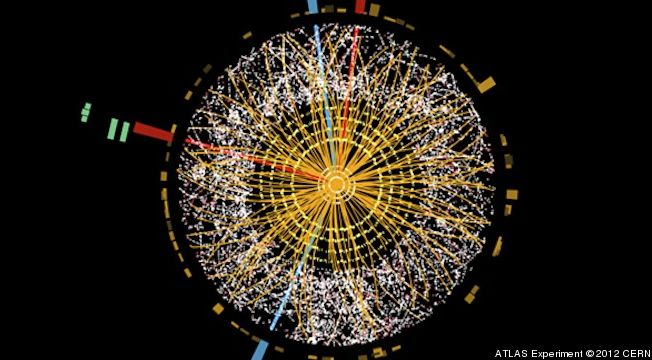
It is said that some 24% of the known mass of the universe is composed of dark matter. Now, thanks to my trustee Nikon CoolPix S630, you can see what I saw. Shown above is a closeup of some dark matter congregating toward the lower center (and, I might add, in a highly suggestive pose, but we won’t go there for now).

Until now, astrophysicists had to infer the presence of dark matter by its behavior, namely gravity and radiation. Now that I have discovered that dark matter shows up so well in my photographs, I have decided to request a Federal grant to quantify the amount of dark material in the universe by beginning with a census conducted in my back yard and extrapolating from that to the infinite reaches of outer space.

I have great confidence in my ability to get this grant because most of the Federal budget consists of dark matter, from both the Democrat and Republican sides of the aisle.

The Peril from Outer Space

More Obscure Things to Worry About

More Obscure Things to Worry About

Today, the notion of destruction from outer space impinged on the news in two separate stories. First of all, at 11:24 am PST, an asteroid named 2012 DA14 came within 17,100 miles of earth over Sumatra, center of the giant 2006 tsunami that killed hundreds of thousands of people. DA14 was approximately the size of two football fields end to end.

Then, the same day, a meteor about the size of an SUV and weighing some 10 tons struck the Ural Mountains of Russia near Chelyabinsk, blowing out the glass of thousands of windows and injuring hundreds if not thousands of people.

The two events were not connected in any way, except insofar as their timing made me think once again of how fragile we are.

If 2012 DA14 had struck the earth, it would have created widespread atmospheric disorders along the lines of the Tunguska meteor or comet strike of 2008 in remote Siberia north of Krasnoyarsk. After more than a hundred years, this event is still shrouded in mystery, as no identifiable pieces of the extraterrestrial object have been recovered to date.

It’s no accident that Russia has seen so many major events of this sort. Despite the secession of some dozen Soviet Socialist Republics (SSRs) when Communism fell around 1989-1990, Russia is still the largest country on earth, constituting some 11.46% of the earth’s total land mass.

It would be nice if events such as the ones described here made us tread a little more lightly over the earth, knowing that we could so easily be atomized by a piece of space junk.

I wonder.

Accepting New Technologies

What Determines Which Technologies We Accept?

What Determines Which Technologies We Accept?

Douglas Adams, whose Hitchhiker’s Guide to the Galaxy was one of the most risible landmarks in my young life, came up with three predictors as to what technologies people will accept. My version comes from the Futility Closet website:

  • Anything that is in the world when you’re born is normal and ordinary and is just a natural part of the way the world works.
  • Anything that’s invented between when you’re 15 and 35 is new and exciting and revolutionary and you can probably get a career in it.
  • Anything invented after you’re 35 is against the natural order of things.

Reading the above sends a chill racing up and down my spine. I accepted computers around the age of 20 and, in fact, found myself a career in computing.

But do I accept tweeting and touch-screen smartphones? No. Will I ever accept them? Possibly. I’ve accepted Facebook, but only with great suspicion and periodic reviews of security parameters. And I use Facebook primarily for announcing new blogs and flagging the books I am currently reading via Goodreads.Com.


Thinking Like a Rat

Richard Feynman

All experiments in psychology are not of this [cargo cult] type, however. For example there have been many experiments running rats through all kinds of mazes, and so on—with little clear result. But in 1937 a man named Young did a very interesting one. He had a long corridor with doors all along one side where the rats came in, and doors along the other side where the food was. He wanted to see if he could train rats to go to the third door down from wherever he started them off. No. The rats went immediately to the door where the food had been the time before.

The question was, how did the rats know, because the corridor was so beautifully built and so uniform, that this was the same door as before? Obviously there was something about the door that was different from the other doors. So he painted the doors very carefully, arranging the textures on the faces of the doors exactly the same. Still the rats could tell. Then he thought maybe they were smelling the food, so he used chemicals to change the smell after each run. Still the rats could tell. Then he realized the rats might be able to tell by seeing the lights and the arrangement in the laboratory like any commonsense person. So he covered the corridor, and still the rats could tell.

He finally found that they could tell by the way the floor sounded when they ran over it. And he could only fix that by putting his corridor in sand. So he covered one after another of all possible clues and finally was able to fool the rats so that they had to learn to go to the third door. If he relaxed any of his conditions, the rats could tell.

Now, from a scientific standpoint, that is an A-number-one experiment. That is the experiment that makes rat-running experiments sensible, because it uncovers the clues that the rat is really using — not what you think it’s using. And that is the experiment that tells exactly what conditions you have to use in order to be careful and control everything in an experiment with rat-running.

I looked into the subsequent history of this research. The next experiment, and the one after that, never referred to Mr. Young. They never used any of his criteria of putting the corridor on sand, or of being very careful. They just went right on running rats in the same old way, and paid no attention to the great discoveries of Mr. Young, and his papers are not referred to, because he didn’t discover anything about rats. In fact, he discovered all the things you have to do to discover something about rats. But not paying attention to experiments like that is a characteristic of cargo cult science.—Richard Feynman, 1974 Commencement Address


More on the Higgs Boson

Higgs Boson Particle Encounter

A few weeks ago, I posted this humorous piece on the Higgs Boson on my blog site at Multiply.Com. I will repeat the text here because, on December 1 of this year, Multiply will delete all my postings and retreat to Southeast Asia. Not being a Filipino, I just decided not to Tagalog:

It’s not every day that physicists around the world can celebrate the discovery of a particle such as the Pigg’s Boatswain, the so-called Dog Particle. Emerging accidentally from the Somewhat Large Hadron Collider (SLHC) at BERN in Switzerland, the Pigg’s Boatswain lurched into existence for several Gilliganseconds when a technician accidentally tossed a soft drink cup into the Collider. At once several subatomic particles generally referred to as ø-cokes and µ-pepsis attained a measurable mass (and vastly increased calorie content).

Swedish physicist Bjorn Oswald Pigg had actually speculated on the existence of the PB in 1961, when he backed his Saab over a dumpster. The so-called resulting Piggs Field was identified as a promising area for future research, but it was not until three weeks ago when the SLHC made it all possible.

When asked about the implications of the discovery, B. O. Pigg, now 92 years old, admitted, “Well, probably nothing, but for dang sure it’ll get me a Nobel—if I should live so long!”

As to whether there were any practical applications, Pigg shrugged. “At present, the immediate result of the PB transformation is a microscopic, but still pungent pile of dog puckie, which requires a sophisticated cleanup that my colleagues claim that there are not sufficient euros minted to accomplish. Maybe in a few more years….”

In the meantime, Ixtaccihuatl joins the scientific community in hailing another great discovery. All the greater because of the humor involved watching journalists trying to wrap their minds around the story.

It was my mistake to call the particle the Pigg’s Boatswain, but then I’m not much of a physicist. I guess it’s just a character quark on my part.

This afternoon, I just finished reading Lisa Randall’s Kindle book entitled Higgs Discovery: The Power of Empty Space. Now I can claim to know even less than I did when I wrote the above. You see, in addition to Higgs Bosons, there are Higgs Fields, the Higgs Mechanism, and Higgs “I’m With Stupid→” T-Shirts (Sizes S, M, L, XL, and LHC).

The Higgs Field is not much like a field at all. Perhaps the best comparison would be a overfilled cat litter box. Imagine what happens when a Spin-0 particle hits it at the speed of light, causing a quality that advanced physicists refer to as Pungency. You might say it really hits the fan, and the resulting Higgs Boson particles shoot in every direction and make a big mess.

Many of the latest discoveries are the result of the RLHC (Ridiculously Large Hadron Collider) in what used to be Greece before Angela Merkel decided to use the real estate for a more useful purpose that cost fewer Euros than housing a bunch of defaulting Greeks. At a power level approaching 3.1416³ TeraGilligans, the number of collisions in the Higgs Field grows to the point that subatomic physicists refer to it officially as a Sh*tload.

The whole point of the RLHC collisions is twofold:

  1. They do not appear to be insured, and
  2. They add mass to particles which previously had none.

There is some question as to what the purpose of this added mass is, but some scientists speculate that’s how all mass in the universe was created, including all the plants and animals to which you are allergic and which sneak up and bite you while you are sleeping. Nice going, guys!