Humanitarians tend to come off as pretty insufferable people. British author John le Carré (a.k.a. David Cornwell) tells of one who had a sense of humor. The story is told in le Carré’s The Pigeon Tunnel, an autobiographical work that traces the real-life antecedents of the characters in his books. This one tells of Yvette Pierpaoli’s efforts to save Cambodian children during the Khmer Rouge atrocities.
I made a couple more journeys to Phnom Penh before the city finally fell. By the time I left for the last time, the Indian shopkeepers and the girls in their rickshaws were shaping to be the last to get out: the traders because the greater the shortages, the higher the prices; the girls because in their innocence they believed their services would be in demand whoever won. In the event, they were recruited to the Khmer Rouge, or died of deprivation in the killing fields. From Saigon, as it still was, I had written to Graham Greene to tell him that I had reread The Quiet American, and that it stood up wonderfully. Improbably the letter reached him, and he wrote back urging me to visit the museum in Phnom Penh and admire the bowler hat with ostrich feathers with which Khmer kings had been crowned. I had to tell him that not only was there no bowler hat; there was no museum any more.
Yvette has become the subject of many wild tales, some apocryphal but many, despite their improbability, true. My favourite, which I heard from her own mouth—not always a guarantee of veracity—tells how in Phnom Penh’s final days she marched a troop of orphaned Khmer children into the French Consulate and demanded passports, one for each child.
“But whose children are they?” the besieged consular official protested.
“They are mine. I am their mother.”
“But they’re all the same age!”
“And I had many quadruplets, you idiot!”
Defeated, perhaps complicit, the Consul demanded to know their names. Yvette reeled them off: “Lundi, Mardi, Mercredi, Jeudi, Vendredi …” [The names of the days of the week in French]
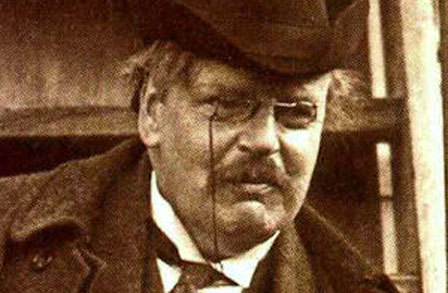
As a voracious reader of books, I have always had my strange little reading traditions. For example, in most years, I have usually read a couple of G. K. Chesterton’s books every February. This year was no different: Since February 1, I have read The Club of Queer Trades (1911) — a re-read, Appreciations and Criticisms of the Works of Charles Dickens (1911), and All I Survey (1933). Below is a quote from his book Orthodoxy (1908) in which he demonstrates, by the following quote, that he knows children as well as he knows God:
Because children have abounding vitality, because they are in spirit fierce and free, therefore they want things repeated and unchanged. They always say, “Do it again”; and the grown-up person does it again until he is nearly dead. For grown-up people are not strong enough to exult in monotony. But perhaps God is strong enough to exult in monotony. It is possible that God says every morning, “Do it again” to the sun; and every evening, “Do it again” to the moon. It may not be automatic necessity that makes all daisies alike; it may be that God makes every daisy separately, but has never got tired of making them. It may be that He has the eternal appetite of infancy; for we have sinned and grown old, and our Father is younger than we.
I was unusually restless today. I started three books and gave up on two of them. The one I continued on was a re-read from fifty years ago, G. K. Chesterton’s All I Survey, first published in 1933. There was a time in the 1970s when I read everything I could find by Chesterton. Today, my shelves hold over a hundred titles of his work, including duplicates. There are few authors whom I enjoy reading so much, probably because he always makes me feel so good.The following is the first paragraph of his essay entitled “On St. George Revivified.”
The disadvantage of men not knowing the past is that they do not know the present. History is a hill or high point of vantage, from which alone men see the town in which they live or the age in which they are living. Without some such contrast or comparison, without some such shifting of the point of view, we should see nothing whatever of our own social surroundings. We should take them for granted, as the only possible social surroundings. We should be as unconscious of them as we are, for the most part, of the hair growing on our heads or the air passing through our lungs. It is the variety of the human story that brings out sharply the last turn that the road has taken, and it is the view under the arch of the gateway which tells us that we are entering a town.
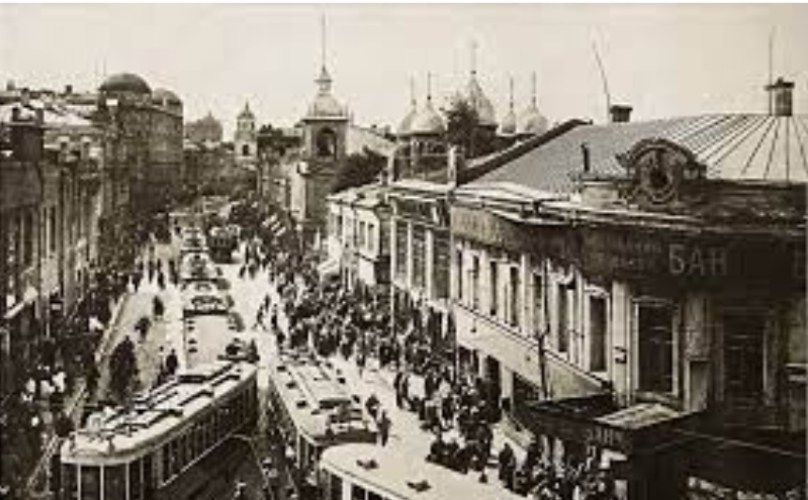
I am currently reading Yuri Andrukhovych’s The Moscoviad, about a Ukrainian writer living in a Moscow where it’s almost always raining during the late days of the Soviet Union. In his book, Andrukhovych has some very pointed things to say about the city:
This is the city of losses. It would be nice to level it. To plant again thick Finnish forests, introduce bears, elk, deer: let them graze around the moss-covered Kremlin ruins, let perches swim in its rivers and lakes returned to life, let wild bees focus on storing honey in the deepest fragrant tree cavities. This land needs a rest from its criminal capital. Perhaps then it will be capable of something good. Since it cannot go on forever poisoning the world with the bacilli of evil, suppression, and aggressive dumb destruction!
I am currently reading Miklós Vámos’s The Book of Fathers (2000), in Hungarian: Apák Könve. In the notes at the end of the novel, I found this anecdote, which I couldn’t help but share with you. It summarizes more than half a millennium of Hungarian history.
One well-known fact is that Hungary and the Hungarians have lost every important war and revolution since the time of the Renaissance king Matthias Corvinus. He occupied Vienna and became Prince of Austria. He died in 1490. Since then, the nation and its heroes can be found only on the losing side.
A famous, if hoary, joke is instructive.
A Hungarian enters a small shop in New York and wants to buy a hat. But he doesn’t have enough dollars on him, so he asks if he could pay in forints, the Hungarian currency.
“I’ve never seen any forints,” the owner of the shop says. “Show me some.”
“Who’s this guy here?” asks the owner.
“This is Sándor Petöfi, the brightest star of Hungarian poetry. He lived in the nineteenth century. He was one of the March Youth who launched the 1848-49 War of Independence. He was killed in the Battle of Segesvár when the war was crushed by the Austrians and the Russians.”
“Oh my God, what an awful story … And who is this guy on the twenty forint bill?”
“This is György Dózsa, who led in peasant uprising in the sixteenth century. It was crushed and he was executed—actually, he was burned on a throne of fire—”
“OK, OK. And who is that on the fifty?”
“That’s Ferenc Rákóczi II, leader of another war of independence, crushed by the Habsburgs. He was forced to spend his life in exile in Turkey.”
“I should have guessed. And on the one hundred?”
“That’s Lajos Kossuth, leader of the 1848-49 War of Independence, you know. After it was crushed, he had to flee—”
The owner stops him again. “OK, you poor man, just go—you can have the hat for free.”
(Note: these banknotes are no longer in circulation, owing to the ravages of inflation.)
I have been reading Norman Douglas’s travel classic Old Calabria, which was written in 1915. Here he talks about the Southern Italians’ attitude toward pets. I include the footnote, which discusses how the ancient Greeks treated their animals.
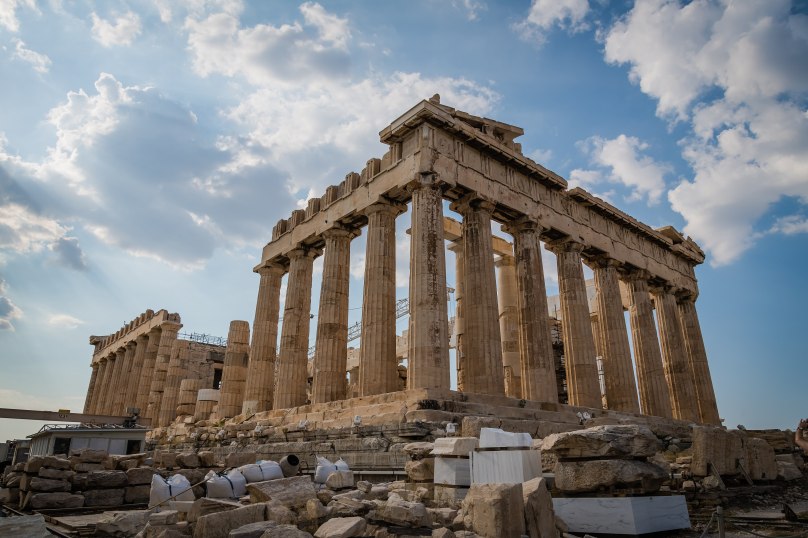
To say that our English zoophilomania—our cult of lap-dogs—smacks of degeneracy does not mean that I sympathize with the ill-treatment of beasts which annoys many visitors to these parts and has been attributed to “Saracenic” influences. Wrongly, of course; one might as well attribute it to the old Greeks.‡ Poor Saracens! They are a sort of whipping-boy, all over the country. The chief sinner in this respect is the Vatican, which has authorized cruelty to animals by its official teaching. When Lord Odo Russell enquired of the Pope regarding the foundation of a society for the prevention of cruelty to animals in Italy, the papal answer was: “Such an association could not be sanctioned by the Holy See, being founded on a theological error, to wit, that Christians owed any duties to animals.” This language has the inestimable and rather unusual merit of being perspicuous. Nevertheless, Ouida’s flaming letters to “The Times” inaugurated an era of truer humanity. . . .
Here follows the footnote:
‡Whose attitude towards animals, by the way, was as far removed from callousness as from sentimentalism. We know how those Hellenic oxen fared who had laboured to draw up heavy blocks for the building of a temple—how, on the completion of their task, they were led into green fields, there to pasture unmolested for the rest of their lives. We know that the Greeks were appreciative of the graces and virtues of canine nature—is not the Homeric Argo still the finest dog-type in literature? Yet to them the dog, even he of the tender Anthology, remained what he is: a tamed beast. The Greeks, sitting at dinner, resented the insolence of a creature that, watching every morsel as it disappeared into the mouth of its master, plainly discovered by its physiognomy the desire, the presumed right, to devour what he considered fit only for himself. Whence that profound word [Greek: kunopes]—dog-eyed, shameless. In contrast to this sanity, observe what an Englishman can read into a dog’s eye:
                That liquid, melancholy eye,
                From whose pathetic, soul-fed springs
                Seemed surging the Virgilian cry—
                The sense of tears in mortal things. . . .
That is how Matthew Arnold interprets the feelings of Fido, watching his master at work upon a tender beefsteak.
Norman Douglas’s work contains surprises on virtually every page. If I have time, I will quote him about the flying monk, Saint Nicholas of Cosentino.
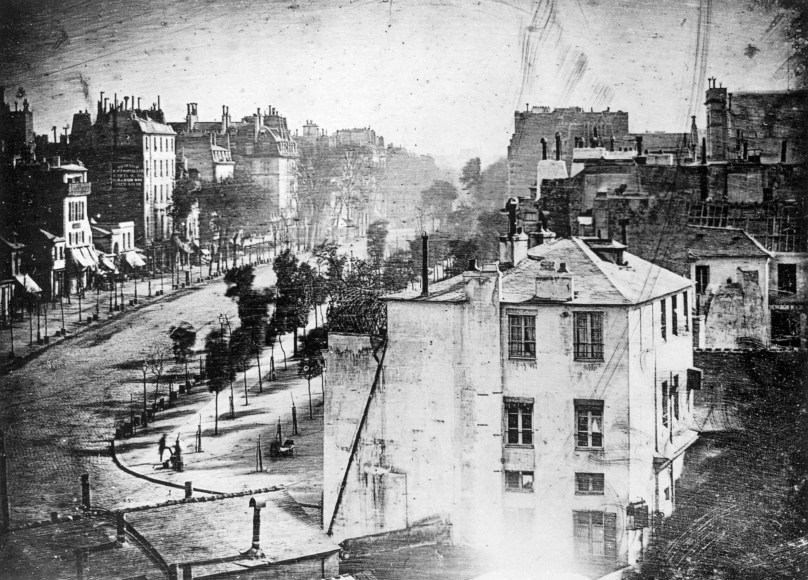
The above photograph is the first one to show a human being. There he is, in the lower left, having his shoes shined. All the pedestrians and carts and carriages have disappeared because this was an eight-hour exposure, ensuring only that static subjects could be recorded. Below is a description of Paris by Honoré de Balzac at the beginning of The Girl with the Golden Eyes (1835) that is anything but static:
One of those sights in which most horror is to be encountered is, surely, the general aspect of the Parisian populace—a people fearful to behold, gaunt, yellow, tawny. Is not Paris a vast field in perpetual turmoil from a storm of interests beneath which are whirled along a crop of human beings, who are, more often than not, reaped by death, only to be born again as pinched as ever, men whose twisted and contorted faces give out at every pore the instinct, the desire, the poisons with which their brains are pregnant; not faces so much as masks; masks of weakness, masks of strength, masks of misery, masks of joy, masks of hypocrisy; all alike worn and stamped with the indelible signs of a panting cupidity? What is it they want? Gold or pleasure? A few observations upon the soul of Paris may explain the causes of its cadaverous physiognomy, which has but two ages—youth and decay: youth, wan and colorless; decay, painted to seem young. In looking at this excavated people, foreigners, who are not prone to reflection, experience at first a movement of disgust towards the capital, that vast workshop of delights, from which, in a short time, they cannot even extricate themselves, and where they stay willingly to be corrupted. A few words will suffice to justify physiologically the almost infernal hue of Parisian faces, for it is not in mere sport that Paris has been called a hell. Take the phrase for truth. There all is smoke and fire, everything gleams, crackles, flames, evaporates, dies out, then lights up again, with shooting sparks, and is consumed. In no other country has life ever been more ardent or acute. The social nature, even in fusion, seems to say after each completed work: “Pass on to another!” just as Nature says herself. Like Nature herself, this social nature is busied with insects and flowers of a day—ephemeral trifles; and so, too, it throws up fire and flame from its eternal crater. Perhaps, before analyzing the causes which lend a special physiognomy to each tribe of this intelligent and mobile nation, the general cause should be pointed out which bleaches and discolors, tints with blue or brown individuals in more or less degree.
By dint of taking interest in everything, the Parisian ends by being interested in nothing. No emotion dominating his face, which friction has rubbed away, it turns gray like the faces of those houses upon which all kinds of dust and smoke have blown. In effect, the Parisian, with his indifference on the day for what the morrow will bring forth, lives like a child, whatever may be his age. He grumbles at everything, consoles himself for everything, jests at everything, forgets, desires, and tastes everything, seizes all with passion, quits all with indifference—his kings, his conquests, his glory, his idols of bronze or glass—as he throws away his stockings, his hats, and his fortune. In Paris no sentiment can withstand the drift of things, and their current compels a struggle in which the passions are relaxed: there love is a desire, and hatred a whim; there’s no true kinsman but the thousand-franc note, no better friend than the pawnbroker. This universal toleration bears its fruits, and in the salon, as in the street, there is no one de trop, there is no one absolutely useful, or absolutely harmful—knaves or fools, men of wit or integrity. There everything is tolerated: the government and the guillotine, religion and the cholera. You are always acceptable to this world, you will never be missed by it. What, then, is the dominating impulse in this country without morals, without faith, without any sentiment, wherein, however, every sentiment, belief, and moral has its origin and end? It is gold and pleasure. Take those two words for a lantern, and explore that great stucco cage, that hive with its black gutters, and follow the windings of that thought which agitates, sustains, and occupies it! Consider! And, in the first place, examine the world which possesses nothing.
In his novel Dombey and Son (1848), Charles Dickens had a striking passage about the effect that railroad construction was having on parts of London. I remember this passage vividly from when I first read the book decades ago.
The first shock of a great earthquake had, just at that period, rent the whole neighbourhood to its centre. Traces of its course were visible on every side. Houses were knocked down; streets broken through and stopped; deep pits and trenches dug in the ground; enormous heaps of earth and clay thrown up; buildings that were undermined and shaking, propped by great beams of wood. Here, a chaos of carts, overthrown and jumbled together, lay topsy-turvy at the bottom of a steep unnatural hill; there, confused treasures of iron soaked and rusted in something that had accidentally become a pond. Everywhere were bridges that led nowhere; thoroughfares that were wholly impassable; Babel towers of chimneys, wanting half their height; temporary wooden houses and enclosures, in the most unlikely situations; carcases of ragged tenements, and fragments of unfinished walls and arches, and piles of scaffolding, and wildernesses of bricks, and giant forms of cranes, and tripods straddling above nothing. There were a hundred thousand shapes and substances of incompleteness, wildly mingled out of their places, upside down, burrowing in the earth, aspiring in the air, mouldering in the water, and unintelligible as any dream. Hot springs and fiery eruptions, the usual attendants upon earthquakes, lent their contributions of confusion to the scene. Boiling water hissed and heaved within dilapidated walls; whence, also, the glare and roar of flames came issuing forth; and mounds of ashes blocked up rights of way, and wholly changed the law and custom of the neighbourhood.
In short, the yet unfinished and unopened Railroad was in progress; and, from the very core of all this dire disorder, trailed smoothly away, upon its mighty course of civilisation and improvement.
But as yet, the neighbourhood was shy to own the Railroad. One or two bold speculators had projected streets; and one had built a little, but had stopped among the mud and ashes to consider farther of it. A bran-new Tavern, redolent of fresh mortar and size, and fronting nothing at all, had taken for its sign The Railway Arms; but that might be rash enterprise—and then it hoped to sell drink to the workmen. So, the Excavators’ House of Call had sprung up from a beer-shop; and the old-established Ham and Beef Shop had become the Railway Eating House, with a roast leg of pork daily, through interested motives of a similar immediate and popular description. Lodging-house keepers were favourable in like manner; and for the like reasons were not to be trusted. The general belief was very slow. There were frowzy fields, and cow-houses, and dunghills, and dustheaps, and ditches, and gardens, and summer-houses, and carpet-beating grounds, at the very door of the Railway. Little tumuli of oyster shells in the oyster season, and of lobster shells in the lobster season, and of broken crockery and faded cabbage leaves in all seasons, encroached upon its high places. Posts, and rails, and old cautions to trespassers, and backs of mean houses, and patches of wretched vegetation, stared it out of countenance. Nothing was the better for it, or thought of being so. If the miserable waste ground lying near it could have laughed, it would have laughed it to scorn, like many of the miserable neighbours.
As I read today for the first time a play by French Writer Honoré de Balzac, I was reminded of the last scene in his great novel Père Goriot as Eugène de Rastignac attended the poor funeral of his old neighbor Goriot..
But just as the coffin was put in the hearse, two empty carriages, with the armorial bearings of the Comte de Restaud and the Baron de Nucingen, arrived and followed in the procession to Pere-Lachaise. At six o’clock Goriot’s coffin was lowered into the grave, his daughters’ servants standing round the while. The ecclesiastic recited the short prayer that the students could afford to pay for, and then both priest and lackeys disappeared at once. The two grave diggers flung in several spadefuls of earth, and then stopped and asked Rastignac for their fee. Eugene felt in vain in his pocket, and was obliged to borrow five francs of Christophe. This thing, so trifling in itself, gave Rastignac a terrible pang of distress. It was growing dusk, the damp twilight fretted his nerves; he gazed down into the grave and the tears he shed were drawn from him by the sacred emotion, a single-hearted sorrow. When such tears fall on earth, their radiance reaches heaven. And with that tear that fell on Father Goriot’s grave, Eugene Rastignac’s youth ended. He folded his arms and gazed at the clouded sky; and Christophe, after a glance at him, turned and went—Rastignac was left alone.
He went a few paces further, to the highest point of the cemetery, and looked out over Paris and the windings of the Seine; the lamps were beginning to shine on either side of the river. His eyes turned almost eagerly to the space between the column of the Place Vendome and the cupola of the Invalides; there lay the shining world that he had wished to reach. He glanced over that humming hive, seeming to draw a foretaste of its honey, and said magniloquently:
“Henceforth there is war between us.”
And by way of throwing down the glove to Society, Rastignac went to dine with Mme. de Nucingen.
Sigizmund Krzhizhanovsky (1887-1950) was a Soviet writer who, in his own words, was “known for being unknown.” Hopefully, that will no longer be true as New York Review Books releases more of his stories. I have just finished reading his Autobiography of a Corpse, which contains a prescient 1939 story titled “Yellow Coal.” Tell me if the first paragraph of the story, quoted below, reminds you of our present situation:
The economic barometer at Harvard University had continually pointed to bad weather. But even its exact readings could not have predicted such a swift deepening of the crisis. Wars and the elements had turned the earth into a waster of its energies. Oil wells were running dry. The energy-producing effect of black, white and brown coal was diminishing yearly. An unprecedented drought had swaddled the sere earth in what felt like a dozen equators. Crops burned to their roots. Forests caught fire in the infernal heat. The selvas of South America and the jungles of India blazed with smoky flames. Agrarian countries were ravaged first. True, forests reduced to ashes had given place to ashy boles of factory smoke. But their days too were numbered. Fuellessness was threatening machines with motionlessness. Even glacier snow-caps, melted by the perennial summer, could not provide an adequate supply of waterpower; the beds of shrinking rivers lay exposed, and soon the turbine-generators would stop.







 Tarnmoor
You must be logged in to post a comment.