The Death of a Bookstore

Sam Johnson’s Bookstore in Mar Vista in Happier Times

This is the story of a bookstore which I frequented for more than forty years before it went belly up two and a half years ago. I started spending time and money there back in the 1970s, when it was located on Santa Monica Boulevard between Colby and Federal. At that point, I was working at Santa Monica and Barry, and the bookstore was on my way to the post office, where I did a daily noontime mail pickup.

Later, the two partners, Bob and Larry, purchased a building on Venice Boulevard near Centinela (see above photo)—and I continued to patronize the store.

But there is something inherently problematical about partnerships. Sooner or later, one of the partners goes off the rails, and their business venture goes to the demnition bow-wows. That’s what happened to Sam Johnson’s. Larry Klein published three books, all of which were excellent, but as he aged, his life took a darker turn. He complained about his health; and he no longer went on strenuous weekend hikes in the San Gabriel Mountains. His worsening health also had an effect on his mind.

The upshot was that his partner Larry Myers somehow received the short end of the stick. And suddenly his milk also soured. When Bob suddenly died, it seems the bookstore was to be put up for sale, with Bob’s estate getting the store. The bookstore had good friends, chief among them David Benesty, who manned the desk when Bob was gone and Larry was beginning to fade away.

Well, Sam Johnson’s is no more, leaving me with nowhere to turn for top condition used books but the Internet. Don’t feel sorry for me: I have some 6,000 books. But the West Los Angeles area is now poorer. And the bookstore is shuttered, with no one taking over the premises. I saw it just the day before yesterday, when I went to Santouka at the Mitsuwa Marketplace for some Japanese ramen soup.

Sam Johnson’s had a formative part to play in my literary tastes. That’s where I became a die-hard fan of the works of G. K. Chesterton,

In East Los

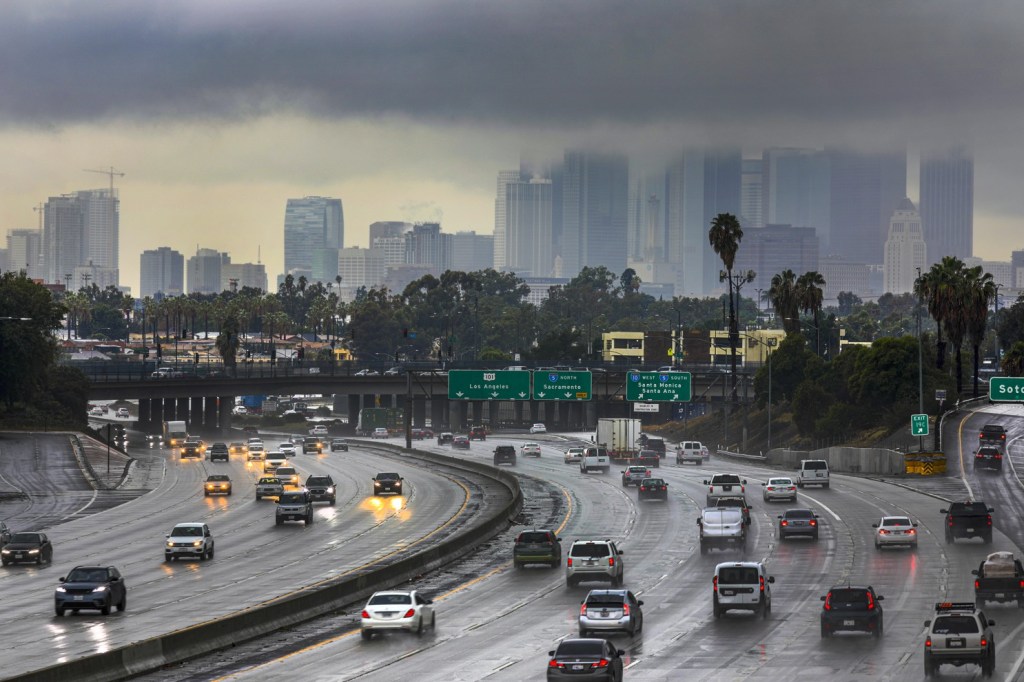
Downtown L.A. as Seen from East Los Angeles

Today, I drove Martine to her ophthalmologist in East Los Angeles. As she is on MediCal, her doctors are not always conveniently located. I don’t mind, however, partly because I find East L.A. (colloquially: East Los) to be a fascinating neighborhood. And the Adventist Health Care Center on Cesar Chavez Avenue seems to be well run. (It is a far cry from the Budapest Hospital I visited in 1977, where patients and staff smoked incessantly and dogs roamed the corridors.)

First I took Martine out for lunch at Philippe’s French Dip Sandwiches on Alameda, just at the fringe of Chinatown. The place has been in business since 1908 and is still very much a going concern. In fact, we had to wait in a 30-minute line to place our order. But my beef stew and Martine’s French dip beef sandwich were both winners.

It turned out to be a hot afternoon: 93º Fahrenheit, 34º Celsius. I set in the Adventist Health Center’s ground floor waiting room, enjoying the air conditioning while waiting for Martine’s tests to be performed. In the meantime, I read Ted Lewis’s British noir classic Jack’s Return Home, on which the 1971 film by Mike Hodges called Get Carter was based.

Helicopterum

Burton W. Chace County Park in Marina Del Rey

delightful It was another warm day, though nowhere near as blistering as those inland areas euphemistically referred to as valleys. Whenever I’m feeling too hot, I always know that it will be miraculous cool and breezy in that park at the west end of Mindanao Way.

So I stopped in at Trader Joe’s for a picnic lunch of a Mexican chicken salad, watermelon chunks, and watermelon juice and found myself a picnic table in one of the three covered picnic pavilions in the park (shown above). Then I moved closer to Stone Point, at the tip of the peninsula, and took out a copy of Roberto Bolaño’s short story collection entitled Last Evenings on Earth and began reading.

Wouldn’t you know it? There are in big cities three things that militate against enjoying a book (or even a good night’s rest): motorcycles, rap music, and helicopters; and I got a 30-minute dose of the latter as it lazily and raucously circled the park without any clear end in mind. I kept thinking to myself how opportune a shoulder-mounted Stinger missile would have been.

But then, one of the drawbacks to big city life is that your neighbor gets all het up and doesn’t give a damn about your need for a modicum of silence. One fantasizes about a gruesome conclusion to each incident, but that never seems to happen. Tant pis!

Vee Dub

Another Show at El Segundo’s Automobile Driving Museum

On Saturday morning, Martine and I drove down to the Automobile Driving Museum for their Air-Cooled Volkswagen Car Show. I was frankly surprised that so many entries and visitors showed up. It reminded me that around 1969 I consider buying a VW Beetle—and that was even before I learned to drive. Because of medical reasons, I was not to get my driver’s license until age 40. I never did get a VW. My first car was a 4-cylinder Mitsubishi Montero, followed by a Nissan Pathfinder, and now a 2018 Subaru Forester.

The Poster for the V Dub Show

In the late 1960s through the 1970s, I knew a lot of people who had Beetles, VW Microbuses (which I always thought looked cool), and Karmann-Ghias.

From the museum, we drove down to Captain Kidd’s Fish Market and Restaurant in Redondo Beach and had a great seafood lunch.

Keeping Cool

Pigeons at the Marina’s Burton Chace Park

At a time when most of the United States and Canada are burning up in the heat, I decided to spend the afternoon at the one place that is always almost preternaturally cool: Burton Chace Park in the middle of Marina Del Rey. No matter how hot it is in Los Angeles, there always seems to be a cool sea breeze at Chace. Today wasn’t particularly warm along the coast, but I was in the mood for a good breeze.

So there I sat at an isolated cement picnic table, finishing a French noir novella by Pascal Garnier entitled Boxes. As I had my new Kindle with me, I decided to sign in to the county park’s wi-fi and check out if Jeff Bezos was actually discounting something I wanted. Well, he wasn’t, but that’s okay.

I took a short walk around the tiny peninsula looking at boats and trying to see where the sea lions were. I had heard them while reading, but they had disappeared by the time I took my walk. I did, however, find these pigeons.

All in all, I spent three hours at Chace, returning home to my apartment, which is infested with fruit flies. Martine and i threw out a lot of the pasta they were feeding on, but somewhere they are being nourished by something else. As I sit here typing this post, they are landing in my hair, and I am reaching up to squeeze their little lives out.

The Isle of California

The Mural “Isle of California” (1972) When It Was Newly Painted

Near the West Los Angeles Post Office is the Village Recording Studio at 1616 Butler Avenue. On its back wall is a mural entitled “Isle of California” showing what remains when most of California has fallen into the ocean. It was painted in 1972 by the L.A. Fine Arts Squad consisting of Victor Henderson, Terry Schoonhoven, and Jim Frazin.

Of course, Southern California will not just fall into the ocean after “the Big One.” What is west of the San Andreas Fault will be displaced northwards, separating itself horizontally from the area east of the fault.

I saw today a fascinating quote from J. B. Priestley in Carey McWilliams’s Southern California Country: An Island on the Land:

There is something disturbing about this corner of America, a sinister suggestion of transience. There is a quality, hostile to men in the very earth and air here. As if we were not meant to make our homes in this oddly enervating sunshine…. California will be a silent desert again. It is all as impermanent and brittle as a roll of film.

Oddly, that’s what I felt shortly after I moved here. The feeling was reinforced by the Sylmar Earthquake of 1971 and the Northridge Earthquake of 1994.

The Same Mural Today: Badly Faded With Earthquake Reinforcing Bolts

Well, Southern California is still here. And I’m still here. The place still feels a bit unreal to me, but I have fallen in love with it. So if the whole place should happen to fall in the ocean after all, I’m a goner.

South Bay

Looking South from King Harbor in Redondo Beach

The Pacific Coast from the airport south to Point Fermin on the Palos Verdes Peninsula is a kind of Beach Neverland in which there are a number of high-price communities such as El Segundo, Manhattan Beach, Hermosa Beach, Redondo Beach, a small sliver of Torrance, and the wealthy enclaves around the hills of Palos Verdes. Collectively, the area is known as the South Bay.

Today, Martine and I drove down to Captain Kidd’s Fish Market & Restaurant in Redondo Beach. It’s a bit of a splurge for us, but we enjoy the fresh fish and the view of the southwest-facing ocean on a sunny day. I had some Canadian salmon char-broiled, and Martine had some sautéed Alaskan cod.

Usually we walk south along the boardwalk after we eat, but today we just returned home. Martine’s feet have been hurting, and she wanted to rest them.

When I first moved to Southern California at the end of 1966, the first area that my friend Peter showed me were the beach communities of the South Bay. To the kid from Cleveland, which I was, it all smacked of hedonism; and I looked on it with disapproval. In later years, I was one of the hedonists on the beach in Santa Monica.

There is something gemlike in these communities. They have always had a kind of glow in my imagination. In fact, I wouldn’t mind living there, if I could afford it.

Under Our Feet

As we tread upon the ground, we tend not to think of what lies beneath our feet. I thought about this after I wrote yesterday’s blog post entitled “Mission Creep.” The small size of the cemeteries at the Santa Barbara and Santa Ynez missions in Southern California troubled me because of the large number of bodies said to be buried there. The Catholic Church did not sanction cremation at that time, so literally thousands of bodies, mostly of Indians, were interred over a 65-year period in these small burial grounds.

I live within walking distance of Kuruvungna Springs, a place where the Tongva or Gabrielino Indians congregated f0or ceremonies or just a fresh drink of spring water. It is entirely possible that as I walk along Santa Monica Boulevard and the streets feeding into it I am walking on the bones of Indians who died in the area—at least those which weren’t carted away by dirt haulers as the area was built up with multi-story commercial and residential buildings.

And then I thought of a great English writer who thought the same way. The quote is from an essay by Sir Thomas Browne (1605-1682) called “Hydriotaphia, urn-burial, or, A discours of the sepulchral urns lately found in Norfolk ….” The 17th century English is hard to read, but I promise that it is rewarding.

In the deep discovery of the Subterranean world, a shallow part would satisfie some enquirers; who, if two or three yards were open about the surface, would not care to rake the bowels of Potosi, and regions towards the Centre. Nature hath furnished one part of the Earth, and man another. The treasures of time lie high, in Urnes, Coynes, and Monuments, scarce below the roots of some vegetables. Time hath endlesse rarities, and shows of all varieties; which reveals old things in heaven, makes new discoveries in earth, and even earth it self a discovery. That great Antiquity America lay buried for a thousand years; and a large part of the earth is still in the Urne unto us.

Though if Adam were made out of an extract of the Earth, all parts might challenge a restitution, yet few have returned their bones farre lower then they might receive them; not affecting the graves of Giants, under hilly and heavy coverings, but content with lesse then their owne depth, have wished their bones might lie soft, and the earth be light upon them; Even such as hope to rise again, would not be content with centrall interrment, or so desperately to place their reliques as to lie beyond discovery, and in no way to be seen again; which happy contrivance hath made communication with our forefathers, and left unto our view some parts, which they never beheld themselves.

Sir Thomas Browne

The reference to Potosi is to the fabulous silver mines at the Cerro Rico (Rich Hill) of Potosi in Bolivia. The mines are at an altitude of approximately 13,300 feet (4,050 meters).

Wherever we may go, we are walking a very few feet above the remnants of the past. We tend to forget this as we follow the latest trends and knock ourselves into a digital frenzy that only hastens us to our own grave.

Mission Creep

Mission Santa Barbara

California has given birth to many beautiful myths. Unfortunately, they frequently have little bearing on the actual history of the Golden State. For instance, the twenty-one Franciscan missions founded by Father Junipero Serra—who has been canonized a saint by Pope Francis in 2015—are among the most peaceful places I have ever visited. Yet they were little more than rural concentration camps in which thousands of Californian Indians found their way to early graves.

If you look at a map of the mission location, you will find that they are all strung out like so many pearls along the Camino Réal closely following the coastline. Indians who dwelt close to the coast were rounded up and assigned as peons to the various missions, where they were worked to death. During the heyday of the missions from 1769 to 1834, some 53,600 adult Indians were baptized, and 37,000 were buried.

The Graveyard of the Santa Barbara Mission

Visiting the Santa Barbara and Santa Ynez missions, I was stunned to find that the postage-stamp-sized cemeteries adjoining the missions held 3,936 and 1,227 bodies respectively. Why is this? The Indians attached to the missions (they were not allowed to leave) were essentially overworked and underfed. When they lived in the missions, the Indians lived in permanent adobe structures that were infested with fleas. Young Indian maidens were treated as nuns and confined to barracks in which the rooms were 50 feet long by 21 feet wide with bunks ranged around the walls. A single high window provided the only ventilation, while the center of the room was an improvised sewer or latrine.

According to Carey McWilliams in Southern California Country: An Island on the Land:

To understand what conversion meant to the Indian, it should be remembered that the process of Missionization necessitated a sudden transition from the settled, customary existence of the Indian in a small rancheria or village to the almost urban conditions that prevailed in the larger Mission establishments. The change … must have come as a deep mental shock to the Indian.

As much as I respect much of Catholic teaching from my long education in religious elementary and high schools, I cannot condone many practices of the past, such as the Inquisition and the treatment of native peoples in the missions.

Corvette

Candy Apple Red Corvette

Today, Martine and I visited the Automobile Driving Museum (ADM) in El Segundo for their annual Chevrolet Corvette event. The Corvette is Martine’s favorite car model, whereas I tend toward super-pragmatic Japanese models. The quarantine has taken a lot out of both of us, and it gives me pleasure to make Martine happy.

The Corvette has been in production since 1953 and is still going strong. Of all the single-model car events we have attended at the museum, the Corvette shows have been the best attended.

Martine Checking Out a Corvette

Her preference is for the earlier models, as she has a distinct dislike of bucket seats, although they are to be found practically everywhere now. Myself, I find the Corvettes to be one of those built-low-to-the-ground sports cars favored by aggressive drivers who like to outperform other cars on the road. As the owner of a 2018 Subaru Forester, I would prefer to get from Point A to Point B safely. To others, where is the fun in that?

Hmm, I’ve Always Suspected That These Beasts Were Made for Flying

As the quarantine lifts, there will be a lot of other events at the ADM, and we are highly likely to go about once a month.