“Air and Light and Space and Time”

Charles Bukowski

Charles Bukowski

“–you know, I’ve either had a family, a job,something has always been in the
way
but now
I’ve sold my house, I’ve found this
place, a large studio, you should see the space and
the light.
for the first time in my life I’m going to have
a place and the time to
create.”

no baby, if you’re going to create
you’re going to create whether you work
16 hours a day in a coal mine
or
you’re going to create in a small room with 3 children
while you’re on
welfare,
you’re going to create with part of your mind and your body blown
away,
you’re going to create blind
crippled
demented,
you’re going to create with a cat crawling up your
back while
the whole city trembles in earthquake, bombardment,
flood and fire.

baby, air and light and time and space
have nothing to do with it
and don’t create anything
except maybe a longer life to find
new excuses
for.

© Charles Bukowski, Black Sparrow Press

For a graphic version, click here.

Beauty and Melancholia

Mabel Normand

Mabel Normand

I have found a definition of the Beautiful, of my own conception of the Beautiful. It is something intense and sad, something a little vague, leaving scope for conjecture. I am ready, if you will, to apply my ideas to a sentient object, to that object, for example, which Society finds the most interesting of all, a woman’s face. A beautiful and seductive head, a woman’s head, I mean, makes one dream, but in a confused fashion, at once of pleasure and of sadness; conveys an idea of melancholy, of lassitude, even of satiety—a contradictory impression, of an ardour, that is to say, and a desire for life together with a bitterness which flows back upon them as if from a sense of deprivation and hopelessness. Mystery and regret are also characteristics of the Beautiful.

A beautiful male head has no need to convey, to the eyes of a man, at any rate—though perhaps to those of a woman—this impression of voluptuousness which, in a woman’s face, is a provocation all the more attractive the more the face is generally melancholy. But this head will also suggest ardours and passions—spiritual longings—ambitions darkly repressed—powers turned to bitterness through lack of employment—traces, sometimes, of a revengeful coldness., … sometimes, also—and this is one of the most interesting characteristics of Beauty—of mystery, and last of all (let me admit the exact point to which I am a modern in my aesthetics) of Unhappiness. I do not pretend that Joy cannot associate with Beauty, but I will maintain that that Joy is one of her most vulgar adornments, while Melancholy may be called an illustrious spouse—so much so that I can scarcely conceive (is my brain a witch’s mirror?) a type of Beauty which has nothing to do with Sorrow. In pursuit of—others might say obsessed by—these ideas, it may be supposed that I have difficulty in not concluding that the most perfect type of manly beauty is Satan—as Milton saw him.—Charles Beaudelaire, Intimate Journals (trans. by Christopher Isherwood)

Kierkegaard’s Wayfarer

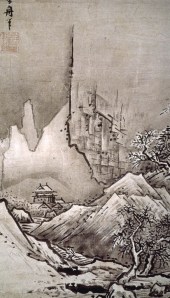
“Winter Landscape” by Sesshu Toyo

“Winter Landscape” by Sesshu Toyo

Imagine a wayfarer. He has been brought to a standstill at the foot of a mountain, tremendous, impassable. It is this mountain ….. no, it is not his destiny to cross it, but he has set his heart upon the crossing; for his wishes, his longings, his desires, his very soul, which has an easier mode of conveyance, are already on the other side; it only remains for him to follow. Imagine him coming to be seventy years old; but the mountain still stands there, unchanged, impassable. Let him become twice seventy years; but the mountain stands there unalterably blocking his way, unchanged, impassable. Under all this he undergoes changes, perhaps; he dies away from his longings, his wishes, his desires; he now scarcely recognizes himself. And so a new generation finds him, altered, sitting at the foot of the mountain, which still stands there, unchanged, impassable. Suppose it to have happened a thousand years ago: the altered wayfarer is long since dead, and only a legend keeps his memory alive; it is the only thing that remains—aye, and also the mountain, unchanged, impassable. And now think of Him who is eternally unchangeable, for whom a thousand years are but as one day—ah, even that is too much to say, for they are for Him as an instant, as if they did not even exist….

Anyone not eternally sure of Himself could not keep so still, but would rise in His strength, Only one who is immutable can be in this manner so still.

He gives men time, and He can afford to give them time, since He has eternity and is eternally unchanging.—Søren Kierkegaard, Judge for Yourselves!

The Elemental Voices

Waves

Waves

The three elemental sounds in nature are the sound of rain, the sound of wind in a primeval wood, and the sound of outer ocean on a beach. I have heard them all, and of the three elemental voices, that of ocean is the most awesome, beautiful, and varied. For it is a mistake to talk of the monotone of ocean or of the monotonous nature of its sound. The sea has many voices. Listen to the surf, really lend it your ears, and you will hear a world of sounds: hollow boomings and heavy roarings, great watery tumblings and tramplings, long hissing seethes, sharp, rifle-shot reports, splashes, whispers, the grinding undertone of stones, and sometimes vocal sounds that might be the half-heard talk of people in the sea.—Henry Beeson, The Outermost House: A Year of Life on the Great Beach of Cape Cod

Don’t Let the “Ballet Skirts” Fool You

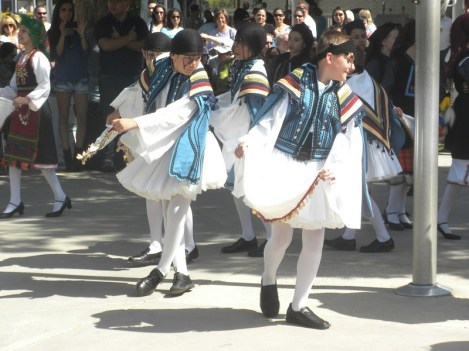
Boys from St. Nicholas Greek Orthodox Church in Macedonian Costume

Boys from St. Nicholas Greek Orthodox Church in Macedonian Costume

Here’s another photo from the Valley Greek Festival in Northridge that Martine and I attended yesterday.

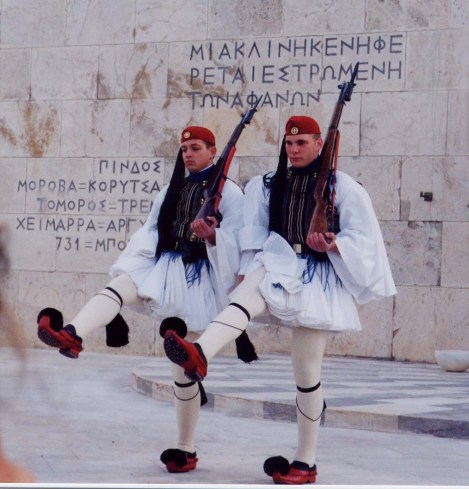
It has always seemed strange to me that the Greeks favored starched white skirts for their male dancers and soldiers. It certainly does not imply any lack of masculinity on their part. As a wartime correspondent, Ernest Hemingway was with the Greek forces invading Turkey in the aftermath of World War One. It was the first time, he wrote, that he had seen “dead men wearing white ballet skirts and upturned shoes with pompoms on them.” Below is a photo of Greek Evzone soldiers on guard duty:

Greek Evzone Troops

Greek Evzone Troops

Don’t let the “ballet skirts” fool you. Although it has not always been well led, the Greek Evzones have always been a formidable fighting force.


“Secret Movements of a Puppet Show”

Charles Churchill (1732-1764)

Charles Churchill (1732-1764)

Peace to such triflers; be our happier plan
To pass through life as easy as we can.
Who’s in or out, who moves this grand machine,
Nor stirs my curiosity nor spleen.
Secrets of state no more I wish to know
Than secret movements of a puppet-show:
Let but the puppets move, I’ve my desire,
Unseen the hand which guides the master-wire.—Charles Churchill, “Night: An Epistle to Robert Lloyd”

Serendipity: A “Miraculous” History

Vikings: The Stereotype

Vikings: The Stereotype

Right under the dedication of his book Feud in the Icelandic Saga, Jesse L. Byock includes this incredible quote from an almost forgotten book written a century ago:

The whole of Icelandic history is miraculous. A number of barbarian gentlemen leave Norway because the government there is becoming civilized and interfering: they settle in Iceland because they want to keep what they can of the unreformed past, the old freedom. It looks like anarchy. But immediately they begin to frame a Social Contract and to make laws in the most intelligent manner: a colonial agent is sent back to the Mother Country to study law and present a report. They might have sunk into mere hard work and ignorance, contending with the difficulties of their new country; they might well have become boors without a history, without a ballad. In fact the Icelandic settlers took with them the intellect of Norway; they wrote the history of the kings and the adventures of the gods. The settlement of Iceland looks like a furious plunge of angry and intemperate chiefs, away from order into a grim and reckless lank of Cockayne. The truth is that those rebels and their commonwealth were more self-possessed, more clearly conscious of their own aims, more critical of their own achievements, than any polity on earth since the fall of Athens. Iceland, though the country is large, has always been like a city-state in many of its ways; the small population, though widely scattered, was not broken up, and the four quarters of Iceland took as much interest in one another’s gossip as the quarters of Florence. In the Sagas, where nothing is of much importance except individual men, and where all the chief men are known to one another, a journey from Borg to Eyjafirth is no more than going past a few houses. The distant corners of the island are near one another. There is no sense of those impersonal forces, those nameless multitudes, that make history a different thing from biography in other lands. All history in Iceland shaped itself as biography or as drama, and there was no large crowd at the back of the stage.

Whew! Years ago, I had read the book from which this long quote is excerpted: W. P. Ker’s The Dark Ages (1904). I have not been able to locate my copy, but was delighted to find that the book is available free of charge in a number of formats, including Kindle.

We should by no means denigrate books like Ker’s just because they were written decades ago. Sometimes those old historians and critics had a lot more on the ball than our contemporaries.


Trunt, Trunt, and the Trolls in the Fells

Troll

Troll

There were once two men who went up into the mountains to gather edible moss. One night they were sharing a tent, and one was asleep and the other awake. The one who was awake saw the one who was asleep go creeping out; he got up and followed him, but however hard he ran he could not catch up with him. The sleeping man was headed straight up the mountain towards the glaciers, and the other saw where a huge giantess was sitting up there on the spur of the glacier. What she was doing was this: she would stretch out her arms with her hands crossed and then draw them in again to her breast, and in this way she was magically drawing the man towards her. The man ran straight into her arms, and then she ran off with him.

A year later, some people from this man’s district were gathering moss at the same place; he came there to meet them, and he was so short-spoken and surely that one could hardly get a word out of him. They asked him who he believed in, and he said he believed in God. The following year he came to the moss-gatherers again, and by then he looked so like a troll that he struck terror into them. However, he was again asked who he believed in, but he made no reply. This time he stayed a shorter time with them than before. The third year, he came again; by then he had turned into an absolute troll, and a very ugly-looking one too. Yet someone plucked up courage to ask him who he believed in, but he said he believed in “Trunt, Trunt, and the trolls in the fells”—and then he disappeared. After this he was never seen again, but for some years afterwards men did not dare go looking for moss in that place.—Jacqueline Simpson, Icelandic Folktales and Legends

Can This Be Me?

Budé

Guillaume Budé

In 1503 he married the daughter of an ancient Norman house, and it is said that, on his wedding-day, by an exceptional act of self-denial, he limited his time of study to three hours only. In his studies he was aided in every possible way by the devotion of his wife. Once, when he was busy reading in his library, one of the servants suddenly rushed in to inform him that the house was on fire. The scholar, without lifting up his eyes from his book, simply said to his informant:—allez avertir ma femme; vous savez bien que je ne m’occupe pas des affaires du menage! (Translated as: “Go tell my wife. You know I don’t concern myself with household matters.”) His health was seriously impaired by his prodigious industry, and the surgeons of the day vainly endeavoured to cure him of his constant headaches by applying a red-hot iron to the crown of his head. Happily he was enabled to find a safer remedy by taking long walks and by cultivating his garden.—John Edwin Sandys, A History of Classical Scholarship, Vol. II, Entry on “Guillaume Budé”

A Dead Language

Ancient Rome

Ancient Rome

My own career is a good example of many things, but none more than in my experience of the language and the literature of Ancient Rome. Like millions of my fellows, I was brought up in the 1930s to study Latin. When I was seventeen I switched to English, which nevertheless meant that I continued to study the classics, though less inflexibly than before. When I secured an award in English and went up to Oxford in 1941 I had the advantage of a classical training, for all that it seldom felt like any sort of advantage at the time.

The foregoing is a mere exordium in that I have no intention of going on to say that to have studied Latin is in itself somehow good for you or for your English style. It is not that a knowledge of Latin protects anybody from making mistakes about the meaning of English words, because the meanings of words are not fixed, they change in and after their move from one language to another. It is true that defendo means ‘I defend,’ but a muscle is not a little mouse, which etymologically it is, nor is a pencil what its origins declare it to be, a doubly small penis. Neither is it the case that, as schoolmasters are supposed to have thought or said at one time, one was helped to think by mastering that language, as if it were a course of mental gymnastics. Nevertheless the student of Latin, as of any considerable dead language, must constantly be trying to choose the right word to give the meaning of a Latin expression in English or an English expression in Latin. And if the writing of English generally is in decline, as many would say it is, we may be tempted to say that people no longer try to choose the right word as they once did. They often got it wrong, but they tried. Do they now?

Something like the foregoing sketch might be developed to accompany an analysis of English poetry as written over the last fifty years or so. If this is seen as having become not only less formally organised but less exact in its expression, then the loss of Latin has surely had a hand in the matter somewhere. Again, I do not simply mean that an acquaintance with Propertius or Catullus in the original is beneficial to any sort of poet, though I think I do think so, but just as simply that translation into and out of Latin verse calls for exactness, and that that quality is demanded in the writing of poetry as nowhere else. Exactness, by the way, is to be understood as applying to more than denotation: a word or phrase must be suitable to its context, so that a dialectal or slang term, for instance, is on the whole unlikely to fit well into a passage of high seriousness — except for special effect, as teachers used to add.

The chances are that no particular virtue attaches to Latin as a language, although its role in our culture is unique and uniquely important. Any dead language will do as the kind of trainer I mean, such as Ancient Greek or, were it copious enough and intelligible, Etruscan. But deadness is necessary. A living language is by definition unfixed, in a state of continuous development and change, adapting and often dropping dialecticisms, provincialisms, technical terms, slang of all sorts, foreign expressions and more. It has no choice but to be useless as any sort of example.

The preceding paragraphs are no doubt speculative. What follows is all too manifest. Not just Latin itself has disappeared but in many cases any certain knowledge of what it was. A phrase like mutatis mutandis, apart from being offensively unintelligible to almost every British person, will be taken as a bit of Italian or French or (it’s tempting to add) Choctaw rather than Latin. You come across it on old gravestones and monks used to sing it, or in it. The rest is silence. Latin is not only dead but cancelled.—Kingley Amis, “The Disappearance of Latin,” The King’s English: A Guide to Modern Usage