La Poderosa’s Final Tour

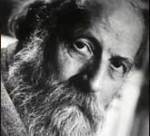
Ernesto “Che” Guevara

Ernesto “Che” Guevara

Due to a premonition, Alberto didn’t want to drive [the motorcycle nicknamed “La Poderosa,” “The Mighty One”], so I sat up front though we only did a few kilometers before stopping to fix the failing gearbox. A little further on, as we rounded a tight curve at a good speed, the screw came off the back brake, a cow’s head appeared around the bend, then many, many more of them, and I threw on the hand brake which, soldered ineptly, also broke. For some moments I saw nothing more than the blurred shape of cattle flying past us on each side, while poor Poderosa gathered speed down the steep hill. By an absolute miracle we managed to graze only the leg of the last cow, but in the distance a river was screaming toward us with terrifying efficacy. I veered on to the side of the road and in the blink of an eye the bike mounted the two-meter bank, embedding us between two rocks, but we were unhurt.

…. [W]e were put up by some Germans who treated us very well. During the night I had a bad case of the runs and, being ashamed to leave a souvenir in the pot under my bed, I climbed out on to the window ledge and gave up all my pain to the night and blackness beyond. The next morning I looked out to see the effect and saw that two meters below lay a big sheet of tin where they were sun-drying their peaches; the added spectacle was impressive. We beat it fast.—Ernesto “Che” Guevara, The Motorcycle Diaries

The Proverbs of Hell

Blake’s Illustration

Blake’s Illustration

In seed time learn, in harvest teach, in winter enjoy.
Drive your cart and your plow over the bones of the dead.
The road of excess leads to the palace of wisdom.
Prudence is a rich ugly old maid courted by Incapacity.
He who desires but acts not, breeds pestilence.
The cut worm forgives the plow.
Dip him in the river who loves water.
A fool sees not the same tree that a wise man sees.
He whose face gives no light, shall never become a star.
Eternity is in love with the productions of time.
The busy bee has no time for sorrow.
The hours of folly are measur’d by the clock, but of wisdom: no clock can measure.
All wholsom food is caught without a net or a trap.
Bring out number weight & measure in a year of dearth.
No bird soars too high, if he soars with his own wings.
A dead body revenges not injuries.
The most sublime act is to set another before you.
If the fool would persist in his folly he would become wise.
Folly is the cloke of knavery.
Shame is Prides cloke.

Prisons are built with stones of Law, Brothels with bricks of Religion.
The pride of the peacock is the glory of God.
The lust of the goat is the bounty of God.
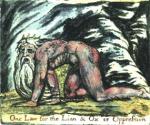
The wrath of the lion is the wisdom of God.
The nakedness of woman is the work of God.
Excess of sorrow laughs. Excess of joy weeps.
The roaring of lions, the howling of wolves, the raging of the stormy sea, and the destructive sword, are portions of eternity too great for the eye of man.
The fox condemns the trap, not himself.
Joys impregnate. Sorrows bring forth.
Let man wear the fell of the lion. woman the fleece of the sheep.
The bird a nest, the spider a web, man friendship.
The selfish smiling fool, & the sullen frowning fool shall be both thought wise, that they may be a rod.
What is now proved was once only imagin’d.
The rat, the mouse, the fox, the rabbet; watch the roots; the lion, the tyger, the horse, the elephant, watch the fruits.
The cistern contains: the fountain overflows.
One thought fills immensity.
Always be ready to speak your mind, and a base man will avoid you.
Every thing possible to be believ’d is an image of truth.
The eagle never lost so much time, as when he submitted to learn of the crow.
The fox provides for himself. but God provides for the lion.
Think in the morning. Act in the noon. Eat in the evening. Sleep in the night.
He who has suffer’d you to impose on him knows you.
As the plow follows words, so God rewards prayers.
The tygers of wrath are wiser than the horses of instruction.
Expect poison from the standing water.
You never know what is enough unless you know what is more than enough.
Listen to the fools reproach! it is a kingly title!
The eyes of fire, the nostrils of air, the mouth of water, the beard of earth.
The weak in courage is strong in cunning.
The apple tree never asks the beech how he shall grow; nor the lion, the horse, how he shall take his prey.
The thankful reciever bears a plentiful harvest.
If others bad not been foolish, we should be so.
The soul of sweet delight can never be defil’d.
When thou seest an Eagle, thou seest a portion of Genius. lift up thy head!
As the catterpiller chooses the fairest leaves to lay her eggs, so the priest lays his curse on the fairest joys.
To create a little flower is the labour of ages.
Damn braces: Bless relaxes.
The best wine is the oldest, the best water the newest.
Prayers plow not! Praises reap not!
Joys laugh not! Sorrows weep not!—from William Blake, “The Marriage of Heaven and Hell”

 

“A Spark from the Original Soul”

Martin Buber

Martin Buber

Question: We are commanded to love our neighbor as ourselves. How do I do this if my neighbor has wronged me?

Answer: You must understand these words rightly. Love your neighbor as something which you yourself are. For all souls are one. Each is a spark from the original soul, and this soul is inherent in all souls, just as your soul is inherent in all the members of your body. It may come to pass that your hand will make a mistake and strike you. But would you take a stick and chastise your hand because it lacked understanding, and so increase your pain? It is the same if your neighbor, who is of one soul with you, wrongs you because of his lack of understanding. If you punish him, you only hurt yourself.

Question: But if I see a man who is wicked before God, how can I love him?

Answer: Don’t you know that the primordial soul came out of the essence of God, and that every human soul is a part of God? And will you have no mercy on man, when you see that one of his holy sparks has been lost in a maze and is almost stifled?—Martin Buber, Ten Rungs: Hasidic Sayings

“Life Uglified”

Paris in the Spring

Paris in the Spring

What will Paris be like tomorrow? The thought was in my mind as, strolling beside the Seine in the mist, I contemplated the glory of the buds that covered the trees with a delicate veil. Paris possesses a beauty that alarms me at times because I feel it is fragile, under threat. Mainly from our town planners. Which young architect is at last going to give us the city of the future, a fine city capable of appealing to the generations to come as we have been enchanted by the Paris that has been fashioned slowly by the centuries? Is it too much to dream of a visionary who will be the poet of space and no longer one of those organisers of a life uglified, to paraphrase Baudelaire, one of those bearers of wasted space who erect modern apartment buildings as graceless cubes, full of the sound and fury of the neighbours’ television sets and plumbing facilities….—Julian Green, Paris


Not Learned in School

Classroom

Classroom

I’ve been making a list of the things they don’t teach you at school. They don’t teach you how to love somebody. They don’t teach you how to be famous. They don’t teach you how to be rich or how to be poor. They don’t teach you how to walk away from someone you don’t love any longer. They don’t teach you how to know what’s going on in someone else’s mind. They don’t teach you what to say to someone who’s dying. They don’t teach you anything worth knowing.—Neil Gaiman, The Sandman

An Enchantment

Charlemagne

Late in life the emperor Charlemagne fell in love with a German girl. The barons at his court were extremely worried when they saw that the sovereign, wholly taken up with his amorous passion and unmindful of his regal dignity, was neglecting the affairs of state. When the girl suddenly died, the courtiers were greatly relieved—but not for long, because Charlemagne’s love did not die with her. The emperor had the embalmed carried to his bedchamber, where he refused to be parted from it. The Archbishop Turpin, alarmed by this macabre passion, suspected an enchantment and insisted on examining the corpse. Hidden under the dead girl’s tongue he found a ring with a precious stone set in it. As soon as the ring was in Turpin’s hands, Charlemagne fell in love with the archbishop and hurriedly had the girl buried. In order to escape the embarrassing situation, Turpin flung the ring into Lake Constance. Charlemagne thereupon fell in love with the lake and would not leave its shores.—Italo Calvino, Six Memos for the Next Millennium, quoting Barbey d’Aurevilly.

Zeus Goes A-Wooing

Leda and the Swan

Whenever the Greek God Zeus was felt attracted toward mortal women, he disguised himself as someone or something else and just raped them. That happened in the case of Europa (either as a bull according to Ovid or as an eagle according to Robert Graves); Danae (as a golden shower—hey, I don’t make this stuff up); Callisto (as the Goddess Artemis); and Alcmene (as her husband who was away at war at the time).

Probably the most famous coupling was with Leda, for which Zeus became a swan. The result was Helen of Troy and Polydeuces. Leda’s legitimate children by King Tyndareus of Sparta were Castor and Clytemnestra. You may recall that Clytemnestra married Agamemnon and later murdered him in his bath when he returned from the Trojan War.

The above photo was taken earlier today by me at the Getty Villa in Malibu, one of the best collections of ancient Greek and Roman antiquities in the New World.

All this comes out in this magnificent poem by William Butler Yeats:

Leda and the Swan by W. B. Yeats

A sudden blow: the great wings beating still
Above the staggering girl, her thighs caressed
By the dark webs, her nape caught in his bill,
He holds her helpless breast upon his breast.

How can those terrified vague fingers push
The feathered glory from her loosening thighs?
And how can body, laid in that white rush,
But feel the strange heart beating where it lies?

A shudder in the loins engenders there
The broken wall, the burning roof and tower
And Agamemnon dead.
                    Being so caught up,
So mastered by the brute blood of the air,
Did she put on his knowledge with his power
Before the indifferent beak could let her drop?

Making Assumptions

Lemony Snicket

Assumptions are dangerous things to make, and like all dangerous things to make — bombs, for instance, or strawberry shortcake — if you make even the tiniest mistake you can find yourself in terrible trouble. Making assumptions simply means believing things are a certain way with little or no evidence that shows you are correct, and you can see at once how this can lead to terrible trouble. For instance, one morning you might wake up and make the assumption that your bed was in the same place that it always was, even though you would have no real evidence that this was so. But when you got out of your bed, you might discover that it had floated out to sea, and now you would be in terrible trouble all because of the incorrect assumption that you’d made. You can see that it is better not to make too many assumptions, particularly in the morning.—Lemony Snicket, The Austere Academy

The Life After Death

Samuel Butler

That there is such a life is as palpable as that there is a life before death. See the influence that the dead have over us. But this life is no more eternal than our present life. Shakespeare and Homer may live long, but they will die, that is to say, become unknown as direct and efficient causes—some day.

Even so God himself dies, for to die is to change and to change is to die to what has gone before. If the units change the total must do so also.

As no one can say which egg or seed shall come to visible life and in its turn leave issue, so no one can say which of the millions of now visible lives shall enter into the afterlife on death, and which have but so little lifeas practically not to count. For most seeds end as seeds or as food for some alien being, and so with lives, by far the greater number are sterile, except in so far as they can be devoured as the food of some stronger life. The Handels and Shakespeares are the few seeds that grow—and even these die.

And the same uncertainty attaches to posthumous life as to pre-lethal. As no one can say how long another shall live, so no one can say how long or how short a reputation shall live. The most unpromising weakly-looking creatures sometimes live to ninety while strong robust men are carried off in their prime. And no one can say what a man shall enter into life for having done. Roughly, there is a sort of moral government whereby those who have done the best work live most enduringly, but it is subject to such exceptions that no one can say whether or no there shall not be an exception in his own case either in his favour or against him.—Samuel Butler, Notebooks