Sea Legs

Commandant Louis Joseph Lahure has a singular distinction in military history — he defeated a navy on horseback.  Occupying Holland in January 1795, the French continental army learned that the mighty Dutch navy had been frozen into the ice around Texel Island. So Lahure and 128 men simply rode up to it and demanded surrender. No shots were fired.

Quick Quote from Futility Closet

Text: Jabberwocky Spell-Checked

Jabberwocky

Jabberwocky

`Twas billing, and the smithy toes
Did gyre and gamble in the wage:
All missy were the brogues,
And the mime rats outrage.

“Beware the Jabber Wick, my son!
The jaws that bite, the claws that catch!
Beware the Jujube bird, and shun
The furious Bender Snatch!”

He took his viral sword in hand:
Long time the Manxwomen foe he sought –
So rested he by the Tutu tree,
And stood awhile in thought.

And, as in offish thought he stood,
The Jabber Wick, with eyes of flame,
Came whiffing through the tulle wood,
And burbled as it came!

One, two! One, two! And through and through
The viral blade went snicker-snack!
He left it dead, and with its head
He went galumphing back.

“And, has thou slain the Jabber Wick?
Come to my arms, my beamish boy!
O crablouse day! Callow! Allay!’
He chortled in his joy.

`Twas billing, and the smithy toes
Did gyre and gamble in the wage;
All missy were the brogues
And the mime rats outrage.

—Futility Closet

Text: Still a Good Book

Bible

The Bible

Textual problems have led some modern scholars to question the credibility of the Gospels and even to doubt the historical existence of Christ. These studies have provoked an intriguing reaction from an unlikely source: Julien Gracq—an old and prestigious novelist, who was close to the Surrealist movement—made a comment which is all the more arresting for coming from an agnostic. In a recent volume of essays, Gracq first acknowledged the impressive learning of one of these scholars (whose lectures he had attended in his youth), as well as the devastating logic of his reasoning; but he confessed that, in the end, he still found himself left with one fundamental objection: for all his formidable erudition, the scholar in question had simply no ear—he could not hear what should be so obvious to any sensitive reader—that, underlying the text of the Gospels, there is a masterly and powerful unity of style, which derives from one unique and inimitable voice; there is the presence of one singular and exceptional personality whose expression is so original, so bold that one could positively call it impudent. Now, if you deny the existence of Jesus, you must transfer all these attributes to some obscure, anonymous writer, who should have had the improbable genius of inventing such a character—or, even more implausibly, you must transfer this prodigious capacity for invention to an entire committee of writers. And Gracq concluded: in the end, if modern scholars, progressive-minded clerics and the docile public all surrender to this critical erosion of the Scriptures, the last group of defenders who will obstinately maintain that there is a living Jesus at the central core of the Gospels will be made of artists and creative writers, for whom the psychological evidence of style carries much more weight than mere philological arguments.—Simon Leys, The Hall of Uselessness: Collected Essays

Text: Pope Francis Speaks Out

Pope Francis

Pope Francis

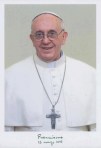
In this context, some people continue to defend trickle-down theories which assume that economic growth, encouraged by a free market, will inevitably succeed in bringing about greater justice and inclusiveness in the world. This opinion, which has never been confirmed by the facts, expresses a crude and naïve trust in the goodness of those wielding economic power and in the sacralized workings of the prevailing economic system. Meanwhile, the excluded are still waiting. To sustain a lifestyle which excludes others, or to sustain enthusiasm for that selfish ideal, a globalization of indifference has developed. Almost without being aware of it, we end up being incapable of feeling compassion at the outcry of the poor, weeping for other people’s pain, and feeling a need to help them, as though all this were someone else’s responsibility and not our own. The culture of prosperity deadens us; we are thrilled if the market offers us something new to purchase; and in the meantime all those lives stunted for lack of opportunity seem a mere spectacle; they fail to move us.—Pope Francis, Evangelii Gaudium

Text: “A Human Being by Definition Only”

Walker Evans Photo

Walker Evans Photo

A civilization which for any reason puts a human life at a disadvantage; or a civilization which can exist only by putting human life at a disadvantage; is worthy neither of the name nor of continuance. And a human being whose life is nurtured in an advantage which has accrued from the disadvantage of other human beings, and who prefers that this should remain as it is, is a human being by definition only, having much more in common with the bedbug, the tapeworm, the cancer, and the scavengers of the deep sea.—James Agee, Cotton Tenants: Three Families

Texts: A Boyhood in Algeria

Albert Camus

Albert Camus

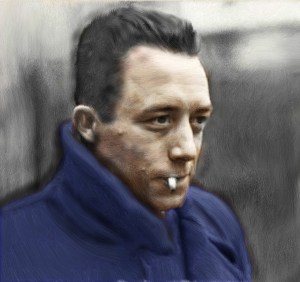
This night inside him, yes these tangled hidden roots that bound him to this magnificent and frightening land, as much to its scorching days as to its heartbreakingly rapid twilights, and that was like a second life, truer perhaps than the everyday surface of his outward life; its history would be told as a series of obscure yearnings and powerful indescribable sensations, the odor of the schools, of the neighborhood stables, of laundry on his mother’s hands, of jasmine and honeysuckle in the upper neighborhoods, of the pages of the dictionary and the books he devoured, and the sour smell of the toilets at home and at the hardware store, the smell of the big cold classrooms where he would sometimes go alone before or after class, the warmth of his favorite classmates, the odor of warm wool and feces that Didier carried around with him, of the cologne big Marconi’s mother doused him with so profusely that Jacques, sitting on the bench in class, wanted to move still closer to his friend … the longing, yes, to live, to live still more, to immerse himself in the greatest warmth this earth could give him, which is what he without knowing it hoped for from his mother.—Albert Camus, The First Man

Hire This Man!

Matt Bramble

Matt Bramble

‘Suppose I was inclined to take you into my service (said he) what are your qualifications? what are you good for?’ ‘An please your honour (answered this original) I can read and write, and do the business of the stable indifferent well — I can dress a horse, and shoe him, and bleed and rowel him; and, as for the practice of sow-gelding, I won’t turn my back on e’er a he in the county of Wilts — Then I can make hog’s puddings and hob-nails, mend kettles and tin sauce-pans.’ — Here uncle burst out a-laughing; and inquired what other accomplishments he was master of — ‘I know something of single-stick, and psalmody (proceeded Clinker); I can play upon the Jew’s-harp, sing Black-ey’d Susan, Arthur-o’Bradley, and divers other songs; I can dance a Welsh jig, and Nancy Dawson; wrestle a fall with any lad of my inches, when I’m in heart; and, under correction, I can find a hare when your honour wants a bit of game.’—Tobias Smollett, The Expedition of Humphry Clinker

“Worse Than Worthless”?

Tattooed Boy

Tattooed Boy

I tried to point out some of the cultural meanings of the vogue for tattooing. First, it was aesthetically worse than worthless. Tattoos were always kitsch, implying not only the absence of taste but the presence of dishonest emotion.

Second, the vogue represented a desperate (and rather sad) attempt on a mass scale to achieve individuality and character by means of mere adornment, which implied both intellectual vacuity and unhealthy self-absorption.

And third, it represented mass downward cultural and social aspiration, since everyone understood that tattooing had a traditional association with low social class and, above all, with aggression and criminality. It was, in effect, a visible symbol of the greatest, though totally ersatz, virtue of our time: an inclusive unwillingness to make judgments of morality or value.—Theodore Dalrymple

You Need to Breathe and You Need to Be

French Writer Albert Camus, Born 100 Years Ago Today

French Writer Albert Camus, Born 100 Years Ago Today

Find meaning. Distinguish melancholy from sadness. Go out for a walk. It doesn’t have to be a romantic walk in the park, spring at its most spectacular moment, flowers and smells and outstanding poetical imagery smoothly transferring you into another world. It doesn’t have to be a walk during which you’ll have multiple life epiphanies and discover meanings no other brain ever managed to encounter. Do not be afraid of spending quality time by yourself. Find meaning or don’t find meaning but ‘steal’ some time and give it freely and exclusively to your own self. Opt for privacy and solitude. That doesn’t make you antisocial or cause you to reject the rest of the world. But you need to breathe. And you need to be.—Albert Camus, Notebooks 1951-1959

“A Frail Jetty Facing North”

Oedipus and Antigone

Oedipus and Antigone

What is unwisdom but the lusting after
Longevity: to be old and full of days!
For the vast and unremitting tide of years
Casts up to view more sorrowful things than joyful;
And as for pleasures, once beyond our prime,
They all drift out of reach, they are washed away.
And the same gaunt bailiff calls upon us all,
Summoning into Darkness, to those wards
Where is no music, dance, or marriage hymn
That soothes or gladdens. To the tenements of Death.

Not to be born is, past all yearning, best.
And second best is, having seen the light,
To return at once to deep oblivion.
When youth has gone, and the baseless dreams of youth,
What misery does not then jostle man’s elbow,
Join him as a companion, share his bread?
Betrayal, envy, calumny and bloodshed
Move in on him, and finally Old Age—
Infirm, despised Old Age—joins in his ruin,
The crowning taunt of his indignities.

So is it with that man, not just with me.
He seems like a frail jetty facing North
Whose pilings the waves batter from all quarters;
From where the sun comes up, from where it sets,
From freezing boreal regions, from below,
A whole winter of miseries now assails him,
Thrashes his sides and breaks over his head.—Sophocles, Oedipus at Colonus (Trans. Anthony Hecht)