Victor Hugo on Balzac’s Death

How Honoré de Balzac died:

Dagny's avatarLa Comedie Humaine by Balzac

The Death of Balzac
By Victor Hugo

On the 18th of August, 1850, my wife, who had been during the day to see Mme. de Balzac, told me that Balzac was dying. I hurried to him.

M. de Balzac had been suffering for eighteen months from hypertrophy of the heart. After the revolution of February he went to Russia, and there married. Some days before his departure I met him in the boulevard. He was then complaining, and breathing noisily. In May, 1850, he returned to France, married, rich, and dying! When he arrived, his legs were already swollen. Four doctors held a consultation. One of them, M. Louis, told me on the 6th of July, “He has not six weeks to live.” It is the same disease that killed Frederic Soulie.

On August 18th my uncle, General Louis Hugo, was dining with me. As soon as the table was…

View original post 1,411 more words

A Philosophical Conundrum

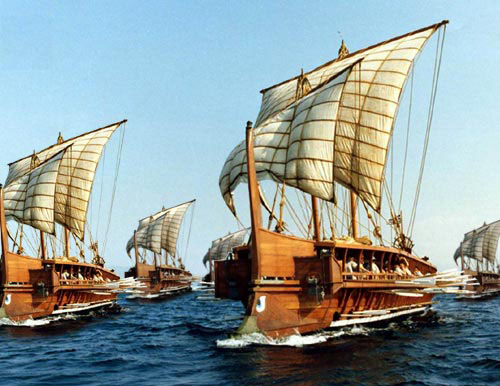
It’s Called “The Ship of Theseus”

It’s Called “The Ship of Theseus”

I got this puzzle from The Futility Closet, which I have decided to add to my links:

Suppose we have a complete wooden ship, and one day we replace one of its wooden planks with an aluminum one. Most people would agree that the ship survives this operation; that is to say, its identity remains unchanged. But suppose that we then replace a second plank, and then a third, until our wooden ship is made entirely of aluminum. Is this the same ship that we started with? If not, when did it change?

Thomas Hobbes adds a wrinkle: Suppose that, as we did all this refurbishing, someone had gathered up all the discarded wooden planks and used them to assemble a second ship. What are we to make of this? “This, without doubt, had also been the same numerical ship with that which was at the beginning; and so there would have been two ships numerically the same, which is absurd.”

And philosopher Roderick Chisholm adds another: “Let us suppose that the captain of the original ship had solemnly taken the vow that, if his ship were ever to go down, he would go down with it. What, now, if the two ships collide at sea and he sees them start to sink together? Where does his duty lie — with the aluminum ship or with the reassembled wooden ship?”


On the Butterfield Overland Trail

Reconstructed Vallecito Stage Station

Reconstructed Vallecito Stage Station

Along the edges of the Anza Borrego State Park are a couple of San Diego County Parks on Highway S-2: One is the Vallecito Regional Park and, a little further down the road, a natural hot springs park at Agua Caliente. After taking our hike down to what remains of the Butterfield Stage Route at Box Canyon, we headed to Vallecito for lunch.

At Vallecito is a reconstruction of the original stage station that served as a place to rest and change horses on the Butterfield Overland Trail between 1858 and 1861. One traveler in 1859 referred to the station as being located in “a beautiful green spot—a perfect oasis in the desert.” (In fact, it’s the first real green spot on the trail west of Yuma, Arizona.) And so it was for Martine and me. We picked out a shady picnic table and reached into our bags for the groceries we had bought that morning in Borrego Springs, looked around at the exhibits in the stage station, and hung around until we were ready for our next hike.

The Butterfield Overland Trail was in use for such a short time primarily because of the Civil War. The route between San Antonio, Texas, and San Diego went through too much Confederate territory; and, besides, a transcontinental railroad was already in the works. Once that was completed in 1869, stagecoaches were on their way out, at least for long distance transport.

One of the few descriptions of the experience of stage travel comes from Mark Twain in Roughing It (1859), which tells of a journey by stagecoach between Missouri and Carson City, Nevada Territory:

Our coach was a great swinging and swaying stage, of the most sumptuous description—an imposing cradle on wheels. It was drawn by six handsome horses, and by the side of the driver sat the “conductor,” the legitimate captain of the craft; for it was his business to take charge and care of the mails, baggage, express matter, and passengers. We three were the only passengers, this trip. We sat on the back seat, inside. About all the rest of the coach was full of mail bags—for we had three days’ delayed mails with us. Almost touching our knees, a perpendicular wall of mail matter rose up to the roof. There was a great pile of it strapped on top of the stage, and both the fore and hind boots were full. We had twenty-seven hundred pounds of it aboard, the driver said—“a little for Brigham, and Carson, and ’Frisco, but the heft of it for the Injuns, which is powerful troublesome ’thout they get plenty of truck to read.”

A Polish Poet Learns Latin

Zbigniew Herbert

Zbigniew Herbert

In my interest in Latin and my admittedly mediocre progress in that sphere there lay an element I might call personal. In the apartment building across the road from us there lived a young person, whose full shape, auburn hair, and dimples stirred my senses and gave me vertigo. She was the daughter of a Latin professor—not from our gymnasium, it is true, but known to us as the author of the book of adapted texts over which we labored; he also published articles in the monthly Philomat, to which Grzesio obliged us to subscribe through him. I used to sit on the balcony with my Auerbach & Dąbrowski Latin grammar and pretend that reading this exceptionally dull tome put me in ecstasy.

It was in fact an act of despair. If the object of my passionate feelings appeared on the balcony, it was not for my sake. She sometimes brushed me with a distracted look, as one glances at clouds moving across the sky. She was waiting for an older colleague of mine from the lyceum, a tall youth with a wavy blond crop, undeniably handsome (he was the standard-bearer of our school and wearing a sash and white gloves at celebrations he really did present well)—but I knew he could never make her happy. Every day around five in the afternoon she would leave the house with my mortal enemy and disappear around the corner into a little street shaded by chestnut trees, where (my feverish imagination told me) terrible things happened: he would take her arm (against the severest injunctions of the middle school rules) and perhaps press a fiery kiss on her silken glove. A storm of contradictory feelings in my tormented heart:

Odi et amo. Quare id faciam, fortasse requiris.
Nescio, sed fieri sentio et excrucior.

What did I think to achieve, holding my Auerbach & Dąbrowski Latin grammar on the balcony so that its cover would be visible from afar? I thought that one day her father—the classical philologist—would notice me and shout across to me: “I have been observing you for a while now, my boy. Your modesty and industry, your love for the Roman tongue are a warranty that you are a proper candidate for my daughter’s husband. I therefore grant you her hand.” And from then on things would proceed as in a fairy tale.

They didn’t. On the other hand, I learned many examples of the use of the more complicated grammatical forms by heart and was able to shine in class, even winning a cordial look from Grzesio.

We labored in the sweat of our brows. The time to reap drew near: the next year we were to proceed to the poetry of Catullus and Horace. But then the barbarians invaded.—Zbigniew Herbert, “A Latin Lesson,” Collected Prose

NOTE: Translated, the above Latin quote reads:

“I hate and I love. Why do I do it, perchance you might ask?
I don’t know, but I feel it happening to me and I’m burning up.”

The lines are from Catullus.

Don’t Let the “Ballet Skirts” Fool You

Boys from St. Nicholas Greek Orthodox Church in Macedonian Costume

Boys from St. Nicholas Greek Orthodox Church in Macedonian Costume

Here’s another photo from the Valley Greek Festival in Northridge that Martine and I attended yesterday.

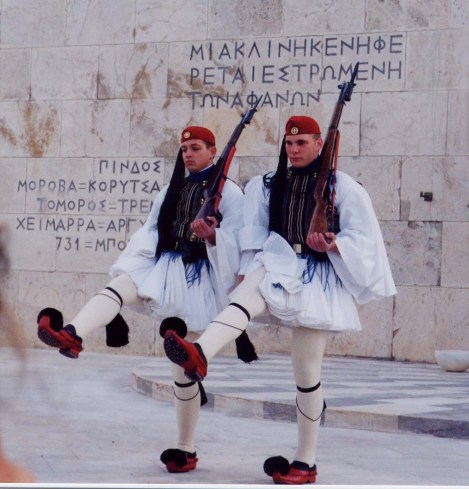
It has always seemed strange to me that the Greeks favored starched white skirts for their male dancers and soldiers. It certainly does not imply any lack of masculinity on their part. As a wartime correspondent, Ernest Hemingway was with the Greek forces invading Turkey in the aftermath of World War One. It was the first time, he wrote, that he had seen “dead men wearing white ballet skirts and upturned shoes with pompoms on them.” Below is a photo of Greek Evzone soldiers on guard duty:

Greek Evzone Troops

Greek Evzone Troops

Don’t let the “ballet skirts” fool you. Although it has not always been well led, the Greek Evzones have always been a formidable fighting force.


Not Learned in School

Classroom

Classroom

I’ve been making a list of the things they don’t teach you at school. They don’t teach you how to love somebody. They don’t teach you how to be famous. They don’t teach you how to be rich or how to be poor. They don’t teach you how to walk away from someone you don’t love any longer. They don’t teach you how to know what’s going on in someone else’s mind. They don’t teach you what to say to someone who’s dying. They don’t teach you anything worth knowing.—Neil Gaiman, The Sandman

An Enchantment

Charlemagne

Late in life the emperor Charlemagne fell in love with a German girl. The barons at his court were extremely worried when they saw that the sovereign, wholly taken up with his amorous passion and unmindful of his regal dignity, was neglecting the affairs of state. When the girl suddenly died, the courtiers were greatly relieved—but not for long, because Charlemagne’s love did not die with her. The emperor had the embalmed carried to his bedchamber, where he refused to be parted from it. The Archbishop Turpin, alarmed by this macabre passion, suspected an enchantment and insisted on examining the corpse. Hidden under the dead girl’s tongue he found a ring with a precious stone set in it. As soon as the ring was in Turpin’s hands, Charlemagne fell in love with the archbishop and hurriedly had the girl buried. In order to escape the embarrassing situation, Turpin flung the ring into Lake Constance. Charlemagne thereupon fell in love with the lake and would not leave its shores.—Italo Calvino, Six Memos for the Next Millennium, quoting Barbey d’Aurevilly.

Zeus Goes A-Wooing

Leda and the Swan

Whenever the Greek God Zeus was felt attracted toward mortal women, he disguised himself as someone or something else and just raped them. That happened in the case of Europa (either as a bull according to Ovid or as an eagle according to Robert Graves); Danae (as a golden shower—hey, I don’t make this stuff up); Callisto (as the Goddess Artemis); and Alcmene (as her husband who was away at war at the time).

Probably the most famous coupling was with Leda, for which Zeus became a swan. The result was Helen of Troy and Polydeuces. Leda’s legitimate children by King Tyndareus of Sparta were Castor and Clytemnestra. You may recall that Clytemnestra married Agamemnon and later murdered him in his bath when he returned from the Trojan War.

The above photo was taken earlier today by me at the Getty Villa in Malibu, one of the best collections of ancient Greek and Roman antiquities in the New World.

All this comes out in this magnificent poem by William Butler Yeats:

Leda and the Swan by W. B. Yeats

A sudden blow: the great wings beating still
Above the staggering girl, her thighs caressed
By the dark webs, her nape caught in his bill,
He holds her helpless breast upon his breast.

How can those terrified vague fingers push
The feathered glory from her loosening thighs?
And how can body, laid in that white rush,
But feel the strange heart beating where it lies?

A shudder in the loins engenders there
The broken wall, the burning roof and tower
And Agamemnon dead.
                    Being so caught up,
So mastered by the brute blood of the air,
Did she put on his knowledge with his power
Before the indifferent beak could let her drop?

Making Assumptions

Lemony Snicket

Assumptions are dangerous things to make, and like all dangerous things to make — bombs, for instance, or strawberry shortcake — if you make even the tiniest mistake you can find yourself in terrible trouble. Making assumptions simply means believing things are a certain way with little or no evidence that shows you are correct, and you can see at once how this can lead to terrible trouble. For instance, one morning you might wake up and make the assumption that your bed was in the same place that it always was, even though you would have no real evidence that this was so. But when you got out of your bed, you might discover that it had floated out to sea, and now you would be in terrible trouble all because of the incorrect assumption that you’d made. You can see that it is better not to make too many assumptions, particularly in the morning.—Lemony Snicket, The Austere Academy