What can one say when the most beautiful woman in the world grows old and dies a divisive figure at the age of 91? When I was a young man, I thought that Brigitte Bardot could do no wrong. She was Venus de Milo personified. I saw her films And God Created Woman (1956) and Contempt (1963) multiple times.
But Brigitte was far from perfect. In her later years, she espoused rightist causes, campaigning for the LePens in French elections and reviling Muslims and even calling the residents of Réunion, a French island in the Indian Ocean, “savages.”
Okay, she wasn’t perfect—except in the way she looked in the 1950s and 1960s. Then, she was a goddess. As a young film freak in Los Angeles, I worshiped the ground she walked on.
Then I heard she was a big animal rights activist. “That’s all right,” I thought. But then I started hearing uglier things. By then, Brigitte was a hermit of sorts living on the French Riviera.
There’s a lesson to be learned there. We are all human, we are all likely to err, we will all eventually lose our looks and die.
He’s from the same part of the world from which I hail. Painesville, the county seat of Lake County, is some 30 miles northeast of Cleveland. He has been called a science fiction writer, a designation which he (rightfully) hates. It’s more speculative fiction, with an emphasis on the short story form.
The man from Painesville was known for being something of a pain. His obituary in the Los Angeles Times remarks:
Over the years, Ellison has been described as fiercely independent, vengeful, sardonic, opinionated, confrontational, foul-mouthed, petulant, infuriating, defiant and a general all-around nuisance—as well as engaging, gregarious, funny, fastidiously organized and generous to his friends.
By his own measure, he was “a hard pill to swallow.”
He is gone, with all his objectionable behavior, but his stories remain. And they are well worth reading. I suggest you try one of the following collections:
I have No Mouth and I Must Scream (1967)
The Beast That Shouted Love at the Heart of the World (1969)
Approaching Oblivion (1974)
Deathbird Stories (1975)
Shatterday (1980)
You might also want to try reading the sci-fi story collection he edited in 1967 entitled Dangerous Visions.
Although he will be remembered as much for being a prickly character as a brilliant writer, I think that over time the latter will replace the former in the estimation of readers.
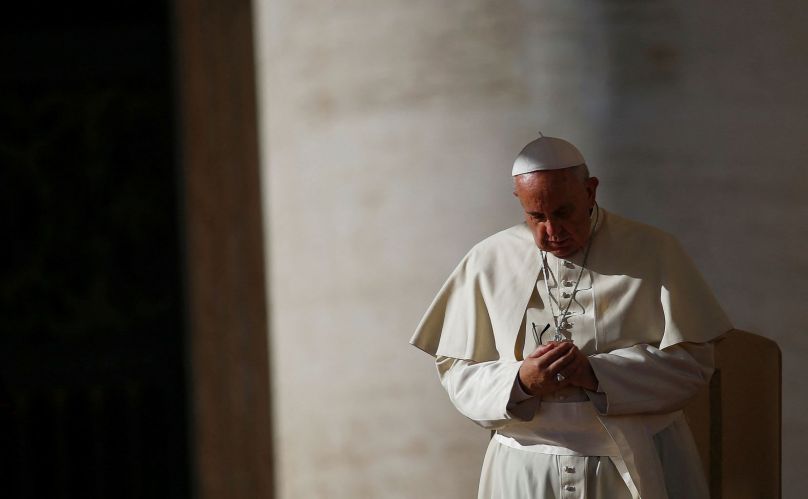
This world needs a steady supply of good men to outweigh the crimes and chicanery of the many. Pope Francis, who died today, was one such. There have been some extraordinarily good popes in the last hundred years (there had to be to make up for the likes of Alexander VI, the 15th century Borgia pope). These included John XXIII, John Paul II (now Saint John Paul II), and Francis, who probably also will be canonized some day.
This has not been a good time for the Catholic Church. There has been a worldwide plague of pedophilia among ministers of the Gospel—especially severe as priests in the Roman Rite may not marry, leaving little outlet for their loneliness. Also, in most Western countries, attendance at churches has been dwindling.
(Yet virtually all popes have come from Western countries. The only exception I could think of in recent memory is John Paul II, who hailed from Poland.)
Controlling the Catholic church is a tall order. It is difficult to be at one and the same time a hard-headed businessman and a saint.
Although I am nobody’s idea of a practicing Catholic, I still have strong emotional ties to the church as a result of eleven years of religious education and the helpfulness of the Catholic chaplain at Dartmouth College. When I came down with a brain tumor (chromophobe adenoma) after my Dartmouth insurance was canceled after graduation in 1966, it was Monsignor William Nolan who managed to talk the insurer to continue covering me and preventing my illness from bankrupting my family.
So, Pope Francis, may angels escort you to your reward.
The Jewish-Ukrainian-Brazilian Clarice Lispector (1920-1977)
If Clarice Lispector were alive today, she would be celebrating her 104th birthday. The strikingly beautiful author with the high cheekbones and wild Scythian eyes was one of the greatest women writers of the 20th century, joining such titans as Virginia Woolf, Joan Didion, Ursula LeGuin, Patricia Highsmith, and Wislawa Szymborska.
In my e-mail today was a message from New Directions Publishing, which publishes some twenty titles by Lispector in English translation. It contained a link to a video entitled “Dias de Clarice em Washington.” It is 29 minutes long in Brazilian Portuguese with English subtitles.
During the 1950s, Clarice was married to a Brazilian diplomat named Maury Gurgel Valente who was posted to the embassy in Washington. From her house in Bethesda, Maryland, she took part in diplomatic social functions and raised a family, as well as writing a number of books and short stories … until it all became too much for her, and she filed for divorce, after which she returned to Brazil.
I urge you to see this video and see what a great writer must do when she is pulled between her marriage and her art:
This is a reprint of a blog posting from May 17, 2016. Martine and I were dismayed to hear of the passing of Roger Corman, who died in Santa Monica at the age of 98 on May 9 of this year. It never ceased to amaze me that one could produce and direct so many interesting films while working in what the film industry has called “poverty row.”
The first time I ever heard of him was when I was a student at Dartmouth. At that time (the mid 1960s) I subscribed to Films and Filming. One issue contained an article entitled “The Crown Prince of Z Films,” referring, of course, to Roger Corman. I was intrigued by what I was hearing of the cheapster director who made so many interesting films for American International Pictures. What I liked most were the Edgar Allan Poe adaptations, usually starring Vincent Price.
Perhaps my favorite was The Masque of the Red Death (1964), about the attempt by a group of dissipated nobles to escape the plague. There were others in the series, including House of Usher (1960), The Pit and the Pendulum (1961), Premature Burial (1962), The Raven (1963), and The Tomb of Ligeia (1964).
When I first met Martine in the late 1980s, I discovered that she was a hard-core Corman addict, liking such films as Attack of the Crab Monsters (1957) and the original The Little Shop of Horrors (1960), which was shot in under a week on a shoestring budget. There are in all about a dozen films he directed that are worth seeing and hold up well over the years. (He also made not a few clinkers, but that’s showbiz!) After he stopped directing around 1970 he continued to produce films and was responsible for some 300+ films over his half century career.
Roger Corman (1926-2024)
Other than the Poe features, I also enjoyed I, Mobster (1958), A Bucket of Blood (1959), The Intruder (1962) starring William Shatner, Tales of Terror (1962), X: The Man with the X-Ray Eyes (1963) starring Ray Milland, The Wild Angels (1966), The Trip (1967), and Bloody Mama (1970).
Corman introduced us to Jack Nicholson, Peter Fonda, Dennis Hopper, and Bruce Dern, to name just a few. In his films were such stars as Boris Karloff and Peter Lorre.
Perhaps I had a misspent youth, but I sure enjoyed it—and continue to do so….
There is a curious parallelism in the lives of America’s two world chess champions. Both Paul Morphy (1837-1884) and Bobby Fischer had reached the pinnacle of chess and seem to have frittered the rest of their lives away. In Morphy’s case, there was no official championship, but he was universally acknowledged to have beaten the best chess players of his day during an extended European trip in 1857-1858. The only major player he did not beat was the British champ, Howard Staunton, mostly because Staunton, who was past his prime, was too chicken-hearted to play him.
After his European trip, Morphy stopped playing chess altogether—much like Bobby Fischer over a hundred years later. In Morphy’s case, the Civil War happened; and, being a Southerner from New Orleans, his sympathies were with the Confederacy. But things only got worse after the war. His friend Charles Maurian wrote about what appeared to be his madness:
It is unfortunately true that Mr. Morphy’s mind has been deranged of late but not to the extent that the New York Sun would have us believe.
I noticed some time ago some extraordinary statements he made of petty persecutions directed against him by unknown persons, that there was something wrong about him, but after a while he openly accused some well known persons of being the authors of the persecutions, and insisted upon their giving him proper satisfaction by arms.
You beg me to inform you if it is true that certain rumours about Paul Morphy are true that he may not be right mentally. I am sorry to have to reply to you that these rumours are only too well founded.
The subject is discussed at some length in a Chess.Com discussion board. Whether or not Morphy went batshit crazy, he was a great chess player. No less a champion than Bobby Fischer called him the greatest player who ever lived. If you can follow chess notation, you should look up some of his greatest games.
Bobby Fischer (1943-2008), Former World Chess Champion
To be sure, Bobby Fischer was no exemplar for anyone’s behavior. His was the classical example of what can happen when you achieve your fondest wish, in his case to become the world chess champion after the Russians controlled the number one spot from 1937 to 1972.
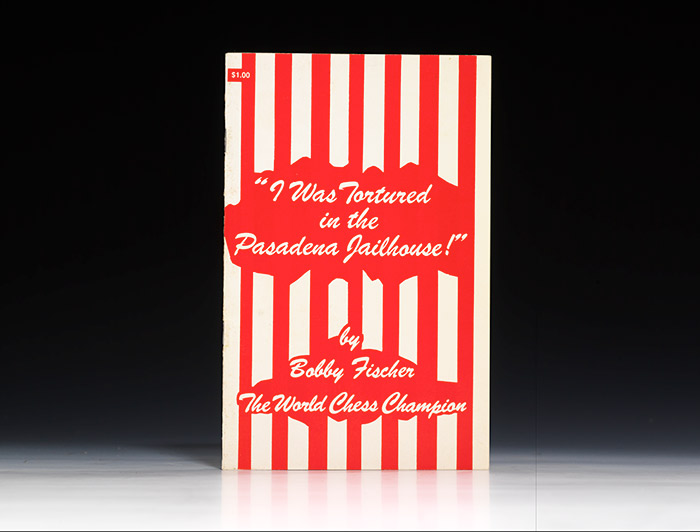
I just finished reading a pamphlet Fischer published after he was picked up by the Pasadena, California police in May 1981 and horrendously mistreated because of his “bad attitude.” He was kept without clothes in an icy cell, deprived of the right to make a phone call, robbed of the cash in his wallet, and denied sufficient food and water during his incarceration. Below is a photo of his pamphlet’s cover:
Why do I appear to be so obsessed with Bobby Fischer? The main reason is that I love chess, and Bobby was one of two American world champions—both of whom went off the rails after their moment of glory. I will post a blog about Paul Morphy (1837-1884) within the next day or so.
Also, I am appalled because this would not have happened to Fischer had he been Russian. Unless for some reason he defied the powers that be in the Soviet Union, he would have lived well with a generous pension from Mother Russia. America doesn’t always know how to treat its heroes. And Fischer was a real hero, possibly the best chess player who ever lived.
Another reason: Fischer’s birth father was NOT Hans-Gerhardt Fischer, whose name appeared on Bobby’s birth certificate, but Paul Neményi, a distinguished Hungarian mathematician whom whom his mother Regina had an affair during the war. See for yourself:
Left: Bobby Fischer, Right: Paul Neményi.
It warms my Magyar heart to know that Bobby was one of my countrymen, both as a Hungarian and as an American.
Bobby Fischer’s Grave in Laugardælir Churchyard in Iceland
He was quite possibly the greatest chess player who ever lived. In 1972, he contended against Boris Spassky for the world title, and won it handily. Even Spassky, who had to put up with a lot of shit from his minders back in the Soviet Union, applauded his victory.
Then things suddenly went bad for Bobby. He hooked up with the Church of God in Pasadena, California; decided not to defend his title against challenger Anatoly Karpov; and even spent time in jail for vagrancy in Pasadena. (He wrote a pamphlet about it which I will share with you in a future post.)
In any case, he didn’t play chess competitively any more With one exception: He played Boris Spassky again, and won again. But neither his games nor Spassky’s were judged to be up to their best. More importantly, the match in Yugoslavia was held in the Federal Republic of Yugoslavia, which was being boycotted by the United Nations (and the United States) for war crimes against the breakaway republics of Croatia, Bosnia, and Kossovo. In fact, Fischer learned that a warrant was out for his arrest.
Where to go? Fischer wound up in custody in Japan, but was saved from further embarrassment by Iceland, which granted him citizenship in appreciation for the first match against Spassky, which was held in Reykjavík.
The last years of Fischer’s life were spent in Iceland. But by this time Fischer was embittered and a prey to conspiracy theories about the United States, the Jews (ethnically, he was one on both sides of his family), the bomb, and you name it. He lost most of the friends he had gained and died sooner than he had to because he refused dialysis.
He is buried in the small hamlet of Laugardælir near Selfoss.
At the Corner of West 5th Street and South Grand in Downtown L.A.
It’s just outside the Central Library, a square (actually, just an intersection) dedicated to the Los Angeles writer John Fante (1909-1983). He is not well known outside of Los Angeles, In fact, he is not well known in Los Angeles either. Fortunately, Charles Bukowski made sure he was not forgotten:
I was a young man, starving and drinking and trying to be a writer. I did most of my reading at the downtown L.A. Public Library, and nothing that I read related to me or to the streets or to the people about me.”
Then one day I pulled a book down and opened it, and there it was. I stood for a moment, reading. Then like a man who had found gold in the city dump, I carried the book to a table. The lines rolled easily across the page, there was a flow. Each line had its own energy and was followed by another like it. The very substance of each line gave the page a form, a feeling of something carved into it. And here, at last, was a man who was not afraid of emotion. The humour and the pain were intermixed with a superb simplicity. The beginning of that book was a wild and enormous miracle to me.
This was in Bukowski’s introduction to the book he describes, John Fante’s Ask the Dust.
Having read four of Fante’s novels, I have to agree. I have just finished Dreams from Bunker Hill, the last of the novels featuring Arturo Bandini, the author’s stand-in for himself. Toward the end of his life, Fante became blind from diabetes; and he dictated the novel to his wife, Joyce.
As I find myself at the Central Library fairly often, I take some pleasure crossing John Fante square and remembering the writer who gave us an inimitable portrait of Los Angeles in his novels.
Although I hail from Cleveland, Ohio, I am not a big fan of what I and many of my friends call “The Mistake on the Lake.” There I one Clevelander I have always admired. No, not Halle Berry, though I find her incredibly beautiful. And not Paul Newman, who I admit was a talented film actor.
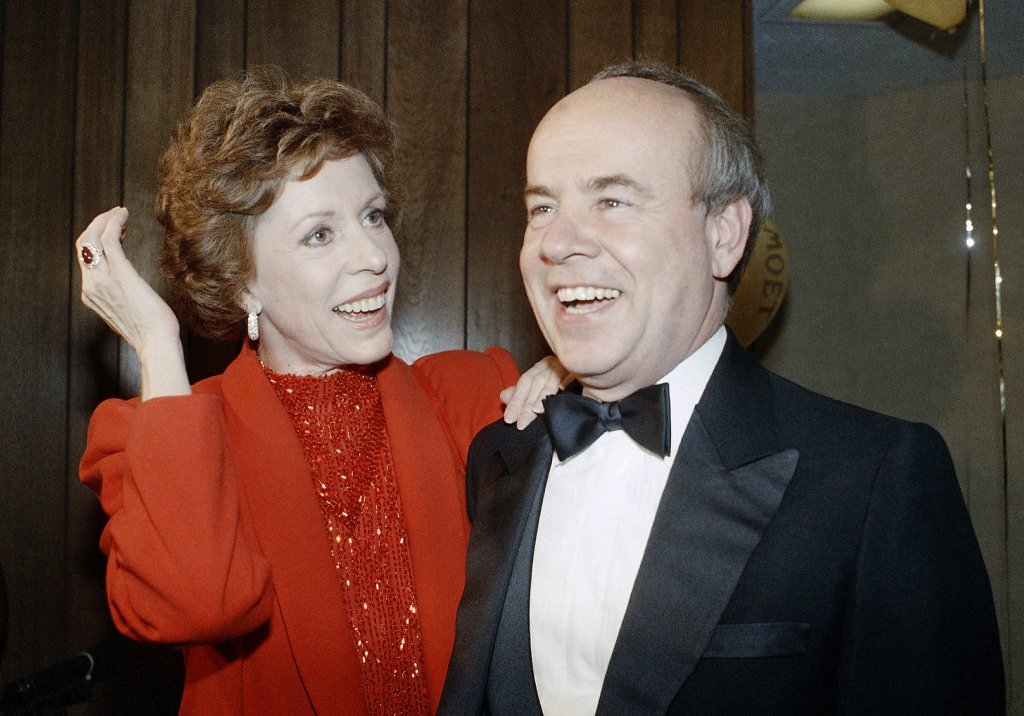
My choice is Tim Conway, who, although born eleven years earlier than me, had a childhood that curiously paralleled my own. Just as I was born to a family that spoke only Hungarian in the home, Tim spoke only Romanian. (Funny, he doesn’t look Romanian—but he was born Toma Conway to an Irish father and a Romanian mother, Sophia, who bore the Romanian equivalent to my mother’s Hungarian name, Zsófi.)
Like my mother, Sophia was born in the United States but taken to be raised in Europe. Like my Slovak father Elek, Daniel Conway adopted his wife’s language in the family circle. Thus, when Tim first attended school, he spoke mostly Romanian, just as I spoke only Magyar.
The parallels stop there. Toma had his name changed to Tim when he started in show business, as there was already a well-known British actor named Tom Conway. Whether playing in McHale’s Navy or The Carol Burnett Show, Tim Conway was one of the funniest men on television. I still watch The Carol Burnett Show on MeTV up to six times a week. Great stuff!








 Tarnmoor
You must be logged in to post a comment.