Why I Went to Iceland

The Geyser Strokkur at—Where Else?—Geysir in Iceland

The Geyser “Strokkur” at—Where Else?—Geysir in Iceland

My friend Catina Martinez wrote, “I’ve had lots of friends and family traveling to Iceland lately. I hope you’ll blog about how you chose Iceland. Sounds lovely.” Well, now that I’m back, I thought I’d start with a summary of why I went and answer Catina’s request.

I suspect my reasons will seem strange to many people, but then I am a strange person. It all started with my reading of the medieval Icelandic sagas, beginning with the Njals Saga and going on to the other four principal works: Grettir’s Saga, Laxdaela Saga, The Eyrbyggja Saga, and Egils Saga. At the time they were written in the 13th and 14th centuries, they were the best literature that was written anywhere at the time in Europe.

Now how could that be? The Icelanders were, after all, Vikings. Didn’t they wear helmets with bulls’ horns on them and inspire the other Europeans with fear? Wasn’t a standard prayer of the time “From the fury of the Norsemen, good Lord, deliver us”? And yet they also created a great literature.

Oh, and along the way, they discovered and settled America. (And also Greenland, along the way.)

Of course, their settlement didn’t last; but the Icelanders were definitely there: At L’Anse aux Meadows in Newfoundland, archeologists have discovered artifacts proving they had been there for a time.

Evidently, there’s something going on in that little island whose total population is less than that of a one-mile radius around my apartment in West Los Angeles. It is the most literate country in the world (100%), and I have heard a strange statistic that even I cannot believe: Namely, that 10% of adult Icelanders have written and published books.

At the same time, Iceland is a country of stark and eldritch beauty. Mostly volcanic in origin, some 18 volcanoes have erupted—some multiple times—since the island was settled by Norwegians late in the 8th century A.D. Some of them, especially Laki in 1783-84 were severe enough to have killed off a quarter of the population and imperiled agriculture throughout the island. The eruption of Eyjafjallajökull (bet you couldn’t say that ten times) in 2010 led to massive disruption of air navigation throughout Europe for months. And during the Middle Ages, Hekla was thought to be the gate of Hell.

The geysers at Geysir, the active volcanoes, the glaciers, the thousands of waterfalls everywhere, and the lovely green valleys of the south of the country make it a land of startling contrasts.

And so it was for me. The place takes my breath away.

In the weeks to come, I will keep coming back to these subjects, with supporting photographs I have taken during the last three weeks, such as the one above.
Off to Iceland

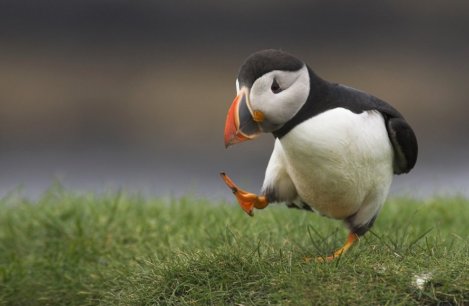
Hey, I Can’t Kick!

Hey, I Can’t Kick!

I’m off to Iceland early tomorrow morning. Because the medications I have to take with me outweigh even a fairly heavy laptop, I will not be blogging during my trip. I’ll be back around July 10.

Packing for Iceland

The Lighter You Pack, the More Fun You’ll Have

The Lighter You Pack, the More Fun You’ll Have

I always shake my head when I see travelers with multiple large suitcases per person. Not only do they pay the airlines a small fortune in fees, but they are severely hampered as to where they can go. When I land at Keflavík Airport on Thursday morning around 6:30 am, the terminal will not be full of native bearers waiting to assume my heavy loads. If I am lucky, I will be able to grab a cart to go through customs. Then I will haul my bags to the Flybus to drive me across the desolate lunar landscape of the Reykjanes Peninsula to Reykjavík BSI Bus Terminal.

There, with my luggage still in tow, I’ll sit down at the travel agency there and obtain maps and bus tickets. Then I’ll take a cab to the Guesthouse Odinn at Óðinsgata 9, where my big bag will be held until check-in time at 1 pm.

I will carry two blue bags, a big one with my clothes, medications, and toiletries, and a small shoulder bag with my electronics, guidebook, and various reservation confirmations. The blue bag is always with me, containing what I need through the day. The big bag generally stays in my room.

For a good guide to packing light, I recommend you check out OneBag.Com, especially their annotated packing lists. They quote a timely lyric from Johnny Cash: “I ain’t takin’ nothin’ that’ll slow down my travelin’ …”

Since I’m on insulin, I’ll have to take particular care packing my medications, especially my insulin, glucose testing supplies, etc. I’ll cut back severely on the nutritional supplements I’ll be taking. I’ll be eating plenty of fish, so no Omega-3. In fact I’ll just take a once a day multi-vitamin plus an antioxidant I’ve been taking for years. Oh, and I’ll be taking a letter from my doctor pointing out to all and sundry that I am a needle medications user.


The Boy Who Loved Maps

Somehow, I Had to Get Out of Cleveland...

Somehow, I Had to Get Out of Cleveland…

Ever since I learned how to speak and read English, I grew to love maps. We had an old atlas whose binding was falling apart. Whenever I had a few spare moments, I would sit down, page through it, and try to memorize the maps that interested me most. Not that I understood what I was looking at: I remember pointing to a Mercator projection map of the world and claiming that Napoleon cheated us in the Louisiana Purchase, as Alaska was so much bigger. And Greenland was gigantic! Was it not one of the world powers?

Even as a boy in Cleveland, I loved the whole idea of far places, of different cultures. In the 1950s, read such obscure books as the Rev. Harold W. Rigney’s Four Years in a Red Hell about the Catholic priest’s imprisonment in Red China, and another book, whose name I have forgotten, about Soviet concentration camps around Vorkuta. What interested me was not so much the attacks on Communism as the books’ exotic locales.

Baudelaire describes me to a tee in “Le Voyage”:

Pour l’enfant amoureux de cartes et d’estampes,
L’univers est égal à son vaste appétit.
Ah! que le monde est grand à la clarté des lampes!
Aux yeux de souvenir que le monde est petit!

Which can be translated as follows (though I prefer the French):

For a child in love with maps and engravings,
The universe is equal to his vast appetite.
Ah, how the world is great by lamplight!
Through the eyes of memory the world is small.

Here I was, simultaneously hooked on the idea of travel and, at the same time, stuck in Cleveland. We didn’t have much money to allow for travel. All I can remember are a few day trips in Ohio, a few days in lovely Detroit, Niagara Falls (but I was only five), and trips to Florida at the ages of five and fourteen. Why do you suppose I wanted to leave Cleveland to go to college? Not only was my parents’ marriage threatening to go on the rocks (it somehow held), but I felt stifled by Cleveland’s provincial ways. All those Hungarian-American homebodies!

But there was always that atlas. You know what? I’m still that way. My mind is a capacious geographic storehouse. I can sketch the outlines of many of the countries on earth and locate their capitals and major cities. And I can tell you what countries border them.

That knowledge has always stood me in good stead. When I go somewhere I have never been before, I make sure that I am prepped for it. Although my vacations only run about two or three weeks, I can s-t-r-e-t-c-h out the time so that the vacation and its preparation take half a year. I started in on Iceland in February, and it won’t be until July that I work it all out of my system.

The Delta of the Paraná

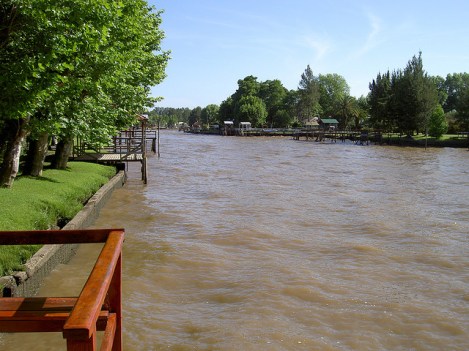
The Delta of the Paraná River near Buenos Aires

The Muddy Delta of the Paraná River near Tigre

Here I am, within a couple of weeks of lifting off for Iceland; and what is going through my mind? Other places I want to visit. I am far from finished with Argentina. Above is the delta of the muddy Paraná River near where it debouches in the Rio de la Plata near Buenos Aires. I was never able to see Bariloche because of the volcanic eruption at Cordon Caulle in Chile. And Martine did not want to visit the Iguazu Falls along the northeast border with Brazil and Paraguay (those pesky mosquitoes!) nor the old Jesuit missions in Paraguay and Misiones Province (again, the bugs).

I don’t know how many years (or months or weeks or days) are left to me—and I don’t want to know. I just know that my sense of wonder is expanding even as my time is contracting. Will my last breath be inhaled near Ulan-Ude on the Trans-Siberian Railroad or at Machu Picchu in the Peruvian Andes or by the Látrabjarg Bird Cliffs in the West Fjords of Iceland or by the ruins of Petra in Jordan or the Széchenyi Baths in Budapest or … wherever?

It doesn’t much matter to me where. I keep thinking of the words from Witter Bynner’s translation of the Tao Teh Ching by Lao Tzu:

From wonder, into wonder
Existence opens.

If I had the money, and if I were no longer committed by my lack of funds to work in accounting, I would be on the road at least half the time.

Then, and only then, I would buy a good notebook computer to take with me. (Otherwise, it’s more of an onus than a bonus to me.)

Note: Since I originally published this, I saw Robert Louis Stevenson’s poem “The Vagabond,” of which this stanza is the refrain:

Let the blow fall soon or late,
Let what will be o’er me;
Give the face of earth around
And the road before me.
Wealth I seek not, hope nor love,
Nor a friend to know me;
All I seek, the heaven above
And the road below me.


The Traveling Cripple

In 2001, I Traveled with a Cane—In Considerable Pain

In 2001, I Traveled with a Cane—In Considerable Pain

When I went to Iceland in 2001 (and yes, this will be the last you will hear about my 2001 trip), I was in considerable pain from a severe case of osteoarthritis in my left femoral head. I had hobbled around with that arthritis ever since 1967, the year after I had my brain surgery. Once my pituitary gland was removed and I started taking hormones, I began to grow again. Unfortunately, my left hip joint did not take too kindly to the changes taking place to my body.

By the year 1997 or 1998, I was using a cane. People would constantly ask me why I was standing up when there was a nearby chair. I would answer them by saying because the pain of getting up was far worse than the mere inconvenience of standing. (I can still stand still for long periods of time without discomfort)

Things got worse when I landed in Iceland in August 2001. Of course, pain or no pain, it didn’t stop me from being active. The only effect was, on the two days of touring with my guide Illugi, I had to avoid climbing a particular hill and taking a trail around lava formations near Dettifoss. Otherwise, I was still pretty game.

Pain is one of those things which I can tolerate in fairly high doses. Not that I want to, but it is usually better than the alternative. Now that Martine is in pain from fibromyalgia (or something that looks and behaves very much like fibromyalgia), I tried to explain this to her; but she wasn’t buying it. Every person has his or her own acceptable threshold of pain, and mine just happens to be higher. Is it because I have been in fairly acute physical pain ever since my childhood—first from a pituitary tumor pressing on my optic nerve, and then from osteoarthritis? Only in the last ten years or so have I been as free of pain as I was when I was ten.

The photo above shows Lake Mÿvatn from my window at the Ferðaþjónustan Bjarg. (Don’t try to pronounce this without a Icelander present … or I should say don’t try to pronounce this with an Icelander present.) Notice the tents between the guesthouse and the lake’s edge.

Many campers don’t like the Bjarg and regard the management as unfriendly. I gained points when registering for one of the two rooms in the guesthouse by asking, “Wasn’t the name of Grettir Asmundarsson’s family home in West Iceland called Bjarg?” Not only was the owner shocked that an American knew this, but I quickly found that he was a big time fan of Grettir’s Saga and named his son Illugi (my guide) after Grettir’s youngest brother.

I loved the Bjarg Guesthouse. It had only two bedrooms, but a big kitchen, where I sat eating harðfiskur with fresh Icelandic butter spread on it. There was also a nice living room which I had to myself when I stayed there.


Iceland 2001: Rainbows and Waterfalls

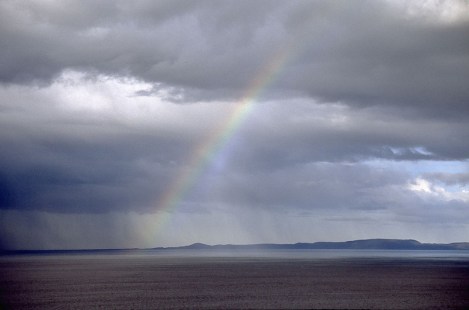
Rainbow in the North of Iceland

Rainbow in the North of Iceland

We were in the north of Iceland, somewhere between Ásbyrgi and Húsavík. By we, I mean our guide Illugi from Lake Mÿvatn, a group of European twenty-somethings, and me, hobbling around with a cane due to severe osteoarthritis. It was a gorgeous day: Bright sunlight interspersed with rain-bearing clouds. A perfect day for rainbows. It was one of those days when one is likely to behold almost more beauty than a human being can stand.

Iceland does that to me. That’s one of the reasons I am bringing up these photographs from twelve years ago. The image of a place that is at once wild and beautiful keeps coming back to me. On a long bus ride along the famous Ring Road, one sees endless waterfalls cascading down from mountains and glaciers; and the changeableness of the weather makes rainbows frequent and spectacular. Sitting here in Westwood during the endless repetition of foggy mornings and hazy sunshine in the afternoon that is typical of L.A. spring weather, I yearn for the crystalline wide open spaces.

Soon. Soon.

The Falls at Dettifoss

The Falls at Dettifoss

Earlier on the same day that I shot the rainbow above, we visited Europe’s most powerful falls at Dettifoss along the Jökulsá á Fjöllum River, one of Iceland’s largest and longest.


Iceland 2001: The Huldufólk

Those Strange Basalt Formations Could Be a Troll ... or the Home of an Elf

Those Strange Basalt Formations Could Be a Troll … or the Home of an Elf

Many Icelanders, particularly those who grew up before the island became cool, believe in the hidden folk. As a matter of fact, despite all that ice, it was once a very hot place—so hot that the residents bake rye bread by burying it in a hole only a couple of feet deep. Many places, like the original Geysir (yes, that’s how it is spelled) are so hot that a single misstep could plunge you into boiling mud.

There are numerous stories about the island’s hidden folk, or huldufólk, namely trolls, ogres, elves, mermen, and others. If you think I’m being tongue-in-cheek while writing this, allow me to refer you to a story that recently hit the news in Reykjavík.

An interest group called Hraunavinir (‘Lava Friends’) is planning to sue over the making of a new road to Álftanes from Engidalur in Garðabær, across the lava field Gálgahraun, and to a roundabout opposite Bessastaðir, the presidential residence.

Seer and piano instructor Erla Stefánsdóttir maintains that the elf boulder Ófeigskirkja will be destroyed in the process and fears that wrath of dwarves in the hidden world will cause accidents on the road, Fréttablaðið reports.

Now this is not the type of story one would encounter in the New York Times. What I found particularly interesting was that there were some serious follow-up stories, including one just a few days ago in which one resident suggested the whole problem could be eliminated by a couple of strategically-placed roundabouts.

In Reykjavík, there is even an Elfschool, which has been open for over twenty years. It is run by Magnus Skarpheðinsson, who is an expert on Iceland’s huldufólk.

When I look at that basaltic plug in the photo above, at Dimmuborgir on the shores of Lake Mývatn in Northeast Iceland, I think that it may well be a petrified troll who hung around after sunset, or the residence of elves, who venture forth from their stony fastness to confound the ways of men.

Iceland 2001: Returning to Heimaey

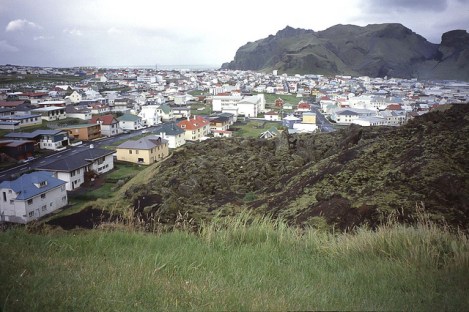
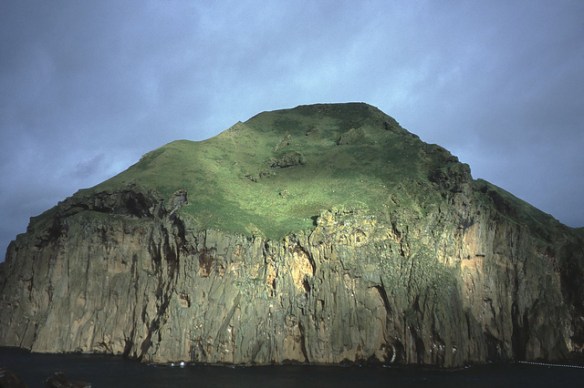
Heimaey Wrapped in an Embrace by the Volcano Eldfell

Heimaey Wrapped in an Embrace by the Volcano Eldfell

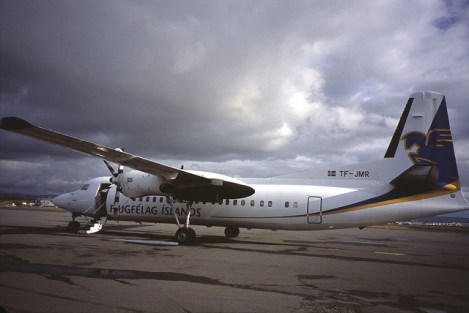
It was difficult getting to Heimaey back in 2001. I had two choices: Either I could take a gut-wrenching 3½-hour ferry ride across the stormy North Atlantic from Þorláshöfn (famous for seasickness) or I could fly there. Now there is a cheaper choice: I could take the ferry from Landeyjahöfn, which is only a 30-minute ferry ride. Back then, I took a ruinously expensive day trip by flying Flugfélag Íslands from Reykavík. Below is a picture of the prop plane I took on that occasion.

The Prop Plane to Heimaey

The Prop Plane to Heimaey

The main reason I’m going to Heimaey is the same reason I decided to go in August 2001, namely to see puffins. I was just a tad late, as I could see the white spots of puffins leaving the bird cliffs for their flight to the British Isles. Here is a picture of the puffins vacating their nests for the flight over the North Atlantic:

PuffinCliffs

The Little White Spots Are Puffins

This time I did my research and timed my visit right. There should be something like two-three million of the little birds feeding their young when I get there.

I will be staying at the Hotel Vestmannaeyjar for two nights, so I should have plenty of time to see the bird life on the island, as well as the volcano show and little natural history museum. There also used to be a fish cannery museum, but I no longer see it mentioned in the lists of sights to visit. Nonetheless, I plan to have plenty of fish, as Heimaey is the busiest fishing port in Iceland. That’s why the Icelanders were so frantic about saving the harbor in 1973 when the volcano Eldfell erupted.

Iceland 2001: Watch a Whale, Eat a Whale

The Port of Husavík in Northern Iceland

The Port of Husavík in Northern Iceland

There is a controversy still going on in Iceland between fisherman who catch whales for domestic consumption and those who run whale-watching cruises for foreign tourists who are dead set against hunting whales.

Although, in general, I am against hunting whales, I think that a small island that has depended on whale meat for over a thousand years deserves a break. Many of the old Icelandic sagas, such as Grettir’s Saga, feature family feuds that began when one family group cut up a beached whale for itself while another claimed the rights to it.

The whales that Icelanders hunt are Northern or Common Minke Whales (Balaenoptera acutorostrata), which are small and relatively common—by no means the endangered species that American, Russian, and Japanese vessels in the Pacific hunted to the point of no return.

During my 2001 to Iceland, I took a whale-watching cruise out of Husavík, along Iceland’s north coast. We only saw a couple of Minke Whales (I guess it was a bad day), but we had a good time. And the galley prepared delicious hot chocolate and sweet rolls for all the passengers.

There is also a decent-sized whaling museum in Husavík that I visited and enjoyed twelve years ago.

If you want me to translate the sign in the above picture, I believe it goes, “If you can read this, you’re too darn close.”