Sunday Morning Walk

Along Broadway in Santa Monica

Along Broadway in Santa Monica

This morning I got up early and prepared to take a walk into downtown Santa Monica. My ultimate destination was a Barnes & Noble Bookstore about three miles from where I live. It was a sunny, cool morning, with the temperature predicted to top out at 64° Fahrenheit (approximately 18° Celsius).

The stretch along Broadway between Centinela Avenue and 26th Street is particularly attractive, with lush plantings of palm trees, cacti, and other decorative flora. The photograph above is looking north on Yale Street as I headed west along Broadway.

At Barnes & Noble, I picked up a book about Iceland. I am trying hard to talk Martine into coming to Iceland with me this summer. Back in 2001, I went alone. I resolved at that time that I wanted to return with Martine: She would love the puffins, the waterfalls (seemingly thousands of them), the glaciers, and the volcanoes. It is a truly strange landscape, and a largely treeless one.

There is an Icelandic joke that runs: What do you do if you’re lost in an Icelandic forest? The answer: Stand up. Because of the strong winds, few trees are very tall. Whole forests, such as the extensive one at Asbyrgi, near Húsavik, look as if it were miniaturized.

I have my work cut out for me. Martine is still suffering from back and shoulder pains, which I am beginning to think are symptoms of fibromyalgia. On one hand, the activity would do her good (she has a tendency to be a couch potato). On the other, I cannot survive the rigors of a tax season without planning for an escape, and Iceland strikes me as a good one.

 

Travel Ain’t What It Used To Be

Cool & Luxurious—No More!

Cool & Luxurious—No More!

I was just looking at photographs of some old travel posters and thought how cool and luxurious all the posters seemed. Now one is more likely to see backpackers wearing camouflage shorts with cargo pockets and staying in hostels. What you don’t see is the pilferage that takes place in their youth hostel and the lost sleep resulting from drunken young partiers who stay up to the wee hours of the morning. Nor do you see the TSA groping your private parts to make sure you’re not carrying a Thompson submachine gun there.

Travel has become at one and the same time more proletarian (no problem with that) and more security-conscious (using procedures that are more annoying than efficacious).

Also, since the heyday of those old posters, the United States has become a whole lot less popular than it used to be. Border crossings are fraught with arcane rules and odd fees such as reciprocal entry, departure and airport taxes. When Martine and I went to Argentina in 2011, for instance, we each had to pay a reciprocal entry tax of U.S. $160.00 to match what we were charging Argentinians entering the U.S.

Of course, it is nowhere as bad as my visit to Czechoslovakia in 1977, when my parents were held at a police station in Presov-Solivar because their papers weren’t in order. (Mine were, but that’s only because I used a visa service that was up on all the regs.)

Still, there is nothing in the world like travel. Whether you plunk yourself down on some sandy beach or—like me—go all over the place taking in the sights, it is at the evry least a balm for the tired soul. At best, it is life at its most exciting, with every minute being a new opportunity for learning.


A Family Christmas

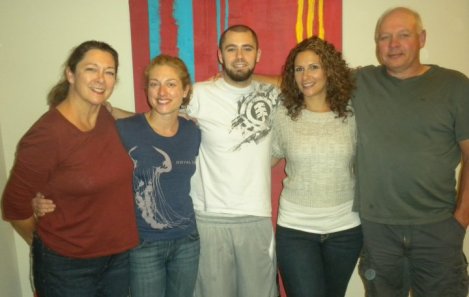
Lori, Hilary, Danny, Jennifer, and Dan

Lori, Hilary, Danny, Jennifer, and Dan

I just returned from Palm Springs about an hour or two ago after spending one of the best Christmases in my adult life. My brother and sister-in-law rented a house in PS’s “Movie Colony” neighborhood.

Present were Dan and Lori, my brother and sister-in-law; Hilary, just returned from Guatemala by way of her home in Seattle; Danny, from L.A.’s South Bay; Jennifer, from San Diego; and Martine and me from West Los Angeles.

As you know, I tend to be something of a Grinch; but the events of the last five days have melted the residual ice that encased my heart. It was great fun talking with my nephew and nieces, and spending the days touring the Coachella Valley with Martine while the kids were involved in hiking, swimming in hot pools, and such like.

Martine and I got to visit the Living Desert Zoo and Botanical Gardens in Palm Desert, which we’ve seen two or three times before; the Palm Springs Air Museum, a labor of love by WW2 veterans; the Oasis Date Gardens in Thermal, California; and the Shields Date Gardens in Indio, California. (Yes, I guess I really do enjoy eating dates.)

In the days to come, I will post blogs about the first two places above, which I think are world-class tourist destinations. And I will try to write something about the Coachella Valley’s date palms.

In the meantime, I hope all of you had a Merry Christmas!


Bucket List

The Inca Ruins at Machu Picchi

The Inca Ruins at Machu Picchu

Every once in a while, I take stock of places I would like to visit, despite the fact that the amount of time I have remaining looks ever more finite. What is particularly difficult for me is that Martine is afraid of going to most of the places on my bucket list, whether for reasons of health (mosquitoes, altitude sickness) or because of socio/political prejudices (Russia, Turkey).

In random order, here are ten places I would give my eye teeth to visit:

  1. The Inca ruins at Machu Picchu in Peru, plus several of the archeological sites near Cuzco.
  2. The Trans-Siberian Railroad from Moscow (if I had the time and money, from London) to Vladivostok.
  3. Visiting Greek ruins in Turkey, Italy, and—oh, yes—Greece.
  4. Pompeii and Herculaneum, for a look at an ancient world buried by a volcanic eruption.
  5. When I went in 2001, I didn’t get a chance to see enough of Iceland, so I want more. And maybe I can add Greenland and the Faeroe Islands as well.
  6. The Shetlands and Outer Hebrides of Scotland.
  7. Argentina’s Iguazu Falls.
  8. A cruise on the Danube to see the lands of my forefathers.
  9. Mauritius and Réunion in the Indian Ocean because, well, I had to pick at least one tropical location.
  10. Chilean Patagonia, because Martine and I traveled through the Argentinean portions and loved them.

That’s a fairly long list, and I wonder how much of it I can get to. The biggest limiting factor, of course, is money. The type of travel I like is not cheap, even though I eschew luxury accommodations and five-star meals.


About That Glacier

Perito Moreno Glacier in Argentina

I have been asked by friends about that glacier shown atop my blog page. It is the Perito Moreno Glacier in the State of Santa Cruz in Argentina. Last year at this time, Martine and I were there on our vacation. In a country full of natural beauty, Perito Moreno is one of the top attractions. It is near the city of El Calafate, from where one can take bus tours that allow one to view the glacier from a number of viewpoints, including from a boat that travels close to its edge.

The man after whom the glacier is named was a 19th century Argentinean naturalist who was the South American equivalent of John Muir. Francisco Pascasio Moreno (nicknamed Perito, or “expert”) was born in Buenos Aires in 1852 and died in 1919. He was largely responsible for the creation of several Patagonian national parks and is memorialized in the La Plata Museum of Natural History.

One of the interesting facts about the Perito Moreno Glacier, other than its massive size, is that it is one of three Andean glaciers that are still growing in size—at a time when glaciers all over the world are retreating or even disappearing. The lake that the glacier melt drains into is Lago Argentino, which is flanked on its western boundary by a number of glaciers, including the massive Upsala and the Spegazzini glaciers.

I will change the image up top eventually, but Martine and I have happy memories of our Argentina trip, and I wanted to be reminded of it every time I looked at Tarnmoor.Com.

Watering the Forests of the Northeast

Forest in Maine

To return for a moment to my recent vacation, one thing I forgot to tell you was that I had forgotten to pack one of my diabetes medications, namely the Metformin HCL. One result was that, even taking insulin, my glucose reading was running rather high (in the 300s). Apparently, when that happens, I have to urinate frequently, about every thirty to forty-five minutes.

While Martine was driving toward the end of our vacation, I felt as if I had to stop by every other tree in the forests of New Brunswick and Maine to water it. That got particularly difficult when there was a chain-link fence separating me from the trees, making it difficult to disguise my actions from other motorists.

That last day from Bar Harbor, Maine, to Manchester, New Hampshire, was definitely the worst. Not only did I have to have Martine stop the car ten to twenty times, but there was a driving rainstorm once we passed Augusta.

Somehow I survived. As soon as we returned to Los Angeles, I started on the Metformin at once. Within a few days, the readings had declined to an acceptable level; and I no longer had to evaluate the cover possibilities of nearby trees.

I can tell you, I left a part of myself in the Northeast,

The Paradise of Apples

Loaded Branch at Green Mountain Orchard

One of the best things about travel is discovering (or, in our case, re-discovering) some great foods. Although we like the apples from Oak Glen, where we journeyed yesterday, nothing can compare with the tanginess of apples and apple cider from Vermont and New Hampshire. There is something about the granitic soil that does something rich and strange to the flavor. And when you make cider from them—without killing the flavor by pasteurizing—the result is one of the most refreshing drinks on the planet.

The first couple of days of our vacation in September were spent in Vermont. After a brief stop at the Vermont Country Store in Rockingham, we drove to nearby Putney, where Green Mountain Orchard is located. We had heard they sold unpasteurized apple cider, and it was true. Between the two of us, we guzzled a whole quart of the stuff and then spent an hour just driving around the property and seeing their trees (such as the one above) as well as their stands of raspberry and blueberry bushes.

When we crossed over the border into Canada, we hoped to be able to find equivalent quality. We bought a bag from a farm stand just west of Fredericton, New Brunswick, but it wasn’t the same thing. The terrain had changed to fertile flatlands, which are good for most crops, but which result in so-so fruit.

I remember buying apple cider by the gallon from Tanzi’s Grocery (now long gone) in Hanover, New Hampshire, when I was a student at Dartmouth. Because at the time we had no access to refrigerators, the students would hang the gallon jugs by the eyelet from their dorm room windows. Most did this to ferment it into hard cider. I just wanted to drink good, cold cider. (Naturally, it was unpasteurized.)

Northern New England will forever go down in my memory for its apples, its Maine lobster, and a delicious preparation of young cod, haddock, or whitefish called scrod that Martine and I ate in Boston back in 2005.


Tories or Loyalists?

Loyalist Reenactors at Kings Landing, New Brunswick

Back in the days before the Cretaceous Extinction, when I was in high school learning the history of the American Revolution, we heard a lot of nasty things about the so-called Tories. These were American colonists who would have no part of the Revolution and who wanted to remain loyal to King George III.

We did not treat these Americans particularly well. We destroyed their property, threatened their lives, and keyed their carriages. The result was that many, if not most, of them fled to Canada or back to Britain.

When one is in Canada, there is an entirely different point of view. The Tories here are called Loyalists. And the United States is seen, particularly from the point of view of the 18th and 19th centuries, as the enemy. After all, we sent Benedict Arnold to invade Canada during the Revolution; but he failed, as he himself was conflicted over his loyalties. Then, during the War of 1812, we invaded twice and were beaten back twice.

In New Brunswick, one of Canada’s Maritime Provinces, there is an open-air park near Fredericton called Kings Landing Historical Settlement, which honors the Loyalist settlers. When the Saint John River was dammed near Fredericton, many old 19th century buildings were moved to Kings Landing and re-assembled as an outstanding museum, complete with costumed reenactors in the houses and shops who were able to explain the details of farming, cooking, printing, milling grains, sawmills, furniture manufacture, and other typical activities of the time.

Martine and I spent a whole day here, from opening time to closing. We even had an excellent lunch at the King’s Head Inn. I don’t suppose we were disloyal Americans for sympathizing with these Tories who, after all, were for the most part decent people who contributed greatly to Canada’s growth in the early days after the English occupied the country after the French and Indian War (1754-1763).

In general, it was interesting during our vacation to see so many of the populations that make up Eastern Canada, from the Loyalists to the French Canadians of Quebec to the Acadians of the Maritime Provinces (who are very distinct from the Quebecers) to the so-called First Nations tribes.

We Americans joke about the Canadians lacking a national identity. We did not find that to be so. It’s just that most Americans don’t bother to see for themselves, or else they just won’t open their eyes.


Time and Tide

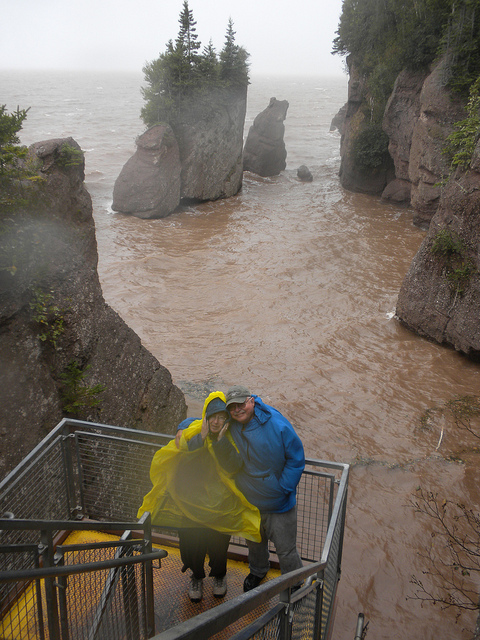
Hopewell Rocks at High Tide, September 19, 2:45 pm

I had always wanted to see the famous high and low tides in Canada’s Bay of Fundy, though I doubted I could do this without some guidance. So Martine and I took the Hopewell Rocks and Bay of Fundy Coastal Tour offered by Roads to Sea of Moncton, New Brunswick. About ten of us crowded into a minibus with Anna-Marie Weir, our capable guide.

We started by going to Hopewell Rocks at low tide, around 8:45 am. We learned that we had by accident picked a day when the difference between high and low tide would be 45.3 feet (13.8 meters). Afterwards, we saw several other sites affected by the tides, including the Harvey Shipyard, the Alma Lookout, the boats in the harbor at Alma, and Cape Enrage. The first three of the above, we saw twice, at intervals that graphically illustrated the striking difference made by the tides.

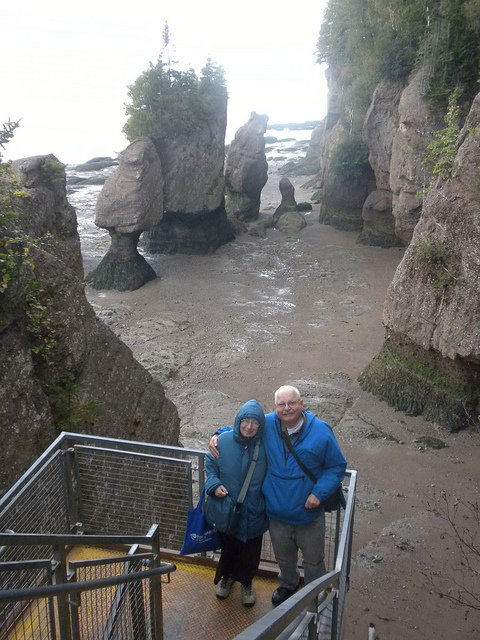
Below is the same location as the above photo in the early morning at low tide:

Hopewell Rocks at Low Tide Earlier the Same Day

We were able to walk among the rocks and take pictures . One can see by the markings along the bottom of the rocks how high the tide normally comes.

That Wednesday we took the tour started with the threat of rain, which, by early afternoon, became a reality—as you can see in the first photo above. Irrespective of the weather, we enjoyed the tour to such an extent that it was one of the highlights of our recent vacation.

Below is a photo of the personable Anna-Maria Weir and the minibus we rode on the tour:

Anna-Marie Weir of Roads to Sea

Martine and I had been in other areas with substantial tidal variation, especially when we visited Normandie in France about fourteen years ago. The high tide at Mont St-Michel reputedly would come in so fast that author Victor Hugo compared it to the speed of a galloping horse. Alas, we never were able to time our visit to see the variation with our own eyes.

Later in the trip, we even crossed the Bay of Fundy in a roll-on roll-off ferry that runs between Digby, Nova Scotia, and St. John, New Brunswick. It was interesting that the ferry docked at both coasts by a steel bridge that moved up and down with the tide. Ours was a surprisingly smooth crossing over its three-hour length. We were even able to eat a delicious supper with the famous Digby scallops, which are particularly huge and succulent.


FDR’s Canadian “Cottage”

FDR’s Summer Home on Campobello Island

During his youth, Franklin Delano Roosevelt spent many of his summers on Campobello Island in the Province of New Brunswick, just a few hundred feet from the Easternmost Point in the United States at Lubec, Maine. Since the 1960s, there is a bridge that connects Lubec with Campobello. But back when FDR stayed here, it was approachable with difficulty, by a combination of trains and ferries.

In 1921, FDR discovered during a visit to the island that he had a paralytic illness, which was later diagnosed as polio. That was a watershed in the ambitious young man’s life: From being an active outdoorsman who loved sailing the waters of Passamaquoddy Bay and the Bay of Fundy, he found himself increasingly a cripple. From that point on, he didn’t have it in him to spend much time time at Campobello.

That was not the case for his wife, Eleanor, who continued to visit the island—especially after her husband died in 1945. One of the highlights of a trip to the massive “cottage” at Campobello is a daily event known as “Tea with Eleanor.” For twenty lucky guests, tea and cookies are served in an adjoining cottage; and the knowledgeable waitstaff tell stories about Eleanor, who is much loved by the local people.

Campobello Island is a strange little island. To buy gasoline or perform many other services, the residents must cross the border into Lubec. There are two restaurants on the island and, I believe, only a couple of places where tourists can spend the night. The cottage is surrounded by a large park and criss-crossing hiking trails, where once there were other resorts for wealthy tourists around the turn of the century.

Lubec and Campobello are about two hours east of Acadia National Park and the resort at Bar Harbor.