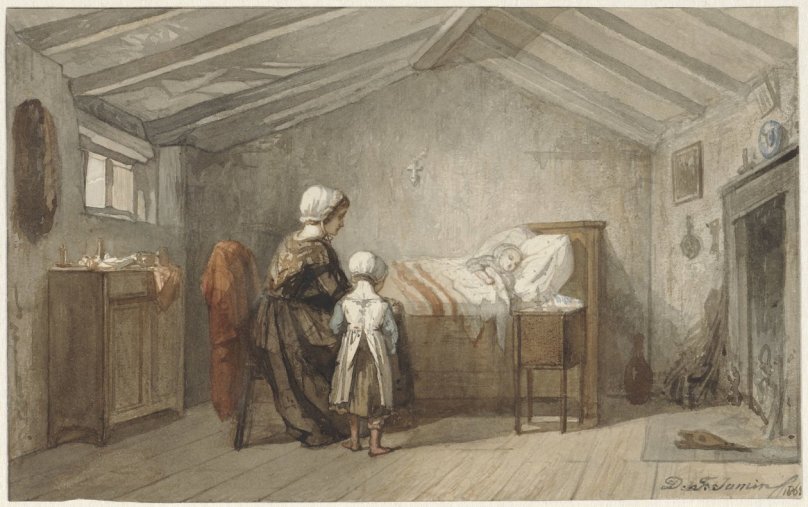
Mother and Daughter by the Sickbed of a Child by Diederik Franciscus Jamin
The above sketch from Amsterdam’s Rijks Museum pretty much describes how I spent most of this week. Something I ate on Tuesday violently disagreed with me, so in addition to the usual messy food poisoning symptoms, I was totally prostrated. Picture Martine at my side feeding me endless glasses of water to avoid dehydration along with hydrocortisone to make up for my body’s inability to produce adrenaline. Without the hydrocortisone, I was likely to die.
To avoid concentrating on the messy details, I would like to present a poem by Robert Louis Stevenson I remember from when I was a boy of ten sleeping in my parents’ bed while I was sick and they were at work. Half the time, my great-grandmother was around to feed me. It presents a very vivid picture of illness seen from the point of view of a child.
The Land of Counterpane
When I was sick and lay a-bed, I had two pillows at my head, And all my toys beside me lay, To keep me happy all the day.
And sometimes for an hour or so I watched my leaden soldiers go, With different uniforms and drills, Among the bed-clothes, through the hills;
And sometimes sent my ships in fleets All up and down among the sheets; Or brought my trees and houses out, And planted cities all about.
I was the giant great and still That sits upon the pillow-hill, And sees before him, dale and plain, The pleasant land of counterpane.
Every time I read a poem by Walt Whitman (1819-1892), I kick myself for not being more familiar with his work. Therefore I resolve to read his collection Leaves of Grass in the coming year. The following short poem is one of my favorites:
A Noiseless Patient Spider
A noiseless patient spider, I mark’d where on a little promontory it stood isolated, Mark’d how to explore the vacant, vast surrounding, It launched forth filament, filament, filament, out of itself. Ever unreeling them, ever tirelessly speeding them.
And you O my soul where you stand, Surrounded, detatched, in measureless oceans of space, Ceaselessly musing, venturing, throwing, seeking the spheres to connect them. Till the bridge you will need be form’d, till the ductile anchor hold, Till the gossamer thread you fling catch somewhere, O my soul.
In his novel Dombey and Son (1848), Charles Dickens had a striking passage about the effect that railroad construction was having on parts of London. I remember this passage vividly from when I first read the book decades ago.
The first shock of a great earthquake had, just at that period, rent the whole neighbourhood to its centre. Traces of its course were visible on every side. Houses were knocked down; streets broken through and stopped; deep pits and trenches dug in the ground; enormous heaps of earth and clay thrown up; buildings that were undermined and shaking, propped by great beams of wood. Here, a chaos of carts, overthrown and jumbled together, lay topsy-turvy at the bottom of a steep unnatural hill; there, confused treasures of iron soaked and rusted in something that had accidentally become a pond. Everywhere were bridges that led nowhere; thoroughfares that were wholly impassable; Babel towers of chimneys, wanting half their height; temporary wooden houses and enclosures, in the most unlikely situations; carcases of ragged tenements, and fragments of unfinished walls and arches, and piles of scaffolding, and wildernesses of bricks, and giant forms of cranes, and tripods straddling above nothing. There were a hundred thousand shapes and substances of incompleteness, wildly mingled out of their places, upside down, burrowing in the earth, aspiring in the air, mouldering in the water, and unintelligible as any dream. Hot springs and fiery eruptions, the usual attendants upon earthquakes, lent their contributions of confusion to the scene. Boiling water hissed and heaved within dilapidated walls; whence, also, the glare and roar of flames came issuing forth; and mounds of ashes blocked up rights of way, and wholly changed the law and custom of the neighbourhood.
In short, the yet unfinished and unopened Railroad was in progress; and, from the very core of all this dire disorder, trailed smoothly away, upon its mighty course of civilisation and improvement.
But as yet, the neighbourhood was shy to own the Railroad. One or two bold speculators had projected streets; and one had built a little, but had stopped among the mud and ashes to consider farther of it. A bran-new Tavern, redolent of fresh mortar and size, and fronting nothing at all, had taken for its sign The Railway Arms; but that might be rash enterprise—and then it hoped to sell drink to the workmen. So, the Excavators’ House of Call had sprung up from a beer-shop; and the old-established Ham and Beef Shop had become the Railway Eating House, with a roast leg of pork daily, through interested motives of a similar immediate and popular description. Lodging-house keepers were favourable in like manner; and for the like reasons were not to be trusted. The general belief was very slow. There were frowzy fields, and cow-houses, and dunghills, and dustheaps, and ditches, and gardens, and summer-houses, and carpet-beating grounds, at the very door of the Railway. Little tumuli of oyster shells in the oyster season, and of lobster shells in the lobster season, and of broken crockery and faded cabbage leaves in all seasons, encroached upon its high places. Posts, and rails, and old cautions to trespassers, and backs of mean houses, and patches of wretched vegetation, stared it out of countenance. Nothing was the better for it, or thought of being so. If the miserable waste ground lying near it could have laughed, it would have laughed it to scorn, like many of the miserable neighbours.
Last night, Martine and I had dinner at a restaurant in Glendale that we have loved for twenty-five years. As soon as we walked in, we noticed some ominous signs. The waitstaff were all young, they were wearing bright new T-shirts imprinted with the name of the restaurant, and there was a brand new illuminated sign. Most seriously, the old owner was not there.
For the first time ever, both Martine and I left the restaurant feeling slightly ill. I almost didn’t make it back to my parked car. And it was lucky that there was a large Mobil gas station at the corner of Brand and Chevy Chase in Glendale, where I was able to dispose of some of the intestinal irritants.
Mind you, I can understand why restaurants are dropping like flies. It is no fun to own or work at a restaurant, especially after the Covid-19 lockdowns. And increasingly, there is more microwaving than cooking taking place in the kitchen—by people who don’t know much about food safety.
Not only in restaurants, but across the board the quality of the American meal has declined precipitously. Even supermarkets are moving away from serving customers who do their own cooking. Recently, I have had problems finding basic food items such as barley or peanut oil. What there is no lack of are frozen meals that taste like cardboard and various “helper” mixes for people afraid to make anything from scratch.
Increasingly, the foods that people eat at home or in restaurants are deficient in nutrition and flavor.
One thing that particularly bothers me is the disappearance of ethnic restaurants as the next generation takes charge. When I first came to Los Angeles, there were loads of great Italian, French, Hungarian, Greek, and other ethnic restaurants. And there were even good cheeseburgers that didn’t look like a 300-pound guy named Rufus sat on them.
I had never read any of Sherman Alexie’s poems before, Wedged in between the short stories in his collection War Games were a number of poems, the most interesting of which is this one at the start of the book:
The Limited
I saw a man swerve his car And try to hit a stray dog, But the quick mutt dodged Between two parked cars
And made his escape. God, I thought, did I just see What I think I saw? At the next red light,
I pulled up beside the man And stared hard at him. He knew that’d I seen His murder attempt,
But he didn’t care. He smiled and yelled loud Enough for me to hear him Through our closed windows:
“Don’t give me that face Unless you’re going to do Something about it. Come on tough guy,
What are you going to do?” I didn’t do anything I turned right on the green He turned left against traffic.
I don’t know what happened To that man or the dog, But I drove home And wrote this poem.
Why do poets think They can change the world? The only life I can save Is my own.
Hendrick ter Brugghen’s Esau Selling His Birthright (1627)
The original text comes from the Old Testament, namely Genesis 25:29-34. The quote is from the New King James Version:
Now Jacob cooked a stew; and Esau came in from the field, and he was weary. And Esau said to Jacob, “Please feed me with that same red stew, for I am weary.” Therefore his name was called Edom [Red]. But Jacob said, “Sell me your birthright as of this day.” And Esau said, “Look. I am about to die; so what is this birthright to me?” Then Jacob said, “Swear to me as of this day.” So he swore to him, and sold his birthright to Jacob. And Jacob gave Esau bread and stew of lentils, then he ate and drank, arose, and went his way. Thus Esau despised his birthright.
I cannot help but think that we Americans are Esau. We were once fairly happy and somewhat more united. Then came the Depression. Then World War Two. We were briefly on top of the world, except that somewhere along the line, we had sold our birthright.
Who is Jacob in this story? Actually, there is no Jacob to whom we sold our birthright. We just dribbled it away, then ate, drank, arose, and went our way, like Esau in the Bible story.
We are not a happy people. Look at our violent movies, our angry music, our wannabe warrior tattoos and facial hair. We had freedom, and still have a lot more than most peoples. But we are fearful and growing stupid with our fear.
We regard it as almost normal that a mentally disturbed person will collect guns to shoot up children at a school or worshipers in a church or—what the hell—random people gathered together for whatever purpose.
Oh what a great fall there was when we sold our birthright. Did we enjoy our pottage? If anything, we enjoyed too much pottage; but for how long can we continue to do so?
When I was a student at Dartmouth, I taught myself how to use the new Basic programming language on the college’s General Electric computer. That was at some time in the mid 1960s. Little did I know that much of my post-graduate life would be involved with computers.
In March 1968, I was hired for the Lexicography & Discourse project at System Development Corporation in Santa Monica. My job involved proofreading and correcting the transcriptions of two Merriam-Webster dictionaries. The project was funded by the Advanced Research Projects Agency (ARPA) of the U. S. Air Force. That was the same agency which created the forerunner of the Internet, which was created to communicate with other computer nodes spread across the country even if several U. S. cities were destroyed by nuclear bombs.
The technology of the late 1960s was clunky, but it enabled us to land on the moon in 1969!
I went on to become a computer programmer and informational technology (IT) specialist for two accounting firms. During that time I saw technology change from a kind of intellectual priesthood into a pursuit for the masses. Everybody wanted in.
It all started with the Apple Macintosh, which supposedly made computing accessible to everyone. Then, the Internet was for everybody, via Prodigy and America Online. Kids were playing computer games.
A major hurdle was passed when touch-screen interfaces were invented. You didn’t need to remember commands with their complicated parameters: You simply pointed, and, if you were lucky, your choice was registered and acted upon. Of course, this went hand in hand with poor language skills. Who needed spelling and grammar when all you had to do was point at the options you wanted.
On one hand, there were many advantages to this; but techno continued to evolve with cryptocurrencies and artificial intelligence (AI). Money was now worth what you wanted it to be worth. And, with AI, you didn’t have to think any more. These are ominous developments. If technology continues to evolve along these lines, I expect no good to come of it.
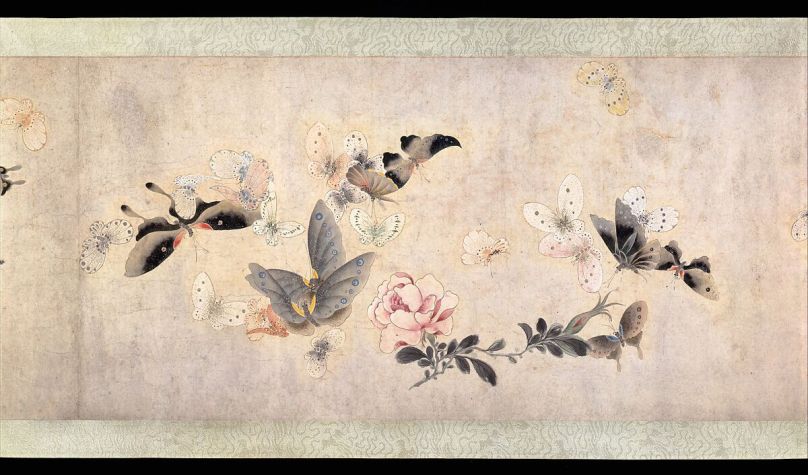
The two greatest poets of T’ang China were Tu Fu (712-770 CE) and Li Po (701-762 CE). The following poem by Li Po is one of the most profound he ever wrote. The Chuang Tzu (4th century BCE) referred to was the Taoist philosopher and follower of Lao Tzu. Forget all this detail: The following poem speaks for itself.
Chuang Tzu and the Butterfly
Chuang Tzu in dream became a butterfly, And the butterfly became Chuang Tzu at waking. Which was the real—the butterfly or the man ? Who can tell the end of the endless changes of things? The water that flows into the depth of the distant sea Returns anon to the shallows of a transparent stream. The man, raising melons outside the green gate of the city, Was once the Prince of the East Hill. So must rank and riches vanish. You know it, still you toil and toil,—what for?





 Tarnmoor
You must be logged in to post a comment.