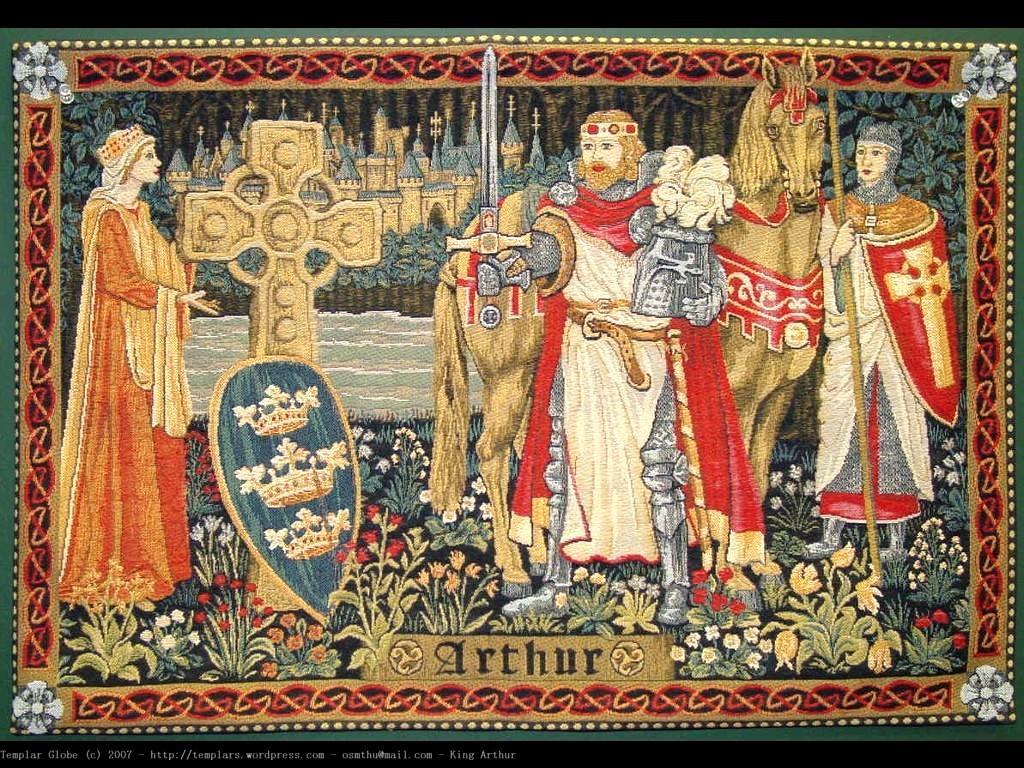
Arthur’s Knights

Tapestry Showing Arthur and Guinevere

I am currently reading Chrétien de Troyes’s Arthurian tale Eric and Enide. I fell in love with this picturesque list of the Knights of the Round Table as detailed by this 12th century French author:

Before all the excellent knights, Gawain ought to be named the first, and second Erec the son of Lac, and third Lancelot of the Lake. Gornemant of Gohort was fourth, and the fifth was the Handsome Coward. The sixth was the Ugly Brave, the seventh Meliant of Liz, the eighth Mauduit the Wise, and the ninth Dodinel the Wild. Let Gandelu be named the tenth, for he was a goodly man. The others I shall mention without order, because the numbers bother me. Eslit was there with Briien, and Yvain the son of Uriien. And Yvain of Loenel was there, as well as Yvain the Adulterer. Beside Yvain of Cavaliot was Garravain of Estrangot. After the Knight with the Horn was the Youth with the Golden Ring. And Tristan who never laughed sat beside Bliobleheris, and beside Brun of Piciez was his brother Gru the Sullen. The Armourer sat next, who preferred war to peace. Next sat Karadues the Shortarmed, a knight of good cheer; and Caveron of Robendic, and the son of King Quenedic and the Youth of Quintareus and Yder of the Dolorous Mount. Gaheriet and Kay of Estraus, Amauguin and Gales the Bald, Grain, Gornevain, and Carabes, and Tor the son of King Aras, Girflet the son of Do, and Taulas, who never wearied of arms: and a young man of great merit, Loholt the son of King Arthur, and Sagremor the Impetuous, who should not be forgotten, nor Bedoiier the Master of the Horse, who was skilled at chess and trictrac, nor Bravain, nor King Lot, nor Galegantin of Wales, nor Gronosis, versed in evil, who was son of Kay the Seneschal, nor Labigodes the Courteous, nor Count Cadorcaniois, nor Letron of Prepelesant, whose manners were so excellent, nor Breon the son of Canodan, nor the Count of Honolan who had such a head of fine fair hair; he it was who received the King’s horn in an evil day; he never had any care for truth.

Szomorú

I Would Always Add the Word Szamár, Donkey in Hungarian

Time for you to learn a little Hungarian. This post is about what I was like as a little boy. I was never considered to be a smiling, happy-go-lucky kid. I would describe myself with the Hungarian word szomorú, which, according to my Órszagh Magyar dictionary meant “sad, woeful, sorrowful, doleful, melancholy, gloomy …”—you get the picture. Then, to cap it off, I would follow it with the word szamár, meaning donkey or ass. Szomorú szamár. (In Hungarian, the “sz” diphthong is pronounced like an English sibilant “s.”) I could summarize it better with the character Eeyore in the Winnie the Pu stories by A.A. Milne. But then, I didn’t know about Eeyore until decades later.

Before you start thinking this sounds unrelievedly grim, there was another size to me as well, one in which I was considerably happier—but only in private. When I was enjoying a book, or drawing imaginary maps, or playing with my friends, I was a different person. It was only among adults and people who were not close to me that I was a melancholy ass.

You see, I was always the shortest and youngest-looking kid in class, and the most unathletic. That hurts when you are the son and nephew of the terrible Paris twins, semi-professional soccer players in Europe and America. Even when I was a senior at Dartmouth College, I was picked on by the local high school kids who thought I was one of them. By then I had my pituitary tumor that accounted for my slow or even non-, growth.

At St. Henry Elementary School in Cleveland, we had to attend daily Mass. You’ll never believe what I prayed for: In place of happiness, I requested wisdom. Well, I never got either, really, so it was a bit of a wasted effort.

I am no longer a melancholy ass, though my friends will probably admit I can be an ass at times. But that doesn’t bother me unduly.

Pointing North

Icebergs Off West Coast of Greenland

Today was a strange day. Around 5 PM, there was a sharp (Richter 3.4) but brief temblor centered in El Segundo. It seems that our part of Southern California is continuing its inexorable millenias-long journey northward. As an odd punctuation to the quake, I noticed two large military helicopters at low altitude heading toward the ocean minutes later.

But my main Northern contribution today was completing Chauncey C. Loomis’s Weird and Tragic Shores: The Story of Charles Francis Hall, Explorer. Chauncey was my favorite English professor at Dartmouth. He, without a doubt, the coolest member of that distinguished faculty. What I did not know at the time was that he was such an adventurous traveler. His bailiwick went far beyond the Eighteenth Century English Novel, to places like Peru and the Arctic.

Chauncey C. Loomis (1930-2009)

Why, despite my admiration for the man, did I wait more than twenty years to seek out and read his book? I knew Chauncey when he was in his thirties (long before the above photo), a young English prof sitting in his office with a hunting dog curcled around his feet. Terminally cool!

I love the conclusion to his book after he discovered that the body of Arctic Explorer Charles Francis Hall was poisoned with arsenic:

Anyway, I didn’t write the book as a murder mystery. In fact, the idea of going to northern Greenland and performing an autopsy occurred to me only late in my research, after I read the transcript of the [Naval] Board of Inquiry’s interrogations. What first had my interest was the Arctic itself (the actual Arctic and the Arctic in the nineteenth-century imagination), the whole saga of nineteenth-century Arctic exploration, and Hall as a characteristic nineteenth-century American of a particular type. The book was intended to be more of a period piece than a murder mystery. Mostly it was meant to be a study of the Arctic conceived as a “challenge” by nineteenth-century western man, a challenge that aroused both the noble and the reprehensible in him: pety and pugnacity, visionary idealism and gross ambition, genuine heroism and macho posturing, self-sacrifice and self-aggrandizement…. I cannot make up my own mind as to whether these nineteenth-century explorers, including Hall, was heroes or fools. My waffling, I suspect, indicates humankind’s general ambivalence about heroism; we yearn for heroes, but we mock them when we have them, and then, having mocked them, we yearn for them again. We know that our world is complex, but heroes often at least seem outwardly simple: they cut through the Gordian knot of complexity with apparent abandon.

Waiting for the Train: A Dream

Combination Bus/Self-Propelled Railroad Car in Alausi, Ecuador

Last night I had a vivid but inconclusive dream, which I would like to summarize here. I was waiting in a suburban area for a train to pick me up. There were two tracks, for trains going in either direction. I was uncertain that the train to Sacramento would stop for me, as I was not sure where I was standing was a station. I was thinking that I should have caught the train in downtown Los Angeles, where it originated.

So, with several other people who were in the same situation, I walked southward through a railroad tunnel to what I hoped was a legitimate station. I noticed that, inside the tunnel, the two tracks had merged into one, and that there were only a few widely scattered indentations in the wall of the tunnel to avoid being crushed by any oncoming trains. I noticed that the walls of the tunnel were covered by what looked like tall pieces of perfectly straight bamboo.

Fortunately, no trains came while we were in the tunnel. On emerging, I noticed an area of large broken stones, like an abandoned quarry in which many others were waiting for trains. I was told this was the station for Newhall. (Actually, in real life, Newhall has a rather nice and very proper station.)

Suddenly, several adults were marshaling high school students, who were looped around with a large chain to keep them together. With equal suddenness, a number of self-propelled railroad cars painted yellow/orange and shaped like school buses showed up to take them to their destinations.

I continued to wait, but was cheered when tickets were being collected and shoved through slots cut into a large rock; and there were signs that my train was approaching.

Did the train stop for me? Did I board it? I’ll never know, because I woke up noticing that I had forgotten to set the alarm to wake me at 7:30 AM.

Geldingadalir

The Volcanic Eruption at Geldingadalir, Iceland

When one takes an international flight to Iceland, one usually lands at Keflavík Airport on the Reykjanes Peninsula. From there, it is a From there it is 30 miles (50 km) to Reykjavík. Those 30 miles contain some of the most desolate volcanic badlands that I have ever seen. It is south of that road, on the way to Grindavík that a fissure in the earth started belching out lava on March 19, 2021. It is still going strong, and it looks like it will destroy the road to Grindavík, forcing the locals to take a more roundabout route to the capital.

The area of the eruption is part of the Krýsuvík-Trölladyngja volcanic system on the Reykjanes Peninsula, a scene of active rifting between two major tectonic plates: the Eurasian and North American. The boundary between these two plates cuts north/south right through the west of Iceland. This is the first eruption on the Peninsula in over 800 years. You can read about the eruption at Hit Iceland and Wikipedia.

The Desolate Reykjanes Peninsula Terrain Seen from the Airport Bus to Reykjavík

I took the above picture from my bus to Reykjavík in June 2013. It amazed me on both my trips to Iceland that the road to the capital was so desolate, so uninhabited, for so many miles. At places, one could see geyser activity marked with little steam clouds. I can only speculate that the Icelanders knew this place was going to blow at some point, so they decided to stay away in droves.

Now, of course, tourists are flocking to the scene of the eruption, but they are warned that things can get ugly fast. In 1783, there was a major eruption along a 27 km fissure called Laki, killing some 9,000 Icelanders with the lava and poison gases associated with the event. You can read about it on the Scientific American website.

No one knows how long the eruption at Geldingadalir will continue, and how much the Peninsula will change as the result of the massive amounts of lava being pumped out.

Automotive Heraldry

There Is Something Classy About the Logos of British Sports Cars

As Martine and I attended a British car show at the Automobile Driving Museum in El Segundo, I became acutely conscious of the snazzy sports car logos—far more sophisticated than most American and Japanese equivalents. Here are just a few of the hood ornaments I snapped at the show. They reminded me of the medieval art of heraldry.

You Can See My Reflection on the Hood

I Had Never Even Heard of This Make

I Don’t Quite Understand the Letters Above the Name “Lotus”

I feel almost Chestertonian in my seeing this heraldic connection, but I really think it is not all that far fetched.

Watch Your Toes

I Say This Because I Can’t Dance … At All!

When I was born, for some reason I was lacking the gene for moving in time with the music. I discovered this failing when I took Hungarian folk dance lessons—in costume—when I was six years old. My partner was my cousin Peggy, who must have thought me an awful drip. I think I left my boot prints all over her pretty dancing shoes.

I never even went to our high school’s senior prom. (I have no idea who I would have invited.) Strangely, I got an invitation to another school’s prom, the one that our family friend’s daughter, Norma Gosner, was attending. Actually, I did all right, because everyone was dancing the twist back then. As you know, the twist is pretty much a no-contact dance in which the two participants merely gyrate in place. Or so it seemed to me.

Once, when I was in my thirties, I even went to a square dancing class in Santa Monica. It was a disaster, never to be repeated.

Except once, when I attended a wedding party held in my brother’s barn in Hackensack, Minnesota. My brother tells me I danced well, but I’ll never know because of all the Jack Daniels and Moonshine I had swilled preparatory to the event. I have no memory of that night.

So I suggest that if you want me to dance with you, you had better get me liquored up first.

Svetlana: Circles of Hell

A Great Writer Who Manages to Look Like an Average Person

I have now reach three books by Svetlana Alexievich and regarded all of them as superb:

  • Secondhand Time: The Last of the Soviets (2014), about the lives of average Russians after the fall of Communism
  • Voices from Chernobyl: The Oral History of a Nuclear Disaster (1997)
  • Zinky Boys: Soviet Voices from the Afghanistan War (1991)

Reading each of those books was a profound experience. Very rarely do I ever re-read works of nonfiction, but I can conceive of myself re-reading all three of these books. Why? Because all of them struck me as being definitive, while all three of them represented multiple points of view. In her own words:

I’ve been searching for a literary method that would allow the closest possible approximation to real life. Reality has always attracted me like a magnet, it tortured and hypnotized me, I wanted to capture it on paper. So I immediately appropriated this genre of actual human voices and confessions, witness evidences and documents. This is how I hear and see the world – as a chorus of individual voices and a collage of everyday details. This is how my eye and ear function. In this way all my mental and emotional potential is realized to the full. In this way I can be simultaneously a writer, reporter, sociologist, psychologist and preacher.

There is something about Russian history that elicits both admiration and dismay:

If you look back at the whole of our history, both Soviet and post-Soviet, it is a huge common grave and a blood bath – an eternal dialogue of the executioners and the victims. The accursed Russian questions: what is to be done and who is to blame. The revolution, the gulags, the Second World War, the Soviet-Afghan war hidden from the people, the downfall of the great empire, the downfall of the giant socialist land, the land-utopia, and now a challenge of cosmic dimensions – Chernobyl. This is a challenge for all the living things on earth. Such is our history. And this is the theme of my books, this is my path, my circles of hell, from man to man.

I look forward to visiting more of these circles of hell in Svetlana Alexievich’s company. There are two more of her books available in English that I have not read: one about the role of women in the Great Patriotic War of 1941-1945, and another on the role of children in the same conflict.

Her work has been translated into 45 languages and published in 47 countries.

The Missionary and the Space Alien

My Guess: Even This Space Alien Is Too Humanoid

In science fiction films, there tends to be two views on encounters with space aliens. One is the romantic view, as exemplified by Close Encounters of the Third Kind, E.T., and Cocoon. In these films, the space aliens are benevolent and almost humanoid. Then there is the realistic vision of War of the Worlds. In this film, we don’t even get a good look at the aliens because they come out shooting from the get-go.

What with all the recent press about UFOs espied by military planes (see picture below), the subject has come up: What is the first encounter going to be like? I don’t think we are likely to encounter humanoids or anything even resembling them. They are probably not even likely to breathe our atmosphere.

I have this picture in my mind of a Christian missionary attempting to convert space aliens to his religion. How is that conversation likely to go? Will the space aliens crucify the missionary because that’s what they think he wants? How would the Christian religion look to a completely alien mind associated with a non-biped without the usual eyes, ears, nose, hands, and feet? I would think space aliens would laugh at what we would consider to be organized religion.

It would certainly sober up many Evangelicals in particular. But then, they are used to not believing in the evidence of their senses, given their political preference.

The image from video provided by the Department of Defense labelled Gimbal, from 2015, an unexplained object is seen at center as it is tracked as it soars high along the clouds, traveling against the wind. “There’s a whole fleet of them,” one naval aviator tells another, though only one indistinct object is shown. “It’s rotating.” The U.S. government has been taking a hard look at unidentified flying objects, under orders from Congress, and a report summarizing what officials know is expected to come out in June 2021. (Department of Defense via AP)

The interesting question is this: How would one go about reconciling the beliefs of space aliens with those of Earthlings, of whatever religious background? Oh to be a fly on the wall of that “conversation”!

The Great Yes and the Great No

This posting originated on Blog.Com on August 16, 2009.

Today, as I was walking along the beach in Venice, I started thinking about sand castles. Then I saw this gem of a poem by Constantine P. Cavafy (1863-1933). If you have ever read Lawrence Durrell’s Alexandria Quartet, you will remember Cavafy as the “poet of the city” who is not named but whose spirit pervades Alexandria, the city where he was born and lived much of his life. In his own words:

I am from Constantinople by descent, but I was born in Alexandria—at a house on Seriph Street; I left very young, and spent much of my childhood in England. Subsequently I visited this country as an adult, but for a short period of time. I have also lived in France. During my adolescence I lived over two years in Constantinople. It has been many years since I last visited Greece. My last employment was as a clerk at a government office under the Ministry of Public Works of Egypt. I know English, French, and a little Italian.

Here is one of my favorite poems of his:

Che fece …. il gran rifiuto


To certain people there comes a day
when they must say the great Yes or the great No.
He who has the Yes ready within him
immediately reveals himself, and saying it he goes

against his honor and his own conviction.
He who refuses does not repent. Should he be asked again,
he would say no again. And yet that no—
the right no—crushes him for the rest of his life.