Stella’s Birthday

Portrait of a Lady, Followers of Caspar Netscher

Today’s poem is “Stella’s Birthday” by Jonathan Swift, written either in 1720 or 1721. This is the version from The Penguin Book of Irish Verse. (It seems that Swift wrote several poems commemorating the young lady’s birthday.)

Stella’s Birthday

All travellers at first incline
Where’er they see the fairest sign
And if they find the chambers neat,
And like the liquor and the meat,
Will call again, and recommend
The Angel Inn to every friend.
And though the painting grows decay’d,
The house will never lose its trade:
Nay, though the treach’rous tapster, Thomas,
Hangs a new Angel two doors from us,
As fine as daubers’ hands can make it,
In hopes that strangers may mistake it,
We think it both a shame and sin
To quit the true old Angel Inn.

Now this is Stella’s case in fact,
An angel’s face a little crack’d.
(Could poets or could painters fix
How angels look at thirty-six:)
This drew us in at first to find
In such a form an angel’s mind;
And every virtue now supplies
The fainting rays of Stella’s eyes.
See, at her levee crowding swains,
Whom Stella freely entertains
With breeding, humour, wit, and sense,
And puts them to so small expense;
Their minds so plentifully fills,
And makes such reasonable bills,
So little gets for what she gives,
We really wonder how she lives!
And had her stock been less, no doubt
She must have long ago run out.

Then, who can think we’ll quit the place,
When Doll hangs out a newer face?
Nail’d to her window full in sight
All Christian people to invite.
Or stop and light at Chloe’s head,
With scraps and leavings to be fed?

Then, Chloe, still go on to prate
Of thirty-six and thirty-eight;
Pursue your trade of scandal-picking,
Your hints that Stella is no chicken;
Your innuendoes, when you tell us,
That Stella loves to talk with fellows:
But let me warn you to believe
A truth, for which your soul should grieve;
That should you live to see the day,
When Stella’s locks must all be gray,
When age must print a furrow’d trace
On every feature of her face;
Though you, and all your senseless tribe,
Could Art, or Time, or Nature bribe,
To make you look like Beauty’s Queen,
And hold for ever at fifteen;
No bloom of youth can ever blind
The cracks and wrinkles of your mind:
All men of sense will pass your door,
And crowd to Stella’s at four-score.

Four Englishmen Do Mexico

British Writer Graham Greene (1904-1991)

In the 1920s and 1930s, Mexico suddenly came to the attention of the English. There had been a messy revolution, numerous political assassinations, persecution of the Catholic Church, and the nationalization of the country’s petroleum assets. English writers seemed to want to understand Mexico, even if it meant an investment of several weeks to do so.

The results were pretty much a hodge-podge. Probably the most interesting works were by Graham Greene in his novel The Power and the Glory (1940) about the religious persecution in Tabasco and Chiapas and The Lawless Roads (1939), a travel book in which the author admits to loathing Mexico. “No hope anywhere. I have never been in a country where you are more aware all the time of hate,” this after he broke his glasses while on the road.

Also interesting is Aldous Huxley (1894-1963) with his tour of Mexico and Central America published in 1934 called Beyond the Mexique Bay.

D. H. Lawrence was hot and cold on the subject of Mexico. His Mornings in Mexico (1927) shows that he knew how to appreciate Mexico, whereas The Plumed Serpent (1926) is a weird and unconvincing novel.

Worst of the books was Evelyn Waugh’s Robbery Under Law: The Mexican Object-Lesson (1939), in which it is apparent that he is in a permanent snit on the subject of Mexico, and his sources were all obviously fascistic jackals. I read the first half of the book with its endless complaints of Lazaro Cardenas’s nationalization of the petroleum industry (was he possibly a disappointed investor?) and the United States’s hamfisted interventions during the Mexican Revolution. At no point did I feel that Waugh was seeing with his own eyes. (And yet, he was such a brilliant novelist. Go figure!)

Puerto Iguazu/Foz de Iguaçu

Three of the 200+ Waterfalls at Iguazu National Park

I was exhilarated by the two days I spent viewing the falls at Iguazu. There were trails leading off in all directions, as the falls were in an area several kilometers long.

My only regret is that I was not able to see the falls from the Brazilian side. Although the falls were in Argentina, the best long-distance view was from the city of Foz de Iguaçu. At the time I was there, in 2015, I would have had to pay a heavy fee to cross the border into Brazil.

The Panoramic View of the Falls from Brazil

It is not always possible to see all the sights, and I was content to view the falls from the Argentinean side—close up. Particularly impressive was the most powerful of the falls, the Garganta del Diablo, or Devil’s Throat. Here is a video from YouTube:

If you ever manage to fly the 6,000 miles to Argentina, I highly recommend spending several days at the falls. On the Argentinean side, Puerto Iguazu has excellent tourist amenities.

Puerto Iguazu 2015

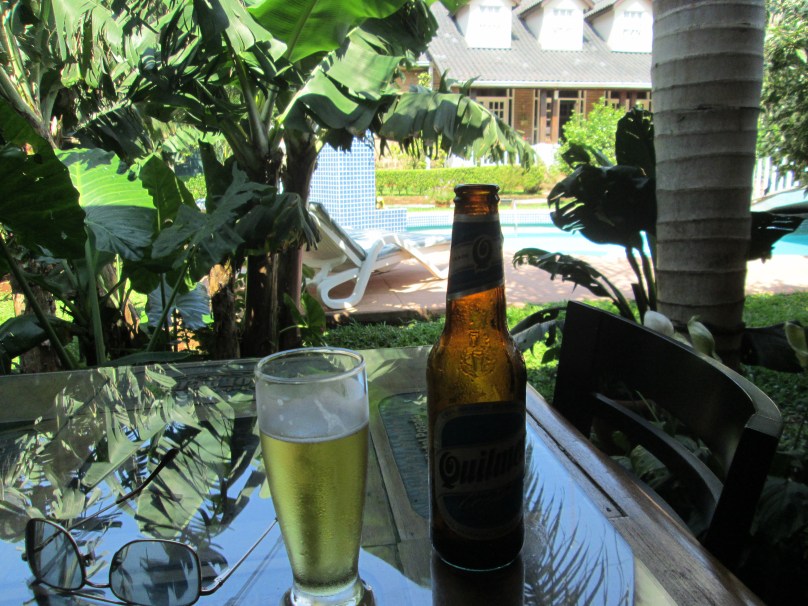
Drinking Beer in Puerto Iguazu

I had good reason to celebrate: I had just survived a hamfisted pick-pocketing attempt as I was walking to the Retiro Bus Terminal in Buenos Aires with over 2,000 Argentinean pesos in my wallet. I finally made it to my all-night bus to Puerto Iguazu, where the borders of Argentina, Brazil, and Paraguay meet. I was there to see the falls, which were spectacular (more about that tomorrow).

At Puerto Iguazu, I was in the jungle, right by the massive falls of the Rio Iguazu—all 275 of them. This was my first visit to what I call a monkey jungle. There were monkeys aplenty, as well as coatimundis and picturesque birds.

Colorful Bird at the Local Aviary

I had always been afraid of the jungle because I hate mosquitoes. Curiously, I did not encounter any, though I spent two days viewing multiple falls in the area. I did encounter a lot of coatimundis, but numerous posted signs warned against feeding them: They have a tendency to get aggressive and go on the attack.

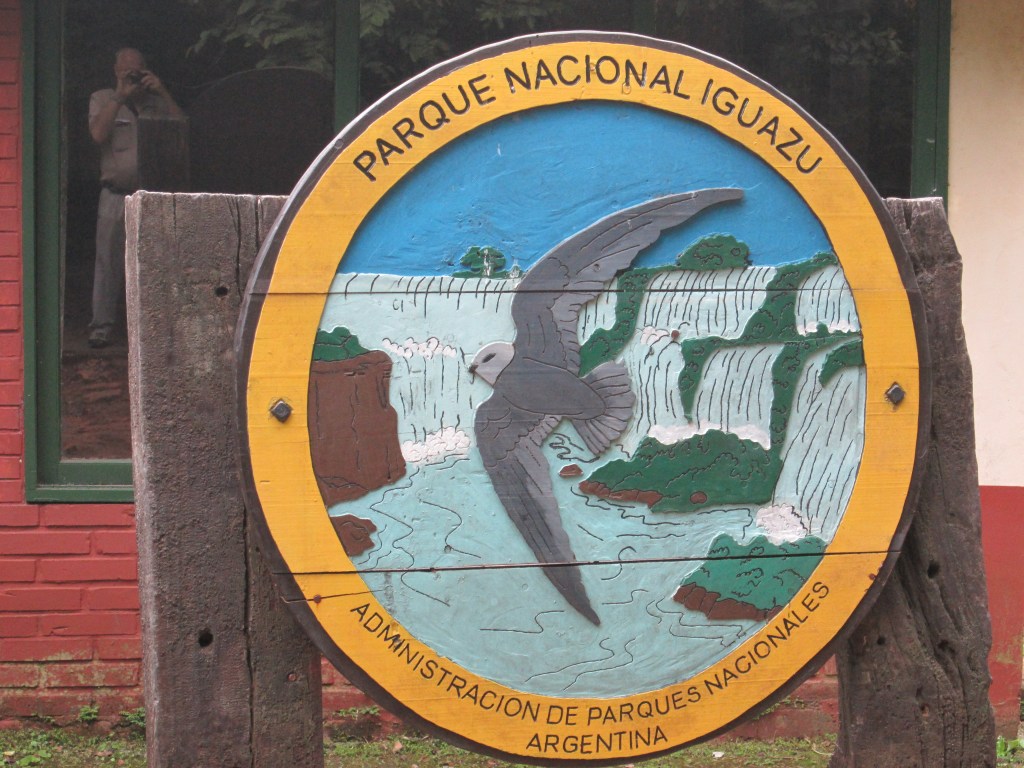
Iguazu National Park Seal

Argentina is a country with numerous national parks. I have visited both the northernmost (Iguazu) and the southernmost (Tierra del Fuego on the Beagle Channel). It is a pity that so few Americans have had the opportunity to visit any of them.

Scrawny Squirrels

Martine Trying to Feed a Squirrel

Sunday was a typical hot-and-cold day with a heavy marine layer and forecasts of rain in the eastern mountains and deserts. In other words, it was Mexican Monsoon season. Rather than break into a sweat in our apartment, I proposed we spend some hours at Chace Park in the Marina, maybe picking up a picnic lunch at the supermarket on the way.

I grabbed a book (George Mackay Brown’s Rockpools and Daffodils) and headed out with Martine to the Marina. She picked up a ready-made chicken sandwich at Ralph’s and saved bits of the crust to feed to the local squirrels and crows.

The park has a large number of scrawny squirrels who, I think, feed mostly on the leavings of picnickers. It was funny to see her approach the squirrels and try to convince them that they should take advantage of the crust she was offering them. Occasionally they did; but then, they decided to give it a pass. Martine turned away disgusted. But it was not in vain: The crows landed and grabbed the crumbs refused by the squirrels.

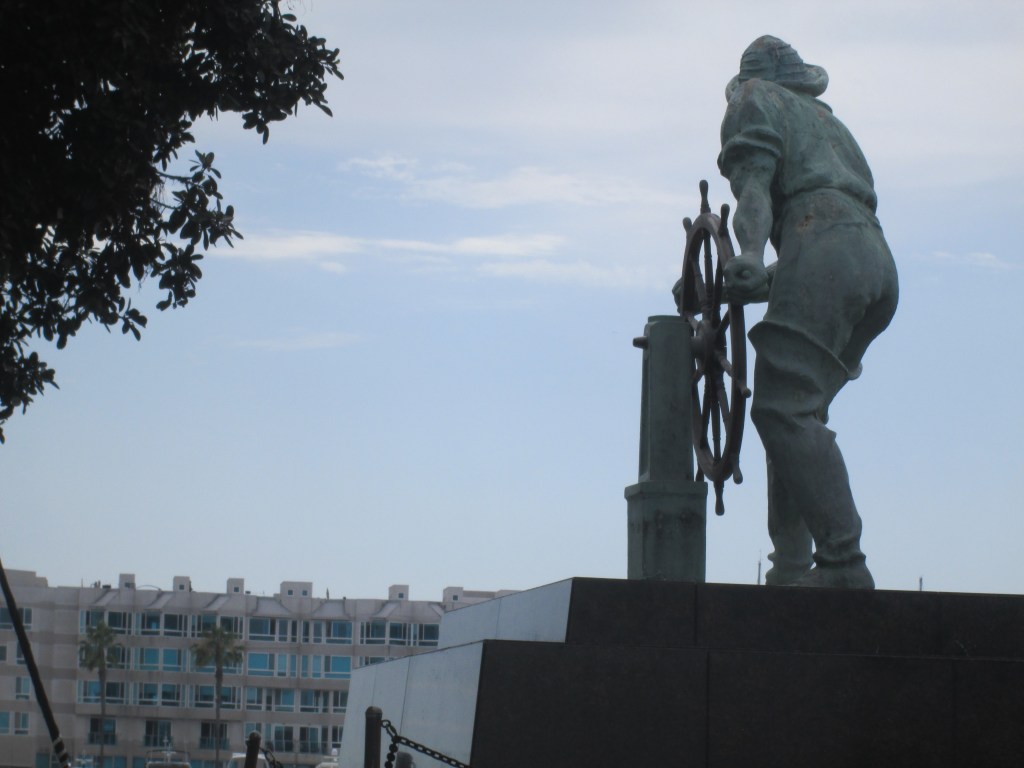
There was a pleasant breeze at Chace Park, and I enjoyed taking a walk that took in the statue of the helmsman at the tip of the peninsula in which the park is situated.

Statue of the Helmsman at Chace Park

The sun didn’t come out, but in sunny California that is no tragedy. We got fed, the crows and squirrels got fed, and I read a goodly chunk of George Mackay Brown, which is always a good thing.

The Ring of Brodgar

Location of Orkney Islands

Just off the Northern tip of Scotland lie the Orkney Islands. You could get there by flying to Kirkwall (when the weather permits), or taking the P & O Ferry St. Ola from Scrabster, just west of Thurso. I have been to Orkney twice, both times crossing the stormy seas of Pentland Firth with my stomach not overly sure of its correct position. The second time was with Martine, who took so much Dramamine that I had trouble shaking her awake to see the Old Man of Hoy as we sailed passed it.

My mind is turning once again to those stormy islands as I read a newspaper column penned by the late George Mackay Brown for The Orcadian between 1979 and 1991. I have loved Brown’s prose and poetry ever since I met him on my first visit to the islands, in September 1976.

The Old Man of Hoy

By the time the St. Ola docked in Stromness, the port where George Mackay Brown lived and called by its Norse name, Hamnavoe, the weather was so bad that Martine thought I had brought her to some Arctic hell. The weather moderated—somewhat. But we had a wonderful time viewing the sights, including the Viking Cathedral of St. Magnus in Kirkwall, the Standing Stones of Stenness, the Ring of Brodgar (which is the new header image for my post), the Neolithic burial chamber at Maes Howe (with runic Viking graffiti), and the stone age village of Skara Brae, once buried by the sands of the North Atlantic.

Places like Orkney, Iceland, Tierra del Fuego in South America, and the deserts of the American Southwest fascinate me. Most Americans would opt for sun, sea, and cocktails as the perfect vacation. Not me!

Thor the Thunderer

Storm Off the Island of Hoy, Orkney, Scotland

For many years, Scottish writer and poet George Mackay Brown wrote a column for the local newspaper of the Orkney Islands, The Orcadian. The following column from his collection Rockpools and Daffodils: An Orcadian Diary 1979-1991. describes a once-in-a-generation thunderstorm:

I think we have never had a thunderstorm like it this generation in Orkney.

We had almost forgotten what a thunderstorm was. A few warnings lingered in the memory. ‘Cover the mirrors’ … ‘Don’t take shelter under a tree’ … Someone had said to us as children, ‘The lightning won’t strike if you wear rubber boots.’ … (Old wives’ mutterings beside the fire, half-forgotten.)

I suppose we ought to have been prepared for thunder—day after day of sunshine, a still brooding loaded atmosphere, no rain for weeks.

We were so thankful for early tokens of a good summer, no-one was complaining.

It came with dramatic suddenness, between breakfast and lunch. The darkening sky, the first vfew rain-drops heavy as coins, a low growl across the sky (as if Thor wasn’t in the sweetest of tempers). But Thor, in the last two or three decades, has occasionally given a growl or two on a summer day, and turned over to sleep again.

Thor the Thunderer had urgent things to do today, it soon became obvious. He had business on his hands. His mighty hammer thudded on the hills, amid flashings.

The clouds were torn apart. Black bags of water, they emptied themselves upon the town. The gardens, at least, must have loved it, after the long drought. One could sense the roots gorging themselves.

The stones of Stromness [Brown’s home town] could do nothing with the sudden weight of water. The gutters gushed and spluttered. Down the Distillery close came a river of water, and swung south. The lightning was mostly vivid blinks, followed at once by peal upon peal. Hundreds of tons of coal were being shifted along the horizon. There was a mighty furniture removal in the sky: grand pianos and huge Victorian sideboards. And sometimes it was as if a cannon had exploded by accident in a close or down a pier, a hideous ripping of hot metal.

The cosmic electricity had quelled the little expensive electricity that man makes. I switched on the light in the eerie darkling room—nothing doing.

A candle responded with a tranquil flame.

A golden fork stabbed down and singed Hoy Sound!

After a time it seemed that Thor had finished his mighty labours for the day. The sky brightened, the thunder grumbled under the horizon.

But Thor must have forgotten some tool in his sky-smithy. Back he came and blew up his forge and struck the anvil a few more mighty blows: while we nervous earthlings below trembled. By early afternoon it was all over. We looked at each other in the cleansed air, we spoke to each other, like folk who had had some wonderful, frightening new experience.

Red Hat

Entrance to Louisiana’s State Penitentiary at Angola

Located in West Feliciana Parish is Louisiana’s fearful Angola State Penitentiary. And within that penitentiary, by far the worst place to be incarcerated was the Red Hat Cell Block, which also contained the state’s electric chair, known as “Gruesome Gertie,” which was used for 87 executions between 1956 and 1991.

The Red Hat Cell Block was named after the red painted straw hats the inmates wore when working on the prison farm. It contained thirty cells that were 3 × 6 feet (0.91 meters × 1.8 meters), with a single window near the ceiling that was 1 foot square (0.3 meters square). Inmates slept on an iron bunk without any mattress. Temperatures frequently soared to slow oven levels; and the cells were infested with rats and other vermin. There was no toilet: prisoners had to eliminate in a bucket that was emptied each morning.

Naturally, most of the inmates of the cell block were non-whites. And, needless to say, even prisoners on death row in Angola had it better.

Entrance to the Red Hat Cell Block

Why am I describing such a terrible place? It is because I am becoming increasingly of the role that racism has played in the history of our country—a history which many Americans are trying to whitewash.

It goes all the way back to the Constitution of the United States. In an article by Steven Mintz entitled “Historical Context: The Constitution and Slavery,” it states:

The word “slave” does not appear in the Constitution. The framers consciously avoided the word, recognizing that it would sully the document. Nevertheless, slavery received important protections in the Constitution. The notorious three-fifths clause—which counted three-fifths of a state’s slave population in apportioning representation—gave the South extra representation in the House of Representatives and extra votes in the Electoral College. Thomas Jefferson would have lost the election of 1800 if not for the Three-fifths Compromise. The Constitution also prohibited Congress from outlawing the Atlantic slave trade for twenty years. A fugitive slave clause required the return of runaway slaves to their owners. The Constitution gave the federal government the power to put down domestic rebellions, including slave insurrections.

Lest we pat ourselves on the back for not being Southerners, I have seen enough in Cleveland and Los Angeles in my time to feel a deep sense of shame. How many decades, how many centuries must pass before the blot of slavery and racism are wiped out?