
Endlessly Wandering the Streets of Paris

Auteuil in Paris’s 16th Arrondissement

Of recent French authors, the one I am most addicted to is Patrick Modiano, winner of the 2014 Nobel Prize for Literature. Since I first read his Out of the Dark (1998) for an Internet French Literature group ten years ago, I have read most of his work and am still hungry for more, though there are only a few titles left to go. And, no doubt, I will probably start re-reading them.

Scene of the Crime (2021) is one of his most recent novels, which I just finished today. Jean Boesman experienced some fascinating but very dicey people back in the 1960s and is haunted by the memory. He has been sought after by several of them for knowing where some swag from past smuggling has been hidden, but he successfully avoids them. Nonetheless, he still endlessly goes over his relationship with the young women in the group. As he says at one point, “We are from our childhood as we are from a country.”

That country was the Paris of the 1960s and 1970s. I cannot read Modiano without a map book of Paris on my lap, following his characters wanderings and evasions through the most walkable city on Earth.

In Scene of the Crime, I tracked Boesman through Boulogne-Billancourt (where Modiano was born), Auteuil, Pigalle/Place Blanche, the Quays along the Seine, and Saint Lazare.

None of Modiano’s books are particularly long: Most can be completed in one or two sittings. I usually take a little longer, because I am following the action on a map of Paris.

Jean-Luc

Jean-Luc Godard (1930-2022) with Wife Anna Karina

Beginning in the 1960s and extending through the early 1970s, I thought that the most exciting filmmaker in the world was Jean-Luc Godard. While I was a film student at UCLA, it seemed that two or three new titles came out every year. All of them enthralled me.

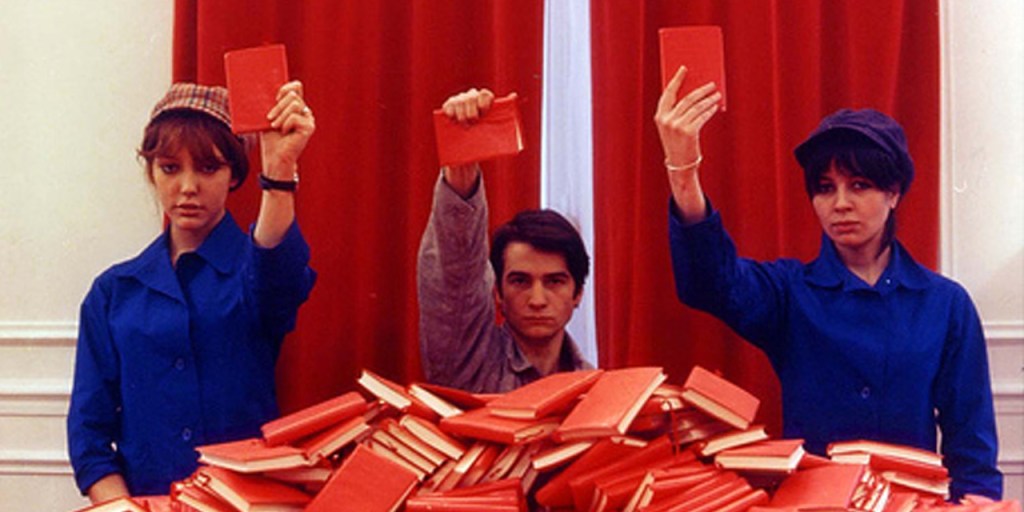
Then, something happened. When La Chinoise came out, I was sorely disappointed. Always sympathetic to revolutionaries, Godard seemed to have turned Maoist. His stars—Jean-Pierre Léaud and Anna Wiazemski—endlessly quoted from Chairman Mao’s little red book. Godard had gone doctrinaire on me. Even though I myself had flirted with the Progressive Labor Party in 1967, as a Hungarian-American I had uneasy feelings about dogmatic Communism.

La Chinoise: Way Too Dogmatic

Still, I thought that most of Godard’s films of the 1960s were exciting. At the time, all my favorite American directors were either dead or dying, and here was a young French director still in his thirties who could be relied upon to produce more masterpieces in the years to come. Alas! It was not to be. I have seen a few of his later productions, which I found not quite up to the standard Godard had set earlier in his career.

Among my favorites of his were:

  • À bout de souffle or Breathless (1960), one of the iconic films of the French New Wave
  • Vivre sa vie or My Life to Live (1962)
  • Le mépris or Contempt (1963), starring Brigitte Bardot
  • Alphaville (1965), a great combo of noir and science fiction
  • Pierrot le fou (1965)
  • Masculin féminin (1966), starring French pop star Chantal Goya
  • Made in USA (1966)
  • Weekend (1967), an apocalyptic satire of the French bourgeoisie

Many of the above films starred Godard’s wife, the lovely Anna Karina, which for me served as an added inducement to see the films.

Godard continued to make films. Between 1968 and 1972, he made political films with the Dziga Vertov Group, none of which I have seen. As late as 2022, he kept releasing films. The exhilaration of the earlier works, however, was gone. I have yet to see more than a handful of them, but I would like to at some point. Many of them are pretty obscure and hard to find.

Last year, at the age of 91, Godard found himself suffering from a series of incapacitating illnesses, such that he committed assisted suicide on September 13, which is allowed by Swiss law. It is an unfortunate end for a great artist whose work influenced my life in so many ways at a time when I was young and alienated. But then, such is life.

On the Surface of Things

Brad Pitt and Leonardo diCaprio in Tarantino’s Once Upon a Time in Hollywood

Once of Oscar Wilde’s most memorable observations in The Picture of Dorian Gray is: “It is only shallow people who do not judge by appearances. The true mystery of the world is the visible, not the invisible….”

That thought flitted in and out of my consciousness as I watched Quentin Tarantino’s Once Upon a Time in Hollywood. Was it a great film? No, but it caught the feeling of the late 1960s in Los Angeles. I had arrived from Cleveland at the tail end of 1966, and I recalled the strange vibe of the times. There was, first of all, the music. Then there were the hippies. I remember buying The Free Press for a quarter every Friday and reading it religiously. It all seemed to come to a head with Charles Manson’s Helter Skelter murders, also known as the Tate-La Bianca killings.

Margaret Qualley as Pussycat, a Manson Girl

One of the things I remember most vividly is my attraction/repulsion response to hippie chicks. Right around 1969, when the film was set, I remember riding the Santa Monica Bus to my job at System Development Corporation. A very cute young blonde boarded on 14th Street with a very short dress on which was written the word “Bamboo” in red over every inch of its white cloth. Her dress was so short that it was of considerable gynecological interest—such that the bus driver almost involuntarily handed her an obscene compliment. She promptly crimsoned and got off the bus at the next stop. But I still remember her vividly some half century later.

Apparently Tarantino felt the same way about the sudden glimpses of female flesh that appeared in the late Sixties. Even the look of L.A. was lovingly captured, from the smog to the relatively light traffic. I loved that about the film.

There were other things that didn’t work quite so well. More about that later.