Nine Christmas Movies

Ralphie (with Glasses) and the Kids from A Christmas Story

Following is a list of the nine Christmas movies I am committed to seeing again and again during the Yule season. It is highly individual and does not contain many of the usual “heartwarming” titles that clog so many lists like atherosclerosis.

They are listed in order of preference:

A Christmas Story (1983)

It is as if this film were deliberately made with me in mind. The opening scenes shot on Cleveland’s Public Square, featuring the toy display at Higbee’s Department Store, were part of my past. And Ralphie’s school resembles Harvey Rice Elementary School, where I spent kindergarten and part of first grade trying to come to terms with the English language.

A Christmas Carol (1951)

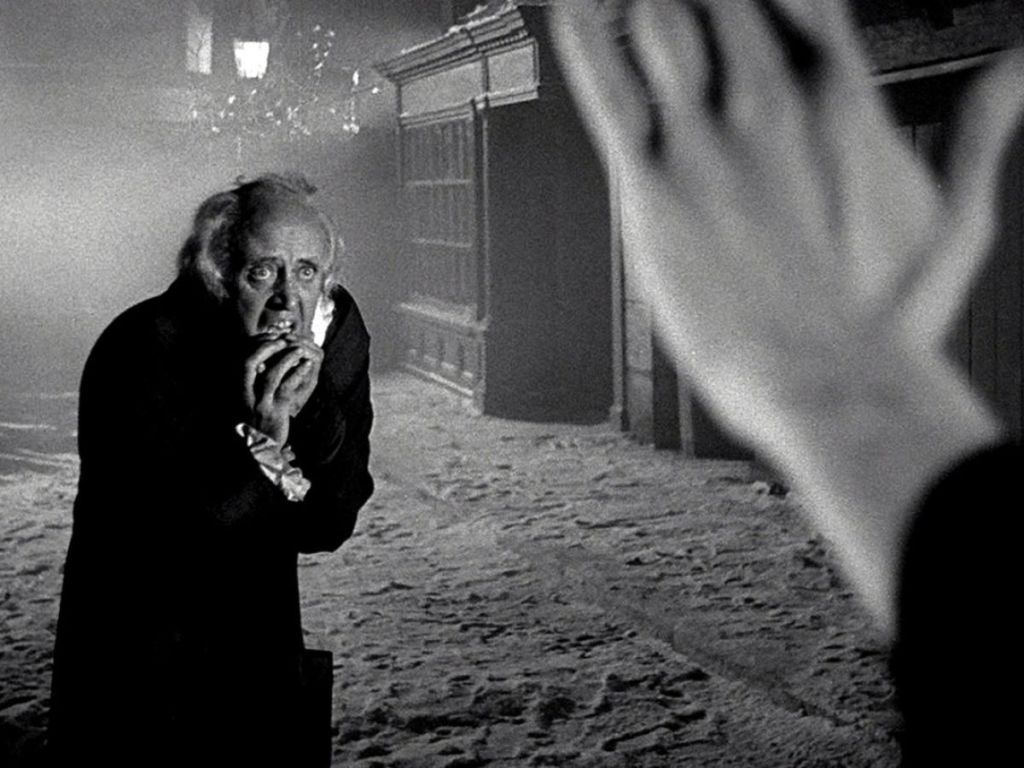
This is by far my favorite version, starring Alastair Sim as Ebenezer Scrooge. I never tire of the story, and this is the most complete telling of Dickens’s tale.

Lady in the Lake (1947)

Robert Montgomery as detective Phillip Marlowe attempting to track down the missing wife of a magazine publisher during Christmas. The love story between Marlowe and Publishing Exec Adrienne Fromsett (played by Audrey Totter) is actually believable.

The remaining titles are in random order and are, to my mind, not quite so good as the top three above:

It’s a Wonderful Life (1946) with Jimmy Stewart
The Shop Around the Corner (1940) also with Jimmy Stewart
The Nightmare Before Christmas (1993) – Stop motion animation from Tim Burton
The March of the Wooden Soldiers (1934) with Laurel & Hardy, a childhood favorite
The Curse of the Cat People (1944) by Val Lewton with Simone Simon singing a lovely French carol
The Bishop’s Wife (1947) with Cary Grant

I’m sure that most people’s reaction to this list is, “What about X, Y, and Z?” They might be on your list, but didn’t make it to mine.

A Merry Xmas to All

During my entire adult life, I have been of two minds about Christmas. On the plus side, it is a pious celebration of God becoming Man in order to save the human race from the shame of Adam and Eve. Though I can’t help wondering that God, being God, could have accomplished the same result any number of ways.

On the negative side, Christmas time has become a two-months-long stress fest in which families immolate their finances and valuable time buying gifts that the recipients do not necessarily want or need. I am happy that the holiday is now over, because I will be able to drive without encountering quite so many highway kamikazes out on endless errands.

It was nice to see the two classical movie versions of Charles Dickens’s A Christmas Carol (1938 with Reginald Owen and 1951 with Alastair Sim, pictured above). In his story, Dickens doesn’t even mention the Deity, but he makes a case for generosity and good will toward men.

I also saw Bob Clark’s marvelous recreation of a 1950 Christmas in his 1983 A Christmas Story. In a way, the quest of Ralphie (Peter Billingley) for a BB gun is not nearly as acceptable a journey as Scrooge’s, but it was a reminder of my own Christmases in Cleveland. The picture showed such old Cleveland landmarks as the Terminal Tower, the Soldiers’ and Sailors’ Monument, and Higbee’s Department Store. I never got much in the way of presents except clothing that I didn’t like—except that my uncle gave me a $20 bill every Christmas, which was like a rare treasure for me, even though I couldn’t spend it on what I wanted.

At least I didn’t have an Aunt Clara who would make me a pink rabbit suit that made me look like a deranged Easter Bunny.

Serendipity: Marley’s Ghost

Tiny Tim with Scrooge in Dickens’s A Christmas Carol

In honor of Christmas, I will excerpt a brief scene from Charles Dickens’s A Christmas Carol, representing the first moment when Ebenezer Scrooge realizes that something is not quite right. He sees, instead of the usual door knocker, the face of his dead partner Jacob Marley. (I know I was a little hard on Dickens in a post I wrote last week, but I think that this particular story is not only one of his best: It has influenced the way that Christmas is celebrated across the West.)

Now, it is a fact, that there was nothing at all particular about the knocker on the door, except that it was very large. It is also a fact, that Scrooge had seen it, night and morning, during his whole residence in that place; also that Scrooge had as little of what is called fancy about him as any man in the city of London, even including—which is a bold word—the corporation, aldermen, and livery. Let it also be borne in mind that Scrooge had not bestowed one thought on Marley, since his last mention of his seven years’ dead partner that afternoon. And then let any man explain to me, if he can, how it happened that Scrooge, having his key in the lock of the door, saw in the knocker, without its undergoing any intermediate process of change—not a knocker, but Marley’s face.

The Door Knocker Transposed into Marley’s Face

Marley’s face. It was not in impenetrable shadow as the other objects in the yard were, but had a dismal light about it, like a bad lobster in a dark cellar. It was not angry or ferocious, but looked at Scrooge as Marley used to look: with ghostly spectacles turned up on its ghostly forehead. The hair was curiously stirred, as if by breath or hot air; and, though the eyes were wide open, they were perfectly motionless. That, and its livid colour, made it horrible; but its horror seemed to be in spite of the face and beyond its control, rather than a part of its own expression.

As Scrooge looked fixedly at this phenomenon, it was a knocker again.

To say that he was not startled, or that his blood was not conscious of a terrible sensation to which it had been a stranger from infancy, would be untrue. But he put his hand upon the key he had relinquished, turned it sturdily, walked in, and lighted his candle.

He did pause, with a moment’s irresolution, before he shut the door; and he did look cautiously behind it first, as if he half expected to be terrified with the sight of Marley’s pigtail sticking out into the hall. But there was nothing on the back of the door, except the screws and nuts that held the knocker on, so he said “Pooh, pooh!” and closed it with a bang.