Tarnmoor’s ABCs: Film

Mack Sennett Bathing Beauties

Mack Sennett Bathing Beauties

I was very impressed by Czeslaw Milosz’s book Milosz’s ABC’s. There, in the form of a brief and alphabetically-ordered personal encyclopedia, was the story of the life of a Nobel Prize winning poet, of the people, places, and things that meant the most to him. Because his origins were so far away (Lithuania and Poland) and so long ago (1920s and 1930s), there were relatively few entries that resonated personally with me. Except it was sad to see so many fascinating people who, unknown today, died during the war under unknown circumstances.

This blog entry is my own humble attempt to imitate a writer whom I have read on and off for thirty years without having sated my curiosity. Consequently, over the next few months, you will see a number of postings under the rubric “Tarnmoor’s ABCs” that will attempt to do for my life what Milosz accomplished for his. I don’t guarantee that I will use up all 26 letters of the alphabet, but I’ll do my best.

These Mack Sennett Bathing Beauties are not what you usually think of when you think of the movies, but that was about a hundred years ago. Film has been around for more than a century, and I have been  a film freak for almost half that time. It all started at Dartmouth College, where there were frequent free screenings at Fairbanks Hall. One afternoon in my freshman year, I saw Carl Theodor Dreyer’s Day of Wrath (1943), about witchcraft in seventeenth century Denmark. I was hooked.

Although my original intention was to become a professor of English, somewhere during my second or third year at college, I decided to switch to film. The Hopkins Center had just opened, and there was a large beautiful theater for screening films. The Dartmouth Film Society put on an ambitious year-long Alfred Hitchcock Retrospective, and my career choice began to waver. When, finally, Arthur L. Mayer, the author of Merely Colossal, came to teach a class in film history, my mind was made up.

Dartmouth had a long history of ties with the film industry. Its Baker Library was the home of the Irving Thalberg collection of Hollywood scripts. Graduates included such film luminaries as Joseph Losey, Robert Ryan, Budd Schulberg, David Picker, and Max Youngstein. Even before my senior year, I had decided to do my graduate work in film history and criticism. During the summer of 1965, I went with my parents to New York, mainly to see Haig P. Manoogian, who ran the film department at New York University. Mr. Manoogian was kind enough to see me, but not kind enough to encourage me—although he was a favorite of Martin Scorsese, who went to school there. I guess he was more interested in film production. (That summer, I also saw the New York World’s Fair of 1964-1965.)

That left the University of Southern California (USC) and UCLA. One of my Dartmouth classmates from the Class of 1965 had attended UCLA. When he came up to Dartmouth to visit, he discouraged me about USC, which he said was a slum and Smog Central.

So I came out to Southern California, where I still live. I attended graduate school at UCLA for several years until Professor Howard Suber put the kibosh on my budding career as a film professor. He was a lackadaisical academic who supposedly was working on a shot-by-shot analysis of Citizen Kane and who didn’t much like movies. I was about to write a thesis about the Westerns of John Ford with Robert Epstein as head of my thesis committee, but then Suber replaced him with himself. At that point, I knew I was finished, as there was little love lost between us. Years later, I joined a letter-writing campaign to have his tenure denied, calling him a cross between Mr. Pickwick and Caligula.

Although I’ve always loved film, I had by this time taught myself how to operate and program computers, and I got a job at System Development Corporation in Santa Monica. Curiously, the person I replaced at SDC was a young woman who had been murdered by a UCLA film student. So here I am today, a computer expert at a Westwood accounting firm, still in love with film, though greatly disappointed because all the great filmmakers I idolized are dead, and the quality of films now being produced has fallen markedly.

Tarnmoor’s ABCs: Earthquakes

Earthquake Fissure in Road

Earthquake Fissure in Road

I was very impressed by Czeslaw Milosz’s book Milosz’s ABC’s. There, in the form of a brief and alphabetically-ordered personal encyclopedia, was the story of the life of a Nobel Prize winning poet, of the people, places, and things that meant the most to him. Because his origins were so far away (Lithuania and Poland) and so long ago (1920s and 1930s), there were relatively few entries that resonated personally with me. Except it was sad to see so many fascinating people who, unknown today, died during the war under unknown circumstances.

This blog entry is my own humble attempt to imitate a writer whom I have read on and off for thirty years without having sated my curiosity. Consequently, over the next few months, you will see a number of postings under the rubric “Tarnmoor’s ABCs” that will attempt to do for my life what Milosz accomplished for his. I don’t guarantee that I will use up all 26 letters of the alphabet, but I’ll do my best.

If there is any natural phenomenon that frightens me, I would have to say it is earthquakes. During my years in Southern California, I have lived through two big ones: The Sylmar earthquake on February 9, 1971 (Richter 6.6) and the Northridge earthquake of January 17, 1994 (Richter 6.7).

On Friday, we had a small tremor centered on nearby Marina Del Rey. It was only a 3.2, but I acted as if it were just the start of a much bigger shake. Sitting in my library reading Proust, I dropped the book, jumped clear over the hassock and headed to the hallway just outside my bathroom to brace myself for what (perhaps) was to come. It didn’t. In the meantime, Martine peered around the corner and asked what was wrong. Did she feel the quake? Yes, but it was only a tiny one. But there I was, standing in the doorway with my heart racing, preparing myself for the worst.

The origins of my fear go back to 1994, when I used to sleep on an improvised futon in my living room. It was around 4:30 am when the earth began to shake in the darkness of the pre-dawn hours. Lights flashed whenever a nearby transformer exploded. Things were falling down from the walls and shelves, and some of them even rolled to where I was lying in terror as the sounds and smells and shaking had incapacitated me. What happened immediately after, I don’t recall because I actually lost my memory. All I know was that I was picked up by the police several hours later carrying two gallon jugs of purified water on Santa Monica Boulevard with blood flowing down my right leg.

Little by little, my terror subsided, only to be ramped up again with each aftershock. The damage caused by the quake was substantial: some nearby buildings were askew, and my kitchen had to be cleaned up with a shovel.

Ever since then, I do not go to bed without laying out all my clothes for the next day on a chair between the bedroom and the front door. Walking barefoot on broken glass and crockery is not a pleasant experience. So even now, a small temblor is capable of bringing back the terror, for however short a time.


Tarnmoor’s ABCs: Dartmouth College

Dartmouth Hall

Dartmouth Hall

It was a beautiful place to spend four years, even if I had never really been more than a few miles away from home by myself before then. I went from being a valedictorian who had won all the non-sports-related honors at Chanel High School to one of hundreds of similar people from all around the country, including those famous prep schools that have sprouted up over all of New England.

At that time, Dartmouth College was isolated by the fact that the Interstate Highway system had not yet made its way into New Hampshire and Vermont. Today, Hanover, New Hampshire, is less than two hours from Boston via I-89. During the months of January and February, we were at times cut off from all supplies until the snow plows could cut a channel for cars and trucks. All four years, I stayed in Middle Wigwam Hall, which was later renamed to McLane Hall. My dorm stood a mile from the center of campus. To get to class, I had to trudge past the eerie old Hanover cemetery, with its tombs dating back to the Eighteenth Century, often on a sidewalk that had obligingly turned into a sheet of ice.

During those years, I suffered frequently from severe frontal headaches, which were the result of a pituitary tumor (chromophobe adenoma) pressing on my optic nerve. The attacks occurred on 50% of all days, with the “penumbra” of the headache beginning around 11 am and reaching a crescendo around midnight. That’s why I did most of my homework before midnight and 3 am. It was not until after I graduated that I was properly diagnosed: Until then, doctors did not know what to think—especially since MRIs and CT Scans had not yet been invented.

Pain and all, I loved Dartmouth. The quality of the instructors was, for the most part, incredibly high. Particularly in the English department, I had a succession of professors I will never forget: men like Chauncey Loomis, Peter Bien, and Thomas Vance.

At first, I hoped to become an English professor, until the movies turned by head. The Dartmouth Film Society screened great films, including a huge year-round Alfred Hitchcock festival. Plus I made the acquaintance of Arthur L. Mayer, the former “Merchant of Menace” from New York’s Rialto Theater and the author of Merely Colossal (1953). It was while at Dartmouth that I decided to go to graduate school in film history and criticism at UCLA—and that’s how I wound up in La La Land.

Dartmouth College had been founded as a missionary school for Indians in 1769 under the patronage of the Earl of Dartmouth. In 1819, the school made legal history when Daniel Webster argued before the Supreme Court in Trustees of Dartmouth College vs. Woodward, better known as the Dartmouth College Case. President Franklin “Handsome Frank” Pierce graduated from there and went on to become one of the most mediocre presidents in U.S. history.

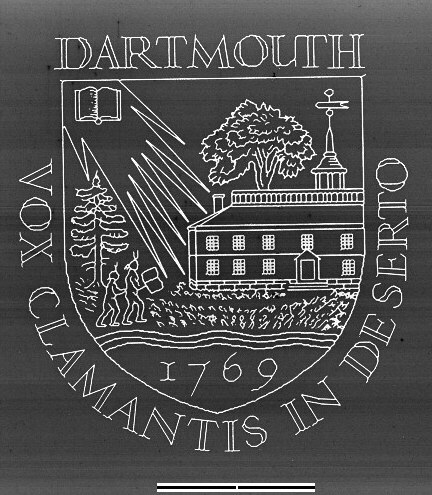
I will leave you with the official seal of Dartmouth:

“A Voice Crying in the Desert”

“A Voice Crying in the Desert”

The motto was most appropriate considering the school’s winter isolation.


Tarnmoor’s ABCs: Cleveland

My Home Town

My Home Town

Cleveland has not aged well. When I was a grade school student, it was one of the ten largest cities in the United States, famed for its steel, machine-tool building, and automotive support industries. Now it is a fraction of the size, with a large bombed-out crater of a central business district and suburbs stretching across several counties in Northeast Ohio. When I graduated from high school, there was a regular diaspora to … anywhere but Cleveland.

The “Mistake on the Lake.” The “Worst Location in the Nation.” Perhaps the ultimate insult was when Amtrak pondered whether it was worth even stopping at the large underground station in the Terminal Tower, illustrated above. There was a time when the Terminal Tower was the largest building in the country outside of New York City.

Just being from Cleveland makes one feel humble. Wasn’t the movie that Maynard G. Krebs of The Affairs of Dobie Gillis always going to see The Monster That Devoured Cleveland? Well, Cleveland got devoured all right: The monster that devoured it was rampant unemployment.

I can only talk about the Cleveland that was because, after 1962, I spent most of my time elsewhere, either in Hanover, New Hampshire, attending Dartmouth College, or here in Los Angeles, where I seem to have set down roots.

The last time I saw my native city was 1998, when I attended my mother’s funeral. She had died in Kings Beach, California, on the shores of Lake Tahoe; but at her request, my brother and I had the body flown to Cleveland, where it was buried next to my father. After the funeral, my brother and I spent some time driving around our old haunts.

What surprised me more than anything else were the trees! When I lived on East 176th Street in the 1950s, the neighborhood was still relatively new and bare; and the trees were all tiny. By 1998, they were gigantic and imposing. It was actually rather nice. I should probably go back there again, perhaps stopping in on a visit to New York or Boston. Most of the people I grew up with are either elsewhere or under the ground, especially the older generation. So it goes.

Tarnmoor’s ABCs: Books

Some of My Books About Iceland

Some of My Books About Iceland

I was very impressed by Czeslaw Milosz’s book Milosz’s ABC’s. There, in the form of a brief and alphabetically-ordered personal encyclopedia, was the story of the life of a Nobel Prize winning poet, of the people, places, and things that meant the most to him. Because his origins were so far away (Lithuania and Poland) and so long ago (1920s and 1930s), there were relatively few entries that resonated personally with me. Except it was sad to see so many fascinating people who, unknown today, died during the war under unknown circumstances.

This blog entry is my own humble attempt to imitate a writer whom I have read on and off for thirty years without having sated my curiosity. Consequently, over the next few months, you will see a number of postings under the rubric “Tarnmoor’s ABCs” that will attempt to do for my life what Milosz accomplished for his. I don’t guarantee that I will use up all 26 letters of the alphabet, but I’ll do my best. My previous posting on this theme was last month.

Well, B is for Books, the love of my life. It all started before I could read … before I could even speak English. I remember my mother reading me stories (translating them into Hungarian). And when she didn’t have a story to read, she made up one. These were just as good as the published stories. I remember walking with her from our apartment on East 120th Street to the public library next to Harvey Rice School. A few doors down, between Buckeye Road and Van Aken, there was a very good doughnut shop where we would sometimes stop.

In 1951, after my brother Dan was born, we moved to the then treeless suburbs of the Harvard-Lee area. I guess my parents didn’t want to have two boys who couldn’t speak English. I was signed up to attend second grade (even though I completed only the first half of first grade at Harvey Rice—Shhh! Please don’t tell anyone) at Saint Henry School on Harvard Road.

Once I got a handle on the English language, by about the fourth or fifth grade, I started accumulating books. On one hand, my parents were delighted at my strides in understanding English. On the minus side, whenever they got some insurance document written in legalese, I had to interpret it for them. (Ever since, I have hated that fine print crap.)

Also, the books started getting to my parents. “Jimmy, why do you need so many books?” “Uh, because I just do.” “Well, pick up after yourself please.”

Years later, the books started getting to Martine. “Jimmy, why do you need so many books?” “Uh, because I just do.” “Well, pick up after yourself please.”

Actually, I have improved some. I now own two Kindles with fifteen hundred books on them. How many physical books do I own? Oh, somewhere around six or seven thousand.

Currently, I read something like ten books a month, usually literature and history, but some travel, science, economics, and philosophy on occasion. If you are curious about my bookish habits, I suggest you check out my page on Goodreads.Com. You’ll see reviews of every book I read. Click here. You can see links to reviews off to the right side of the four or five books I have read most recently.

I have always assumed that God would let me live as long as I have books to read. And I keep buying more books. It’s like finding the genie in the bottle and wishing for an infinite number of wishes.

Okay, so I’m a bit delusional.


Tarnmoor’s ABCs: Automobile

Me and My Nissan

Me and My Nissan


I was very impressed by Czeslaw Milosz’s book Milosz’s ABC’s. There, in the form of a brief and alphabetically-ordered personal encyclopedia, was the story of the life of a Nobel Prize winning poet, of the people, places, and things that meant the most to him. Because his origins were so far away (Lithuania and Poland) and so long ago (1920s and 1930s), there were relatively few entries that resonated personally with me. Except it was sad to see so many fascinating people who, unknown today, died during the war under unknown circumstances.

This blog entry is my own humble attempt to imitate a writer whom I have read on and off for thirty years without having sated my curiosity. Consequently, over the next few months, you will see a number of postings under the rubric “Tarnmoor’s ABCs” that will attempt to do for my life what Milosz accomplished for his. I don’t guarantee that I will use up all 26 letters of the alphabet, but I’ll do my best. This is a reprint from a Blog.Com posting from 2009, but I had to give it up at that time. This time, I will try to complete my alphabet.

For starters, here is Milosz’s take on a thing that has also assumed some importance in my life: the automobile:

Surely the automobile was invented in order to make a mockery of those pessimists who predicted that the number of horses would grow exponentially and that cities would choke to death from the stench of horse excrement. From Kiejdany county, in which there was a single automobile (Count Zabiello’s), I was catapulted into California [Milosz taught at Berkeley], where the automobile is just the same as electricity and bathrooms. I am not nostalgic for the good old days. I lived amidst filth and stench without being aware of it. And I belonged to the so-called upper social strata. The Wilno [today’s Vilnius] of my school years had cobblestone streets and only a couple of neighborhoods had sewers. One can imagine the mountains of garbage and excrement in Wilno during the Romantic era. It would be worthwhile to describe the female readers of La Nouvelle Héloïse [an influential work by Rousseau] not from above, but from below: f\rom the perspective of their chamber pots (where were they emptied?), their underpants (they didn’t wear any), and their gymnastic contortions while washing.

Now I rather doubt that most environmentalists would consider some of these factors when they rue the effect of the automobile on our civilization. No doubt, the internal combustion engine is both a boon and a bane to us, as the mercury in our thermometers creeps up from year to year. Here we are, thinking we have broken the Earth—at least until another Krakatoa-style volcanic explosion or major meteor or asteroid strike shows us the real face of catastrophe.

I, on the other hand, would like to talk about the automobile from another point of view. I came to it rather late in my life. As I have written earlier, I had a pituitary tumor in my youth that has had repercussions on my health extending to the present. Starting in the 1970s, I had to take a blood pressure medication called Catapres that resulted in a narcoleptic response every time I traveled in a car or bus. I had to postpone driving for many years, at least until a more efficacious medication was found.

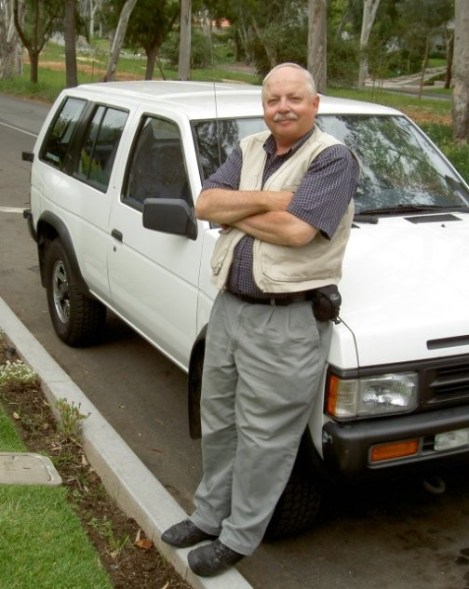
Then, in 1985, at the age of forty, I finally got my drivers license and purchased a four-cylinder Mitsubishi Montero, which lasted for ten years. Then I bought the 1994 Nissan Pathfinder (see photo above) which I am still driving today. I am like Yeats’s Irish airman for whom “a lonely impulse of delight drove to this tumult in the clouds.”

No one loves heavy traffic. Southern California is, unfortunately, a cacopolis with regards to driving. Ah, but then there is nothing like setting off at 4:00 am, before the first hint of sunrise, and dashing through the empty freeways of Los Angeles to the deserts of the Southwest or along the coast to the beauties of the Central Coast and points north. When I can choose my time, driving is sheer pleasure.

That’s why I think that the next step for mankind is not the bus and the bicycle, but another type of vehicle powered by a different source of energy. When it does not become a nightmarish experience, as it so often does, driving could be one of the great pleasures of life.