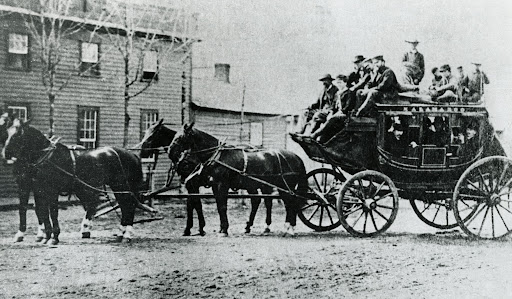
It was ten years before the completion of the transcontinental railroad in 1869. Just by chance, there were three notable journeys across the Plains to the West that year which were described in books that are still worth reading and readily available:
Mark Twain’s Roughing It is partly fictionalized but largely true, and it is still one of the funniest books ever written
Sir Richard Francis Burton’s The City of the Saints: Among the Mormons and Across the Rocky Mountains to California is mostly about a trip to visit Salt Lake City and Brigham Young, but includes the whole journey from East to West
Newspaper Editor Horace Greeley’s An Overland Journey from New York to San Francisco in the Summer of 1859 is not as well known but equally valuable
If you are interested in the history of the Western United States, these three books together constitute a priceless snapshot of what it was like in one particular year.
This evening, two thoughts came together in my mind with a kind of grim ferocity. On one hand, I am troubled by the 74 million voters who backed Trump in 2020. Where did they come from? And why?
On the other hand, I read a wonderful essay by Geoff Dyer entitled “Ranging Across Texas” in the July 17, 2020 issue of The Times Literary Supplement. Dyer is one of those writers whose words set me to thinking. Ostensibly, his essay is about his experience reading Larry McMurtry’s Lonesome Dove. In it he quotes V. S. Naipaul who, in writing about John Steinbeck, says, “A writer is in the end, not his books, but his myth. And that myth is in the keeping of others.”
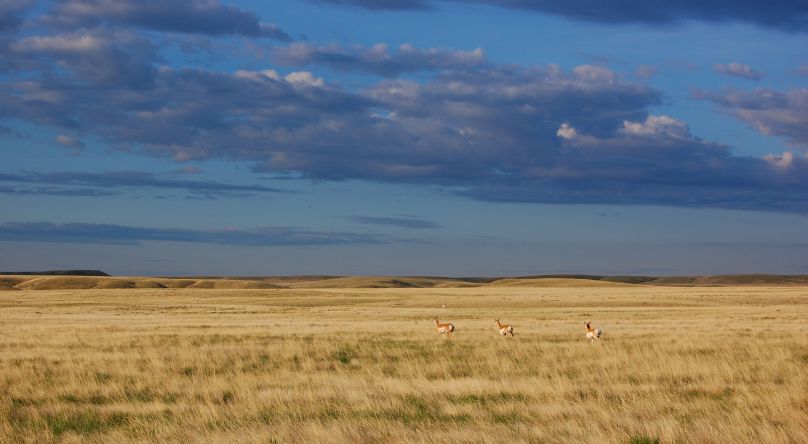
My ideas on this are still not well formed, but I am thinking that there is something about the American landscape and its vastness that gives rise to the crazies who belong to the Oath Keepers, QAnon, the Proud Boys, and others. In the narrowness of the European continent, people have to work together at the risk of repeated mutual slaughters. Americans, however, can hole up in a small town in the middle of nowhere and be as crazy as loons.
America is vast, particularly the West and the Great Plains, where much of Trump’s support is concentrated. (The rest is in the South, where the Civil War is still being contested in slow motion.)
In one of his essays, McMurtry writes:
In time I came to feel that there ought to be some congruity between prose and landscape. You wouldn’t adopt a Faulknerian baroque if your story was to be set on the flat unbaroque plains of west Texas.
I remember my visits to Patagonia where, in the rain shadow of the Andes, where there is almost always a howling wind, there is a similar history of crime and even anarchy.
We don’t much celebrate Columbus Day any more, because we are becoming more acutely conscious of the fact that we massacred millions of Indians for their land. In Patagonia, that was even more of a crime: There are relatively few aborigines in Argentina after the “Conquest of the Desert” of General Julio Argentino Roca in the 1870s.
I guess we have always tried to paper over our crimes with fine thoughts. We just have to recognize, in the words of Kyd’s The Spanish Tragedy, “Hieronymo is mad agayne!”

 Tarnmoor
You must be logged in to post a comment.