Vodka and Zakuski

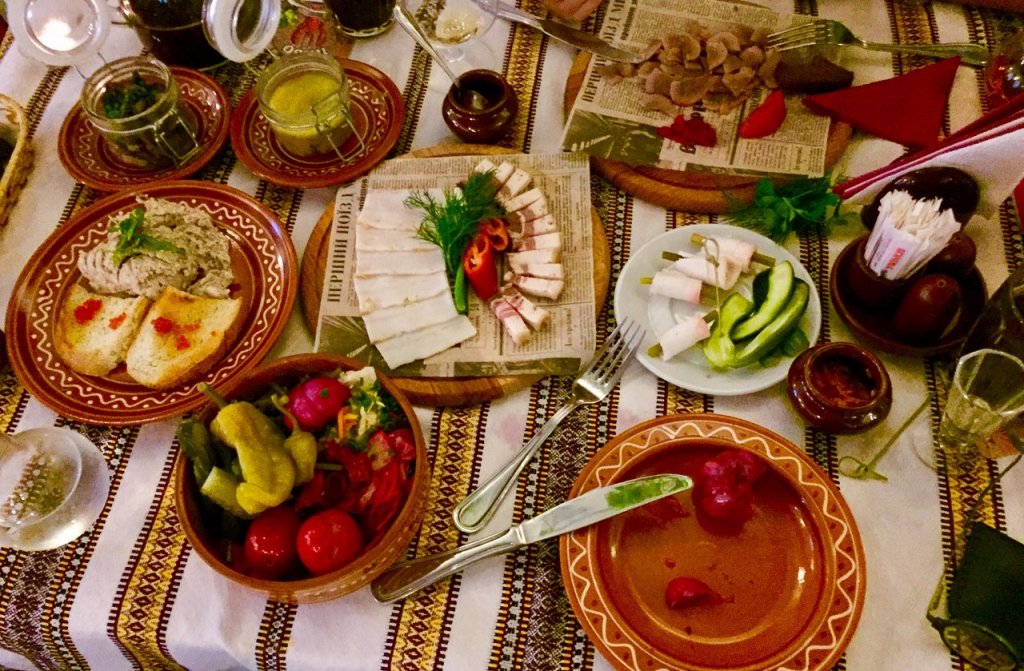
Zakuski: Hors d’Oeuvres to Go with Vodka

It’s a culinary tradition in Slavic countries such as Russia and Ukraine: When you drink vodka, you eat zakuski, which literally means “something to bite after.” It sounds like a delicious culinary tradition. Except for one thing: I’ve never had vodka.

After reading Ukrainian writer Andrey Kurkov’s Jimi Hendrix Live in Lviv (2012), I just might get myself a bottle. Throughout the novel, the characters are dealing with a strange anomaly. The inland city of Lviv has strange incidents of seagulls, starfish, a stench of seaweed, and salt water crabs appearing in various places throughout the city.

Several residents band together to try to identify the problem, which they do after the consumption of a whole lot of vodka and zakuski. Their Lviv is a magical city in which the hand of the late Jimi Hendrix is buried in a local cemetery, having been supplied by the KGB with the help of Lithuanian operatives. Why? Apparently to study the speed of the spreading of rumors in Soviet society.

This is the fifth work of fiction by Ukrainian author Andrey Kurkov that I have read. They are all of them sweet and gentle—especially as they come from a land that is now mired in a brutal invasion by Russian forces. I cannot help but think that Kurkov’s whimsy can be as deadly to Putin’s aims as any weapons in his arsenal. Anyhow, let’s hope so. I have a lot more of Kurkov that I want to read; and I hope he continues to live a long and productive life.

A Great Writer from Ukraine

Andrey Kurkov

Eight years ago, I came across a strange book that I fell in love with. It was by a Ukrainian author who was born in Leningrad (1961) and writes in Russian. Death and the Penguin (1996), his first novel translated into English, became an international bestseller. According to Wikipedia:

The novel follows the life of a young aspiring writer, Viktor Alekseyevich Zolotaryov, in a struggling post-Soviet society. Viktor, initially aiming to write novels, gets a job writing obituaries for a local newspaper. The source of the title is Viktor’s pet penguin Misha, a king penguin obtained after the local zoo in Kyiv gave away its animals to those who could afford to support them. Kurkov uses Misha as a sort of mirror of (and eventual source of salvation for) Viktor. Throughout the story, Misha is also lost, unhappy and generally out of his element, literally and figuratively. One of the striking themes of the novel is Viktor’s tendency to go from justifiably paranoid appraisals of his increasingly dangerous position to a serene, almost childish, peace of mind.

From then, I went on to two other novels and a nonfiction work:

  • Penguin Lost (2005), a sequel to Death and the Penguin
  • The Case of the General’s Thumb (2000)
  • Ukraine Diaries: Dispatches from Kiev (2014)

I am currently most of the way through my favorite of his works: Grey Bees (2018) about a gentle Russian beekeeper who lives in a mostly deserted village in the contested “Grey Zone” between Ukraine and the Russian-occupied Donetsk “People’s Republic,” formerly part of Ukraine. During the course of the story, Sergey Sergeyich travels between zones and tries to survive the fragmentation and confusion that occurs because of Putin’s desire to rebuild the Russian empire as it was. And this was before Putin’s 2022 invasion of Ukraine.

It is not possible to read this book without falling in love with the author’s gentleness in spite of the world falling to pieces around his ears.

Go East Young Man

PARIS – JUNE 07: (FILE PHOTO) Bohumil Hrabal poses while in Paris,France on a promotional visit on the 7th of June 1995. (Photo by Ulf Andersen/Getty Images)

England and Western Europe do not have a monopoly on great literature. I love prospecting for interesting writers from Eastern Europe. Perhaps that has something to do with the fact that I am Hungarian (and Czech and Slovak), and that I feel that the writers of the East have gotten short shrift from the American literary establishment.

I have just finished reading Bohumil Hrabal’s Why I Write? and Other Early Prose Pieces, which consists of his early work, much of which was circulated via samizdat, or underground typescript distribution to bypass strict censorship. There is a freshness to most of the stories within and a sharp attention to dialog as it is actually spoken by common people. Several whole stories consist of stream of consciousness ramblings of Hrabal’s Uncle Pepin, who goes on for pages shifting from one topic to another. Footnotes explain many of the obscure local references to Bars in Prague and people unknown outside of the Czech Republic.

From Ukraine, there is Andrey Kurkov, whose Death and the Penguin fills us in on the absurdity of life in Kiev. His Ukraine Diaries bring us up to date on the tensions with Putin’s Russia.

The former Soviet Union is another good source, such as the literary journalism from Svetlana Alexievich of Belarus, who won the Nobel Prize for Literature in 2015. I was appalled by her book of interviews on the Russian War in Afghanistan, called (in English) Zinky Boys. I also read Voices from Chernobyl, which gives a Russian perspective on that disaster.

Anna Politkovskaya’s criticisms of Putin cost her her life. She was murdered at her block of flats upon returning from grocery shopping. Her books on Chechnya (especially A Small Corner of Hell: Dispatches from Chechnya) and Putin’s Russia earned her the enmity of Putin, who cynically staged a show trial of several stooges who probably didn’t have anything to do with her killing.

Every month I try to read at least one Eastern European book. Often, they are the best things I’ve read that month.

Meanwhile, Back in the Ukraine

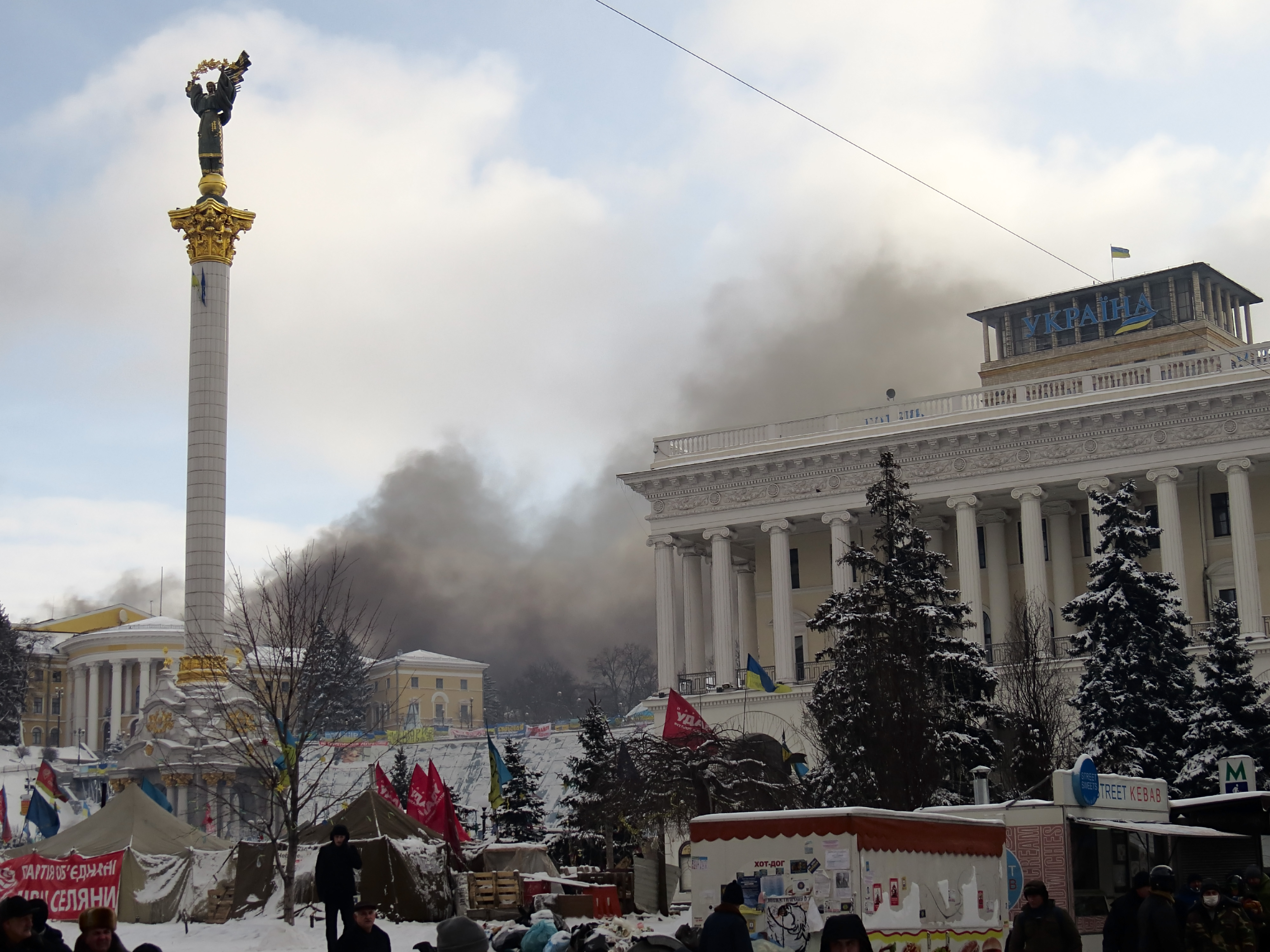
Battle on January 10, 2014 at Kiev’s “Euromaidan”

Battle on January 10, 2014 at Kiev’s “Euromaidan”

The one Ukrainian author I have read is Andrey Kurkov, a Russian who lives in Kiev and considers himself Ukrainian. He is best known for three mystery novels, the first two of which feature a penguin named Mischa: Death and the Penguin, Penguin Lost, and The Case of the General’s Thumb.

During the 2013-2014 revolution that sent President Viktor Yanukovych to Russia requesting asylum from Putin, Kurkov kept a diary of daily events in Kiev, the Crimea, and Eastern Ukraine. It was published in 2014 as Ukrainian Diaries: Dispatches from Kiev. His mystery novels have a wry sense of humor which also carries over to this diary:

Posters and signs have been put up all over the country with images showing that all Ukrainians, after the signature of the Association Agreement with the EU, will become homosexuals. Even in the metro, each time you take an escalator, you have to pass dozens of these posters. In Kiev, he propaganda campaign is considered laughable, but I am afraid that in the east and in the provinces, people will naively believe that universal conversion to homosexuality is the condition imposed by Europe on Ukraine for the signature of the treaty. (November 28, 2013)

And: “Yesterday, Parliament announced an open forum day. Everyone was given the chance to speak. Or, in other words, no one listened.” (February 5, 2014)

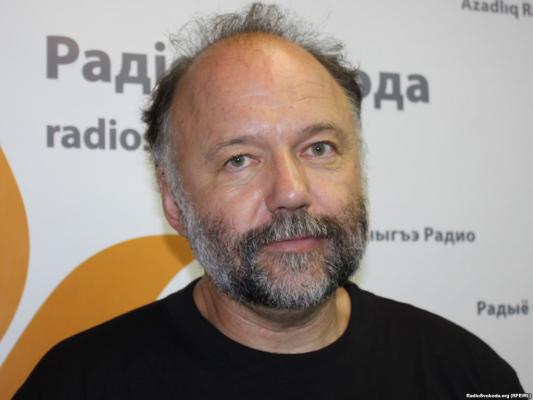
Ukrainian Author Andrey Yuryevich Kurkov

Ukrainian Author Andrey Yuryevich Kurkov

Since it declared its independence from the former Soviet Union in 1991, the Ukraine has had a succession of governments that could only be described as a combination of thuggery and rapine—in fact, pretty much the sort of governing we could expect from a Donald J. Trump. You can see in Kurkov’s penguin mysteries the dysfunctionality of Ukrainian politics at work. Now, in the diaries, we see Kurkov losing sleep whether he would be dragged out of his flat by security forces, tortured, and killed.

Fortunately for us, he wasn’t. I look forward for his other works to be translated from Russian to English.