
The Wanderer

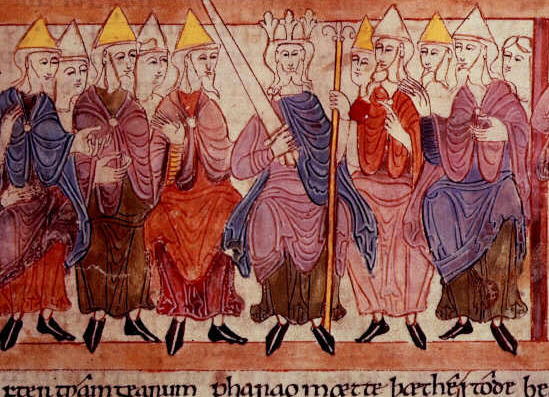
One of Many Anglo-Saxon Edwards Who Preceded the Conquest

The English language has a long history. We don’t have any samples of what the English spoke during the Roman occupation. In fact, it was not until the Angles, Saxons, and Jutes crossed the Channel into Britain that we have the bare bones of a literature. Today, I present one of the great Anglo-Saxon poems.

If you want to hear the poem in the original Anglo-Saxon of the Dark Ages, you can do so by checking out this YouTube site. It is a far, far cry from the language we speak today.

Here is “The Wanderer” in a modern translation from the Poetry Foundation:

The Wanderer

Always the one alone longs for mercy,
the Maker’s mildness, though, troubled in mind,
across the ocean-ways he has long been forced
co stir with his hands the frost-cold sea,
and walk in exile’s paths. Wyrd is fully fixed.

   Thus spoke the Wanderer, mindful of troubles,

of cruel slaughters and dear kinsmen’s downfall:
“Often alone, in the first light of dawn,
I have sung my lament. There is none living
to whom I would dare to reveal clearly
my heart’s thoughts. I know it is true
that it is a nobleman’s lordly nature
to closely bind his spirit’s coffer,
hold fast his treasure-hoard, whatever he may think.
The weary mind cannot withstand wyrd,
the troubled heart can offer no help,
and so those eager for fame often bind fast
in their breast-coffers a sorrowing soul,
just as I have had to take my own heart—
Often wretched, cut off from my own homeland,
far from dear kinsmen—and bind it in fetters,
ever since long ago I hid my gold-giving friend
in the darkness of earth, and went wretched,
winter-sad, over the ice-locked waves,
sought, hall-sick, a treasure-giver,
wherever I might find, far or near,
someone in a meadhall who might know my people,
or who would want to comfort me, friendless,
accustom me to joy. He who has come to know
how cruel a companion is sorrow
for one with few dear friends, will understand:
the path of exile claims him, not patterned gold,
a winter-bound spirit, not the wealth of earth.
He remembers hall-holders and treasure-taking,
how in his youth his gold-giving lord
accustomed him to the feast—that joy has all faded.

   And so he who has long been forced to forego

his lord’s beloved words of counsel will understand:
when sorrow and sleep both together
often bind up the wretched exile,
it seems in his mind that he clasps and kisses
his lord of men, and on his knee lays
hands and head, as he sometimes long ago
in earlier days enjoyed the gift-throne.
But when the friendless man awakens again
and sees before him the fallow waves,
seabirds bathing, spreading their feathers,
frost falling and snow, mingled with hail,
then the heart’s wounds are that much heavier,
longing for his loved one. Sorrow is renewed
when the memory of kinsmen flies through the mind;
he greets them with great joy, greedily surveys
hall-companions—they always swim away;
the floating spirits bring too few
familiar voices. Cares are renewed
for one who must send, over and over,
a weary heart across the binding waves.

   And so I cannot imagine for all this world

why my spirit should not grow dark
when I think through all this life of men,
how suddenly they gave up the hall-floor,
mighty young retainers. Thus this middle-earth
droops and decays every single day;
and so a man cannot become wise, before he has weathered
his share of winters in this world. A wise man must be patient,
neither too hot-hearted nor too hasty with words,
nor too weak in war nor too unwise in thoughts,
neither fretting nor fawning nor greedy for wealth,
never eager for boasting before he truly understands;
a man must wait, when he makes a boast,
until the brave spirit understands truly
where the thoughts of his heart will turn.

   The wise man must realize how ghastly it will be

when all the wealth of this world stands waste,
as now here and there throughout this middle-earth
walls stand blasted by wind,
beaten by frost, the buildings crumbling.
The wine halls topple, their rulers lie
deprived of all joys; the proud old troops
all fell by the wall. War carried off some,
sent them on the way, one a bird carried off
over the high seas, one the gray wolf
shared with death—and one a sad-faced man
covered in an earthen grave. The Creator
of men thus destroyed this walled city,
until the old works of giants stood empty,
without the sounds of their former citizens.

   He who deeply considers, with wise thoughts,

this foundation and this dark life,
old in spirit, often remembers
so many ancient slaughters, and says these words:
‘Where has the horse gone? where is the rider? where is the giver of gold?
Where are the seats of the feast? where are the joys of the hall?
O the bright cup! O the brave warrior!
O the glory of princes! How the time passed away,
slipped into nightfall as if it had never been!
There still stands in the path of the dear warriors
a wall wondrously high, with serpentine stains.
A storm of spears took away the warriors,
bloodthirsty weapons, wyrd the mighty,
and storms batter these stone walls,
frost falling binds up the earth,
the howl of winter, when blackness comes,
night’s shadow looms, sends down from the north
harsh hailstones in hatred of men.
All is toilsome in the earthly kingdom,
the working of wyrd changes the world under heaven.
Here wealth is fleeting, here friends are fleeting,
here man is fleeting, here woman is fleeting,
all the framework of this earth will stand empty.’

   So said the wise one in his mind, sitting apart in meditation.

He is good who keeps his word, and the man who never too quickly
shows the anger in his breast, unless he already knows the remedy
a noble man can bravely bring about. It will be well for one who seeks mercy,
consolation from the Father in heaven, where for us all stability stands.

A Word of Explanation

The following discussion is taken from the Octavia Randolph website:

Wyrd is an Old English noun, a feminine one, from the verb weorthan “to become”. It is related to the Old Saxon wurd, Old High German wurt, Old Norse urür. Wyrd is the ancestor of the more modern weird, which before it meant odd or unusual in the pejorative sense carried connotations of the supernatural, as in Shakespeare’s weird sisters, the trio of witches in MacBeth. The original Wyrd Sisters were of course, the three Norns, the Norse Goddesses of destiny.

Wyrd is Fate or Destiny, but not the “inexorable fate” of the ancient Greeks. “A happening, event, or occurrence”, found deeper in the Oxford English Dictionary listing is closer to the way our Anglo-Saxon and Norse forbears considered this term. In other words, Wyrd is not an end-point, but something continually happening around us at all times. One of the phrases used to describe this difficult term is “that which happens”.
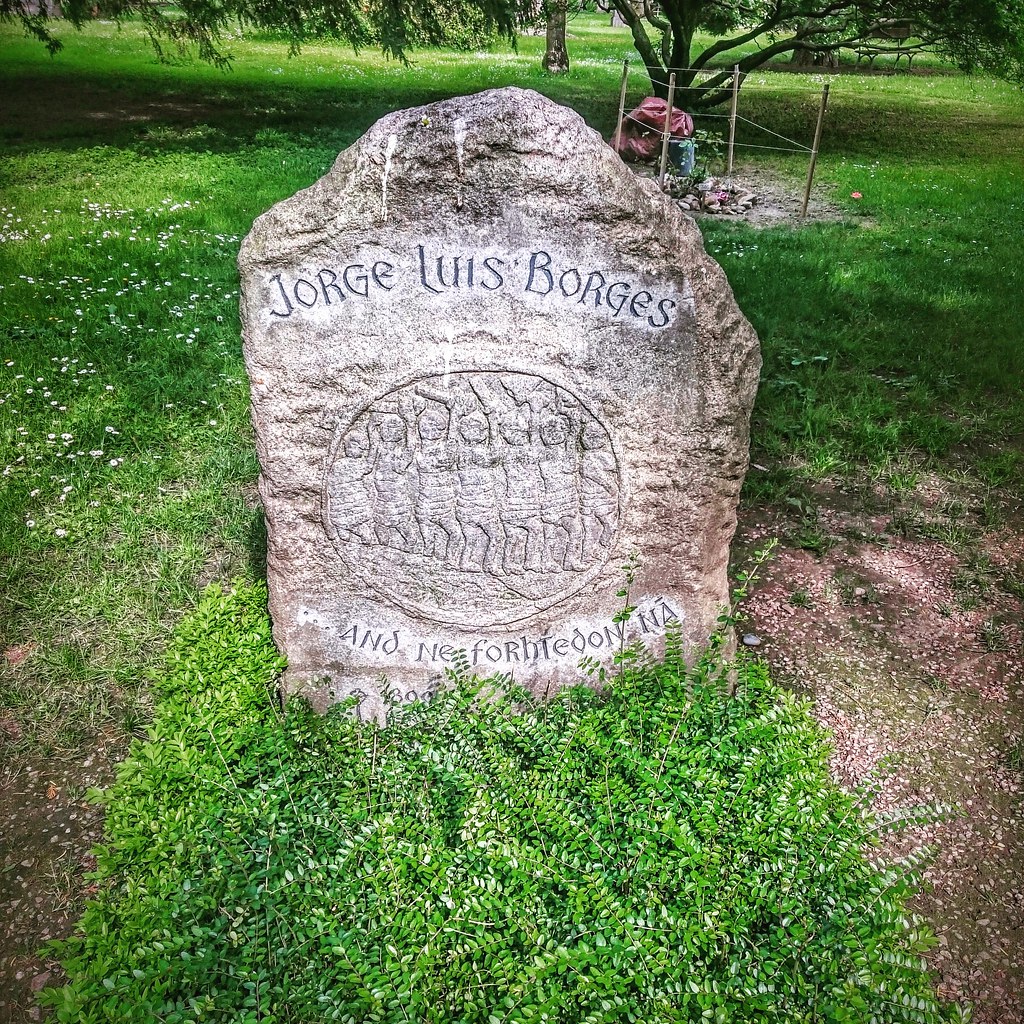
And ne forhtedon na

The Tomb of Jorge Luis Borges (1899-1986) in Geneva Switzerland

The title of this post is in Anglo-Saxon from the gravestone of Jorge Luis Borges. It comes from The Battle of Maldon. Translated, it means “Be not afraid.” Toward the end of his life, Borges learned Anglo-Saxon and even studied Old Norse, which is the language of Iceland.

Here is an early poem by Borges (from Fervor de Buenos Aires, 1923) on the subject of death. The translation is by W. S. Merwin.

Remorse for Any Death

Free of memory and hope,
unlimited, abstract, almost future,
the dead body is not somebody: It is death.
Like the God of the mystics,
whom they insist has no attributes,
the dead person is no one everywhere,
is nothing but the loss and absence of the world.
We rob it of everything,
we do not leave it one color, one syllable:
Here is the yard which its eyes no longer take up,
there is the sidewalk where it waylaid its hope.
It might even be thinking
what we are thinking.
We have divided among us, like thieves,
the treasure of nights and days.

Ezra Pound’s “The Seafarer”

If he did nothing else during his life, Ezra Pound (1885-1972) gave us a magnificent translation of one of the great surviving Anglo-Saxon poems:

The Seafarer

May I for my own self song’s truth reckon,
Journey’s jargon, how I in harsh days
Hardship endured oft.
Bitter breast-cares have I abided,
Known on my keel many a care’s hold,
And dire sea-surge, and there I oft spent
Narrow nightwatch nigh the ship’s head
While she tossed close to cliffs. Coldly afflicted,
My feet were by frost benumbed.
Chill its chains are; chafing sighs
Hew my heart round and hunger begot
Mere-weary mood. Lest man know not
That he on dry land loveliest liveth,
List how I, care-wretched, on ice-cold sea,
Weathered the winter, wretched outcast
Deprived of my kinsmen;
Hung with hard ice-flakes, where hail-scur flew,
There I heard naught save the harsh sea
And ice-cold wave, at whiles the swan cries,
Did for my games the gannet’s clamour,
Sea-fowls, loudness was for me laughter,
The mews’ singing all my mead-drink.
Storms, on the stone-cliffs beaten, fell on the stern
In icy feathers; full oft the eagle screamed
With spray on his pinion.
Not any protector
May make merry man faring needy.
This he little believes, who aye in winsome life
Abides ‘mid burghers some heavy business,
Wealthy and wine-flushed, how I weary oft
Must bide above brine.
Neareth nightshade, snoweth from north,
Frost froze the land, hail fell on earth then
Corn of the coldest. Nathless there knocketh now
The heart’s thought that I on high streams
The salt-wavy tumult traverse alone.
Moaneth alway my mind’s lust
That I fare forth, that I afar hence
Seek out a foreign fastness.
For this there’s no mood-lofty man over earth’s midst,
Not though he be given his good, but will have in his youth greed;
Nor his deed to the daring, nor his king to the faithful
But shall have his sorrow for sea-fare
Whatever his lord will.
He hath not heart for harping, nor in ring-having
Nor winsomeness to wife, nor world’s delight
Nor any whit else save the wave’s slash,
Yet longing comes upon him to fare forth on the water.
Bosque taketh blossom, cometh beauty of berries,
Fields to fairness, land fares brisker,
All this admonisheth man eager of mood,
The heart turns to travel so that he then thinks
On flood-ways to be far departing.
Cuckoo calleth with gloomy crying,
He singeth summerward, bodeth sorrow,
The bitter heart’s blood. Burgher knows not —
He the prosperous man — what some perform
Where wandering them widest draweth.
So that but now my heart burst from my breast-lock,
My mood ‘mid the mere-flood,
Over the whale’s acre, would wander wide.
On earth’s shelter cometh oft to me,
Eager and ready, the crying lone-flyer,
Whets for the whale-path the heart irresistibly,
O’er tracks of ocean; seeing that anyhow
My lord deems to me this dead life
On loan and on land, I believe not
That any earth-weal eternal standeth
Save there be somewhat calamitous
That, ere a man’s tide go, turn it to twain.
Disease or oldness or sword-hate
Beats out the breath from doom-gripped body.
And for this, every earl whatever, for those speaking after —
Laud of the living, boasteth some last word,
That he will work ere he pass onward,
Frame on the fair earth ‘gainst foes his malice,
Daring ado, …
So that all men shall honour him after
And his laud beyond them remain ‘mid the English,
Aye, for ever, a lasting life’s-blast,
Delight mid the doughty.
Days little durable,
And all arrogance of earthen riches,
There come now no kings nor Cæsars
Nor gold-giving lords like those gone.
Howe’er in mirth most magnified,
Whoe’er lived in life most lordliest,
Drear all this excellence, delights undurable!
Waneth the watch, but the world holdeth.
Tomb hideth trouble. The blade is layed low.
Earthly glory ageth and seareth.
No man at all going the earth’s gait,
But age fares against him, his face paleth,
Grey-haired he groaneth, knows gone companions,
Lordly men are to earth o’ergiven,
Nor may he then the flesh-cover, whose life ceaseth,
Nor eat the sweet nor feel the sorry,
Nor stir hand nor think in mid heart,
And though he strew the grave with gold,
His born brothers, their buried bodies
Be an unlikely treasure hoard.

A Proof of Immortality?

Anglo-Saxon Facial Armor

Once again I turn to the Argentinian poet Jorge Luis Borges who in so many ways replicates my thoughts. Perhaps, it is because he has influenced me so much over so many years?

Poem Written in a
Copy of Beowulf

At various times I have asked myself what reasons
Moved me to study while my night came down,
Without particular hope of satisfaction,
The language of the blunt-tongued Anglo-Saxons.
Used up by the years my memory
Loses its grip on words that I have vainly
Repeated and repeated. My life in the same way
Weaves and unweaves its weary history.
Then I tell myself: it must be that the soul
Has some secret sufficient way of knowing
That it is immortal, that its vast encompassing
Circle can take in all, can accomplish all.
Beyond my anxiety and beyond this writing
The universe waits, inexhaustible, inviting.

This translation is by Alastair Reid from Jorge Luis Borges: Selected Poems 1923-1967, edited by Norman Thomas di Giovanni.


“That Came to Pass This Also May”

Anglo-Saxon Court

Anglo-Saxon Court

This blog posting consists of three views of an Anglo-Saxon poem called “Deor.” First I suggest you click here to see the poem being recited aloud in the original language.

Next, here is Seamus Heaney’s translation of the poem in modern English:

Welund himself knew misery by worms.
The brave man knew hardship,
had to himself for company sorrow and longing,
winter-cold misery; He often found woe,
since Nithhad by force laid a thin sinew-bond onto the better man.

That came to pass, this also may!

Beadohilde was not as sorrowful from her brothers’ death
as from her own thing,
that she certainly understood that she was pregnant;
She was never able to think confidently,
about what she should do.

That came to pass, this also may!

We found out that for Maethhilde,
many became the bottomless embraces of the Geat,
that the sorrowful love deprived her of all sleep.

That came to pass, this also may!

Theodric possessed for thirty winters the city of Maeringa;
That was known to many.

That came to pass, this also may!

We discovered the wolfen thought of Ermanaricus;
He occupied widely the people of the kingdom of the Goths.
That was a harsh king.
Many a man lived bound to sorrows,
woe in expectation,
often wishing that this kingdom was overcome.

That came to pass, this also may!

He lived sorrowful, deprived of joy,
he grew dark in his spirit,
it seemed to him that the troubles would be endless.
I might then think that throughout this world the wise Lord changes enough,
shows honour to many a man, true splendor,
a portion of woes to some.

That I by myself wish to tell,
that I once was a scop of the Heodenings,
dear Lord.

The name ‘Deor’ was mine.

I had for many winters a good fellowship, a loyal lord,
until now Heorrenda, a man skilled in poetry,
received a privilege that the protecting lord once gave to me.

That came to pass, this also may!

Finally, here is the written poem in the original Anglo-Saxon:

Welund him be wurman    wræces cunnade.
Anhydig eorl    earfoþa dreag,
hæfde him to gesiþþe    sorge ond longaþ,
wintercealde wræce,    wean oft onfond,
siþþan hine Niðhad on    nede legde
swoncre seonobende    on syllan monn.
Þæs ofereode,    þisses swa mæg!
Beadohilde ne wæs    hyre broþra deaþ
on sefan swa sar    swa hyre sylfre þing:
þæt heo gearolice    ongieten hæfde
þæt heo eacen wæs—    æfre ne meahte
þriste geþencan,    hu ymb þæt sceolde.
Þæs ofereode,    þisses swa mæg!
We þæt Mæðhilde    monge gefrugnon
wurdon grundlease    Geates frige,
þæt hi seo sorglufu    slæp ealle binom.
Þæs ofereode,    þisses swa mæg!
Ðeodric ahte    þritig wintra
Mæringa burg—    þæt wæs monegum cuþ.
Þæs ofereode,    þisses swa mæg!
We geascodan    Eormanrices
wylfenne geþoht;    ahte wide folc
Gotena rices.    Þæt wæs grim cyning.
Sæt secg monig    sorgum gebunden,
wean on wenan,    wyscte geneahhe
þæt þæs cynerice    ofercumen wære.
Þæs ofereode,    þisses swa mæg!
Siteð sorgcearig    sælum bidæled,
on sefan sweorceð,    sylfum þinceð
þæt sy endeleas    earfoða dæl.
Mæg þonne geþencan    þæt geond þas woruld
witig dryhten    wendeþ geneahhe,
eorle monegum    are gesceawað,
wislicne blæd,    sumum weana dæl.
Þæt ic bi me sylfum    secgan wille,
þæt ic hwile wæs    Heodeninga scop,
dryhtne dyre.    Me wæs Deor noma.
Ahte ic fela wintra    folgað tilne,
holdne hlaford,    oþþæt Heorrenda nu,
leoðcræftig monn    londryht geþah,
þæt me eorla hleo    ær gesealde.
Þæs ofereode,    þisses swa mæg!

There are only two letters of the alphabet that are unfamiliar to most of us. There is the thorn (Þ), which is pronounced like the soft th in thick. Next is the edh (ð), pronounced like the hard th in then.

Notice how the poetic line is broken into two fragments, with the additional space indicating a pause.

After a while, the recurring refrain Þæs ofereode,    þisses swa mæg!—“That came to pass, this also may”stands out like the heart of Anglo-Saxon philosophy. The gentle fatalism of that refrain is one of the things we lost when Harold Godwinsson died at Hastings in 1066 with a Norman arrow in his eye.

I now know why Jorge Luis Borges was so intent on learning Anglo-Saxon towards the end of his life. It is a beautiful language and lends itself well to poetry.

The Shield Wall

Anglo-Saxon Battle Helmet

Anglo-Saxon Battle Helmet

I am continuing to undergo a period of interest in the Anglo-Saxons. It started with some old poetry, and now I am reading the latest in Bernard Cornwell’s excellent series various called Warrior Chronicles and Saxon Tales. Set in the Tenth Century, we see the half-pagan, half-Christian Uhtred of Bebbanburg and his son of the same name battling internal enemies in the Mercian kingdom as well as Viking raiders.

Warfare among the Anglo-Saxons was a bloody affair. The warriors on each side linked their shields together and proceeded to hack above and below them with swords and axes to bring down their foe. In The Empty Throne, we find the senior Uhtred laid up with battle scars, but pretending to be hurt more than he is.

Reading this description of shield wall battle from Cornwell’s earlier The Pagan Lord, one wonders that he is alive at all:

There is a way of battle. In the end the shield walls must meet and the slaughter will begin and one side will prevail and the other will be beaten down in a welter of butchery, but before the blades clash and before the shields crash, men must summon the nerve to make the charge. The two sides stare at each other, they taunt and insult each other. The young fools of each army will prance ahead of the wall and challenge their enemy to single combat, they will boast of the widows they plan to make and of the orphans who will weep for their fathers’ deaths. And the young fools fight and half of them will die, and the other half strut their bloody victory, but there is still no true victory because the shield walls have not met. And still the waiting goes on. Some men vomit with fear, others sing, some pray, but then at last one side will advance. It is usually a slow advance. Men crouch behind their shields, knowing that spears, axes and arrows will greet them before the shields slam together, and only when they are close, really close, does the attacker charge. Then there is a great bellow of noise, a roar of anger and fear, and the shields meet like thunder and the big blades fall and the swords stab and the shrieks fill the sky as the two shield walls fight to the death. That is the way of battle.

After years of reading Cornwell’s Richard Sharpe novels of the Napoleonic Wars, which I devoured with great pleasure, I find the Warrior Chronicles to be at least as good.

The Seafarer

Viking Craft

Viking Craft

Several days ago, I quoted an Anglo-Saxon poem called “The Wanderer.” Today, I give you a somewhat longer piece, which was translated by Ezra Pound in 1911. According to Wikipedia:

The poem is told from the point of view of an old seafarer, who is reminiscing and evaluating his life as he has lived it. The seafarer describes the desolate hardships of life on the wintry sea. He describes the anxious feelings, cold-wetness, and solitude of the sea voyage in contrast to life on land where men are surrounded by kinsmen, free from dangers, and full on food and wine. The climate on land then begins to resemble that of the wintry sea, and the speaker shifts his tone from the dreariness of the winter voyage and begins to describe his yearning for the sea. Time passes through the seasons from winter — “it snowed from the north” — to spring — “groves assume blossoms” — and to summer — “the cuckoo forebodes, or forewarns.”

Then the speaker again shifts, this time not in tone, but in subject matter. The sea is no longer explicitly mentioned; instead the speaker preaches about steering a steadfast path to heaven. He asserts that “earthly happiness will not endure,” that men must oppose “the devil with brave deeds,” and that earthly wealth cannot travel to the afterlife nor can it benefit the soul after a man’s death.

Generally speaking, I am not a big fan of Ezra Pound, but in this early version, I think he surpasses himself. This is “The Seafarer” by that greatest of Anglo-Saxon poets, Anonymous:

May I for my own self song’s truth reckon,
Journey’s jargon, how I in harsh days
Hardship endured oft.
Bitter breast-cares have I abided,
Known on my keel many a care’s hold,
And dire sea-surge, and there I oft spent
Narrow nightwatch nigh the ship’s head
While she tossed close to cliffs. Coldly afflicted,
My feet were by frost benumbed.
Chill its chains are; chafing sighs
Hew my heart round and hunger begot
Mere-weary mood. Lest man know not
That he on dry land loveliest liveth,
List how I, care-wretched, on ice-cold sea,
Weathered the winter, wretched outcast
Deprived of my kinsmen;
Hung with hard ice-flakes, where hail-scur flew,
There I heard naught save the harsh sea
And ice-cold wave, at whiles the swan cries,
Did for my games the gannet’s clamour,
Sea-fowls, loudness was for me laughter,
The mews’ singing all my mead-drink.
Storms, on the stone-cliffs beaten, fell on the stern
In icy feathers; full oft the eagle screamed
With spray on his pinion.
Not any protector
May make merry man faring needy.
This he little believes, who aye in winsome life
Abides ‘mid burghers some heavy business,
Wealthy and wine-flushed, how I weary oft
Must bide above brine.
Neareth nightshade, snoweth from north,
Frost froze the land, hail fell on earth then
Corn of the coldest. Nathless there knocketh now
The heart’s thought that I on high streams
The salt-wavy tumult traverse alone.
Moaneth alway my mind’s lust
That I fare forth, that I afar hence
Seek out a foreign fastness.
For this there’s no mood-lofty man over earth’s midst,
Not though he be given his good, but will have in his youth greed;
Nor his deed to the daring, nor his king to the faithful
But shall have his sorrow for sea-fare
Whatever his lord will.
He hath not heart for harping, nor in ring-having
Nor winsomeness to wife, nor world’s delight
Nor any whit else save the wave’s slash,
Yet longing comes upon him to fare forth on the water.
Bosque taketh blossom, cometh beauty of berries,
Fields to fairness, land fares brisker,
All this admonisheth man eager of mood,
The heart turns to travel so that he then thinks
On flood-ways to be far departing.
Cuckoo calleth with gloomy crying,
He singeth summerward, bodeth sorrow,
The bitter heart’s blood. Burgher knows not —
He the prosperous man — what some perform
Where wandering them widest draweth.
So that but now my heart burst from my breast-lock,
My mood ‘mid the mere-flood,
Over the whale’s acre, would wander wide.
On earth’s shelter cometh oft to me,
Eager and ready, the crying lone-flyer,
Whets for the whale-path the heart irresistibly,
O’er tracks of ocean; seeing that anyhow
My lord deems to me this dead life
On loan and on land, I believe not
That any earth-weal eternal standeth
Save there be somewhat calamitous
That, ere a man’s tide go, turn it to twain.
Disease or oldness or sword-hate
Beats out the breath from doom-gripped body.
And for this, every earl whatever, for those speaking after —
Laud of the living, boasteth some last word,
That he will work ere he pass onward,
Frame on the fair earth ‘gainst foes his malice,
Daring ado, …
So that all men shall honour him after
And his laud beyond them remain ‘mid the English,
Aye, for ever, a lasting life’s-blast,
Delight mid the doughty.
Days little durable,
And all arrogance of earthen riches,
There come now no kings nor Cæsars
Nor gold-giving lords like those gone.
Howe’er in mirth most magnified,
Whoe’er lived in life most lordliest,
Drear all this excellence, delights undurable!
Waneth the watch, but the world holdeth.
Tomb hideth trouble. The blade is layed low.
Earthly glory ageth and seareth.
No man at all going the earth’s gait,
But age fares against him, his face paleth,
Grey-haired he groaneth, knows gone companions,
Lordly men are to earth o’ergiven,
Nor may he then the flesh-cover, whose life ceaseth,
Nor eat the sweet nor feel the sorry,
Nor stir hand nor think in mid heart,
And though he strew the grave with gold,
His born brothers, their buried bodies
Be an unlikely treasure hoard.

“Here Is Man Brief”

Scene from the Bayeux Tapestry

Scene from the Bayeux Tapestry

This was a world that almost seemed to know it wasn’t going to be around long. Anglo-Saxon poetry is not plentiful, but what exists has a sadness that is touching. The following is an excerpt from “The Wanderer” as translated by Clifford Truesdell IV:

Where went the rider? Where went the giver of treasure? Where went the high seats? Where are the halls of feasting? Alas for the bright cup! Alas for the mailed warrior! Alas for the prince’s glory! How time vanishes, darkens under night’s helmet as if it never were. Stands now where stood beloved companions a wall, wondrous high, snake-like mottled. Spears’ might took off the warriors, slaughter-greedy weapons, notorious fate; and storms smite these stone walls; snow falling binds the earth, winter’s tumult. When dark comes night’s shadow deepens, sends from north fierce hail-fall, to harrow men. All is hardship in earth realm, Fate’s course undoes world under heaven. Here are goods brief, here is friend brief, here is man brief, here is kin brief.

Virtually all known Anglo-Saxon poems and fragments can fit into a slim paperback edition. I myself own two such collections, and find myself coming back again and again.