
Why the Arab Spring Failed

With Islam, You Have to Buy the Whole Package

With Islam, You Have to Buy the Whole Package

If a religion is pervasive enough to tell you which hand to use to wipe your butt, the chances are that things won’t improve when you throw out that dictator, such as Mubarak, Assad, or Gaddafi. Instead of a thousand flowers blooming, what you are likely to get in his place is a bunch of ragged bearded men brandishing AK-47s and insisting on more radical forms of religious fundamentalism. Since politics and then whole subject of governance is dictated by the Quran, there is no such thing as democracy or a constitution that does not comply with Sharia law. There is only religious fundamentalism or dictatorship: the dial does not go in any other direction.

My comments here are primarily restricted to the Arab countries and a few North African countries. For over half a century, Turkey has been a largely secular democracy (though with some Islamist leanings). The Muslims of Southeast Asia run the gamut from Pakistan as the most fundamentalist to Malaysia and Indonesia as more permissive.

With most flavors of Islam, there is no hierarchy: There are just a lot of imams contradicting one another. (The only exception is Iran, where there is a hierarchy of Ayatollahs with Khamenei in charge.)

When many of the Arab (and some North African) countries erupted two years ago, most Americans (myself included) had some foolish notion that the result would be an ultimate victory for liberal democracy. As it turned out, it was anything but!
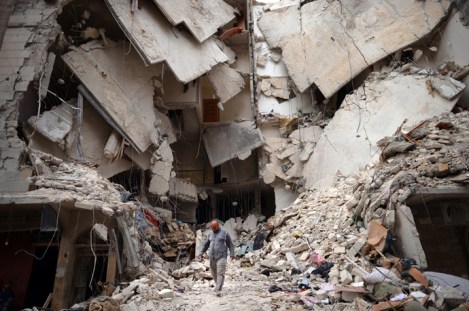
Heads I Win, Tails You Lose

Yeah, Let’s Clean It Up and Rid Ourselves of More American Fighting Men and Women

Yeah, Let’s Clean It Up and Rid Ourselves of More American Fighting Men and Women!

Even at this late date, we can find Neocons and Universal Hawks like John McCain advocating that we intervene militarily in Syria. After all, it worked so well for us in Iraq, Afghanistan, and Libya.

Now first of all, whom do we support? The cruel Baathist dictatorship of Bashar al-Assad, or the Islamofascists of Al-Qaida? Come on, quick! It’s one or the other. Or maybe we can just kill everyone and turn the country into a parking lot for future wars.

I am beginning to think that one characteristic of Americans is that they do not have the ability to learn from experience. Do you suppose it could be all that Oxycontin, or maybe there’s something in that bad beer that most Yanquis drink while watching (un)reality shows on the idiot box? In any case, as soon as the opportunity for another war in a country that we don’t understand (and—really—do we understand any of them?) presents itself, there’s a large contingent all gung ho for getting G.I. boots on the ground.

Let me look in my crystal ball: If we intervene on behalf of Bashar, we will be treated with contempt the world over. If we intervene on behalf of the rebels, we will be allying ourselves with Al-Qaida—and we will be treated with contempt the world over. If we don’t intervene at all, we will be treated with contempt the world over … but we wouldn’t have to bury the charred, exploded remains of thousands of young American men and women. I don’t know, but number three is looking mighty good to me.

The Arab Spring has shown us that the Middle Eastern man in the street wants to live in a democracy like Americans, but they have absolutely no idea of how to get there. The only people who are well organized are either the Islamofascists or the tyrants and their stooges. There are maybe a handful of others, but they are constantly disheartened by the actions of their coreligionists.

I think that the best thing we can do is not rely on the Middle East for anything and just let the people kill one another. Sure, we can send them Band Aids and antiseptics and such, but no weapons and none of our military personnel.

Living With the Mau Mau

Mau Mau Terrorists in Kenya

Things change. I remember during the 1950s reading horror stories of the Mau Mau Uprising in Kenya. There were ghastly tales of what the Kikuyu were doing to British settlers. Around the same time, the Hungarian Revolution of 1956 was taking place. I still remember reading—was it in The Reader’s Digest?—of the Communist Secret Police (the dread AVO) taking captured Budapest prisoners and grinding their living bodies into hamburger meat. For themselves? To feed to their pets?

Not too much time passed before Jomo “Burning Spear” Kenyatta, one of the leaders of the Mau Mau, was named President of an independent Kenya in 1964. Then, after the Hungarian Revolution was ground into goulash by the Russian Tanks of Nikita Khruschchev, Hungarian President János Kádar developed a reputation as being one of the most enlightened Communist satellite leaders—without in any way sacrificing his Marxist/Leninist credentials.

We are perhaps facing a similar situation with the changes wrought by the Arab Spring. Groups that had been associated with terrorism may perhaps turn out to be our Middle East allies of tomorrow:

Amid chaos and uncertainty, the Islamists alone offer a familiar, authentic vision for the future. They might fail or falter, but who will pick up the mantle? Liberal forces have a weak lineage, slim popular support, and hardly any organizational weight. Remnants of the old regime are familiar with the ways of power yet they seem drained and exhausted. If instability spreads, if economic distress deepens, they could benefit from a wave of nostalgia. But they face long odds, bereft of an argument other than that things used to be bad, but now are worse.

These are the observations of Hussein Agha and Robert Malley writing in the November 8, 2012, issue of The New York Review of Books in their excellent article “This Is Not a Revolution.”