Serendipity: “Nothing Is Ever Repeated”

Juan José Saer (1937-2005)

Juan José Saer (1937-2005)

This is how I find new authors: Sick with a miserable cold, I go to Yamadaya Ramen in Westwood and while snarfing down a premium shio with extra bamboo shoots, I read the November 20, 2014 edition of The New York Review of Books and find a review by David Gallagher of an Argentinean author I would very much like to read, Juan José Saer. Here he talks about La Grande, Saer’s unfinished novel that has recently been published by Open Letter:

On a long, meditative bus ride from Rosario back to Santa Fe, Tomatis concludes that even the most familiar objects in his house change all the ti9me. “When we return to the kitchen from the dining room, or to the dining room from the kitchen, in the time it takes to find a clean knife in the utensil drawer, everything has changed,” he muses, and in the manner of the Colastiné Indians, he wonders if his house or town will still be there when he gets back. Nula is fascinated with the notion that no two instances are alike, and he obsesses about it on the most unlikely occasions, as when he kisses for the first time a girl called Virginia, with whom he is about to have a one-night stand. In his car, on their way to a motel he reflects that no two kisses are the same. With Virginia by his side he somehow has the time and the inclination to tell himself that

although everything is alike, nothing is ever repeated, and that since the beginning of time, when the great delirium began its expansion, … every event is unique, flaming, unknown, and ephemeral: the individual does not incarnate the species, and the part is not a part of the whole, but only a part, and the whole in turn is always a part; there is no whole; the goldfinch that sings at dawn sings for itself; … and its previous song, which even it does not remember singing, and which seems so much like the one before, if one listened carefully, would clearly be different.

 

The Liberator and the Ombú

I Had to Come All the Way to Peru to See This Argentinian Tree

I Had to Come All the Way to Peru to See This Argentinian Tree

It is a tree from the pampas of Argentina, which, although I have been to that country twice, I have not yet seen at ground level. My first acquaintance with the tree is from W. H. Hudson’s little known (but excellent) Tales of the Pampas:

In all this district, though you should go twenty leagues to this way and that, you will not find a tree as big as this ombú, standing solitary, where there is no house; therefore it is known to all as “the ombú,” as if but one existed; and the name of all this estate, which is now ownerless and ruined, is El Ombú. From one of the higher branches, if you can climb, you will see the lake of Chascomus, two thirds of a league away, from shore to shore, and the village on its banks. Even smaller things will you see on a clear day; perhaps a red line moving across the water—a flock of flamingos flying in their usual way. A great tree standing alone, with no house near it; only the old brick foundations of a house, so overgrown with grass and weeds that you have to look closely to find them. When I am out with my flock in the summer time, I often come here to sit in the shade. It is near the main road; travellers, droves of cattle, the diligence, and bullock-carts pass in sight. Sometimes, at noon, I find a traveller resting in the shade, and if he is not sleeping we talk and he tells me the news of that great world my eyes have never seen.

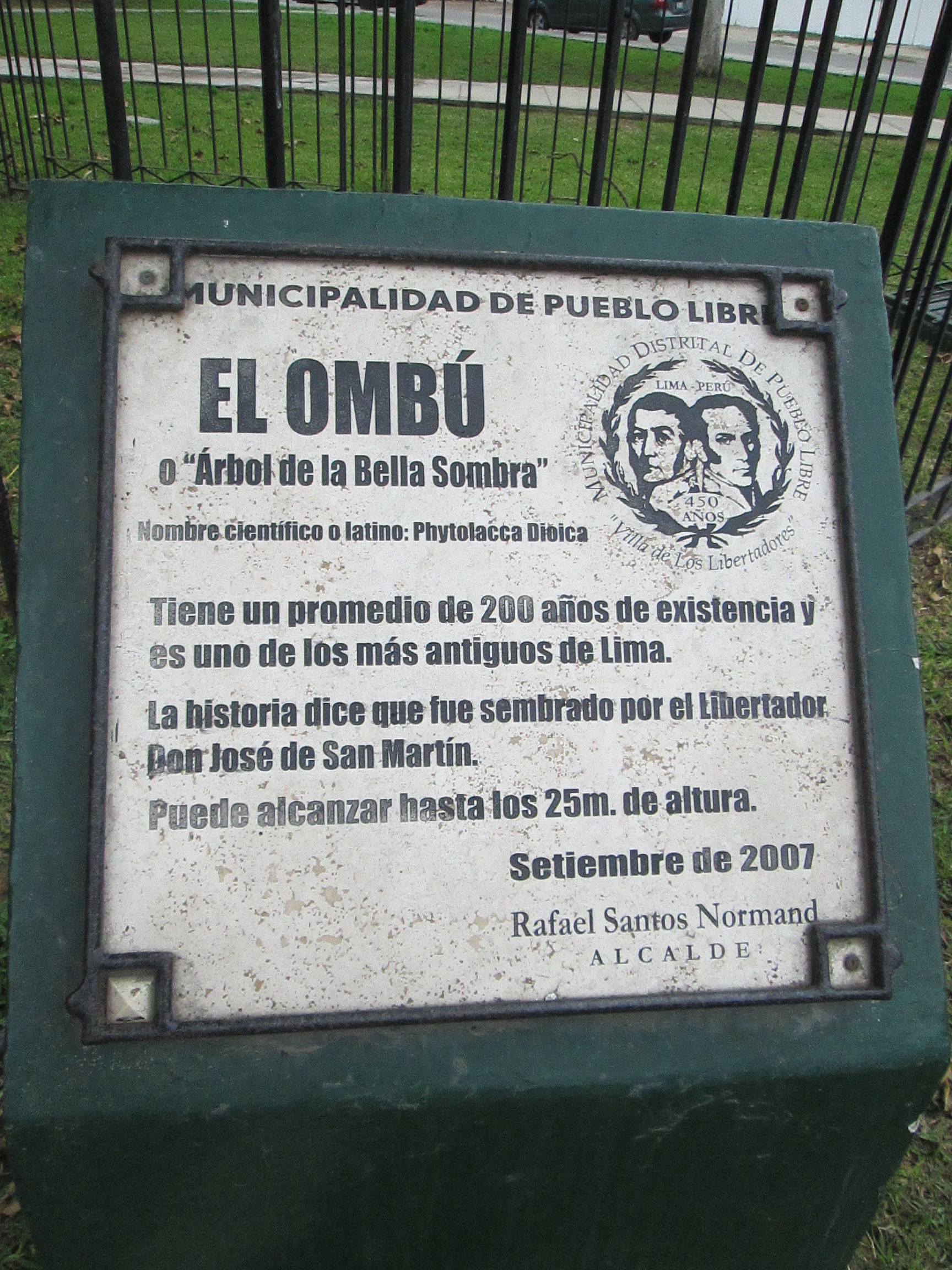
Then, in September, while walking in Lima’s Pueblo Libre between the Museo Larco and the National Museum of Anthropology, I saw my first Ombú, which I photographed.

Sign Identifying the Ombú Tree

Sign Identifying the Ombú Tree

What I find interesting about this sign, and this particular tree, is that the seed was purported to have been sowed by José de San Martín, an Argentinian who is considered by the Peruvians as the great liberator of their country. Curiously, Simon Bolivar did more than San Martín to actually free the country from the Spanish yoke, but it was the Argentinian who first declared Peru’s freedom. In the end, it was Bolivar who finally sealed the deal by his military victories.

They would have done it together, if it were not for the fact that they didn’t get along well together. Bolivar felt that San Martín was horning in on his action, and that he was quite capable of actually liberating Peru by himself. The discouraged San Martín returned to Argentina.

In 2011, Martine and I visited his tomb in the Metropolitan Cathedral of Buenos Aires, where a military honor guard protects his remains.

So it was not only my first Ombú, but it was a historically important one at that.


Imagining Argentina

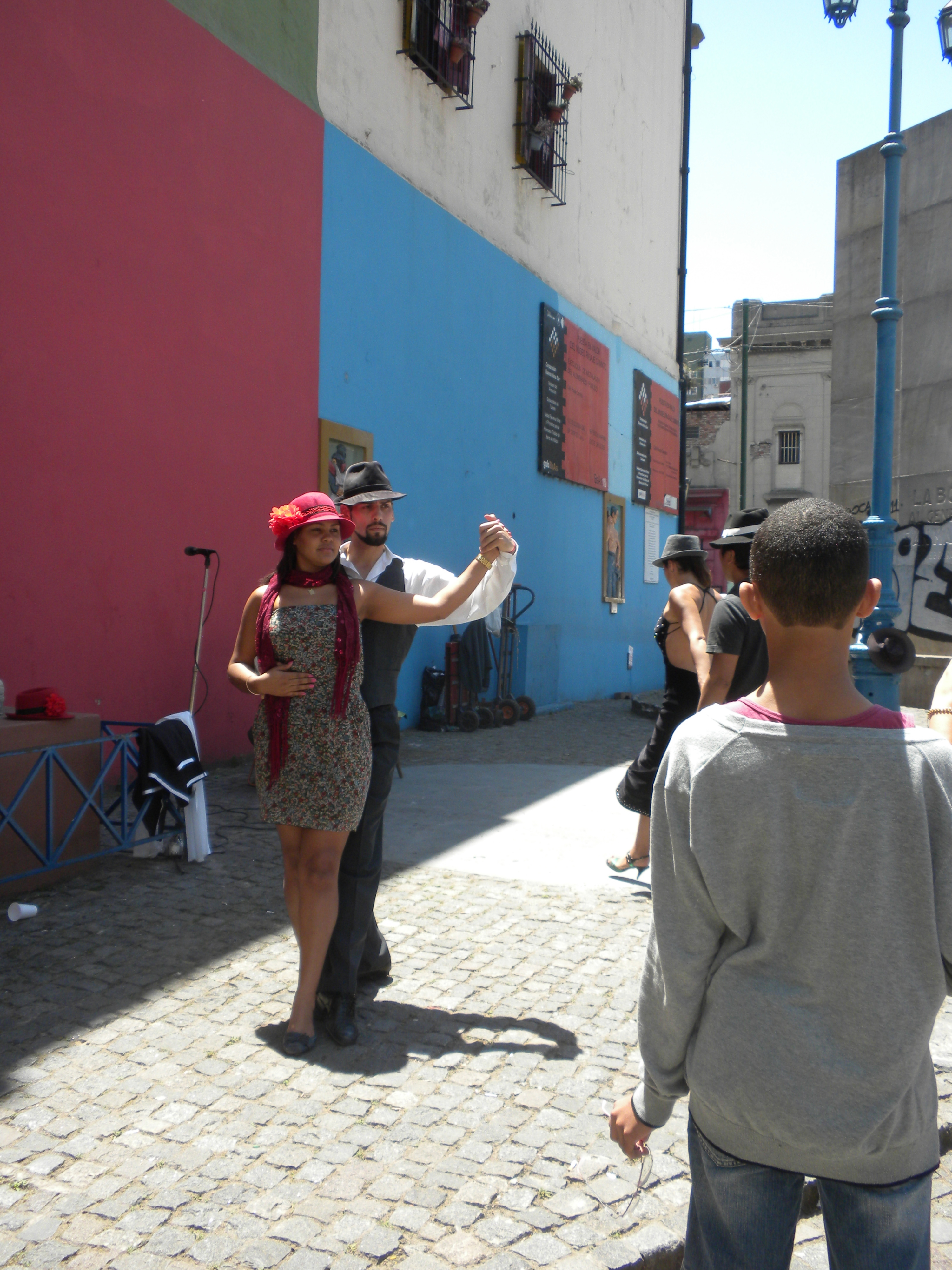
Tango Dancers in La Boca

Tango Dancers in La Boca

Even though I’ll be in Arequipa, Peru, a month from today, I still look back fondly to Argentina, which I visited in 2006 and 2011. In fact, today Martine and I ate dinner at Empanadas Place at Sawtelle and Venice Boulevards in Mar Vista. I had an entraña (skirt steak) sandwich and iced mate cocido, while Martine had two empanadas, one stuffed with spinach and the other chopped beef. It is probably one of our favorite places to eat on L.A.’s West Side; and, according to Martine, the empanadas there were better than what we were served in Argentina. (Of course, the place for empanadas is in Northwest Argentina around Salta and Tucumán.)

In addition to Empanadas Place, there is a very good Argentinean restaurant on Main Street in Culver City: the Grand Casino Bakery & Café. We go there several times a year.

I have come to love drinking yerba mate tea and—very occasionally—sneaking some alfajores cookies filled with dulce de leche. My two visits to the Southern Cone of South America have resulted in a series of cravings I have yet to fill. Although we saw a good part of Patagonia, I have yet to go to Carmen de Patagones, Viedma, San Carlos de Bariloche, and Esquel. (In 2011, there was a major volcanic eruption at Puyehue and Cordon Caulle in the Chilean Andes which covered several whole states of Patagonia with ash—so we went to El Calafate instead to see the glaciers.)

To be sure, when I return from Peru, I will be haunted by my desire for Peruvian food. Fortunately, there are also Peruvian restaurants in L.A.; but I am sure it is but a pale shadow of what I will be eating next month. Plus, I will no doubt miss interacting with the Quechua and Aymara peoples of the Peruvian altiplano.

Slipping Off the Pedestal

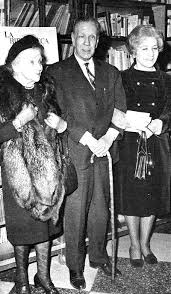
Jorge Luis Borges Flanked by His Mother and His Wife Elsa

Jorge Luis Borges Flanked by His Mother and His Wife Elsa

It was bound to happen sooner or later: After worshiping the man for over forty years, I am finally beginning to have my doubts about Jorge Luis Borges the man. But not, by any means, of Borges the poet and writer of short stories and essays. I still think he deserved the Nobel Prize for Literature on merit alone, but I begin to understand why he cheesed off the liberal-minded Nobel Prize Selection Committee.

Perhaps my favorite translator of Borges is Norman Thomas di Giovanni, whose book Georgie and Elsa: Jorge Luis Borges and His Wife, The Untold Story has just recently been published. Di Giovanni worked closely with Borges during the 1960s, shortly after he married Elsa Astete Millán, and through the divorce. What Di Giovanni discovered was that Borges was fatally naive when it came to women, politics, and social life. In fact, he was incredibly feckless in many ways. Di Giovanni writes:

[I]n later years, he travelled to Chile to receive a medal from the hands of Augusto Pinochet. This was one of the worst decisions of his life. But, he maintained, in his digging-his-heels-in mode that no one was going to tell him what he could or could not do. I imagine that it would never have occurred to Borges to question and be horrified by Pinochet’s well-oiled programme of eliminating Communists and other left-wingers. Borges was so universally condemned for his action that I think he came to realize his colossal mistake. But to justify it and himself, when I mentioned his folly to him, he said, ‘But I thought the medal was a gift of the Chilean people.’

Equally, if not more disastrous, was Borges’s marriage to Elsa. Years earlier, he had mooned over her; but, typically, someone else married her. (“Georgie” was not prime marriage material, as he lived with his mother well into his old age.) Then, one day, he met her again and—discovering that she was now widowed—took up with her again. By now, Borges was a famous literary figure; and, Elsa, being a social climber, thought that she was now about to enter the high life.

Her behavior during visits to the United States was execrable. She would steal silverware and other “souvenirs” from Borges’s friends and associates. During a visit to the Rockefellers, she insisted in photographing every room and asking about all the furnishings. It got to the point that people stopped inviting Borges lest Elsa come along. When she accidentally left a nutria coat in Cambridge after one trip, she made the return of the coat into an international incident involving U.S. and Argentinian ambassadorial and consular staffs.

Not that Borges was an ideal husband. He was an elderly blind man who happened to be impotent (which Elsa had known earlier) and incredibly old fashioned, a sort of Anglo-Argentinian who was neither all one thing or all the other. Finally, with di Giovanni’s help, Borges divorced her. He later re-married, with Maria Kodama, who now controls his esate.

Di Giovanni’s book is mandatory reading to supplement all the hagiographical biographies of the author who never quite get at the man’s character.


Italy West

Tourists Wandering the Caminito

Tourists Wandering the Caminito

I was thinking today of Buenos Aires, especially that colorful—but fetching—tourist trap known as La Boca with its short Caminito, a diagonal street about a block long. La Boca (“The Mouth”) was literally the mouth of the now polluted Ria Chuelo. It was also the center of life for the thousands of Italian immigrants who found their way to Argentina between the 1870s and the early 1900s. At one point, the residents declared their independence of their new homeland and raised the flag of Genoa. But President Julio Argentino Roca personally ripped it down.

The bright colors originally were marine paints left over from the shipping that docked here. The neighborhood has an edgy blue collar vibe that finds its center in the soccer football stadium known as La Bombonera (“The Chocolate Box”), home of the Boca Juniors, one of Buenos Aires’s premier football teams.

In 2011, Martine and I took a hop-on, hop-off bus tour of BA that included La Boca, where we stopped for a couple of hours to take pictures and take in all the tacky souvenirs.

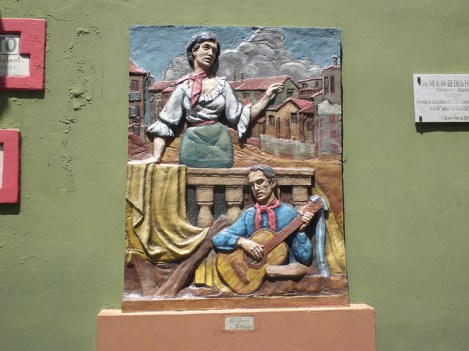
Art on the Caminito

Art on the Caminito

Because it is so far distant from the United States, not many Americans find their way 6,000 miles south to Argentina. In our case, we went even farther south, all the way to Tierra Del Fuego and the southernmost city in the world, Ushuaia.

I would dearly love to go back there some time and see some of the places we missed. And I’d even like to hang around La Boca some more.


An Old Friend from Patagonia

Young Magellanic Penguin at the Aquarium of the Pacific

Young Magellanic Penguin at the Aquarium of the Pacific

Today, Martine and I cashed in on a two-for-one discount ticket at Long Beach’s Aquarium of the Pacific. As usual, it was a wonderful experience—with one exception: the large numbers of small children in evidence. Although we were there at opening time at 9:00 am, so were the crowds; and they only grew as the day wore on. But then, there was enough to see to keep the curmudgeon side of me in abeyance. It is a rare achievement for me not to have thrown any whining, obstreperous toddlers into the shark tank. And the sharks also looked mighty appreciative at my consideration.

Before the crowds got too large, we saw a presentation about penguins at the Aquarium’s Molina Animal Care Center. On display was a young Magellanic penguin, of the type Martine and I saw two years ago in Patagonia, first at Isla Martillo in Tierra Del Fuego and then at the giant rookery at Punta Tombo in the State of Chubut. These are not to be compared with the larger Empire and King penguins to be found in Antarctica. Instead, they are to be found mostly in the southern parts Argentina and Chile. Below are some Magellanic penguins Martine and I saw on Isla Martillo on the Beagle Channel in Tierra Del Fuego, near Estancia Harberton.

Adult Magellanic Penguins

Adult Magellanic Penguins

Penguins are having a rough time of it because of the changes in ocean temperature due to global warming. Instead, jellyfish seem to be taking over by eating the penguins’ favorite food, krill. For more information, click on this article from The Telegraph. That would be a shame. No one ever had the urge to hug a jellyfish, but there is something about penguins that makes one’s heart go out to them.

The Bus and Train Freak

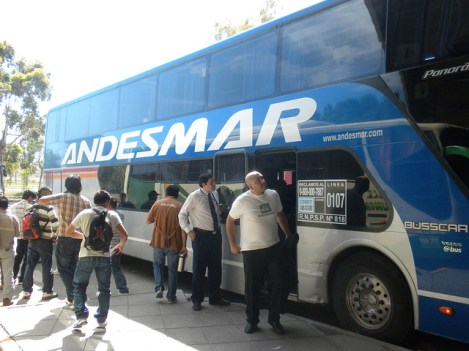
At the Bus Station in Trelew, Argentina

At the Bus Station in Trelew, Argentina

Here in the United States, our intercity ground transportation is the pits. Even Mexico has us beat, with buses they manufacture themselves. Of course, neither the U.S. nor Mexico are any good at railroads, with a few minor exceptions.

One thing about me that you may not know is that I am a transportation freak. I think about public transportation a lot. Two weeks ago, I suddenly woke up in the middle of the night remembering the bus company that took me in 2001 from Reykjavík to Akureyri via the Kjölur route across the desolate plateau that forms the center of the island. The bus I took was labelled Seydisfisbilar Akureyrar. (There may be a few diacritical marks missing: The line doesn’t show up on a present day Google search.).

The funny thing is that I could figure out bus and train schedules almost irrespective of what European language they’re written in. Asking questions and understanding the answers is an entirely different issue.

In Argentina, Martine and I rode long-distance buses between Puerto Madryn, Trelew, and Gaiman—mostly on the 28 de Julio line. They were so far and away better than anything Greyhound has in the field that I blush with shame. Even the verbal interface with the ticket agents in the above cities was relatively easy, until I found out that, on some routes, seating is assigned rather than being asiento libre (“sit where you please”).

When I am in Iceland, if I run into Straeto employees that either do not or will not speak English, I may run into a spot of trouble. But since 95% of Icelanders under the age of 70 speak English, that is pretty much a baroque fear.

As for Icelandic train schedules, there are none, primarily because no one ever built a passenger railroad to serve a sparsely populated island in the Arctic.


Travel Changes You

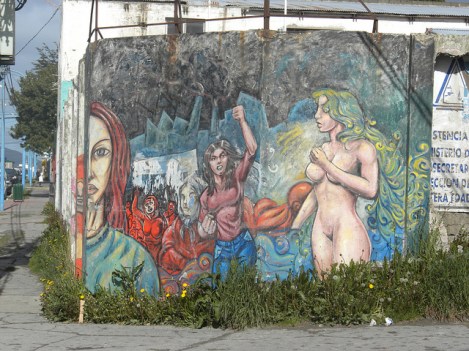
Mural Along Rivadavia in Ushuaia, Tierra Del Fuego

Mural Along Rivadavia in Ushuaia, Tierra Del Fuego

I remember my first vacation on my own. Despite protests from my parents, who, of course, wanted me to come to Cleveland and slip into the family ways like putting on a glove. But I was thirty years old, and I wanted to travel.

As a child, my travels were limited to places my parents wanted to go, places like Detroit; Lake Worth, Florida; Niagara Falls; and Passaic, New Jersey. My only choice as a child was a day trip to Schoenbrunn Village in Central Ohio, site of the first settlement in the state. (And the folks did not enjoy it, although my brother and I did.)

So, in November 1975, I decided to spend eighteen days in Yucatán visiting ancient Mayan ruins. It was a great trip, and it turned me around completely. No longer was I going to be satisfied by hanging out in Cleveland, a city from which all my friends had fled after high school.

Above is a mural on Rivadavia, a north/south street in the Tierra Del Fuego capital of Ushuaia. It also happens to be the street where I slipped on the ice in 2006 and cracked my right humerus, just one block north. No matter: Five years later I returned with Martine, stayed at the same bed & breakfast (the Posada del Fin del Mundo), and had a wonderful time.

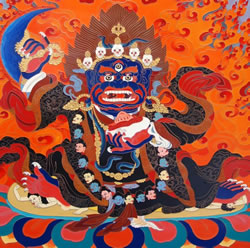
It’s like those Tibetan pictures of devils deliberately intended to frighten you, like the following:

Tibetan Demon

Tibetan Demon

According to the Tibetan Book of the Dead, if you are frightened of the demons, your soul will gravitate toward a copulating couple; and you will be reborn as their child. If you are not moved by fear, there is a chance that you will obtain Nirvana.

That’s why I would have no fear about traveling to Turkey, to Russia along the Trans-Siberian Railway, and any number of places. Of course, I have no intention of visiting Syria, North Korea, Somalia, or Mali. That would not be prudent.


A Jesuit Paradise?

Stamps Commemorating the Jesuit Missions of Paraguay

Stamps Commemorating the Jesuit Missions of Paraguay

It is interesting to me that, for the first time in its history, the papacy is in the hands of a Jesuit, from South America no less. In southeastern Paraguay and in the Argentinean state of Misiones, there are numerous ruins attesting to the 17th and 18th century Jesuit missions—missions that were so powerful that they were, in effect, in control of the Guarani Indians of the area. If you ever saw Roland Joffe’s 1986 movie, The Mission, with Robert DeNiro, Liam Neeson, and Jeremy Irons, you have some idea of what the Jesuit government of Paraguay was like.

You can find out even more by reading the forgotten classic history by R. B. Cunninghame Graham entitled A Vanished Arcadia: Being Some Account of the Jesuits in Paraguay 1607 to 1767.

It even finds its way into Voltaire’s Candide, but its author being such an anticlerical cuss, he has his hero kill the Jesuit commandant of one of the missions. Yet he writes in Histoire Politique et Philosophique des Indes:

When in 1768 the missions of Paraguay left the hands of the Jesuits, they had arrived at perhaps the highest degree of civilization to which it is possible to conduct a young people, and certainly at a far superior state than that which existed in the rest of the new hemisphere. The laws were respected there, morals were pure, a happy brotherhood united every heart, all the useful arts were in a flourishing state, and even some of the more agreeable sciences: plenty was universal.

I have long thought that, if my thoughts had ever taken a turn toward the Catholic priesthood, I would have become a Jesuit. My teachers at St. Peter Chanel in Bedford, Ohio, wanted me to become one of them, a Marist. But, in the end, I became neither.

So now Pope Francis is a Jesuit from Argentina. He, I am sure, is quite aware of the history of the Jesuits in the southern cone of South America. It would be nice if he did for the Catholic Church what the Jesuits did for the Guarani in Paraguay and Argentina. Benedict XVI was a good man, but not strong enough for the task of making his faith relevant to a world that is falling away from the Church.


The Impulse to Escape

There’s Nothing Like a Rough Tax Season to Make You Want to Escape

There’s Nothing Like a Rough Tax Season to Make You Want to Escape

If you’ve been reading these pages for a while, you might think I seem a trifle obsessed. This is especially true during tax season, when the stress and long hours make me dream of escape. It is not unusual for me to spend six months reading and meticulously planning my escape.

Last year was an exception. Originally, Martine and I were going to go for a long drive through the Southern States. Then I noticed that the temperature topped out at about 100° Fahrenheit (that’s 37° Celsius) every day . For us, that reminds us more of hell than a vacation, so we made a last-minute switch to Vermont, Maine, New Brunswick, and Nova Scotia. We can do the South some other time, perhaps when they all turn Democrat. (Hah!)

The year before (2011), when we went to Argentina, I read so much Argentinean history and literature that I got some incredulous responses from the locals.

Because Iceland’s summer tourist season is so short (2-3 months at maximum), I don’t have six months; but I am embarked on an ambitious reading program to reacquaint myself with the great sagas (I am re-reading Egil’s Saga, Njals Saga, and Grettir’s Saga) and deepen my knowledge of Halldór Laxness’s novels as well as adding some newer authors to the mix. Fortunately, Iceland now has some excellent mystery writers, including Arnaldur Indriðason, Yrsa Sigurdardottir, and Edward Weinman (the latter Icelandic because of his long acquaintance with the country).

Whenever I have a few spare moments, I am checking out Icelandic websites, particularly with regards to the availability of public transportation (I will rent a car only if Martine comes with me) and accommodations. Many Icelandic guesthouses accept only guests with sleeping bags, which is not my preference. After a while, sleeping bags smell worse than old sneakers that are used daily in a heat wave.

I love to research a vacation. After a hard day of pumping out tax returns (like today), I prefer to put myself into another time and place. And Iceland will do nicely for this purpose.