The Father’s Curse

A Drawing by Jean-Baptiste Greuze (1725-1805)

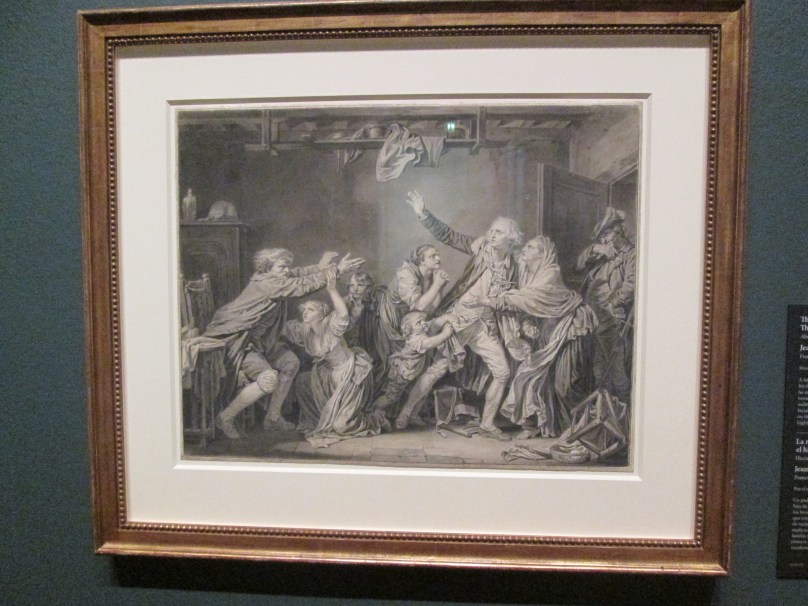
It was the Getty Center that turned me on to the art of Jean-Baptiste Greuze when they had an exhibit in 2002 on “French Drawings in the Age of Greuze.” He may be been something of a moralizer, but his drawings and his paintings are wonderfully dynamic. The above drawing is from a special exhibit at the Getty entitled “Virtue and Vice: Allegory in European Drawing.”

The vice in this case is a son (standing, right) announcing to his family that he has joined the army. He is embraced by his mother while his father (seated, left) curses him for his decision. The full name of the brush and gray wash over graphite drawing is: “The Father’s Curse: The Ungrateful Son.” The museum description of the drawing is as follows:

A father reacts furiously to his son’s decision to leave his family and join the army. With outstretched arms, he releases an angry curse that thrusts the young man toward the door, where a recruiting officer watches with indifference. The family’s pleading gestures and dramatic facial expressions communicate their anguish. Based on the popular painting the artist exhibited in 1777, this highly finished sheet served as the model for a print.

Here is the painting by Greuze that preceded the drawing:
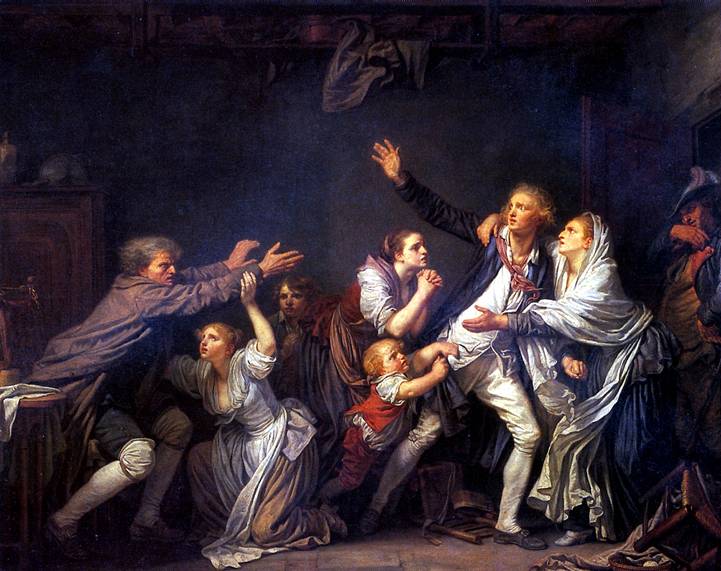
This painting was praised by no less a critic than Denis Diderot, the famous French Encyclopedist. I actually like the drawing that ensued more than the painting because it looks more like a domestic scene rather than a stage proscenium.

I wonder why Greuze found it necessary to do a drawing after he did an oil painting. If, as the Getty description noted, the drawing was turned into a print, I would be very interested in seeing the print or engraving based on it.
Kaibiles

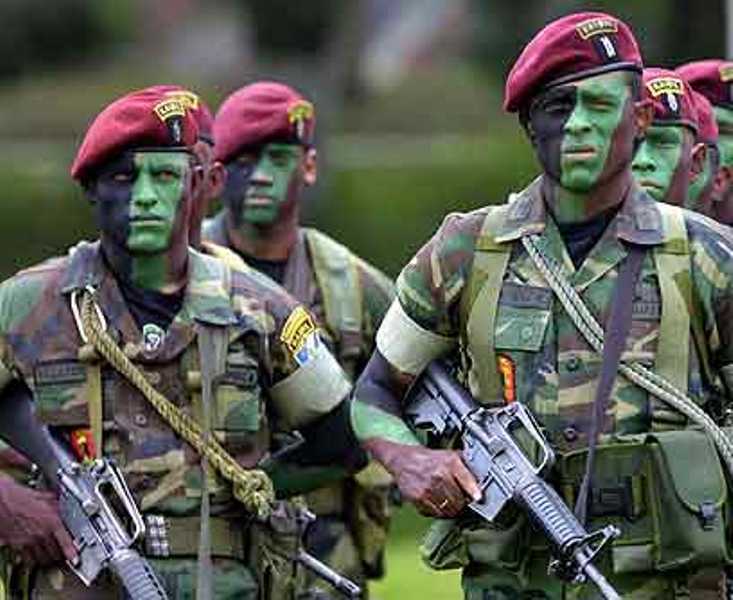
Guatemalan Army Elite Kaibil Troops

Usually translated as “Tigers,” the kaibiles are elite counterinsurgency troops of the Guatemalan army. According to Ronald Wright’s Time Among the Maya: Travels in Belize, Guatemala, and Mexico, the Mayan word actually implies a “double” or something of double the normal strength. Wright describes meeting a kaibil detachment as he enters Guatemala from Belize:

The pole across the road is lifted, and we are waved through, between a wooden watchtower and a sandbagged machine-gun nest. Not far beyond the tower there’s a billboard with a naive painting pf a Guatemalan soldier in camouflage fatigues. The soldier is shouting, “If I advance, follow me; if I delay, hurry me; if I retreat, kill me!” An inscription below him boasts: ¡AQUI SE FORJAN LOS MEJORES COMBATIENTES DE AMERICA!—HERE ARE FORGED THE BEST FIGHTERS IN AMERICA! I have just begun to wonder whether this is intended for Belizean visitors or rebellious citizens when I see the back of the sign, which direcs its message to those coming from the Guatemalan interior. It shows a gorilla head in the King Kong tradition, or maybe Planet of the Apes. Maniacal eyes burn ferociously, the gaping mouth is dripping with blood and armed with sharp fangs; and lest anyone fail to get the pun … the creature wears a Che Guevara cap. Above it is the single word ¡ATREVETE!—roughly, MAKE MY DAY.

Wright goes on to describe kaibil hazing rituals which include cannibalism and drinking human blood.

His book, which was originally written in 1989, is (fortunately) now a little dated. Most of the depredations on the Maya population by the Guatemalan army have ceased since a peace that was signed in 1996. Still, when I go to Guatemala in January, I plan to steer clear of the army. Many of the army posts Wright describes no longer exist. I hope.