Quid hoc ad Iphycli boves?

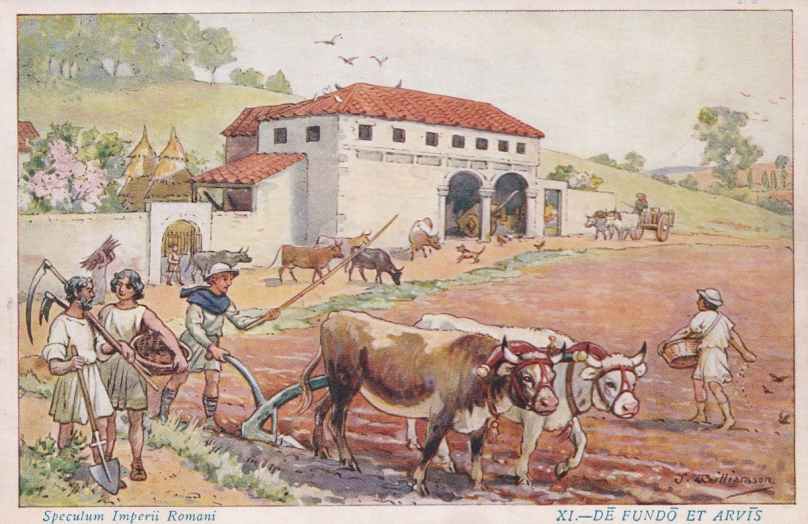
Old School Card Showing Cattle Farming in the Roman Forum

Roughly translated, the title of today’s post is “What has this to do with the cattle of Iphyclus?” or, more loosely, “Let us return tom the subject at hand.”

I am currently reading Sir Walter Scott’s Kenilworth (1821). Scott is famous for starting his novels slowly. I have just read fifty pages of densely packed plotting as Edmund Tressilian gets lost fleeing Cumnor and his horse throws a shoe. He meets up with an old scholar named Erasmus Holiday who converses mostly in Latin and who is delighted to meet anyone with even an imperfect knowledge of the old Romish tongue.

What Tressilian wants, quite simply, is the directions to the nearest blacksmith so he can continue on his way, but Erasmus is not willing to let go of him that easily. Finally, after numerous quotes from Latin classics, he deputes Hobgoblin (aka Flibbertigibbet), the son of his washerwoman, to show him the way to Wayland Smith, the local farrier.

And here we are detained still more by the rumors of said farrier being a tool of the devil as a result of his former association with a local mountebank.

Eventually Tressilian gets to his destination accompanied by Smith, who is now his servant.

There was a time when I would have been upset at the slow development of the story in Kenilworth, but now I am delighted. This is definitely a slow read, requiring frequent consultation with the notes and (yes) a detailed glossary.

In my old age, I now appreciate Scott’s divergence from the subject at hand. He is so damnably erudite and enjoys sharing it with us. Will Tressilian ever rescue the lovely Amy Robsart from the clutches of the evil Richard Varney? Eventually, I’ll find out; but, in the meantime, whether or not the cattle of Iphyclus enter the fray, I will enjoy every minute of this long and painstaking read.

Winding Down

If you know anything about me, you know that I read a lot of books, something around 160 per year. This month, to date, I have not read anything. I just didn’t feel good enough.

To make matters worse, my apartment will be inspected by the City of Los Angeles a week from today. Not only did I not read anything, but Martine and I have been preparing to donate upward of a thousand books by January 29.

It breaks my heart to donate books that I had spent big bucks collecting, including Folio Society, Library of America, and other premium hardbound editions.

I only hope that the people who get these books appreciate their quality. In the end, it’s probably best that I don’t think too much about this. It would be even more grim if I were given a warning by the city to gut my personal library.

Clarice Lispector in the U.S.

The Jewish-Ukrainian-Brazilian Clarice Lispector (1920-1977)

If Clarice Lispector were alive today, she would be celebrating her 104th birthday. The strikingly beautiful author with the high cheekbones and wild Scythian eyes was one of the greatest women writers of the 20th century, joining such titans as Virginia Woolf, Joan Didion, Ursula LeGuin, Patricia Highsmith, and Wislawa Szymborska.

In my e-mail today was a message from New Directions Publishing, which publishes some twenty titles by Lispector in English translation. It contained a link to a video entitled “Dias de Clarice em Washington.” It is 29 minutes long in Brazilian Portuguese with English subtitles.

During the 1950s, Clarice was married to a Brazilian diplomat named Maury Gurgel Valente who was posted to the embassy in Washington. From her house in Bethesda, Maryland, she took part in diplomatic social functions and raised a family, as well as writing a number of books and short stories … until it all became too much for her, and she filed for divorce, after which she returned to Brazil.

I urge you to see this video and see what a great writer must do when she is pulled between her marriage and her art:

Clarice Lispector (R) and Sons

The End of the Tether

This is a difficult subject to treat because I myself am reaching the age at which one can pay most grievously for mistakes made earlier in life. I have just finished re-reading Joseph Conrad’s The End of the Tether, about a British sea captain in Malayan waters who has passed up a peaceful retirement to help out his daughter, who had married unwisely.

Although Captain Whalley in his youth was one of the most brilliant sea captains in the South Seas, he has grown old and forced himself to take on a rickety steamship in need of repair. The owner is a nervous former lottery winner who serves as the ship’s engineer. While he spends every spare hour evaluating possible winning lottery numbers, Captain Whalley, with the help of a native serang, handles the sailing of the vessel.

Unknown at the outset is that Captain Whalley is going blind, and it is primarily the Malay serang who is responsible for captaining the ship. As one can guess, things do not end well.

As I approach eighty years of life on earth, I see many of my friends in their retirement years similarly afflicted as a result of difficult situations that over time have gone critical. I earnestly hope that I will not be one of them.

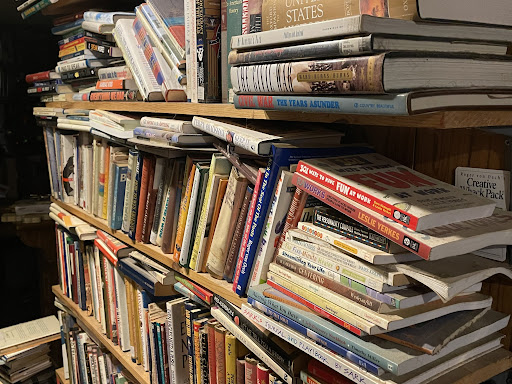
For one thing, I did not save up enough money for retirement, having spent obscene amounts of money on books. Today I have a fantastic library of five or six thousand volumes. But what happens if I should suddenly die? That would leave Martine in the position of trying to find out how to turn my library into cash, if possible. This at a time when there are precious few bookstores around that could buy hundreds of books at a time.

At least I don’t buy books any more. The Los Angeles Library and my Amazon Kindle account for most of the books I read.

I owe it to the people I love to whittle away at my library, however it pains me. Alas, I am mortal. I have made mistakes. I will pay for those mistakes.

Books I Won’t Be Reading Any Time Soon

Dreck

On most days, I check the “Deals” section of the Amazon Kindle Store for titles I want to read and can get cheap. As I go through the list of titles, I encounter mostly dreck. I thought I would present a list of the most revolting titles from today’s deals. As they were obviously written with little attention to care, I thought it would be best not to italicize or boldface the titles. They barely even deserve upper case letters.

  • That Time I Got Drunk and Saved a Demon by Kimberly [the] Lemming
  • The Perfect Marriage: A Completely Gripping Psychological Suspense [Gripping where?]
  • The Healer’s Way (Book 1): A Portal Progression Fantasy Series [Huh?]
  • Future Proof: The Time Travel Novel That Everyone’s Talking About. [I sincerely doubt that]
  • Stranded: The Bestselling Psychological Thriller with a Jaw-Dropping Twist, Perfect for Summer [of 1953?]
  • Heat of the Moment: A Billionaire Romance [Must be self love]
  • The Patriot: A Second Chance, Fake Relationship Romance [What?]
  • Forge Master: A LitRPG Adventure [When I found out that LitRPG meant literary role playing game, I yawned and thought “greasy kid stuff”]
  • The Hero She Needs by Anna [the] Hack[ett]
  • Come Back for Me: A Small Town Second Chance Romance [Jeez, that must be a whole genre]
  • Fury: A Fake Dating Workplace Romance [So, is fake dating a thing now?]
  • The Silent Wife: A Gripping Emotional Page Turner with a Twist That Will Take Your Breath Away [I’m choking already]
  • Wielder of Shadows: An Enemies to Lovers Fantasy Romance
  • This Is Going to Hurt: Secret Diaries of a Young Doctor [Ouch!]
  • The Awe of God: The Astounding Way a Healthy Fear of God Transforms Your Life [About the same way an unhealthy fear of everything would]

I know that most of these titles are destined for women readers; and I know that there is a male equivalent which is just as off-putting. It’s just that Amazon doesn’t feature them in their store deals page.

Survival Mechanism

My father was a semi-professional athlete both in Czechoslovakia and in Cleveland, where he played in the 1930s in a nationality-based soccer league. As his firstborn, I was something of a disappointment to him. I was a bit of a shrimp, later ballooning into a short tubby boy with a broad spectrum of allergies. Plus, around the age of ten, I started getting severe frontal headaches almost daily that were constantly misdiagnosed by the physicians we saw. (It turned out to be a pituitary tumor, which was successfully operated on after I graduated from college.)

What unpromising material!

When my brother was born, my father must have breathed a sigh of relief. Dan was tall and an athlete in my father’s mold.

Where did that leave me?

Thanks to my mother’s genius for story-telling—what with dark forests and witches and princesses—I turned to books as soon as I learned to read. There was a period of adjustment of several years during which I had to switch from being an American kid who spoke only Hungarian to an English-speaker. Those dark forests and witches and princesses, luckily, could also be found in books, together with a lot of other interesting stuff.

Although I always had friends, I was left out of school sports because I was frankly somewhat sickly. That turned out to be all right in the end, as my friends were interested in the same sort of things that I was. With Richard Nelson, who was an astronomy freak, I collaborated in writing an illustrated hand-printed study of our solar system and galaxy. Richard later became a meteorologist. Then there was James Anthony, who became a gynecologist.

While I was physically weak, books made me strong in every other way. I never became a famous author or a college professor, but I held down some interesting jobs that help finance my love of books. And I always read a lot. Even today, as I approach my ninth decade, I read anywhere from twelve to sixteen books a month.

What started out as a survival mechanism has brought happiness to my life. I have no children (because I no longer have a pituitary gland), but my retirement years have been mostly contented.

I know that there will be bad times to come as Martine and I age, but I retain a mostly sunny view of life. And in an election year in which Donald Trump is running, that’s a major accomplishment.

My Annual Book Orgy

Where I Will Be This Weekend

What with bookstores becoming rarer than hen’s teeth and the average American seemingly unable to read anything more daunting than the label of a beer can, I am becoming ever more determined to support books and reading. Therefore, I shall be spending the weekend looking at books, buying books, and attending talks by authors as well as poetry readings, My next post will be on Monday, April 22.

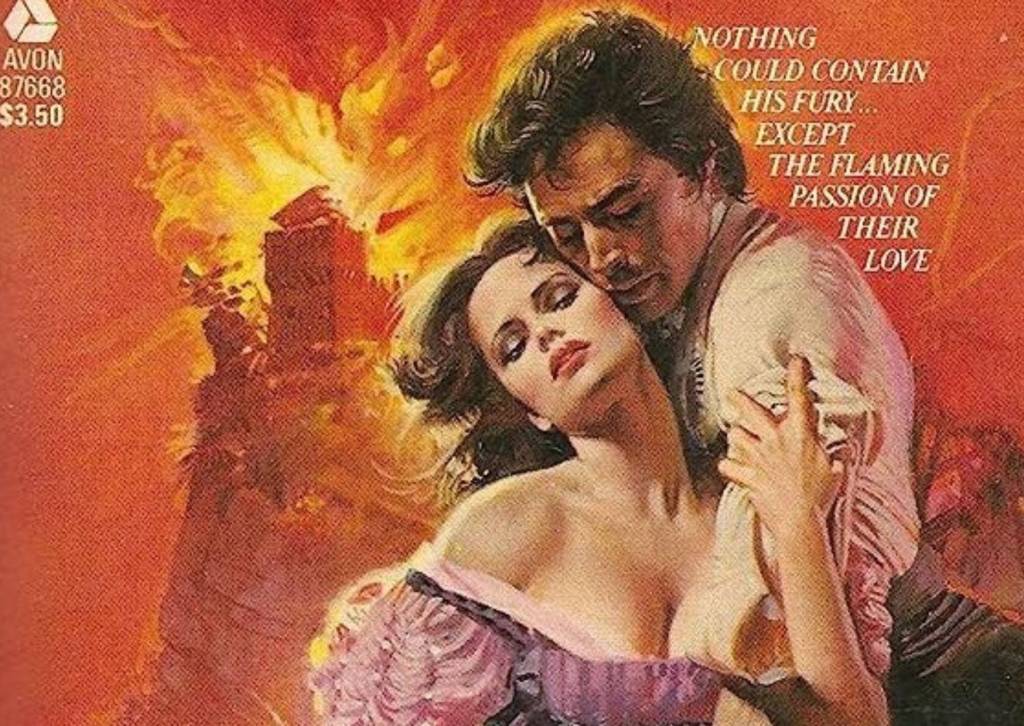
The Los Angeles Times Festival of Books has become a huge event that brings together readers of all stripes. I even forego my usual sneering at readers of bodice-ripper romances: They, too, are readers—like me in one way, unlike in all others.

When I am not scanning book titles, I go for rest to the Poetry Pavilion, where there is a new poet every twenty minutes during the day. The pavilion never fills up like some of the other stages with big name celebrities, but it is (1) more comfortable and (2) more rewarding. Although I don’t read as much poetry as I should, it is always interesting to hear poets reading their own work.

Next week, I will write posts about those poets that interested me the most.

Horizons East

Romanian Writer Mircea Cărtărescu

For their reading, Americans tend not to look beyond English-speaking North America and the countries of Western Europe. As a Hungarian, I have always delighted in the literature of Eastern Europe. In this post, I will give you a list of some of my favorite recent fiction from the former Soviet satellites, including one Ukrainian author, because Vladimir Putin is trying to turn his country into a Russian satellite.

I do not include any Russian authors—not because of any prejudice against—but because the field is so rich it deserves a separate post. Here’s the list in alphabetical order by author:

Ivo Andrić (Bosnian 1892-1975)

Won the Nobel Prize in 1961 for his novel The Bridge on the Drina about the Bosnian city of Viśegrad under the Ottomans and the Austro-Hungarians who succeeded them.

Ádám Bodor (Transylvanian Hungarian b. 1936)

His The Sinistra Zone (1992) is a delightfully funny story of one man’s quest to find his adopted son in a Romanian bear sanctuary and military zone near the Ukrainian border and spirit him return home with him.

Mircea Cărtărescu (Romanian b. 1956)

I am on the point of finishing his novel Solenoid (2015), which is a wonderful work strongly influenced by Kafka, Borges, and Boris and Arkady Strugatsky. He has been shortlisted for the Nobel Prize and is likely to win it soon.

Bohumil Hrabal (Czech 1914-1997)

I have read several great novels from this Czech writer, including Dancing Lessons for the Advanced in Age (1964), I Served the King of England (1973), and Too Loud a Solitude (1977). His gentle humor is catching.

Franz Kafka (Czech Jew 1883-1924)

Although he wrote in German and died a hundred years ago, his work is a major influence on many of the Eastern European authors. My favorites: The Trial (1925) and his short stories.

Gyula Krúdy (Hungarian 1878-1933)

I have read most of his work that has been translated into English, but my favorites were The Crimson Coach (1913) and his journalism collected in Krúdy’s Chronicles (published in 2000).

Andrey Kurkov (Ukrainian b. 1961)

He wrote most of his works in Russian (a larger audience and more $$$), but after Putin has vowed to switch to the Ukrainian dialect. My favorites: Death and the Penguin (1996) and Grey Bees (2018).

Stanislaw Lem (Polish 1921-2006)

Yes, I know he is a sci-fi writer, but his work, especially Solaris (1961) and The Futurological Congress (1971) are of high literary quality.

Olga Tokarczuk (Polish b. 1962)

Won the 2018 Nobel Prize. So far, I’ve read only one of her novels, namely, House of Day, House of Night (1998), which is one of the best books I’ve read so far this year.

Ten Tens

Over the last quarter of a century, I have read over three thousand books. Ever since I was a sickly child unable to compete in physical sports with my age group, I have used books to feel good about myself and to ready myself to compete in a dog-eat-dog world. Now that I am retired, I find that reading still has huge benefits, particularly when it comes to keeping on an even keel as I enter my eighth decade.

If you want to see the last two thousand or so books I have read and written reviews for, look me up on Goodreads.Com using as your Google search field: Goodreads Tarnmoor.

In the meantime, here are ten of the best books I have read in the last year and a half presented in alphabetical order by the last name of the author:

  1. Ivan Bunin: Collected Stories. Although he is virtually forgotten today, Bunin has written some of the greatest short stories ever penned by a Russian author.
  2. Alejo Carpentier: Explosion in a Cathedral. If you think that a book about the influence of the French Enlightenment on the Caribbean couldn’t be fascinating, guess again!
  3. Geoff Dyer: Last Days of Roger Federer and Other Endings. Superb essays on the theme of the special quality of an artist’s last works.
  4. Tove Jansson: The Summer Book. A gentle and truly lovely book written by a Finnish author in Swedish, of course. If the name sounds familiar, remember the Moomintrolls.
  5. Clarice Lispector: Too Much of Life: The Complete Crônicas. This bizarrely beautiful Ukrainian/Brazilian writer wrote short journalistic essays that are a classic for our times.
  6. Lucretius: The Nature of Things. A long philosophical poem by an ancient Roman that, even today, is worth mining for the author’s unique insights.
  7. John Cowper Powys: Wolf Solent. Another great work by an author who is almost forgotten today. Read this and you will think differently about living in a rural English town.
  8. Juan Rulfo: Plain in Flames. This Mexican writer did not publish much, but these short stories will make you sit upright. Like John Webster, Rulfo could “see the skull beneath the skin.”
  9. Georges Simenon: Strangers in the House. He wrote hundreds of mysteries, but writers like William Faulkner Patricia Highsmith, and John LeCarré recognized his greatness.
  10. Olga Tokarczuk: House of Day, House of Night. This Polish Nobelist describes life in rural Silesia. As one reviewer wrote: “What emerges is the message that the history of any place–no matter how humble–is limitless, that by describing or digging at the roots of a life, a house, or a neighborhood, one can see all the connections, not only with one’s self and one’s dreams but also with all of the universe.”

Probably what all these works have in common is that they are not as well known as most books. Sometimes, the surprise of reading an author like Dyer or Lispector or Tokarczuk can take you to more interesting places simply because you have not heard of them before.

“It Is Bells Within”

Like me, Emily Dickinson loved reading. (Unlike me, she had the talent to show for it.) Today, I present one of her untitled poems on the joys of books.

Unto my books so good to turn
Far ends of tired days;
It half endears the abstinence,
And pain is missed in praise.

As flavors cheer retarded guests
With banquetings to be,
So spices stimulate the time
Till my small library.

It may be wilderness without,
Far feet of failing men,
But holiday excludes the night,
And it is bells within.

I thank these kinsmen of the shelf;
Their countenances bland
Enamour in prospective,
And satisfy, obtained.