Don’t Fall For His Poor Old Blind Man Act

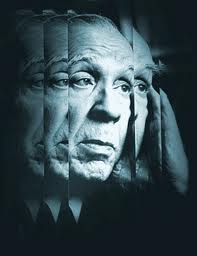
Jorge Luis Borges

Jorge Luis Borges

It is easy to be fooled by Jorge Luis Borges (1899-1986). He spent the last couple decades of his life giving out interviews, some of them book-length. The damned thing of it all is that he was a devious interview subject. He would insist that he was apolitical:

I am not politically minded. I am aesthetically minded, philosophically perhaps. I don’t belong to any party. In fact, I disbelieve in politics and in nations. I disbelieve also in richness, in poverty. Those things are illusions. But I believe in my own destiny as a good or bad or indifferent writer.

Yes, but, at the same time he irked one Swedish literary critic that he single-handedly prevented Borges from receiving the Nobel Prize in Literature because, at one time, he accepted an honor from Chile’s dictator General Pinochet Ugarte. Also, he so burned up Juan Peron that he derisively appointed the Argentinean to be the poultry inspector for Buenos Aires.

In an article for the L.A. Review of Books that was reprinted by Salon.Com, Filipina writer Gina Apostol has an interesting perspective on Borges, who, as you may or may not know, is one of my favorite authors:

As a writer from the colonized world, I find Borges’s work almost intolerably revealing, as if spoken directly to the political debates that beset my country. Borges’s postcolonial critique and analysis in his ficciones are obscured by his philosophical sleights of hand, startling plots, and narrative wizardry, but though buried, his critique is powerful. In particular, I am struck by his logic of the inverse. His use of doppelgangers (sometimes triplegangers) and mirrors and refractions and texts within texts — spies that become victims, heroes that are villains, detectives caught in textual traps of their own making, translators who disappear in puffs of smoke in someone else’s writer’s block — in Borges’s stories, these astonishing mutations force us to see reality from new perspectives, force us to question our own encrusted preconceptions. While questions of ontology and Berkeleyan illusion and all those philosophical games beloved of Borges are paramount, the constant revisiting of the problems of fictionality and textuality in these stories have profound echoes for the postcolonial citizen, bedeviled by and grappling with questions of identity and nation, questions seething always under our every day, our working hours, our forms of art.

What I find interesting is that Borges himself claims he is an unreliable interviewee. He instructs his interviewers to doubt everything he says. Because he was an old blind man, we tended too often to give him the benefit of the doubt, when he was very artfully putting us on.

Because he lived through so many dictatorships, such as those of Peron and the juntas of the 1930s and 1970s, Borges has learned to be what Eastern Europeans used to call an aesopic writer. According to Dr. Gerd Reifahrt:

One possibility is for [authors] to seek refuge in the realm of the Aesopic. Aesop is said to have written fables in the sixth Century B.C. to veil his opinions, and writers 26 centuries later continue to use and develop his method. In symbolic and coded terms, they write fairy tales and fables, and employ myths and elements of folklore. New forms of discourse emerged, where political realities and social truths were referred to in symbolic and coded terms rather than explicitly mentioned, and where, concurrently, these realities and truths were re-framed and re-contextualized. Protest and subversion found a new voice.

So all those tricks with mirrors and identity that Jorge Luis Borges employs represent a sophisticated method of confronting what some dire realities were for Argentinians in the not too distant past. Apostol writes, “Borges’s writing was always, to some degree, a creative form of reading, and many of his best fictions were meditations on the condition of fictionality: reviews of invented books, stories whose central presences were not people but texts.” Behind the invented lay the unvarnished reality, which he confronted indirectly.

			

Things That Might Have Been

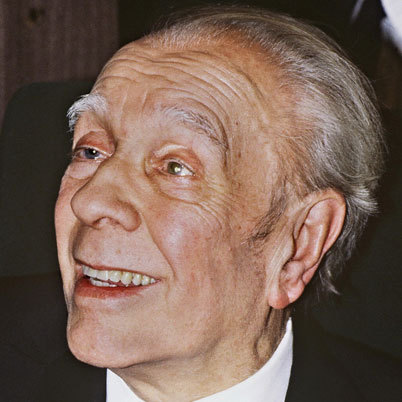
Jorge Luis Borges

Jorge Luis Borges

It takes a massively creative mind to imagine not only what has been, but what has not been—though they might well have been! I love the poetry of the late Argentinean Jorge Luis Borges, who died in 1986. Blind for much of his adult life, Borges saw things few poets have seen. Although he wrote less as he aged, everything he wrote is precious.

Things That Might Have Been

I think of things that weren’t, but might have been.
The treatise on Saxon myths Bede never wrote.
The inconceivable work Dante might have had a glimpse of,
As soon as he’d corrected the Comedy’s last verse.
History without the afternoons of the Cross and the hemlock.
History without the face of Helen.
Man without the eyes that gave us the moon.
On Gettysburg’s three days, victory for the South.
The love we never shared.
The wide empire the Vikings chose not to found.
The world without the wheel or the rose.
The view John Donne held of Shakespeare.
The other horn of the Unicorn.
The fabled Irish bird that lights on two trees at once.
The child I never had.

In another of his poems, Borges imagines that Don Quixote never left his library, but imagined all his adventures based on the epics of chivalry he read there.

Read Borges, and before long you, too, will see the other horn of the unicorn.


South

When Was the Last Time YOU Thought About South America?

When Was the Last Time YOU Thought About South America?

Let’s face it: Most Americans almost never think about South America. Oh, there are a few exceptions, such as when the World Cup comes around and we are reminded how many great soccer football teams there are “down there.”  Also, when Carnival Time in Rio comes close. Also, when we keep hearing about how the forests of the Amazon are gradually being clear-cut.

I think this is a fundamental flaw about being the world’s Number One military power. According to the Stockholm International Peace Research Institute (SIPRI), here are the world’s top ten for 2013:

  1. United States – $682.0 billion
  2. People’s Republic of China – $166.0 billion
  3. Russia – $90.7 billion
  4. United Kingdom – $60.8 billion
  5. Japan – $59.3 billion
  6. France – $58.9 billion
  7. Saudi Arabia – $56.7 billion
  8. India – $46.1 billion
  9. Germany – $45.8 billion
  10. Italy – $34.0 billion

Note that there are no South American countries in the list, though Brazil comes in at 11th place with $33.1 billion. (When was the last time they fought a war?) In other words, there are no major military players in South America. So we don’t have to worry about them, right? And that is the fundamental flaw about being Number One: You tend not to think about smaller countries because they simply don’t impinge on your way of life. In other words, you lay yourself open for a big unpleasant surprise.

I actually remember my first such unpleasant South America surprise. Dwight D. Eisenhower was President from 1952 to 1960. On May 13, 1958, he sent Vice President Nixon to Caracas, where his motorcade was attacked by an angry mob. As a 13-year-old in Cleveland, I was outraged that a no-name country like Venezuela had the nerve to insult the United States. This plus the subsequent insurgency in Cuba and takeover by Castro led to the creation of the Alliance for Progress during the Kennedy Administration. (But we had to undergo a baptism by fire at the Bay of Pigs first.)

Then there was more bad news to come. We were being inundated by cocaine being smuggled in from Colombia and other nearby countries. Then there was this matter of the FARC insurgency in Colombia and the Sendero Luminoso (Shining Path) in Peru. The whole continent appeared to be unraveling like a cheap suit. The Tupamaros in Uruguay and the disappearances in Argentina under Videla didn’t help either, nor did Pinochet in Chile.

At a certain point along the way, a certain positive influence from Argentina turned my life around. It was my discovery of the writer Jorge Luis Borges. Once I started reading his works, I began to see the world through his eyes. There was this battle called Junin that was fought in Peru. Then there were the Unitarios and Federalistas in Argentina. I began to get more interested, and then I actually went to Argentina in 2006 (only to break my shoulder by falling in a blizzard in Tierra Del Fuego) and 2011. Now I want to go to Peru in 2014, if I can swing it financially.

And, of course, I have been reading ever so much more about South America—so much so, in fact, that I look at the globe in an entirely different light. Perhaps South America will gain by all these years of benign neglect. Perhaps not. We still enforce the Monroe Doctrine after a fashion to keep Europe out, but we pretty much leave the continent alone unless our multinational corporations want to cut down their trees or extract their mineral wealth. Eventually, I see the nations down there nationalizing those industries and, with luck, putting the skids on some of the worst abuses. Until then, our corporations will be a stench in their nostrils.


Omigosh, What Have I Done?

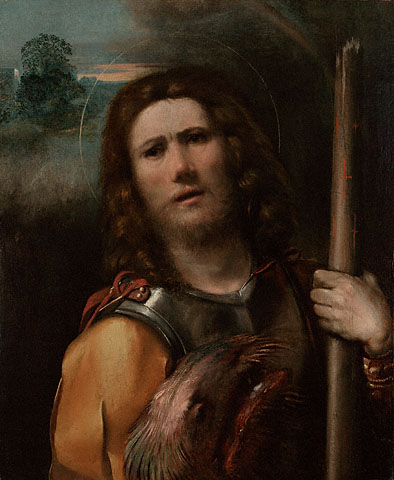
Saint George by Dosso Dossi (ca. 1515)

Saint George by Dosso Dossi (ca. 1515)

Today Martine and I drove to the Getty Center and looked at the paintings, special exhibitions, and decorative arts. What particularly interested me was a painting by the Italian Dosso Dossi (born Giovanni di Niccolò de Luteri) around 1515 of Saint George immediately after slaying the dragon. It’s not an expression of joy or celebration by any means. Almost, it seems as if the saint is asking himself, “Oh my God, what have I done?” Perhaps some ancient knowledge of the dragon’s has been conveyed to the Roman soldier, and he foresees that the world will never be the same again.

The painting is a small one, measuring 27½ x 24 inches, and by no means in a dominant location in the exhibition hall. Still, the facial expression drew my attention immediately and held it. I would have liked to photograph it (without flash, of course), but the guard in that particular hall forbade it; so I noted the name of the artist and luckily found it on the Getty Center website, which describes the oil as follows:

Dosso Dossi depicted the aftermath of Saint George’s battle with the dragon, in which he wields the creature’s bloodied head and the lance broken during the fight. Under an emerging rainbow, the victorious patron saint of Ferrara, Italy, emerges from the darkness of the battle. Dossi poignantly expressed his subject’s recent emotional turmoil in the saint’s penetrating expression. He appears weary yet resolute in his triumph.

The symbols of Saint George’s Christian faith—crosses rendered in vivid strokes of red paint as though the blood of his opponent drips down its shaft—mark the weapon. The color of the crosses echoes the blood ringing the beast’s mouth and also symbolizes the blood of Christ.

I don’t altogether agree with Saint George appearing “weary but resolute in his triumph.” I guess each work of art speaks to different people in different ways.

There is a poem by Jorge Luis Borges entitled “Limits” which, to me, conveys the spirit of this painting:

There is a line of Verlaine I shall not recall again,
There is a nearby street forbidden to my step,
There is a mirror that has seen me for the last time,
There is a door I have shut until the end of the world.
Among the books in my library (I have them before me)
There are some I shall never reopen.
This summer I complete my fiftieth year:
Death reduces me incessantly.

(Translated by Anthony Kerrigan)

Of Heaven and Hell

Jorge Luis Borges

Jorge Luis Borges

I cannot ever stop thinking of Jorge Luis Borges, of his poems, of his stories, of his diamond-like essays. For the better part of a half century, the man has guided my steps, sent me off to the Iceland of the Sagas, the paradoxes of G. K. Chesterton, the fantastic stories of that forgotten writer Rudyard Kipling, and the paintings of Xul Solar.

Today, I want to share with you the ending of a poem called “Of Heaven and Hell,” which I found in a Penguin Borges collection entitled Poems of the Night:

When Judgment Day sounds in the last trumpets
and planet and millennium both
disintegrate, and all at once, O Time,
all your ephemeral pyramids cease to be,
the colors and the lines that trace the past
will in the semidarkness form a face,
a sleeping face, faithful, still, unchangeable
(the face of the loved one, or, perhaps, your own)
and the sheer contemplation of that face—
never-changing, whole, beyond corruption—
will be, for the rejected, an Inferno,
and for the elected, Paradise.

For me, I think that face will be that of Martine. (My own face is out of the question: It is trapped in some mirror that first time I recognized it reminded me more of my father’s features than of my own.) No, Martine’s face frequently forms in my thoughts, as a special gift given to me by a God who showed me a gentle pity that was, I have always believed, more than I deserved. Does that mean I am one of what Borges called the “elegidos,” “the elect”? Time will tell.

“All Things Are Their Own Prophecy of Dust”

Death Mask from Mycenae

Death Mask from Mycenae

Perhaps of all the writers I have read in my long and checkered life, none has had such an outsize influence on me as Jorge Luis Borges. Even at this late date, years after he has left us, he still guides my thinking. Here is a wonderful poem about mutability by the Argentinian poet:

Adam Is Your Ashes

The sword will die just like the ripening cluster.
The glass is no more fragile than the rock.
All things are their own prophecy of dust.
Iron is rust. The voice, already echo.
Adam, the youthful father, is your ashes.
The final garden will also be the first.
The nightingale and Pindar both are voices.
The dawn is a reflection of the sunset.
The Mycenaean, his burial mask of gold.
The highest wall, the humiliated ruin.
Urquiza, he whom daggers left behind.
The face that looks upon itself in the mirror
Is not the face of yesterday. The night
Has spent it. Delicate time has molded us.

What joy to be the invulnerable water
That ran assuredly through the parable
Of Heraclitus, or the intricate fire,
But now, on this long day that doesn’t end,
I feel irrevocable and alone.

José Justo Urquiza was President of the Argentinian Confederation between 1854 and 1860. In 1852, he defeated the dictator Juan Manuel de Rosas at the Battle of Caseros.

Heraclitus was the Pre-Socratic Greek philosopher who said that one never crosses the same river twice: “We step and do not step into the same rivers, we are and we are not.”

The “long day that doesn’t end” could refer to his blindness. Unfortunately for all of us, that long day finally did end on June 14, 1986. (Could it have been that long ago?)

Even as I read this poem, my heart yearns for a return to Argentina. Last night, on a cold January day with my apartment heater blasting away, I drank a steaming cup of mate cocido and thought of that remote land at the tip of South America—a land that produced so many of my favorite writers (in addition to Borges, César Aira and Adolfo Bioy-Casares) and so many wonderful experiences. Even when I broke my shoulder by falling on the ice in Tierra del Fuego back in 2006—an event that would usually be seen as a bad sign—I loved the place and wanted to return. I did in November 2011. Now I am only marking time until my return.

A Classification of Animals

Mythical Animal

These ambiguities, redundancies, and deficiencies recall those attributed by Dr. Franz Kuhn to a certain Chinese encyclopedia entitled Celestial Emporium of Benevolent Knowledge. On those remote pages it is written that animals are divided into (a) those that belong to the Emperor, (b) embalmed ones, (c) those that are trained, (d) suckling pigs, (e) mermaids, (f) fabulous ones, (g) stray dogs, (h) those that are included in this classification, (i) those that tremble as if they were mad, (j) innumerable ones, (k) those drawn with a very fine camel’s hair brush, (l) others, (m) those that have just broken a flower vase, (n) those that resemble flies from a distance.—Jorge Luis Borges, “The Analytical Language of John Wilkins”

“The Beast Not Found In Verse”

Borges and His Tigers

As you may (or may not) know, I am and always have been a devotee of the stories, poems, and essays of Argentinean writer Jorge Luis Borges. Here is a poem in which he tries to bring a tiger to life through sheer artistry, but fails—or does he?

The Other Tiger by Jorge Luis Borges

A tiger comes to mind. The twilight here
Exalts the vast and busy Library
And seems to set the bookshelves back in gloom;
Innocent, ruthless, bloodstained, sleek
It wanders through its forest and its day
Printing a track along the muddy banks
Of sluggish streams whose names it does not know
(In its world there are no names or past
Or time to come, only the vivid now)
And makes its way across wild distances
Sniffing the braided labyrinth of smells
And in the wind picking the smell of dawn
And tantalizing scent of grazing deer;
Among the bamboo’s slanting stripes I glimpse
The tiger’s stripes and sense the bony frame
Under the splendid, quivering cover of skin.
Curving oceans and the planet’s wastes keep us
Apart in vain; from here in a house far off
In South America I dream of you,
Track you, O tiger of the Ganges’ banks.

It strikes me now as evening fills my soul
That the tiger addressed in my poem
Is a shadowy beast, a tiger of symbols
And scraps picked up at random out of books,
A string of labored tropes that have no life,
And not the fated tiger, the deadly jewel
That under sun or stars or changing moon
Goes on in Bengal or Sumatra fulfilling
Its rounds of love and indolence and death.
To the tiger of symbols I hold opposed
The one that’s real, the one whose blood runs hot
As it cuts down a herd of buffaloes,
And that today, this August third, nineteen
Fifty-nine, throws its shadow on the grass;
But by the act of giving it a name,
By trying to fix the limits of its world,
It becomes a fiction not a living beast,
Not a tiger out roaming the wilds of earth.

We’ll hunt for a third tiger now, but like
The others this one too will be a form
Of what I dream, a structure of words, and not
The flesh and one tiger that beyond all myths
Paces the earth. I know these things quite well,
Yet nonetheless some force keeps driving me
In this vague, unreasonable, and ancient quest,
And I go on pursuing through the hours
Another tiger, the beast not found in verse.

Last year around this time, Martine and I were in Buenos Aires. Because she was curious about guanacos, we visited the Buenos Aires Zoo in Palermo at Sarmiento and Las Heras. Now that was the same zoo where Borges would visit before the days of his blindness set in to see the tigers.

He would write frequently about tigers, even titling one of his books Dreamtigers. The above poem is probably my favorite of all.

A Yellow Rose

Borges

Neither that afternoon nor the next did the illustrious Giambattista Marino die, he whom the unanimous mouths of Fame—to use an image dear to him—proclaimed as the new Homer and the new Dante. But the still, noiseless fact that took place then was in reality the last event of his life. Laden with years and with glory, he lay dying on a huge Spanish bed with carved bedposts. It is not hard to imagine a serene balcony a few steps away, facing the west, and, below, marble and laurels and a garden whose various levels are duplicated in a rectangle of water. A woman has placed in a goblet a yellow rose. The man murmurs the inevitable lines that now, to tell the truth, bore even him a little:

Purple of the garden, pomp of the meadow,
Gem of spring, April’s eye …

Then the revelation occurred: Marino saw the rose as Adam might have seen it in Paradise, and he thought that the rose was to be found in its own eternity and not in his words; and that we may mention or allude to a thing, but not express it; and that the tall, proud volumes casting a golden shadow in a corner were not—as his vanity had dreamed—a mirror of the world, but rather one thing more added to the world.

Marino achieved this illumination on the eve of his death, and Homer and Dante may have achieved it as well.—Jorge Luis Borges, El Hacedor