
Am I Still an Auteurist?

This Is the Magazine That Started It All

The Politique des Auteurs started in France with the writers of Cahiers du Cinema. André Bazin and a young cadre of rising filmmakers and critics felt that the French cinema was becoming too literary and that much was to be learned from the vitality of the American film industry. With almost every issue, they were discovering scores of new film artists such as John Ford, Howard Hawks, Nicholas Ray, and even such downmarket geniuses as Edgar G. Ulmer.

By 1962, the auteurists found an American disciple in Andrew Sarris, film critic for The Village Voice in New York. For the Winter 1962-1963 issue of Film Culture, Sarris created a whole issue dedicated to the auteur theory. As a student at Dartmouth College, I paid to photocopy the entire issue and used it religiously as a guide until Sarris came out a few years later with the greatly expanded American Cinema: Directors and Directions 1929-1968.
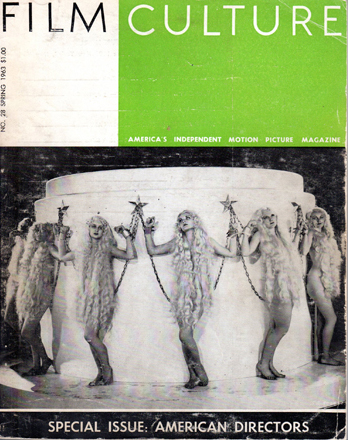
The Notorious Auteur Issue of 1962-1963

Circles and Squares: In the interim, Pauline Kael published a blistering attack in Film Quarterly called “Circles and Squares: Joys and Sarris.” Many of her attacks hit home, and they certainly exposed Sarris’s weaknesses as a film theoretician. I had met Pauline Kael and liked her work, but as a young man I was a budding auteurist.

Now, half a century and thousands of films later, I still see myself as having been influenced by the Cahiers crowd and Sarris, but I think there is a lot more to film than an a priori theory imposed from above. On the plus side, the auteurists opened me to the incredible riches of the American film—but I started liking films by such card-carrying non-auteurs as Felix Feist, Edward L. Cahn, Robert Florey, and Charles Vidor.

I give the credit to the auteur theory for introducing me to the idea that American films can also be great. I started my love of film by watching such foreign productions as Carl Dreyer’s Day of Wrath (1948) and Wojciech Has’s The Saragossa Manuscript (1962); but by the late 1960s I was beginning to give Hollywood its due and loosened up considerably.

La Politique des Auteurs

Cahiers du Cinema: The French Film Journal That Started It All

I find now that yesterday’s post took a lot for granted. One can’t just float a concept like the auteur theory and expect to be understood. When I first got into films at Dartmouth College, I was influenced by a French monthly called Cahiers du Cinema, and by the work of an American film critic writing for the Village Voice named Andrew Sarris, who tried to translate the French critics’ ideas into the American idiom. For Film Culture magazine (Winter 1962/1963), he wrote a long article entitled “Notes on the Auteur Theory in 1962.” I photocopied his article and kept it with me for years, until he turned it into a book in 1968 entitled The American Cinema: Directors and Directions 1929-1968.

The whole issue of the auteur theory is simple: If the cinema is an art form, then who is the artist in the cinema? Is it the producer? No, he’s mostly just a money man. Is it the film studio? Again, their major concern is money. Is it the writer, the actors, the director of photography, the editor? No times four. They just do what they’re told to do. The auteur theory elevated the director to the role of the artist. When the director is a studio hack, the result can be entertaining, but is rarely great. Yesterday, I wrote:

Why did I not go to the movies this year? Simply put, I remain an auteurist; and there were few films this year made by the directors whose work I follow. I am not interested in the films of William Seiter, Norman Panama, Archie Mayo, George Archainbaud, Alan Crosland, Alfred L. Werker, and any number of studio hacks who never signed their names to a great film. They were for the most part competent film makers whose work was light and entertaining; but I was after bigger game.

Now thye French considered Jerry Lewis to be an auteur, a true film artist. His films after he parted with Dean Martin are usually directed by him in a consistent and very competent way. You may not think that Jerry Lewis is a film artist, but he fits the idea the French have of the immature American male—like it or not.

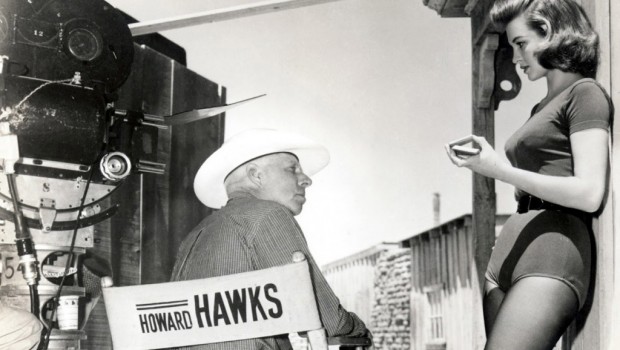
Director Howard Hawks with Angie Dickinson on the Set of Rio Bravo (1958)

So who are the great film auteurs? There are almost as many lists as there are film critics. I remembered long discussions with my fellow film freaks in the late 1960s as to who was great and who wasn’t: I called the activity “trading bubble gum cards.”

Here is Andrew Sarris’s auteur pantheon:

  • Charles Chaplin
  • Robert Flaherty (he wouldn’t make my list)
  • John Ford
  • D. W. Griffith
  • Howard Hawks
  • Alfred Hitchcock
  • Buster Keaton (though he didn’t sign his name as director)
  • Fritz Lang
  • Ernst Lubitsch
  • F. W. Murnau
  • Max Ophüls
  • Jean Renoir
  • Josef von Sternberg
  • Orson Welles

A few of the names are predominantly European directors who also made several films in America (like Murnau, Ophüls, and Renoir).