Global Art Outside the Marketplace

Detail of Tingatinga Image from Tanzania

On Thursday of last week, I spent several hours at the Fowler Museum at UCLA viewing art that is outside the normal art marketplace. According to their website:

The Fowler Museum at UCLA explores global arts and cultures with an emphasis on Africa, Asia, the Pacific, and the Indigenous Americas—past and present. The Fowler enhances understanding and appreciation of the diverse peoples, cultures, and religions of the world through dynamic exhibitions, publications, and public programs, informed by interdisciplinary approaches and the perspectives of the cultures represented. Also featured is the work of international contemporary artists presented within the complex frameworks of politics, culture and social action. The Fowler provides exciting, informative and thought-provoking exhibitions and events for the UCLA community and the people of greater Los Angeles and beyond.

One gallery presented the work of Amir H. Fallah, a Persian-American, in an exhibit entitled “The Fallacy of Borders.” Then there were a number of Jain embroidered hangings from Indian shrines. There were a few Tanzanian paintings from the Tingatinga school left over from a larger exhibit that closed last month. Finally, there was the ongoing exhibit entitled “Intersections: World Arts, Local Lives” which included the following sculpture group from Mexico:

Calavera Sculpture from Mexico

Most of this art was not created for corporate conference rooms or major art museums. Much of it is folk art created to reflect a local culture. Some of it is commercial, but never for the art market of New York or London. All of it is outside European-American culture (except for some aboriginal American art).

When I visit the Fowler or other folk art museums, such as the Museo Mindalae in Quito, Ecuador, I see art that opens up other cultures to me. I am not just seeing another stale work of abstract expressionism created to make money in the New York market. I am seeing something that speaks for a people or for a religion. The result is utterly refreshing.

I hope in the weeks to come to reprise some of the folk art I have seen on my travels.

Calaveras

One of Posada’s Calaveras: Street Cleaners

John Webster was a Jacobean dramatist known for the grimness of his plays. According to the first stanzas of a poem by T. S. Eliot called “Whispers of Immortality”:

Webster was much possessed by death
And saw the skull beneath the skin;
And breastless creatures under ground
Leaned backward with a lipless grin.

Daffodil bulbs instead of balls
Stared from the sockets of the eyes!
He knew that thought clings round dead limbs
Tightening its lusts and luxuries.

Donne, I suppose, was such another
Who found no substitute for sense,
To seize and clutch and penetrate;
Expert beyond experience,

He knew the anguish of the marrow
The ague of the skeleton;
No contact possible to flesh
Allayed the fever of the bone.

I cannot think of these lines without think of José Guadalupe Posada (1852-1913), who is famous for his depictions of cavorting skeletons.

Posada’s “The Day of the Dead”

As I am thinking once again of going to Mexico this next winter, I am thinking of the country’s great artists, including José Clemente Orozco, Diego Rivera and Frida Kahlo, David Siqueiros, and Rufino Tamayo, to name just a few. And Posada belongs on that list, though perhaps in a more minor key.

Unlike most Americans, the people of Mexico do not sweep the idea of death under a carpet. In fact, November 2, called All Souls Day in the Catholic Church, is the Dia de los Muertos, the Day of the Dead, throughout Mexico. Families visit their dead in the cemeteries with a picnic lunch and with all their children in tow. I remember a long intercity bus ride back in the 1980s on this day on which most of the passengers were joyfully looking forward to their Day of the Dead festivities. The children had white sugar calaveras, or skulls, which are a special treat available throughout the country.

This feeling about death goes back to the Maya and the Aztecs, who fought wars just to get prisoners to serve as sacrificial victims, whose hearts were cut out still steaming from their bodies with an obsidian knife and dedicated to the gods.

Posada’s Mexico

Posada’s Assault of the Zapatistas

Posada’s Attack of the Zapatistas

José Guadalupe Posada was born in Aguascalientes, Mexico, in 1852.During the Mexican Revolution. By the time of the Mexican Revolution, of which the above engraving shows a scene, he was poor despite his immense talent as a folk artist. He died in 1913, but not before having influenced the great muralist José Clemente Orozco. It was Orozco’s frescoes in the Reserve Room of Dartmouth College’s Baker Library that influenced me in my own visual tastes.

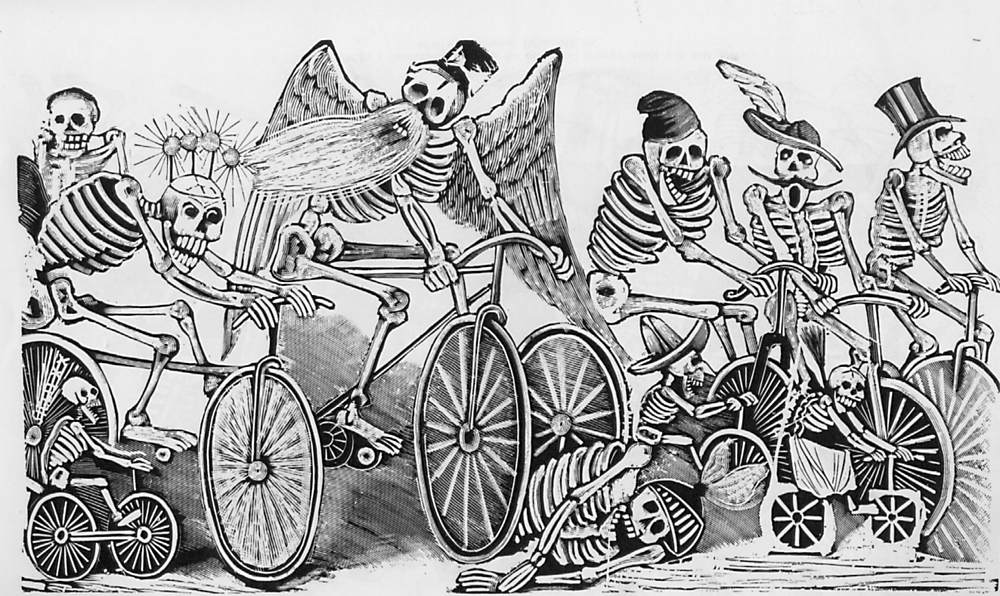
Posada’s Cyclists

Posada’s Cyclists

Posada is probably best known for his calaveras, images of skeletons savagely satirizing life under Mexican dictator Porfirio Diaz. Not surprisingly, most of these cavorting skeletons have become associated with the Mexican Day of the Dead, or All Souls’ Day, on November 2. On this day, families have picnics by the graves of their loved ones who have passed on.

I thought Posada would be a good artist for Halloween as well.