Samhainophilia

The Winner: Most Popular and Guilt-Free Holiday

There is a such a word as samhainophobia, which means hatred of Halloween. By applying the principal of parallelism, there must be such a word as samhainophilia, meaning love of Halloween. According to Wikipedia:

Samhain is a Gaelic festival on 1 November marking the end of the harvest season and beginning of winter or the “darker half” of the year. It is also the Irish and Scottish Gaelic name for November. Celebrations begin on the evening of 31 October, since the Celtic day began and ended at sunset. This is about halfway between the autumnal equinox and winter solstice. It is one of the four Gaelic seasonal festivals along with Imbolc, Bealtaine, and Lughnasa.

We don’t celebrate Imbolc, Bealtaine, or Lughnasa very much any more; but Samhain, or Halloween, is continue to grow more and more popular. Think about it: There isn’t any guilt associated with buying a few bucks worth of candy and giving it to kids. On the other hand, you have to cook up a huge complicated feast for Thanksgiving and pretend to be nice to all your most objectionable relatives.

And don’t even get me started about Christrmas! You have to kill a tree, decorate it with expensive ornaments, buy expensive gifts for everybody, and do all the same stuff required for Thanksgiving, except maybe you don’t have to serve turkey at your holiday feast.

Then there are all those other holidays: You have to set off an explosive on Independence Day, blowing off a finger or limb. You have to get drunk and endanger your marriage at a New Years office party. And so on and so on.

Heck, I’ll take the candy any day.

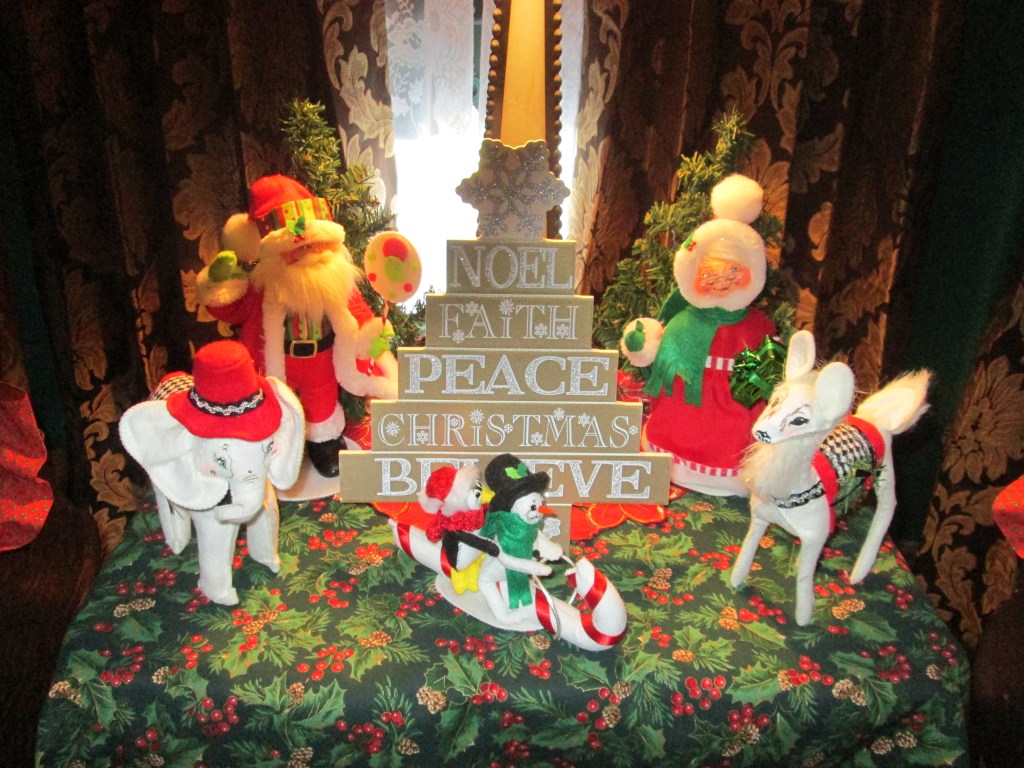
The above photo was taken at Los Angeles’s Grier Musser Museum of Victoriana. Martine and I spent a pleasant afternoon visiting the museum owners, Susan and Rey Tejada, who live on the premises. They have an impressive collection of holiday-related books, animated displays, and figurines. I spent over an hour looking at 3-D First World War images on a stereopticon. They also have a great collection of pop-up books of every description.

Nine Christmas Movies

Ralphie (with Glasses) and the Kids from A Christmas Story

Following is a list of the nine Christmas movies I am committed to seeing again and again during the Yule season. It is highly individual and does not contain many of the usual “heartwarming” titles that clog so many lists like atherosclerosis.

They are listed in order of preference:

A Christmas Story (1983)

It is as if this film were deliberately made with me in mind. The opening scenes shot on Cleveland’s Public Square, featuring the toy display at Higbee’s Department Store, were part of my past. And Ralphie’s school resembles Harvey Rice Elementary School, where I spent kindergarten and part of first grade trying to come to terms with the English language.

A Christmas Carol (1951)

This is by far my favorite version, starring Alastair Sim as Ebenezer Scrooge. I never tire of the story, and this is the most complete telling of Dickens’s tale.

Lady in the Lake (1947)

Robert Montgomery as detective Phillip Marlowe attempting to track down the missing wife of a magazine publisher during Christmas. The love story between Marlowe and Publishing Exec Adrienne Fromsett (played by Audrey Totter) is actually believable.

The remaining titles are in random order and are, to my mind, not quite so good as the top three above:

It’s a Wonderful Life (1946) with Jimmy Stewart
The Shop Around the Corner (1940) also with Jimmy Stewart
The Nightmare Before Christmas (1993) – Stop motion animation from Tim Burton
The March of the Wooden Soldiers (1934) with Laurel & Hardy, a childhood favorite
The Curse of the Cat People (1944) by Val Lewton with Simone Simon singing a lovely French carol
The Bishop’s Wife (1947) with Cary Grant

I’m sure that most people’s reaction to this list is, “What about X, Y, and Z?” They might be on your list, but didn’t make it to mine.

Christmas Cheer

Christmas Display at the Grier Musser Museum

This afternoon, Martine and I visited our friends Rey and Susan Tejada at the Grier Musser Museum near downtown L.A. The Victorian house is being dwarfed by a four-story apartment building under construction just north of them, but the Spirit of Christmas is very much evident in the holiday-related antiques on display.

I forgot to bring my camera along, so the picture above is from our 2019 visit at Christmas time.

As Christmas Day gets closer, I have pretty much surrendered to the good feelings that supposedly prevail at this time. Martine is listening to the Classic Christmas Music channel on Music Choice, and I no longer grit my teeth—unless they decide to play “The Little Drummer Boy,” in which case I feel it incumbent on me to leave the room. Pah-RUP-pup-PUM.

I just want to make Martine happy this time of year. On Monday, I will cook up one of her favorite dishes, a beef stew from a recipe in the New York Times. And we already have a couple of bottles of her favorite wine, Egri Bikavér (Bull’s Blood of Eger) from Hungary.

If Martine is happy, I will be happy.

Devoirs

Yay! I Survived Turkey Day!

Of course, it was nowhere near so bad as I imagined it would be. I tend to get a bit crotchety about holidays. They tend so often to make for bad feelings because there are all those things one has to do to make for the perfect holiday. If it turns out to be less than perfect, one is floored by feelings of inadequacy.

The French have a word for it: devoirs. Check out the Alpine French School website for a discussion of the different meanings of the term, particularly the second meaning. The devoirs for Thanksgiving include:

  • A turkey dinner with mashed potatoes, green bean casserole, cranberry sauce, pumpkin pie, etc etc etc
  • Getting together with as many of your family that you can sit around your dining room table
  • Discussions about politics with that uncle with whom you do not wish to converse

If you think that’s a lot, let’s take a look at thge many devoirs pertaining to Christmas:

  • Expensive and thoughtful gifts for everyone
  • A tree in the living room with ornaments, tinsel, and lights
  • Multi-colored lights festooning the front of your house
  • Maintaining harmful myths about Santa and elves to your underage children
  • Sending Christmas cards to family, friends, acquaintances, and just about everyone else

Just remember one thing: You don’t have to buy into all the “oughts” connected with the holidays. Your more conventional friends will probably think you a bit of a Grinch. Note, however, that it is better to be thought a Grinch than to be depressed and broke.

I took Martine out to Cafe 50s so she could have her Thanksgiving turkey, while I, of course, ordered something other than bird. She also had her favorite Hawaiian Tropic milk shake, so she is quite pleased with our quasi-celebration of the holiday.

A Poem for Boxing Day

The period between Christmas and New Years Day has always been strange. Even among the ancient Mayans, the last five days of the 365-day Haab calendar were called Uayeb, just to fill out the remainder of the year after the 18 months of 20 days each had transpired.

In much of the English-speaking world—but not the United States—today is Boxing Day. It has nothing to do with pugilism and is more a commemoration of certain Victorian practices regarding gifting servants.

It’s also Kwanzaa, a made-up holiday for African-Americans to celebrate their origins and serve as an alternative to that White persons’ holiday known as Christmas.

I was delighted to find a Scottish poem that also celebrates (or debunks) this period. It is “The Daft Days” by Robert Fergusson (1750-1774), written in a broad Scots dialect:

The Daft Days

Now mirk December’s dowie face
Glowrs owr the rigs wi sour grimace,
While, thro’ his minimum of space,
The bleer-ey’d sun,
Wi blinkin light and stealing pace,
His race doth run.

From naked groves nae birdie sings,
To shepherd’s pipe nae hillock rings,
The breeze nae od’rous flavour brings
From Borean cave,
And dwyning nature droops her wings,
Wi visage grave.

Mankind but scanty pleasure glean
Frae snawy hill or barren plain,
Whan winter, ‘midst his nipping train,
Wi frozen spear,
Sends drift owr a’ his bleak domain,
And guides the weir.

Auld Reikie! thou’rt the canty hole,
A bield for many caldrife soul,
Wha snugly at thine ingle loll,
Baith warm and couth,
While round they gar the bicker roll
To weet their mouth.

When merry Yule-day comes, I trou,
You’ll scantlins find a hungry mou;
Sma are our cares, our stamacks fou
O’ gusty gear,
And kickshaws, strangers to our view,
Sin fairn-year.

Ye browster wives, now busk ye braw,
And fling your sorrows far awa;
Then come and gie’s the tither blaw
Of reaming ale,
Mair precious than the well of Spa,
Our hearts to heal.

Then, tho’ at odds wi a’ the warl’,
Amang oursels we’ll never quarrel;
Tho’ Discord gie a canker’d snarl
To spoil our glee,
As lang’s there’s pith into the barrel
We’ll drink and ‘gree.

Fidlers, your pins in temper fix,
And roset weel your fiddle-sticks;
But banish vile Italian tricks
Frae out your quorum,
Not fortes wi pianos mix –
Gie’s Tulloch Gorum.

For nought can cheer the heart sae weel
As can a canty Highland reel;
It even vivifies the heel
To skip and dance:
Lifeless is he wha canna feel
Its influence.

Let mirth abound, let social cheer
Invest the dawning of the year;
Let blithesome innocence appear
To crown our joy;
Nor envy wi sarcastic sneer
Our bliss destroy.

And thou, great god of Aqua Vitae!
Wha sways the empire of this city,
When fou we’re sometimes capernoity,
Be thou prepar’d
To hedge us frae that black banditti,
The City Guard.

I’m Back

Angels at the Grier-Musser Museum

My computer was down last week, so I was consequently unable to post. It’s been patched up for now, and a new computer is on order. After all, I’ve had this Dell Optiplex 9010 for ten years, so it’s about time to replace it.

In the meantime, Merry Christmas to all my readers. Oh, and I think I’ll also add a “bah humbug!” for good measure.

Welcome to HallowThanksMas

Display at the Grier Musser Museum (2015)

It didn’t used to be this way, but now Halloween is now a portal to a ten week holiday season that includes Halloween, the Day of the Dead (All Souls Day), Thanksgiving, Christmas, New Years Day, Martine’s birthday, and my birthday. Fortunately, I don’t take it as seriously as most people do; and I even try to enjoy bits and pieces of it.

In past years, I spent much of October reading horror stories and watching horror films. This year, I’ve not been feeling well, thanks to a hideous attack of bronchitis and asthma. Fortunately, I am feeling better now. And the only horror stories I’ve read were in a collection by Robert Aickman entitled The Wine Dark Sea. I particularly recommend the short story of the same name that opens the collection.

Tomorrow I get my Covid and flu shots, to be followed in two weeks by a vaccination for RSV. I know that the whole issue of vaccinations has become politicized, but I just don’t feel like dying of negligence.

Anyhow, I wish you well during he upcoming HallowThanksMas season. Just don’t let it weigh you down.

The End of HalloThankMas

Our End of Year Holiday Ordeal Is Now Over!

From the beginning of October to the end of the Tournament of Roses Parade is one unending holiday, which I call HallowThanksMas, but others shorten (not by much) to HalloThankMas. It’s supposed to be a time of family closeness, warmth, and happiness—but isn’t, not by a long shot.

This is why I love the whole idea of Festivus—a holiday for the rest of us—as introduced by the Seinfeld show in 1997. It consists of the following:

  • A vertical, unadorned aluminum pole
  • A Festivus dinner, during which there is an “airing of grievances”
  • In response to pushback from the diners, there are “feats of strength,” during which the whiners are wrestled to the ground
  • “Festivus Miracles” are easily explained coincidences

I actually like Halloween, though I never attend Halloween parties, nor would any of my friends be so unwise as to invite me to one. But Thanksgiving and Christmas could and probably should be replaced by something like Festivus. It’s cheaper, does not involve the consumption of dry birds, does not involve greeting cards or gifts, and airs out all the hidden aggressions behind the holidays.

Think about it.

Return to Uayeb Yet Again Part Deux

To date, I have written five posts about the Maya “month” of Uayeb or Wayeb, which consists of the last five days of the Haab Calendar of 365 days. The Haab calendar has twenty months of eighteen days each, which isn’t quite enough to make up the full complement, so the Maya added a short stub of a month containing the five “nameless days.”

There is also a Maya god named Uayeb, who is the god of misfortune. That sounds about right.

The Cartoonist Scott Stantis Has an Intuitive Understanding of Uayeb

Here is a link to my previous posts on the subject:

Below is the Maya glyph for the “month” of Uayeb, or Wayeb (kind of looks like a tiny-headed god flexing his muscles, doesn’t it?)

In his comments to last year’s post, my friend Mudpuddle noted that “the glyph looks like a surfer headed for muscle beach!”

I am amused by how well a Maya calendrical belief fits in so well with our civilization, in which the days between Christmas and New Year and almost universally considered as dead time.

So don’t make any big plans until the New Year. But you kind of knew that anyway, no?

An Abrupt End to Carols

It Happened Decades Ago in Sacramento …

I first met Martine when she was living in Sacramento and working as a civilian at the old Sacramento Army Depot. My mother was alive at the time and lived near McClellan Air Force Base. One day, while I was visiting her, I saw this young woman approach the front door carrying a bag of oranges. It was my first meeting with Martine, whom I invited out on a date set for New Years Eve.

It was a strange date. We saw a Swedish film called My Life as a Dog, then we went out to a Chinese restaurant. We had difficulty finding one, as there were rolling power outages occurring all around the city. But we finally found one where the lights were on.

When I would drive up to visit Martine around Christmas time, she typically listened to a radio station that played nothing but Christmas carols. That didn’t bother me much, except they always snuck in “The Little Drummer Boy” (pa-rum pum pum pum).

Once, as it was nearing midnight on Christmas Day in 1988 or 1989, they started to play that damned song. Somebody at the radio station must have been of my mind, because just as they were to ring out with the nth pa-rum pum pum pum, at the stroke of midnight there was a sound as if a chicken were having its neck wrung. And that was it for the Christmas carols on that station that year. I laughed so hard I started coughing.

I always hated that song pa-rum pum pum pum.