
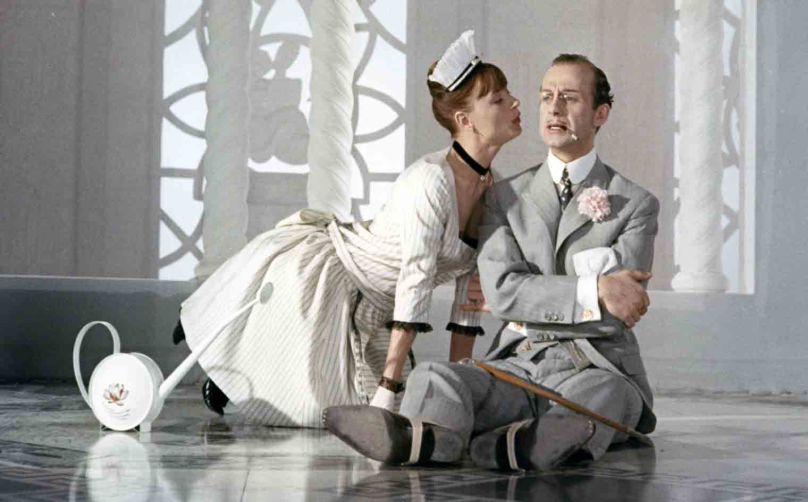
Color

Harriet Andersson and Jarl Kulle in Bergman’s All These Women (1964)

Yesterday I posted about my love for black & white films. Today, I would like to redress the balance by talking about the pros and cons of color film. With the new motion picture and video cameras, color is, for the most part, what the camera is programmed to shoot, especially when the camera is digital.

There was a brief time in the 1960s when film directors made some exciting use of color film stock. I am thinking of such films as Michelangelo Antonioni’s The Red Desert (1964), Ingmar Bergman’s All These Women (1964), and—going back a couple of decades—Michael Powell and Emeric Pressburger’s Black Narcissus (1947).

In fact, the Internet Movie Database (IMDb) has released a list of 275 films “with Amazing Use of Colours.” The list includes some well-known titles as Alfred Hitchcock’s Vertigo (1958), Robert Zemeckis’s Forrest Gump (1994), Jacques Demy’s The Umbrellas of Cherbourg (1964), and Steven Spielberg’s E.T. (1982). Interestingly, there are scores of titles of films of which I have never heard: In each case, some film-maker wanted to make something different and succeeded.

As digital film becomes more prevalent, the temptation is for producers and directors to not attempt anything special. This is particularly true of films released by HBO, Netflix, Hulu, and others in multiple parts. Most of these productions I frankly ignore. Graphically speaking, most are failures.

Even films released as features for the theaters are not necessarily any better. In the old days of the Hollywood Studios, interesting cinematography was a matter of institutional pride. But that was then….
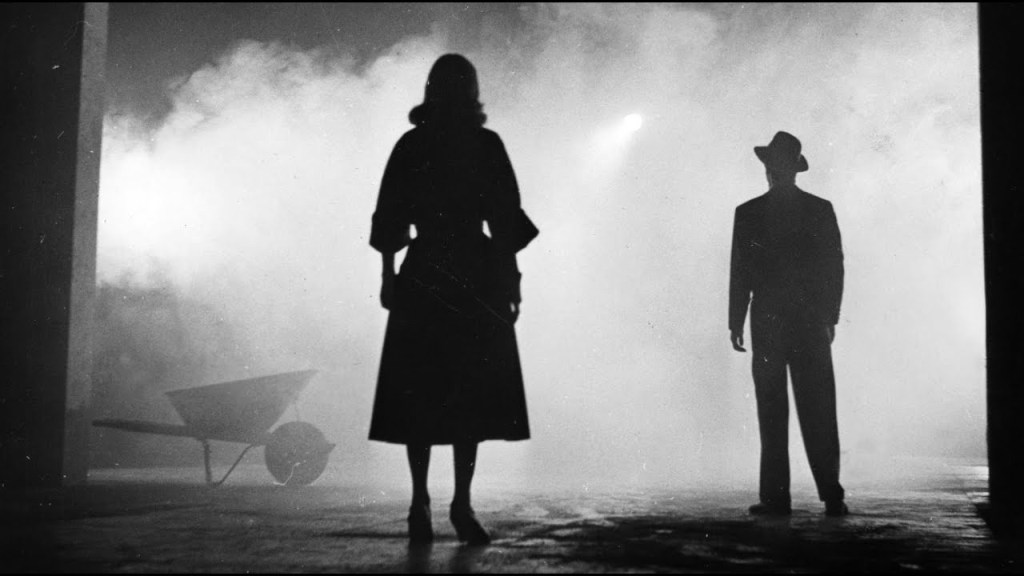
Light, Dark and Noir

Still from Joseph H. Lewis’s The Big Combo (1955)

One of the great visual artists of the American film was John Alton (1901-1996), a cinematographer famous for the visual style of some of the best noir films. Born Johann Jacob Altmann in Sopron, Hungary, Alton was instrumental in creating a look across the films of different directors at different studios that became a quintessential characteristic of an entire American genre.

As he wrote in his book Painting with Light:

The director of photography visualizes the picture purely from a photographic point of view, as determined by lights and the moods of individual sequences and scenes. In other words, how to use angles, set-ups, lights, and camera as means to tell the story.

John Payne in Robert Florey’s The Crooked Way (1949)

In an otherwise unremarkable film I saw last night on Turner Classic Movies (TCM), Alton’s work lifted the film up to an entirely different level. United Artists’ The Crooked Way was a tale of a war hero amnesiac who, on investigating his pre-war life, finds he was a criminal. Alton’s images of Los Angeles, including a bail bond shop, a night club, and a war surplus warehouse made the film a feast for the eyes.

Still from Anthony Mann’s T-Men (1947)

Even in a movie shot for a poverty row studio like Eagle-Lion Pictures, Alton was superb. Of course, it helped that the director was Anthony Mann, whose noir credentials are impeccable.

To see a list of the noir films Alton photographed, check out this website and scroll halfway down for a list of eighteen of his noir masterpieces.

And just to demonstrate his versatility, Alton was also superb in working with color, such as in Allan Dwan’s Slightly Scarlet (1958) and Stanley Donen’s musicasl with Gene Kelly, An American in Paris (1951)