3989 East 176th Street

Where I Lived 1948-1964

Where I Lived 1948-1964

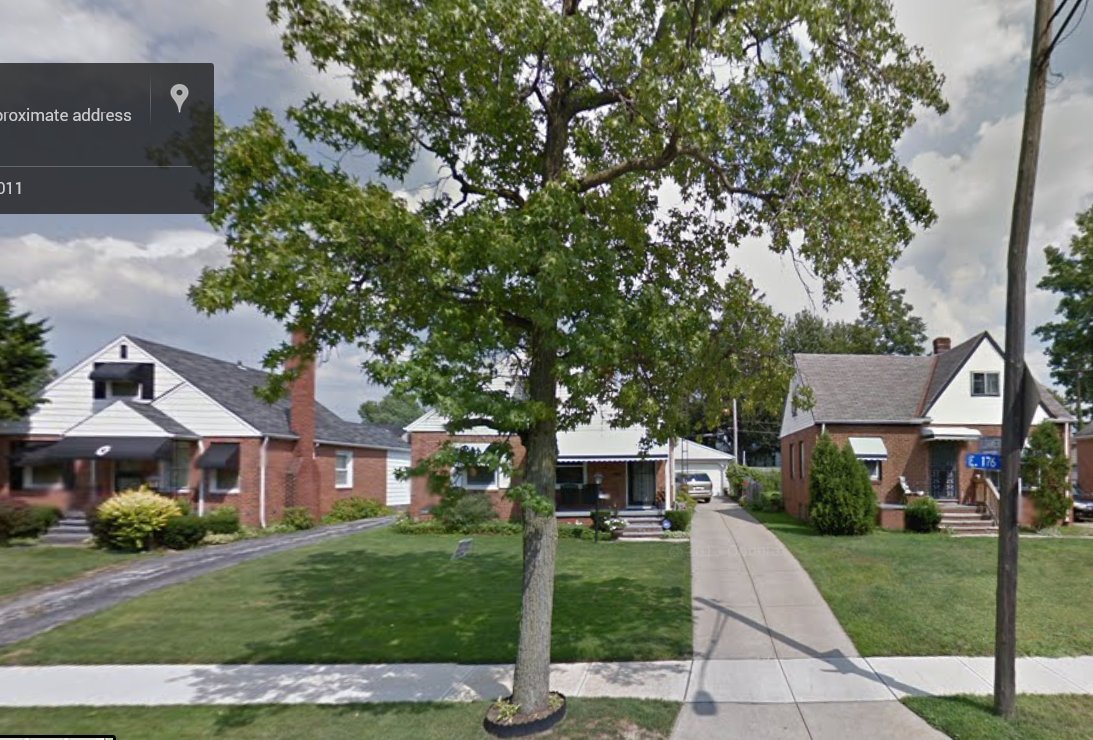
When I looked up my old street address on Google, I was also given the opportunity to get a photographic view of the house where I spent most of my childhood up to fifty years ago. The house in the middle fronts on where Eldamere runs into East 176th Street. On the left side of us lived the Smiths; on the right, the Fordosis, our “enemies.” The photograph makes the front yards look much bigger than they were by about a quarter. The tree hides the window to my second story attic room, where I spent much of my time doing my homework and reading.

We were just a few houses in from Harvard Avenue, where Charley Fontana’s corner grocery store was located. Once, when I was little, William Boyd, the star of the Hopalong Cassidy television series, stopped at Fontana’s and was mobbed by little kids, one of whom was me. He handed out embossed plastic commemorative coins stamped with the name Hopalong Cassidy.

About half a mile left on Harvard was Saint Henry’s Church and School, where I attended grades two through eight. (Don’t tell anyone this, but, to my eternal shame, I never finished first grade.) Then I spent four years at Chanel High School in Bedford, which was renamed St. Peter Chanel before it blinked out of existence last year.

It was a pretty nice neighborhood when we moved there in the late 1940s. Because most of the houses were pretty new back then, the streets were barren. Now they are flanked by large trees that were just getting started when we moved to Parma Heights. By then I was at Dartmouth College and was way too sophisticated to care.

What made us move out was a real estate practice known as blockbusting. The early 1960s were a time of racial tension. When real estate salesmen paraded potential black buyers to neighborhood houses, the existing residents—including my family—panicked and sold out. We thought the neighborhood would become an evil slum like the Hough District just east of downtown. It never did: The new owners apparently were just as intent on making it a nice place to live as the Hungarians and Poles who left the area.

When I returned in 1998 to look around with my brother, we were pleasantly surprised.


Tarnmoor’s ABCs: Cleveland

My Home Town

My Home Town

Cleveland has not aged well. When I was a grade school student, it was one of the ten largest cities in the United States, famed for its steel, machine-tool building, and automotive support industries. Now it is a fraction of the size, with a large bombed-out crater of a central business district and suburbs stretching across several counties in Northeast Ohio. When I graduated from high school, there was a regular diaspora to … anywhere but Cleveland.

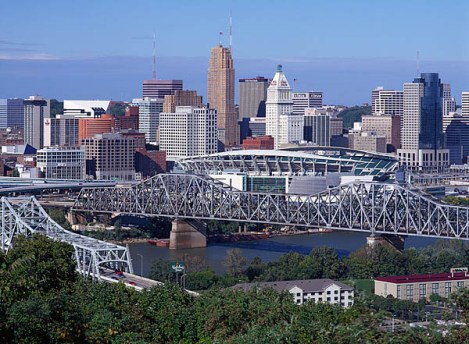
The “Mistake on the Lake.” The “Worst Location in the Nation.” Perhaps the ultimate insult was when Amtrak pondered whether it was worth even stopping at the large underground station in the Terminal Tower, illustrated above. There was a time when the Terminal Tower was the largest building in the country outside of New York City.

Just being from Cleveland makes one feel humble. Wasn’t the movie that Maynard G. Krebs of The Affairs of Dobie Gillis always going to see The Monster That Devoured Cleveland? Well, Cleveland got devoured all right: The monster that devoured it was rampant unemployment.

I can only talk about the Cleveland that was because, after 1962, I spent most of my time elsewhere, either in Hanover, New Hampshire, attending Dartmouth College, or here in Los Angeles, where I seem to have set down roots.

The last time I saw my native city was 1998, when I attended my mother’s funeral. She had died in Kings Beach, California, on the shores of Lake Tahoe; but at her request, my brother and I had the body flown to Cleveland, where it was buried next to my father. After the funeral, my brother and I spent some time driving around our old haunts.

What surprised me more than anything else were the trees! When I lived on East 176th Street in the 1950s, the neighborhood was still relatively new and bare; and the trees were all tiny. By 1998, they were gigantic and imposing. It was actually rather nice. I should probably go back there again, perhaps stopping in on a visit to New York or Boston. Most of the people I grew up with are either elsewhere or under the ground, especially the older generation. So it goes.

Never the Twain Shall Meet

Cincinnati? Isn’t That Part of the Confederacy?

Cincinnati? Isn’t That Part of the Confederacy?

I was born in Cleveland, Ohio, and spent the first seventeen years of my life there. During that whole time, and even since then, I have never known a Clevelander who has been to Cincinnati. By air, the two cities are a mere 217 miles (or 349 km) apart. That really isn’t very far, considering that there is a good deal greater distance between Los Angeles and San Francisco. And yet Angelenos travel to San Francisco, Portland, Seattle, and Vancouver (and vice versa) a good deal more than Clevelanders travel to Cincinnati.

Why do you suppose that is? I thought about it for a while and came to the conclusion that Ohio is somewhat like Iraq or Syria, where two or more cultures co-exist (when they are not killing one another). Northeastern Ohio, where Cleveland lies, is pretty much a blue state kind of area, heavily into unions and the Democratic Party; whereas Southern Ohio is solidly Republican.

For instance, Ohio’s 8th Congressional District, currently represented by John Boehner, has not sent a Democrat to Congress since 1937.

Yesterday, while Martine and I were eating lunch at Jerry’s Deli in Marina Del Rey, the TV monitors were televising a game between the Cincinnati Bengals and the Baltimore Ravens. I’d be willing to bet there are more Bengal fans in Los Angeles than there are in Cleveland. It’s almost as if the inhabitants of “The Mistake on the Lake” (as Cleveland is known to those who, ulp, love her) think they are part of the Confederate States of America. And, in a way, they are….

Howdy Doody and Harvey Rice

Me on a Tricycle Ca. 1950

Me on a Tricycle Circa 1950

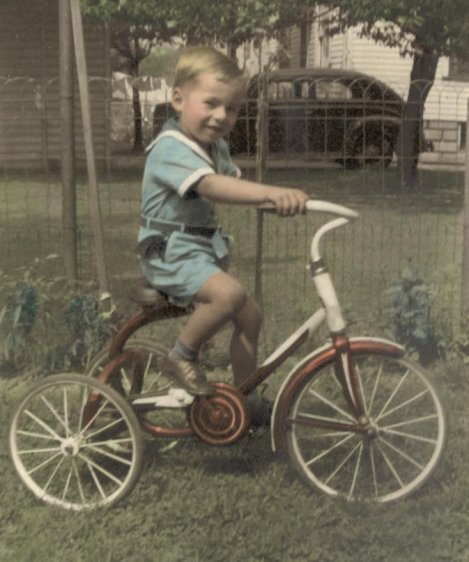
That’s me on a tricycle, sometime around 1950. We were living at 2814 East 120th Street off Buckeye Road in Cleveland. The whole place was filthy with Hungarians. There were so many, in fact, that I did not know the English language existed until two things happened: First, we got a television set late in 1949, and I started watching the Howdy Doody show at 5 pm every day, just after Kate Smith closed her show by singing “When the Moon Comes Over the Mountain.” (It took me a while to understand what Howdy and Buffalo Bob Smith were saying.)

Secondly, I started kindergarten at Harvey Rice School on East 116th Street in January of 1950. My parents thought that, living as we did in a Hungarian neighborhood, the public school teachers would speak Hungarian. Nothing doing! Mrs. Idell sent me home with a note pinned to my shirt that asked, “What language is this child speaking?” As if she didn’t know!

That last factor decided my Mom that we had to leave our little Hungarian womb on the East Side and move to the suburbs. Gone forever would be the Reverend Csutoros and the First Hungarian Reformed Church; the Regent and Moreland movie theaters; Kardos’s Butcher Shop with its delicious Hungarian sausages; the College Inn, where my Dad would take me for French Fries; and the Boulevard Lanes where my Dad bowled and I kept score.

It was a cohesive little world, but my parents ate the apple from the Tree of Knowledge when they decided to raise me as a Hungarian. You know what? I’m grateful that they did. I made my adjustment to English (and I’m still making it), but my heart belongs to the Magyar Puszta.

.