
The Man in the High Castle

Prague Castle, Seat of the Czech Government

Prague Castle, Seat of the Czech Government

No, this isn’t about the Philip K. Dick novel of that name, but about a nation’s president who came to the world’s notice after many years as a jailed dissident and as a playwright of international renown. I am referring to Václav Havel, the last president of Czechoslovakia and (after Slovakia decided to go its own way) the first president of the Czech Republic.

I have just finished reading his informal memoir, To the Castle and Back: Reflections on My Strange Life as a Fairy Tale Hero. Written after he left office in 2003, this book consists of three interleaved sequences:

  1. Reflections written mostly in 2005 during a protracted visit to the United States
  2. A series of memos to his staff dating from 1993-2003 that he found on his computer
  3. An ongoing interview with Czech writer Karel Hvizd’ala about his experiences running a country that had suddenly cast off the yoke of Communism

It also shows some of the small issues that endlessly plagued him, such as the following:

In the closet where the vacuum cleaner is kept, there also lives a bat. How to get rid of it? The lightbulb has been unscrewed so as not to wake it up and upset it.

At other times, Havel had to complain to his staff about the ugliest old telephones being in the most prominent places, about the length of the watering hose used in the gardens, and why the good silverware was not being used for state dinners.

I was curious to discover that Havel, despite being a well-known writer, was petrified whenever he had to begin writing anything. And he appears to have written all his own speeches! (And well, too.)
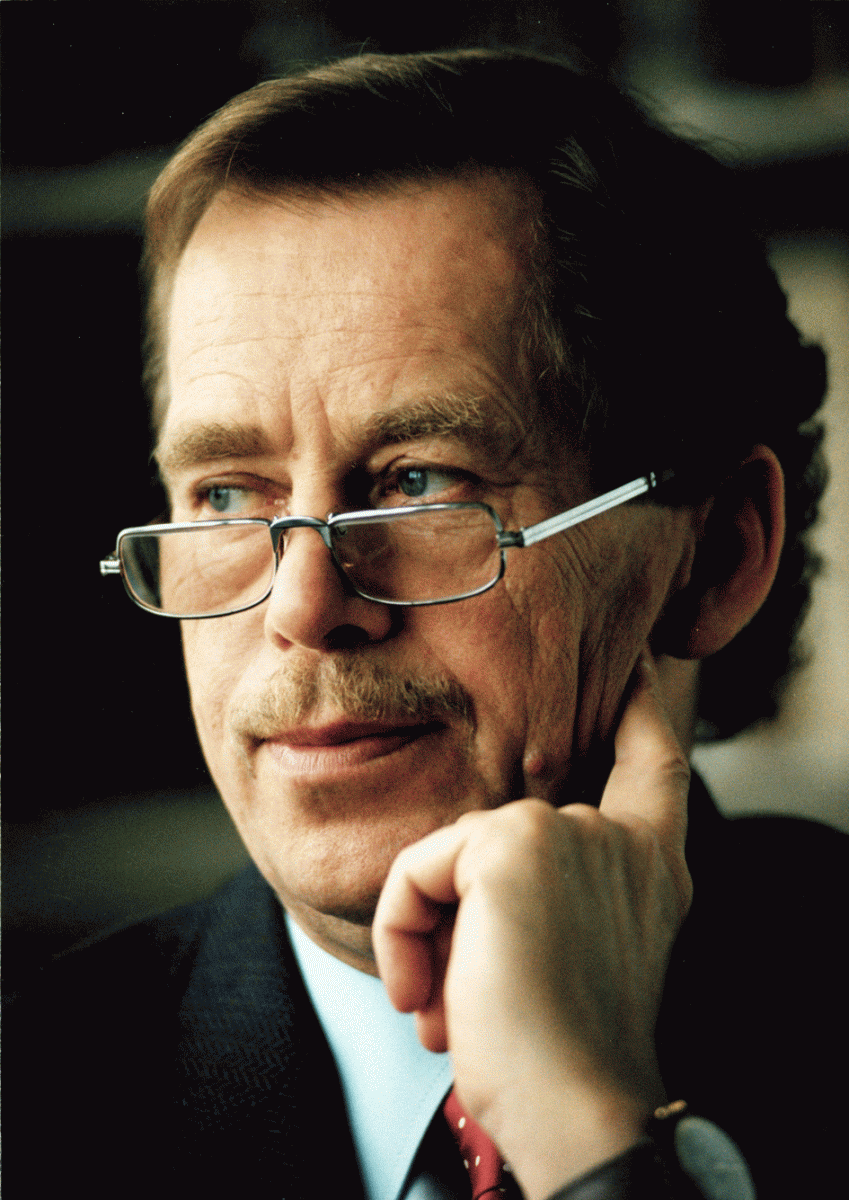
Czech President Václav Havel

Czech President Václav Havel

Particularly impressive was Havel’s answer as to Hvizd’ala as to what his credo was as the President of the Republic:

I think that the moral order stands above the legal, political, and economic orders, and that these latter orders should derive from the former, and not be techniques for getting around its imperatives. And I believe this moral order has a metaphysical anchoring in the infinite and the eternal.

Can you imagine any of our own leaders being so candid, to the point, and right at the same time?

Despite the book’s informality, I find it that To the Castle and Back gives probably the best picture of what the transition from Communism to Capitalism was like in one country, and the perils of what Havel calls “postcommunism,” in which the former Communist leaders, being still in a position of power and with all the right connections, loot the country.


An Embarrassment to the Russians

Cardinal Jószef Mindszenty

Cardinal Jószef Mindszenty

I have just finished reading Victor Sebestyen’s excellent Twelve Days: The Story of the 1956 Hungarian Revolution. As a Hungarian-American I was acutely conscious of the events of that Fall. I never forgave President Eisenhower, Secretary of State John Foster Dulles, or Secretary-General Dag Hammarskjöld of the United Nations for what I felt was their craven refusal to confront a very sticky issue. Did I say confront? They essentially ignored it—even while Radio Free Europe was broadcasting military advice and promises of American and U.S. military aid. Aid that never came. All that came was a mass invasion of Russian troops and armor that crushed the rebellion definitively.

As a kid in Cleveland in 1956, and as a student at St. Henry’s Catholic School, I had always thought that one of the heroes of the Revolution was Jószef Cardinal Mindszenty, Prince Primate, Archbishop of Esztergom, and leader of the Catholic Church in Hungary from the last year of World War II to his death in the 1970s. Poor Mindszenty had been imprisoned by the Hungarian Communist leadership until the beginning of the Revolution, in which he actually played no real part. Just days after he was released from prison, he sought asylum of the American legation in Budapest, where he stayed for the next fifteen years.

As a Catholic school kid, we were urged to sell the Diocese of Cleveland’s Catholic Universe Bulletin from door to door in our neighborhoods. According to the Universe Bulletin, Mindszenty was the hero of the Hungarian Revolution, whereas actually he played pretty much a walk-on, walk-off role. But I was just a kid and I believed all that pap.

In the end, Mindszenty proved an embarrassment to the Russians because it kept the memory of the uprising alive in peoples’ minds, even if he himself was a non-player. In the end, Pope Paul VI ordered Mindszenty to leave Hungary, and the Kádár government allowed him to go. His continued existence in the American legation made it difficult for the Catholic Church to come to any accommodation with the Kádár régime.

Mindszenty was just a minor embarrassment to the Russians. It was the Hungarian Revolution itself that proved to be a much greater embarrassment. After 1956, the Communist parties of Western Europe felt that Russia had behaved brutally. Never again were the Communist parties of France, Italy, Britain, and other countries bring any serious political influence to bear. From 1956, it was a mere 31 years before Soviet Communism itself crumbled.


Imaginative Infamy

Soviet-era postage stamps honoring Sergei Kirov

No one could say that Josef Stalin was unimaginative when it came to being one of the greatest tyrants in living memory. You may have heard of the old saying “Keep your friends close, but your enemies even closer.” In the 1920s and 1930s, Sergei Kirov was a rising star in the Communist party, and reputed to be one of the dictator’s best and closest friends. They even took working vacations together on the Black Sea.

But there was this nagging problem: Kirov was getting much too popular. At the Seventeenth Party Congress early in 1934, both positive and negative votes for various leaders were cast; and it appeared that a large number of negative votes were cast against The Man of Steel (Stalin). In fact, some party leaders approached Kirov and suggested that he take over the reins of power. As a loyal party member, Kirov reported this to Stalin, who thereupon rigged the vote count so that he himself won.

On December 1, Kirov was shot in the back of the head just outside his second-floor office at the Smolny Institute in Leningrad. When Stalin was contacted in Moscow, he rushed at once to Leningrad and took over the investigation in person. The gunman was, in all probability, Leonid Nikolaev.

But it didn’t stop there. Stalin saw Kirov’s death (which he may or may not have engineered himself) as the perfect opportunity to rid himself of some enemies from the earliest days of the party. Hurled into prison were Lev Kamenev and Grigorii Zinoviev, two of the early Bolsheviks whom Stalin accused of masterminding a massive conspiracy leading to his friend’s death. Before it was all over, upwards of several thousand enemies and families and friends of enemies of Stalin were fingered by the NKVD and either imprisoned, exiled, or shot outright.

In the meantime, Stalin make a big show of grieving for Kirov, being one of his pallbearers, and retrospectively naming him as one of the Heroes of the Revolution. Also he authorized some postage stamps honoring his memory (see illustration above), renamed streets around the Soviet Union to honor him, and even changed the name of the Maryinsky Ballet in Leningrad to the Kirov Ballet.

This was only the beginning of what came to be known as Stalin’s Purges, which reached their peak in 1937-1938. In the end, untold millions of lives were affected, and the literature of the era has given birth to many great novels in which these events were mirrored, books such as Arthur Koestler’s Darkness at Noon, Victor Serge’s The Case of Comrade Tularev, and Anatoly Rybakov’s Children of the Arbat and Fear. And these in turn gave birth to Alexander Solzhenitsyn’s many works about the Gulag Archipelago.

I have just finished reading Amy Knight’s excellent Who Killed Kirov? The Kremlin’s Greatest Mystery, in which she concludes:

The story of Kirov’s murder did not end with the trials of January 1935. On the contrary, the murder and its aftermath marked the beginning of a nightmare that would consume the Soviet Union for the next four years. Some historians insist that the police terror that unfolded after Kirov’s assassination was not the product of any grand strategy of Stalin’s, but rather a haphazard, frenzied process that fed on itself. But when one considers how Stalin meticulously pored over transcripts of interrogations and indictments and how he systematically meted out retribution to his real or perceived enemies, a picture of a carefully planned vendetta emerges.

Friendship with those who are too powerful and too paranoiac has its price.