

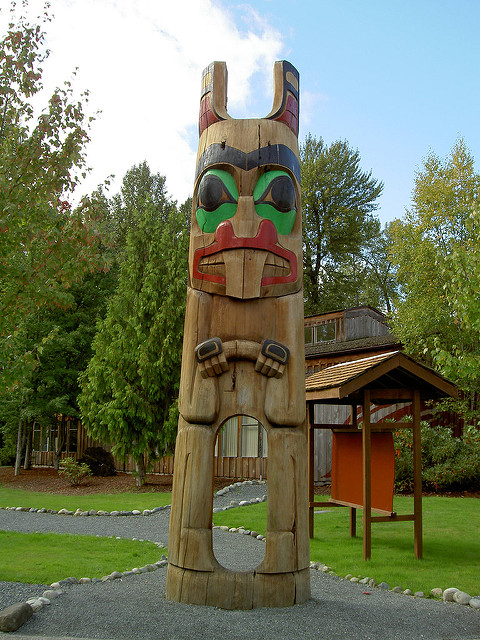
Detail from Totem Pole in Victoria BC
Totem poles are some of the most accessible images of aboriginal spirits. The best I’ve seen were on Vancouver Island in British Columbia, mostly in Victoria and Cowichan. After seeing them, I read Franz Boas’s book Primitive Art (1927). As I wrote in a previous blog, “It’s a difficult read, but like many difficult reads, eminently worthwhile.”
One of the reasons that totem poles are so stunningly impressive is that they are still being made by Indians in the U.S. and First Nations members in British Columbia. Unlike Hopi Kachinas, which are also still being made, they are a public art form; and many old poles have been gathered together and put on display.
I would love to visit the Alaska panhandle to see the Haida totem poles on Prince of Wales Island, and perhaps also the Haida Gwaii archipelago in British Columbia north of Vancouver Island.

Totem Poles at Cowichan in 2004
One could stand in front of a totem pole and try to guess at what the images are signifying. For instance, in the loincloth-clad figure on the right above, he is cradling a fish (probably a salmon) in his left hand while wearing an oversized hat with blue and red strips along the bottom. What does that mean?
If I were to go back to Cowichan for another look, I would be deeply disappointed. When I did go back a few years later, the totem poles were looking uncared for and there was talk of turning the tribal facility into a conference center. I wonder if that ever happened.

 Tarnmoor
You must be logged in to post a comment.