Where Reading Is Honored

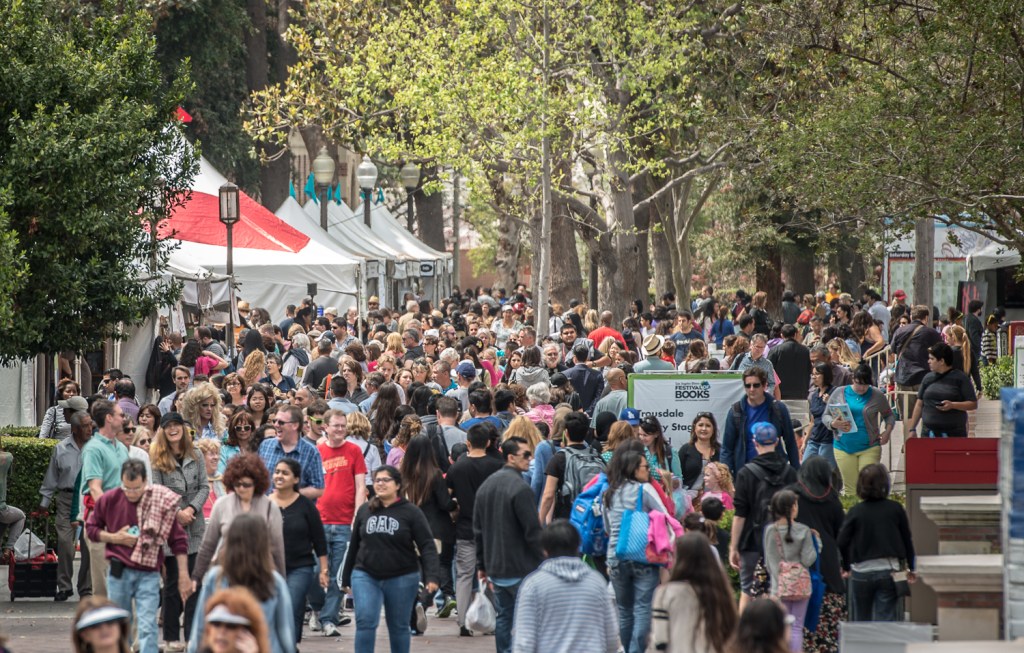
Yes, It Really Was That Crowded

After several consecutive wet weekends, this last weekend was ideal for a big get-together. And that’s exactly what happened at the campus of the University of Southern California (USC) where the 2024 edition of the Los Angeles Times Book Festival took place. I do not recall being in such a crowd scene for decades. In fact, it was so crowded that I couldn’t buy more than three books because the booths that interested me the most were jammed with people.

The only reason I could tolerate the crowds is that they were there honoring books and reading, which are sacred to me. Never mind that most of them read nothing but crap. The important thing is that they were coming together to honor an activity that is disappearing from our anti-intellectual culture.

This time I noticed for the first time that so many of the booths related to self-publishing. And, since no one ever heard of these authors, their booths were, for the most part, unvisited. Well, they are part of the publishing world, too, and with luck a handful of them may make it to the big time.

As with last year, I spent most of my time at the Poetry Stage, where there was a different poetry reading every twenty minutes. There, I made the acquaintance of three women poets I will be discussing later this week.

The one that got away, however, was the Salvadorean poet Yesika Salgado, who spoke at the Latinidad Stage in Spanish, English, and Spanglish. She was magnificent. I couldn’t buy her book because the line to buy a copy and have the poet sign it was approximately a hundred persons long; and I was by that time exhausted and ready to return home.

I guess I should have spent more time at the Latinidad Stage. Even though my Spanish is pretty punk, the people in attendance were into their poets in a big way, and Yesika is a real force on the L.A. literary scene, as this YouTube video will show:
Smart Phones and Brussels

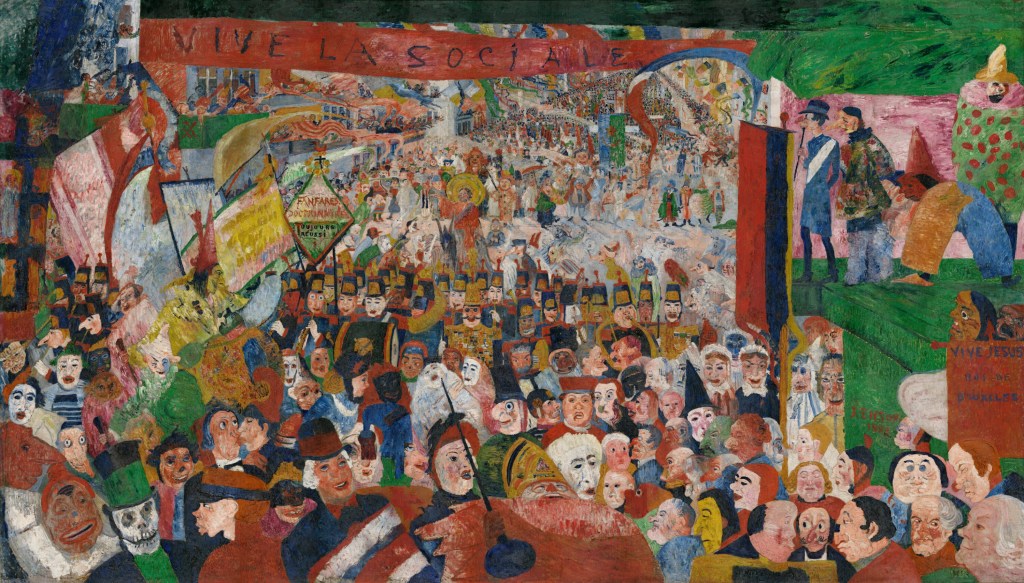
James Ensor’s Christ’s Entry into Brussels 1889

On Friday, I took a bus (to avoid the $20 parking fee) to the Getty Center to view the latest exhibitions and to reacquaint myself with the permanent collection. Unfortunately, the museum was mobbed. Time and time again, I was prevented from seeing a painting because some oversized bozo was stationed in front finger f—ing his smart phone, totally oblivious to the crowds and the magnificent artworks around him.

They reminded me of one of my favorite paintings in the Getty’s permanent collection, James Ensor’s Christ’s Entry into Brussels 1889. Look closely at the crowd entering with Christ who appears (with golden halo) in the center of the painting and slightly to the left. Now imagine each member of the crowd with a smart phone and not giving a tinker’s damn about anything but his or her Facebook or Instagram or whatever.

The Getty’s notes on the painting confirm my opinion:

James Ensor took on religion, politics, and art in this scene of Christ entering contemporary Brussels in a Mardi Gras parade. In response to the French pointillist style, Ensor used palette knives, spatulas, and both ends of his brush to put down patches of colors with expressive freedom. He made several preparatory drawings for the painting, including one in the J. Paul Getty Museum’s collection.

Ensor’s society is a mob, threatening to trample the viewer–a crude, ugly, chaotic, dehumanized sea of masks, frauds, clowns, and caricatures. Public, historical, and allegorical figures, along with the artist’s family and friends, make up the crowd. The haloed Christ at the center of the turbulence is in part a self-portrait: mostly ignored, a precarious, isolated visionary amidst the herdlike masses of modern society. Ensor’s Christ functions as a political spokesman for the poor and oppressed–a humble leader of the true religion, in opposition to the atheist social reformer Emile Littré, shown in bishop’s garb holding a drum major’s baton and leading on the eager, mindless crowd.

After rejection by Les XX, the artists’ association that Ensor had helped to found, the painting was not exhibited publicly until 1929. Ensor displayed Christ’s Entry prominently in his home and studio throughout his life. With its aggressive, painterly style and merging of the public with the deeply personal, Christ’s Entry was a forerunner of twentieth-century Expressionism.

I managed to enjoy my visit despite the crowds. I guess it was Spring Break for too many people, so I should have known better.

Dia de los Muertos

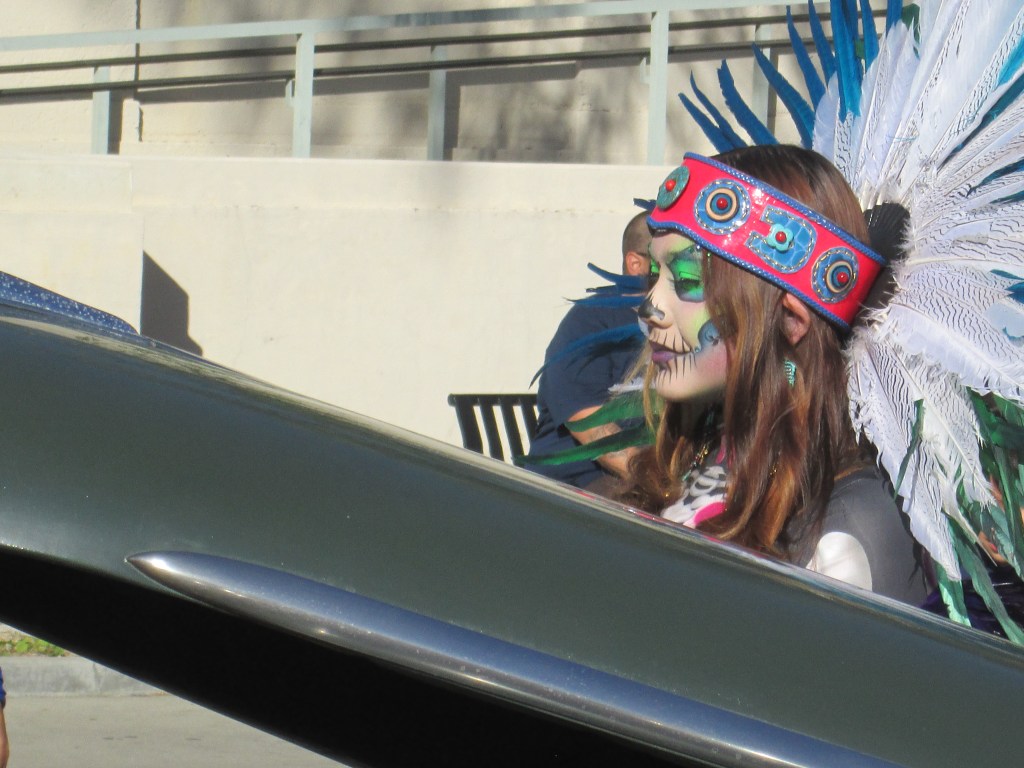
Although the Mexican Day of the Dead actually occurred on November 2, All Souls Day in the Catholic liturgy, the neighborhood of Canoga Park decided to hold their festival today. Martine and I were to meet a friend at the festival, but there was the usual problem with cell phones: It was too loud to here the telephone ring.

That was the first thing that set Martine off. Second was the size of the crowd. Neither of us positively like crowds, but her dislike of them approaches the realm of phobia. Thirdly, she abhors skeletons and costumes that suggest death. Finally, there were a lot of classical cars on display; but they were all tricked out as Mexican low-riders.

Only the first two things set me off, but I was interested in the costumes people wore and the cars. Many of the cars had ofrendas, little memorials to loved ones who have passed on.

An Ofrenda Occupying the Trunk of a Low-Rider

Where Martine did not particularly like Mexican customs, I, on the other hand, have many years of traveling in the Republic and admiring from afar these same customs. I remember one bus ride I had back in the 1980s on the Dia de los Muertos between Mazatlán and Durango. The bus was filled with Mexican families on their way to have a picnic at the cemetery by the grave of their loved ones. I thought it was a splendid custom, and I helped out by holding a baby for a few miles while the young mother who sat next to me was otherwise occupied.

In the end, I knew I had to make it up to Martine. I could have made a scene and called her too thin-skinned, but instead I bought her her first cotton candy in sixty years. Then, on the way home, we stopped at Bea’s Bakery in Reseda for some of their first class pastries.So, in the end, she had some good things to remember.

Unmoved by Crowds

Not for Me

Not for Me

I belong to that class of unhappy people who are not easily affected by crowd excitement. Too often I find myself sadly unmoved in the midst of multitudinous emotion. Few sensations are more disagreeable. The defect is in part temperamental, and in part due to that intellectual snobbishness, that fastidious rejection of what is easy and obvious, which is one of the melancholy consequences of the acquisition of culture. How often one regrets this asceticism of the mind! How wistfully one longs to rid oneself of the habit of rejection and selection, and to enjoy all the dear, obviously luscious, idiotic emotions without an after-thought. And indeed, however much we may admire the Chromatic Fantasia of Bach, we all of us have a soft spot somewhere in our minds that is sensitive to “Roses in Picardy.” But the soft spot is surrounded by hard spots, the enjoyment is never unmixed with critical disapprobation. The excuses for working up a communal emotion, even communal emotion itself, are rejected as too gross. We turn from them as a cenobite of the Thebaid would have turned from dancing girls or a steaming dish of tripe and onions.—Aldous Huxley, Complete Essays, Vol. I.