
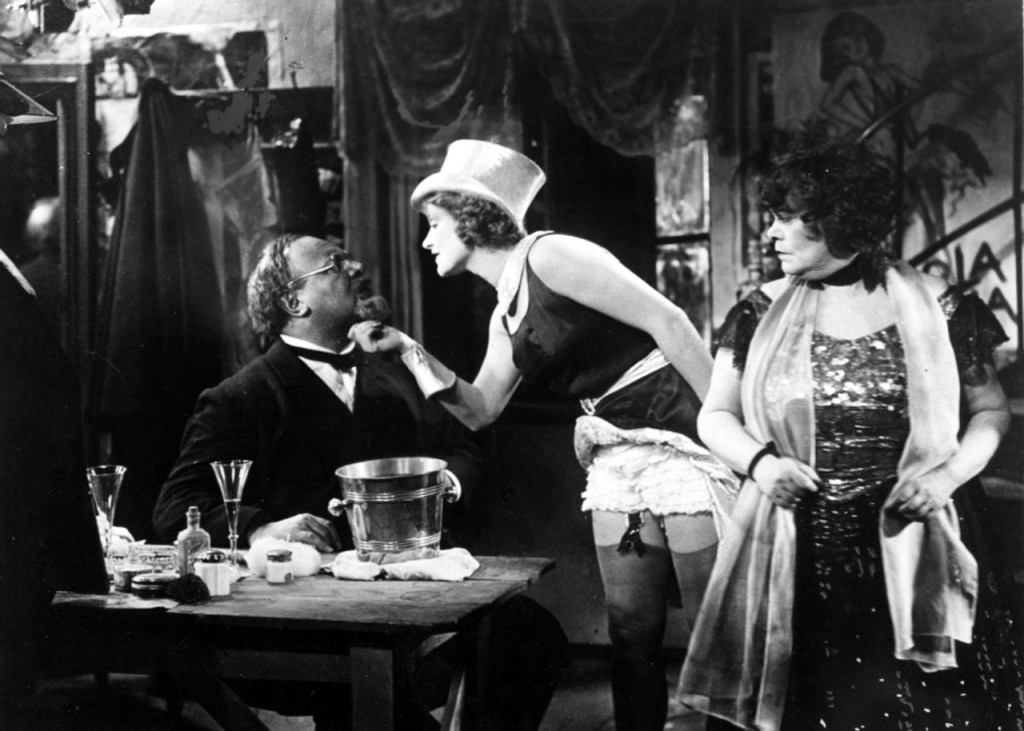
Emil Jannings (Left) and Marlene Dietrich (Center) in The Blue Angel
A cucoloris is defined by Wikipedia as “light modifier (tool, device) for casting shadows or silhouettes to produce patterned illumination…. The cucoloris is used to create a more natural look by breaking up the light from a man-made source. It can be used to simulate movement by passing shadows or light coming through a leafy canopy.”
The films of Josef Von Sternberg with Marlene Dietrich made extensive use of cucolorises. In scenes which other directors would open up, such as a troop of French Foreign Legionnaires marching through town in Morocco (1930) or a Chinese steam locomotive going down the middle of a crowded street in Shanghai Express (1932), Von Sternberg conveys a sense instead of claustrophobia and encroaching shadows.
Included in the series were:
- The Blue Angel (1930), shot in Germany
- Morocco (1930)
- Dishonored (1932)
- Shanghai Express (1932)
- Blonde Venus (1932)
- The Scarlet Empress (1934)
- The Devil Is a Woman (1936)
Even in the later films, the same lighting technique can be found in The Shanghai Gesture (1941) and Macao (1952).

Cucoloris
It is almost as if all the films were set in Lola Lola’s dressing room in The Blue Angel. In many ways, he is the diametric opposite of John Ford, whose film scenes frequently extended to the far horizon.
The seven Sternberg/Dietrich films listed above are among my favorite films of all time. I have seen all of them multiple times and will continue to do so. When I was a student in UCLA’s Graduate School, I visited Von Sternberg at his house in Westwood (his wife taught in the art department) and knew his son Nicholas.
I own a copy of his rare autobiography, Fun in a Chinese Laundry, and read his hard-to-find 1920s novel Daughters of Vienna.
 Tarnmoor
You must be logged in to post a comment.