
“Something Indecent?”

Polish Poet Czeslaw Milosz (1911-2004)

Czeslaw Milosz was born in Eastern Europe the same year as my father was born. Only, Elek Paris was no poet; and Czeslaw Milosz was one of the greatest poetic voices of his century. For many years, he lived in the United States and taught at Berkeley. He won the Nobel Prize for Literature in 1980 and died in his native Poland in 2004.

Note that the title of the following poem ends with a question mark:

Ars Poetica?

I have always aspired to a more spacious form   
that would be free from the claims of poetry or prose   
and would let us understand each other without exposing   
the author or reader to sublime agonies.   

In the very essence of poetry there is something indecent:   
a thing is brought forth which we didn’t know we had in us,   
so we blink our eyes, as if a tiger had sprung out   
and stood in the light, lashing his tail.   

That’s why poetry is rightly said to be dictated by a daimonion,   
though it’s an exaggeration to maintain that he must be an angel.   
It’s hard to guess where that pride of poets comes from,   
when so often they’re put to shame by the disclosure of their frailty.   

What reasonable man would like to be a city of demons,   
who behave as if they were at home, speak in many tongues,   
and who, not satisfied with stealing his lips or hand,   
work at changing his destiny for their convenience?   

It’s true that what is morbid is highly valued today,   
and so you may think that I am only joking  
or that I’ve devised just one more means   
of praising Art with the help of irony.   

There was a time when only wise books were read,   
helping us to bear our pain and misery.   
This, after all, is not quite the same   
as leafing through a thousand works fresh from psychiatric clinics.   

And yet the world is different from what it seems to be   
And we are other than how we see ourselves in our ravings.
People therefore preserve silent integrity,   
thus earning the respect of their relatives and neighbors.   

The purpose of poetry is to remind us   
how difficult it is to remain just one person,   
for our house is open, there are no keys in the doors,   
and invisible guests come in and out at will.

What I’m saying here is not, I agree, poetry,   
as poems should be written rarely and reluctantly,   
under unbearable duress and only with the hope   
that good spirits, not evil ones, choose us for their instrument.
The Pill of Murti-Bing

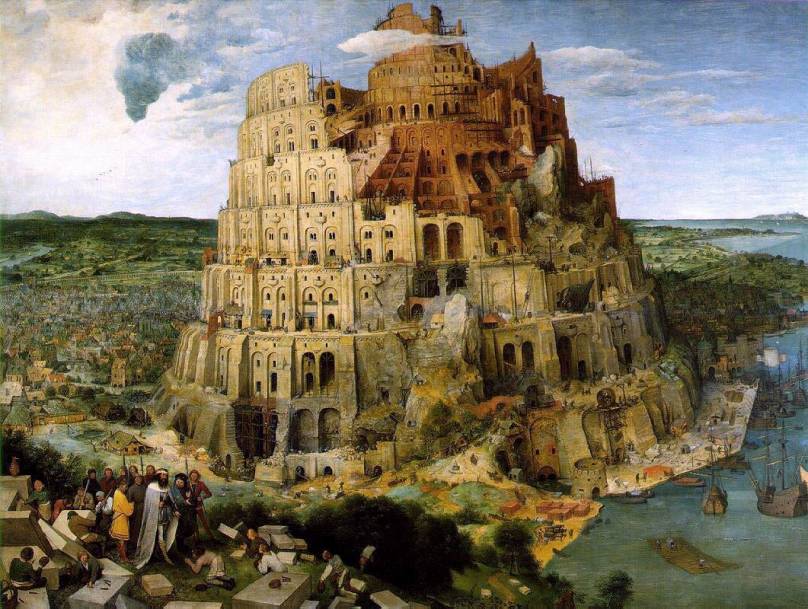
“The Tower of Babel” by Peter Bruegel the Elder

When I used to write ads for the software company whose director of corporate communications I was, I was always running afoul of management, who always insisted that I put a positive spin on every point I made. Anything that could possibly be seen to be negative was to be avoided at all costs.

Being a bit negative is a part of my Hungarian heritage. When your country is on one of the two main invasion paths into Europe (the other being Poland), you can’t help a certain amount of negativity. It’s part of our nature.

I feel there is something wrong about always being positive. It tends to encourage the persons on the other end to be passive and accepting. Polish poet Czeslaw Milosz, writing in The Captive Mind, a book about why people accepted the promises and lies about Communism, quotes an earlier Polish novel from the 1920s:

In this story, Central Europeans facing the prospect of being overrun by unidentified Asiatic hordes pop a little pill [the pill of Murti-Bing] which relieves them of fear and anxiety; buoyed by its effects, they not only accept their new rulers but are positively happy to receive them.

In an article entitled “Murti-Bing Conservatism” written for The American Conservative, Rod Dreher develops this idea:

For Miłosz, Polish intellectuals who capitulated to communism and Soviet rule had taken the pill of Murti-Bing. It was what made their condition bearable. They could not stand to see reality, for if they recognized what was really happening in their country, the pain and shock would make life too much to take.

This is why people who have no financial or status tied up in protecting abuse of corruption within an institution can nevertheless be expected to rally around that institution and its leaders. Those who tell the truth threaten their Murti-Bing pill supply, and therefore their sense of order and well-being. To them, better that a few victims must be made to suffer rather than the entire community be forced to wean itself from Murti-Bing.

In the United States, we are facing a similar situation today—all the way from the opposite end of the political spectrum. It is not Communism that is the cause, but Trumpism. Millions of voters who are either ignorant or disingenuous choose to believe that water runs uphill and that the current President is spouting truth when in actuality he is lying like a rug.

I recommend that anyone interested in what happens to this country read Milosz’s The Captive Mind. It is by far the best book about Communism I have ever read.

Oh, and the Tower of Babel? That’s what happens when our sense of reality has become so fragmented that our society begins to fracture.

“A Song on the End of the World”

Czeslaw Milosz (1911-2004)

Born in Lithuania, but known primarily as a Polish poet, Czeslaw Milosz is perhaps my favorite Eastern European poet of the 20th century. In 1980, he won the Nobel Prize for Literature. Here is one of my favorites among his works, written in Warsaw in 1944:

A Song on the End of the World

On the day the world ends
A bee circles a clover,
A fisherman mends a glimmering net.
Happy porpoises jump in the sea,
By the rainspout young sparrows are playing
And the snake is gold-skinned as it should always be.

On the day the world ends
Women walk through the fields under their umbrellas,
A drunkard grows sleepy at the edge of a lawn,
Vegetable peddlers shout in the street
And a yellow-sailed boat comes nearer the island,
The voice of a violin lasts in the air
And leads into a starry night.

And those who expected lightning and thunder
Are disappointed.
And those who expected signs and archangels’ trumps
Do not believe it is happening now.
As long as the sun and the moon are above,
As long as the bumblebee visits a rose,
As long as rosy infants are born
No one believes it is happening now.

Only a white-haired old man, who would be a prophet
Yet is not a prophet, for he’s much too busy,
Repeats while he binds his tomatoes:
There will be no other end of the world,
There will be no other end of the world.

“At a Certain Age”

As Polish Poet Czeslaw Milosz shows us, the urge to confess can be a problem. Sometimes you just have to bottle it all up and hope it doesn’t burst.

At a Certain Age

We wanted to confess our sins but there were no takers.
White clouds refused to accept them, and the wind
Was too busy visiting sea after sea.
We did not succeed in interesting the animals.
Dogs, disappointed, expected an order,
A cat, always immoral, was falling asleep.
A person seemingly very close
Did not care to hear of things long past.
Conversations with friends over vodka or coffee
Ought not to be prolonged beyond the first sign of boredom.
It would be humiliating to pay by the hour
A man with a diploma, just for listening.
Churches. Perhaps churches. But to confess there what?
That we used to see ourselves as handsome and noble
Yet later in our place an ugly toad
Half opens its thick eyelid
And one sees clearly: “That’s me.”

“On Angels”

Cuzco School Detail of an Angel

I love this poem by Polish poet Czeslaw Milosz (1911-2004). Sometimes I think that those who have lived much of their lives under Communism understand best our need for angels.

On Angels
All was taken away from you: white dresses,
wings, even existence.
Yet I believe you,
messengers.

There, where the world is turned inside out,
a heavy fabric embroidered with stars and beasts,
you stroll, inspecting the trustworthy seams.

Short is your stay here:
now and then at a matinal hour, if the sky is clear,
in a melody repeated by a bird,
or in the smell of apples at close of day
when the light makes the orchards magic.

They say somebody has invented you
but to me this does not sound convincing
for the humans invented themselves as well.

The voice — no doubt it is a valid proof,
as it can belong only to radiant creatures,
weightless and winged (after all, why not?),
girdled with the lightning.

I have heard that voice many a time when asleep
and, what is strange, I understood more or less
an order or an appeal in an unearthly tongue:

Day draw near
another one
do what you can.

I love the message conveyed by the angel: “do what you can.”

“The Poet Remembers”

Polish Poet Czesław Miłosz (1911-2004)

Sometimes, I like to look at what is happening in this country with the eyes of an Eastern European. I dedicate this poem to our president.

You Who Wronged

You who wronged a simple man
Bursting into laughter at the crime,
And kept a pack of fools around you
To mix good and evil, to blur the line,

Though everyone bowed down before you,
Saying virtue and wisdom lit your way,
Striking gold medals in your honor,
Glad to have survived another day.

Do not feel safe. The poet remembers.
You can kill one, but another is born.
The words are written down, the deed, the date.

And you’d have done better with a winter dawn,
A rope, and a branch bowed beneath your weight.