Day of the Dead

November 2 in the Catholic liturgy is All Souls’ Day, or in Mexico, El Dia de Los Muertos, the Day of the Dead. Here is a poem by Alberto Rios, a Hispanic resident of Arizona.

November 2: Día de los muertos

1

It is not simply the Day of the Dead—loud, and parties.
More quietly, it is the day of my dead. The day of your dead.

These days, the neon of it all, the big-teeth, laughing skulls,
The posed calacas and Catrinas and happy dead people doing funny things—

It’s all in good humor, and sometimes I can’t help myself: I laugh out loud, too.
But I miss my father. My grandmother has been gone

Almost so long I can’t grab hold of her voice with my ears anymore,
Not easily. My mother-in-law, she’s still here, still in things packed

In boxes, her laughter on videotape, and in conversations.
Our dog died several years ago and I try to say his name

Whenever I leave the house—You take care of this house now,
I say to him, the way I always have, the way he knows.

I grew up with the trips to the cemetery and pan de muerto,
The prayers and the favorite foods, the carne asada, the beer.

But that was in the small town where my memory still lives.
Today, I’m in the big city, and that small town feels far away.

2

The Day of the Dead—it’s really the days of the dead. All Saints’ Day,
The first of November, also called the día de los angelitos

Everybody thinks it’s Day of the Dead—but it’s not, not exactly.
This first day is for those who have died a saint

And for the small innocents—the criaturas­—the tender creatures
Who have been taken from us all, sometimes without a name.

To die a saint deserves its day, to die a child. The following day,
The second of November, this is for everybody else who has died

And there are so many,
A grandmother, a father, a distant uncle or lost cousin.

It is hard enough to keep track even within one’s own family.
But the day belongs to everyone, so many home altars,

So many parents gone, so many husbands, so many
Aunt Normas, so many Connies and Matildes. Countless friends.

Still, by the end of the day, we all ask ourselves the same thing:
Isn’t this all over yet?

3

All these dead coming after—and so close to—Halloween,
The days all start to blend,

The goblins and princesses of the miniature world
Not so different from the ways in which we imagine

Those who are gone, their memories smaller, their clothes brighter.
We want to feed them only candy, too—so much candy

That our own mouths will get hypnotized by the sweetness,
Our own eyes dazzled by the color, our noses by the smells

The first cool breath of fall makes, a fire always burning
Somewhere out there. We feed our memories

And then, humans that we are, we just want to move quickly away
From it all, happy for the richness of everything

If unsettled by the cut pumpkins and gourds,
The howling decorations. The marigolds—cempasúchiles

If it rains, they stink, these fussy flowers of the dead.
Bread of the dead, day of the dead—it’s hard to keep saying the word.

4

The dead:
They take over the town like beach vacationers, returning tourists getting into everything:

I had my honeymoon here, they say, and are always full of contagious nostalgia.
But it’s all right. They go away, after a while.

They go, and you miss them all over again.
The papel picado, the cut blue and red and green paper decorations,

The empanadas and coconut candy, the boxes of cajeta, saladitos,
Which make your tongue white like a ghost’s—

You miss all of it soon enough,
Pictures of people smiling, news stories, all the fiestas, all this exhaustion.

The coming night, the sweet breads, the bone tiredness of too much—
Loud noise, loud colors, loud food, mariachis, even just talking.

It’s all a lot of noise, but it belongs here. The loud is to help us not think,
To make us confuse the day and our feelings with happiness.

Because, you know, if we do think about our dead,
Wherever they are, we’ll get sad, and begin to look across at each other.

Among the Dead

Day of the Dead Participants

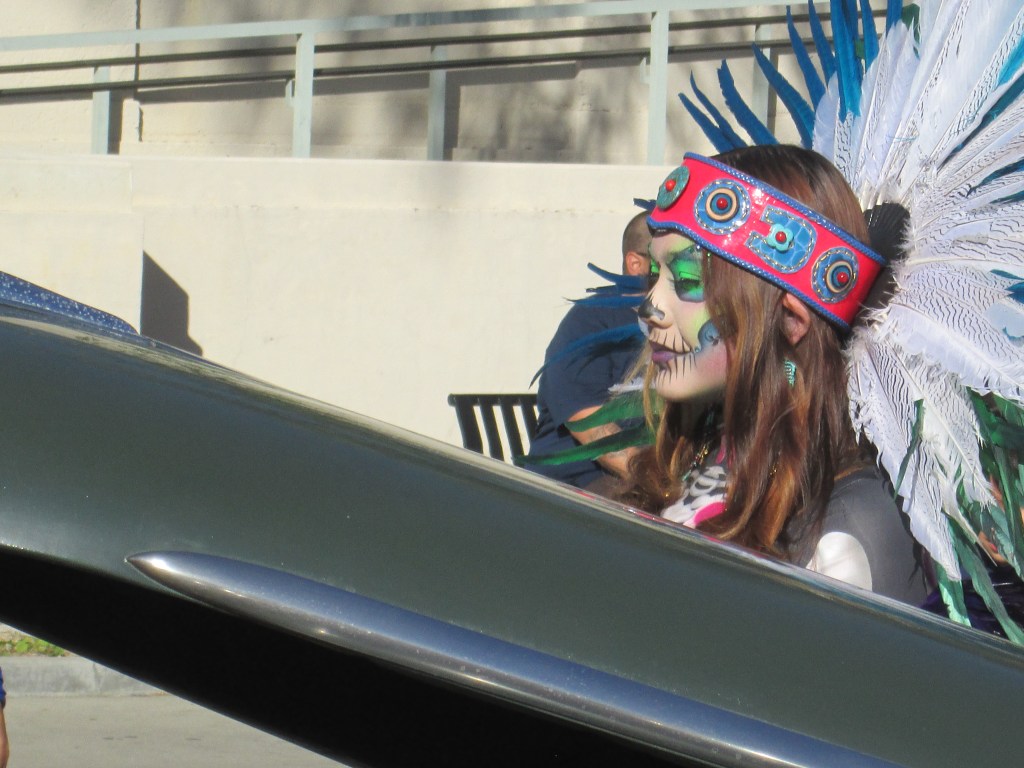
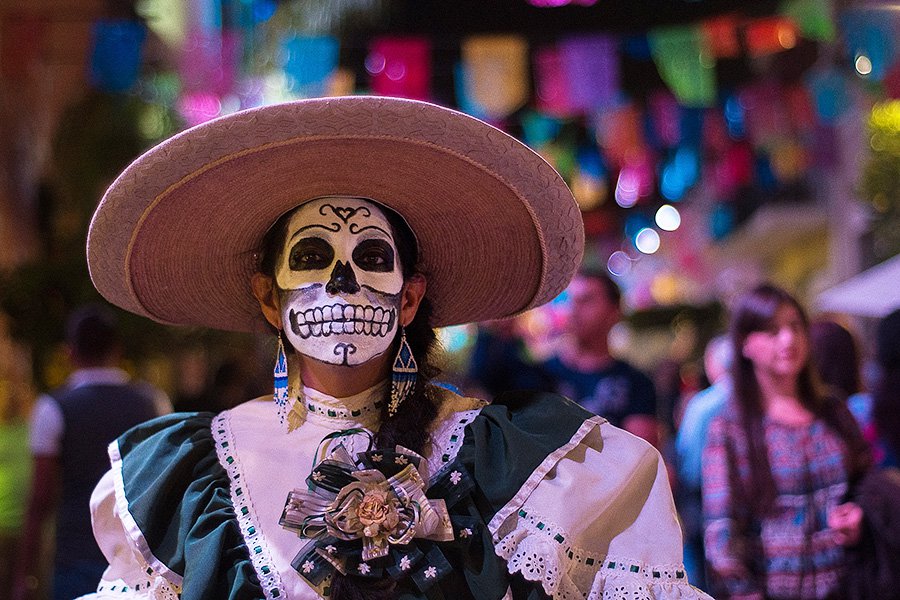
This is kind of a coda to yesterday’s post entitled “Dia de los Muertos.” Many of the attendees at the Day of the Dead Festival in Canoga park wore nifty costumes and frequently had very professional face painting jobs. There was a booth at the festival where most of the work was probably done.

As much as Martine felt intimidated by the size of the crowd, I wound up enjoying the artistry of the costumes and makeup, and the obvious sincerity of the ofrendas (the little altars to a family’s dead).

A Gathering of Skeletons

I will probably have to go by myself, but I wouldn’t mind traveling to other Day of the Dead observances next year. As much as I like Halloween, I also admire the Mexicans’ celebratory confrontation of their own future demise.

Dia de los Muertos

Although the Mexican Day of the Dead actually occurred on November 2, All Souls Day in the Catholic liturgy, the neighborhood of Canoga Park decided to hold their festival today. Martine and I were to meet a friend at the festival, but there was the usual problem with cell phones: It was too loud to here the telephone ring.

That was the first thing that set Martine off. Second was the size of the crowd. Neither of us positively like crowds, but her dislike of them approaches the realm of phobia. Thirdly, she abhors skeletons and costumes that suggest death. Finally, there were a lot of classical cars on display; but they were all tricked out as Mexican low-riders.

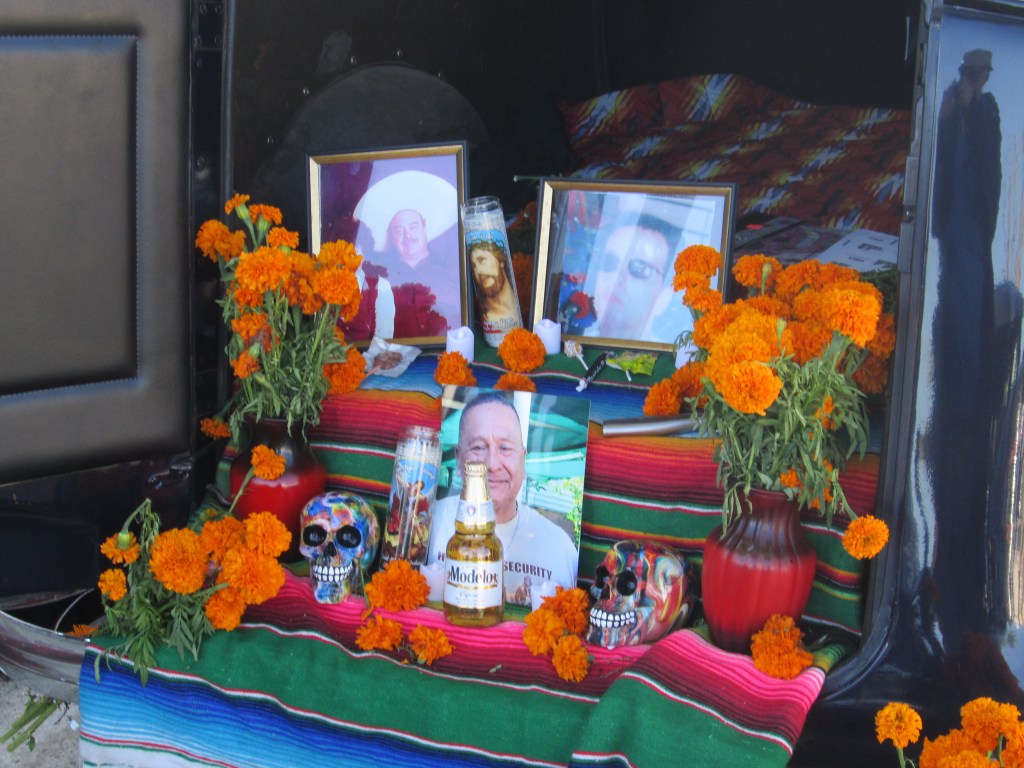
Only the first two things set me off, but I was interested in the costumes people wore and the cars. Many of the cars had ofrendas, little memorials to loved ones who have passed on.

An Ofrenda Occupying the Trunk of a Low-Rider

Where Martine did not particularly like Mexican customs, I, on the other hand, have many years of traveling in the Republic and admiring from afar these same customs. I remember one bus ride I had back in the 1980s on the Dia de los Muertos between Mazatlán and Durango. The bus was filled with Mexican families on their way to have a picnic at the cemetery by the grave of their loved ones. I thought it was a splendid custom, and I helped out by holding a baby for a few miles while the young mother who sat next to me was otherwise occupied.

In the end, I knew I had to make it up to Martine. I could have made a scene and called her too thin-skinned, but instead I bought her her first cotton candy in sixty years. Then, on the way home, we stopped at Bea’s Bakery in Reseda for some of their first class pastries.So, in the end, she had some good things to remember.

Todos Somos Calaveras

Statue of Skeletal Woman at Mérida’s Hotel La Piazzetta

At some time in the 1980s—I disremember the year—I was on a long bus ride between Mazatlán and Durango over the mountains. It was November 2, the Day of the Dead, and the bus was crowded with men, women, and children headed toward distant cemeteries with baskets of food. A young mother with a baby and numerous packages sat down next to me taking the aisle seat. I helped her by holding the child or various packages for a while, until she disappeared at some small town to hold a picnic by the grave of one of her loved ones. Was it her husband? her mother? I never knew.

The following quote is from Elizabeth Sayers and Chloe Sayer’s book The Skeleton at the Feast. It throws some light on the feast day:

In Mexico—to quote Ms Sayer—the first and second of November belong to the dead. According to popular belief, the deceased have divine permission to visit friends and relatives on earth and to share the pleasures of the living. To an outsider the celebrations might seem macabre, but in Mexico death is considered a part of life. A familiar presence, it is portrayed with affection and humor by artists and crafts workers. For the Aztec, as for other ancient peoples, death signified not an end but a stage in a constant cycle. Worship of death involved worship of life, while the skull—the symbol of death—was a promise of resurrection…. The death of the individual was seen as a journey, for which numerous offerings were needed. Life is a fleeting moment—a dream—from which death awakens us.

It is all summarized in the Mexican saying “Todos somos calaveras”—“We are all skeletons.” The candy stores are full of confections shaped like skulls and skeletons. All the energy that we Gringos put into Halloween is directed toward La Dia de los Muertos. I suspect that, perhaps, the Mexican holiday is, all told, more healthy than our Halloween.

Calaveras

One of Posada’s Calaveras: Street Cleaners

John Webster was a Jacobean dramatist known for the grimness of his plays. According to the first stanzas of a poem by T. S. Eliot called “Whispers of Immortality”:

Webster was much possessed by death
And saw the skull beneath the skin;
And breastless creatures under ground
Leaned backward with a lipless grin.

Daffodil bulbs instead of balls
Stared from the sockets of the eyes!
He knew that thought clings round dead limbs
Tightening its lusts and luxuries.

Donne, I suppose, was such another
Who found no substitute for sense,
To seize and clutch and penetrate;
Expert beyond experience,

He knew the anguish of the marrow
The ague of the skeleton;
No contact possible to flesh
Allayed the fever of the bone.

I cannot think of these lines without think of José Guadalupe Posada (1852-1913), who is famous for his depictions of cavorting skeletons.

Posada’s “The Day of the Dead”

As I am thinking once again of going to Mexico this next winter, I am thinking of the country’s great artists, including José Clemente Orozco, Diego Rivera and Frida Kahlo, David Siqueiros, and Rufino Tamayo, to name just a few. And Posada belongs on that list, though perhaps in a more minor key.

Unlike most Americans, the people of Mexico do not sweep the idea of death under a carpet. In fact, November 2, called All Souls Day in the Catholic Church, is the Dia de los Muertos, the Day of the Dead, throughout Mexico. Families visit their dead in the cemeteries with a picnic lunch and with all their children in tow. I remember a long intercity bus ride back in the 1980s on this day on which most of the passengers were joyfully looking forward to their Day of the Dead festivities. The children had white sugar calaveras, or skulls, which are a special treat available throughout the country.

This feeling about death goes back to the Maya and the Aztecs, who fought wars just to get prisoners to serve as sacrificial victims, whose hearts were cut out still steaming from their bodies with an obsidian knife and dedicated to the gods.