It was another warm day, so I decided to drive to Chace Park in the Marina . stopping at Trader Joe on the way to pick up a salad and beverage for a picnic on the way. I had only a few pages more to read of Virgil’s Georgics and hoped to finish the book while enjoying the sea breezes.
It was not to be. A crow was flopping around on the ground, unable to fly. Several passersby had stopped and were loudly discussing what to do about the poor crow. There were as many opinions as there were people. Eventually, a homeless person picked up the bird and placed it a few feet away in the shade.
What did I do? Nothing. Crows are wild creatures. Any intervention on my part would have terrified the bird at a point when it was dealing with its own problems. I was not about to make a pet of it so that I could brag to my friends that I had “rescued” it.
I was outraged that the people in the park had in some way profaned the final moments of one of God’s creatures.
Perhaps many people would feel that I was being hard hearted because I chose not to interfere. Perhaps I was being kinder to that bird by leaving it alone. After all, I actually like crows.
The following is from Jack Kerouac’s Doctor Sax, about his youth in Lowell, Massachusetts. Here he describes a sobering scene in his typical jazzy style:
A man carrying a watermelon passed us, he wore a hat, a suit in a warm summer night; he was just on the boards of the bridge, refreshed, maybe from a long walk up slummy swilly Moody and its rantankling saloons with swinging doors, mopped his brow, or came up through Little Canada or Cheever or Aiken, rewarded by the bridge of eve and sighs of stone—the great massive charge of the ever stationary ever yearning cataracts and ghosts, this is his reward after a long dull hot dumb walk to the river thru houses—he strides on across the bridge—We stroll on behind him talking about the mysteries of life (inspired we were by moon and river), I remember I was so happy—something in the alchemy of the summernight, Ah Midsummer Night’s Dream, John a Dreams, the clink of clock on rock in river, roar—old gloor-merrimac figalitating down the mark all spread—I was happy too in the intensity of something we were talking about, something that was giving me joy.
Suddenly the man fell, we heard a great thump of his watermelon on wood planks and saw him fallen—Another man was there, also mysterious, but without watermelon, who bent to him quickly and solicitously as by assent and nod in the heavens and when I got there I saw the watermelon man staring at the waves below with shining eyes (‘Il’s meurt, he’s dying,’ my mother’s saying) and I see him breathing hard, feeble-bodied, the man holding him gravely watching him die, I’m completely terrified and yet I feel the profound pull and turn to see what he is staring at so deadly-earnest with his froth stiffness—I look down with him and there is the moon on shiny froth and rocks, there is the long eternity we have been seeking.
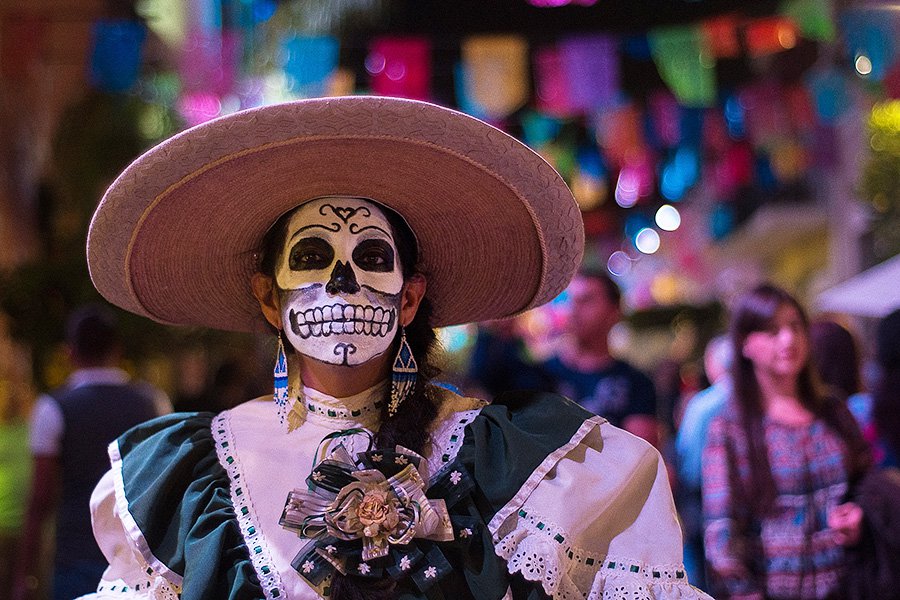
November 2 in the Catholic liturgy is All Souls’ Day, or in Mexico, El Dia de Los Muertos, the Day of the Dead. Here is a poem by Alberto Rios, a Hispanic resident of Arizona.
November 2: Día de los muertos
1
It is not simply the Day of the Dead—loud, and parties. More quietly, it is the day of my dead. The day of your dead.
These days, the neon of it all, the big-teeth, laughing skulls, The posed calacas and Catrinas and happy dead people doing funny things—
It’s all in good humor, and sometimes I can’t help myself: I laugh out loud, too. But I miss my father. My grandmother has been gone
Almost so long I can’t grab hold of her voice with my ears anymore, Not easily. My mother-in-law, she’s still here, still in things packed
In boxes, her laughter on videotape, and in conversations. Our dog died several years ago and I try to say his name
Whenever I leave the house—You take care of this house now, I say to him, the way I always have, the way he knows.
I grew up with the trips to the cemetery and pan de muerto, The prayers and the favorite foods, the carne asada, the beer.
But that was in the small town where my memory still lives. Today, I’m in the big city, and that small town feels far away.
2
The Day of the Dead—it’s really the days of the dead. All Saints’ Day, The first of November, also called the día de los angelitos—
Everybody thinks it’s Day of the Dead—but it’s not, not exactly. This first day is for those who have died a saint
And for the small innocents—the criaturas—the tender creatures Who have been taken from us all, sometimes without a name.
To die a saint deserves its day, to die a child. The following day, The second of November, this is for everybody else who has died
And there are so many, A grandmother, a father, a distant uncle or lost cousin.
It is hard enough to keep track even within one’s own family. But the day belongs to everyone, so many home altars,
So many parents gone, so many husbands, so many Aunt Normas, so many Connies and Matildes. Countless friends.
Still, by the end of the day, we all ask ourselves the same thing: Isn’t this all over yet?
3
All these dead coming after—and so close to—Halloween, The days all start to blend,
The goblins and princesses of the miniature world Not so different from the ways in which we imagine
Those who are gone, their memories smaller, their clothes brighter. We want to feed them only candy, too—so much candy
That our own mouths will get hypnotized by the sweetness, Our own eyes dazzled by the color, our noses by the smells
The first cool breath of fall makes, a fire always burning Somewhere out there. We feed our memories
And then, humans that we are, we just want to move quickly away From it all, happy for the richness of everything
If unsettled by the cut pumpkins and gourds, The howling decorations. The marigolds—cempasúchiles—
If it rains, they stink, these fussy flowers of the dead. Bread of the dead, day of the dead—it’s hard to keep saying the word.
4
The dead: They take over the town like beach vacationers, returning tourists getting into everything:
I had my honeymoon here, they say, and are always full of contagious nostalgia. But it’s all right. They go away, after a while.
They go, and you miss them all over again. The papel picado, the cut blue and red and green paper decorations,
The empanadas and coconut candy, the boxes of cajeta, saladitos, Which make your tongue white like a ghost’s—
You miss all of it soon enough, Pictures of people smiling, news stories, all the fiestas, all this exhaustion.
The coming night, the sweet breads, the bone tiredness of too much— Loud noise, loud colors, loud food, mariachis, even just talking.
It’s all a lot of noise, but it belongs here. The loud is to help us not think, To make us confuse the day and our feelings with happiness.
Because, you know, if we do think about our dead, Wherever they are, we’ll get sad, and begin to look across at each other.
For Halloween, I’ve decided to excerpt as short short story in its entirety from Thomas Ligotti’s excellent collection entitled Noctuary.
One May Be Dreaming
Beyond the windows a dense fog spreads across the graveyard, and a few lights beam within hazy depths, glowing like old lamps on an empty street. Night is softly beginning.
Within the window are narrow bars, both vertical and horizontal, which divide it into several smaller windows. The intersections of these bars form crosses. Not far beyond the windowpanes, there are other crosses jutting out of the earth-hugging fog in the graveyard. To all appearances, it is a burial ground in the clouds that I contemplate through the window.
Upon the window ledge is an old pipe that seems to have been mine in another life. The pipe’s dark bowl must have brightened to a reddish-gold as I smoked and gazed beyond the window at the graveyard. When the tobacco had burned to the bottom, perhaps I gently knocked the pipe against the inside wall of the fireplace, showering the logs and stones with warm ashes. The fireplace is framed within the wall perpendicular to the window. Across the room are a large desk and a high-backed chair. The lamp positioned in the far right corner of the desk serves as illumination for the entire room, a modest supplement to those pale beacons beyond the window. Some old books, pens, and writing paper are spread across the top of the desk. In the dim depths of the room, against the fourth wall, is a towering clock that ticks quietly.
Those, then, are the main features of the room in which I find myself: window, fireplace, desk, and clock. There is no door.
I never dreamed that dying in one’s sleep would encompass dreaming itself. I often dreamed of this room and now, near the point of death, have become its prisoner. And here my bloodless form is held while my other body somewhere lies still and without hope. There can be no doubt that my present state is without reality. If nothing else, I know what it is like to dream. And although a universe of strange sensation is inspired by those lights beyond the window, by the fog and the graveyard, they are no more real than I am. I know there is nothing beyond those lights and that the obscured ground outside could never sustain my steps. Should I venture there I would fall straight into an absolute darkness, rather than approaching it by the degrees of my dying dreams.
For other dreams came before this one—dreams in which I saw lights more brilliant, a fog even more dense, and gravestones with names I could almost read from the distance of this room. But everything is dimming, dissolving, and growing dark. The next dream will be darker still, everything a little more confused, my thoughts … wandering. And objects that are now part of the scene may soon be missinfg: perhaps even my pipe—if it was ever mine—will be gone forever.
But for the moment I am safe in my dream, this dream. Beyond the window a dense fog spreads across the graveyard, and a few lights beam within hazy depths, glowing like old lamps along an empty street. Night is softly beginning.
RUSSIA – CIRCA 1984: shows Tadzhik Soviet Socialist Republic flags and arms, circa 1984
I am currently reading a book of stories by the Russian writer Maxim Osipov entitled Rock, Paper, Scissors and Other Stories. In the title story is an incredible Tadzhik woman who kills an official of a small rural town in Russia who tries to rape her. Her name is Ruhshona Ibragimovma. Although working in a menial position at a restaurant, she is a highly educated woman, which, in the position she finds herself, becomes increasingly unimportant to her.
[D]eath’s omnipresence is no accident, no unhappy mistake. Everyone fears death, just as they fear misfortune, yet death is inescapable, which means it is real. And that we did not invent it. At this very moment Ruhshona begins to see death as the most important thing that can exist within a person. She views those who don’t carry death within themselves—who don’t live by it—as empty, like wrapping paper, like candy wrappers. Hollow, soulless people. She can pick them out at a glance.
The following poem is taken from a volume entitled The Wreck of the Archangel. It is from my favorite Scottish poet, George Mackay Brown, whom I met at Stromness on the Orkney Mainland in 1976.
In Memoriam I. K.
That one should leave The Green Wood suddenly
     In the good comrade-time of youth,
     And clothed in the first coat of truth
Set out alone on an uncharted sea:

Who’ll ever know what star
     Summoned him, what mysterious shell
     Locked in his ear that music and that spell,
And what grave ship was waiting for him there?

The greenwood empties soon of leaf and song.
     Truth turns to pain. Our coats grow sere.
     Barren the comings and goings on this shore.
He anchors off The Islands of the Young.
Life is strange when you don’t have a pituitary gland. Mine was removed by surgery in September 1966. On Wednesday I woke up early to go to the bathroom. After I did by business, I got up and … and … and …
B L A C K O U T
When consciousness returned, I was bleeding from a large bump on the left of my forehead and I felt as if one of my ribs was broken. Imagine Martine’s surprise when she woke up to go to the john about an hour later! There I lay, covered in blood and unable to raise myself due to (1) pain from my broken rib and (2) general weakness due to adrenal insufficiency.
Without a functioning pituitary, one has no thyroid function, no sex hormones, and—oh, yes—no adrenaline. All those have to be supplied from outside the body. Those early morning hours can be killers. Ingmar Bergman had a good reason to call it “The Hour of the Wolf.” At my request, Martine got me a glass of water and five 10mg tabs of Hydrocortisone.
Eventually Martine has to call 9-1-1 to get an ambulance. I couldn’t just lie on the bathroom floor forever. The emergency medical technicians took one look at me, hoisted me up, and trundled me of to the UCLA Medical Center, where I spent a couple of days in the intensive care unit and an observation ward.
I strongly suspect that this is how I will leave this world. At some point, the adrenal debt will be too high; and there will be a general system shutdown. Not a particularly painful exit.
I worked for a quarter of a century for two accounting firms, the second of which was an outgrowth of an earlier firm. During that time, the best friends I had at work were two accountants. Don Kiyomi Yamagishi was a Nisei and in every way more of an American than I ever was. Danilo Cabais Peña was a Filipino. Both passed away in the late 2010s. (Somewhere, I have a picture of Dan Peña; but it will take me some time to find it. When I do, I’ll post it.)
Both of my accountant friends were genuinely good human beings. Surprisingly, that’s not always true in that particular profession, where the temptation to cheat carries both penalties and rewards.
I was greatly saddened that I lost both of my friends—both within the space of a single year. I attended both of their funerals and had to soldier on at work for another year without their wise counsel.
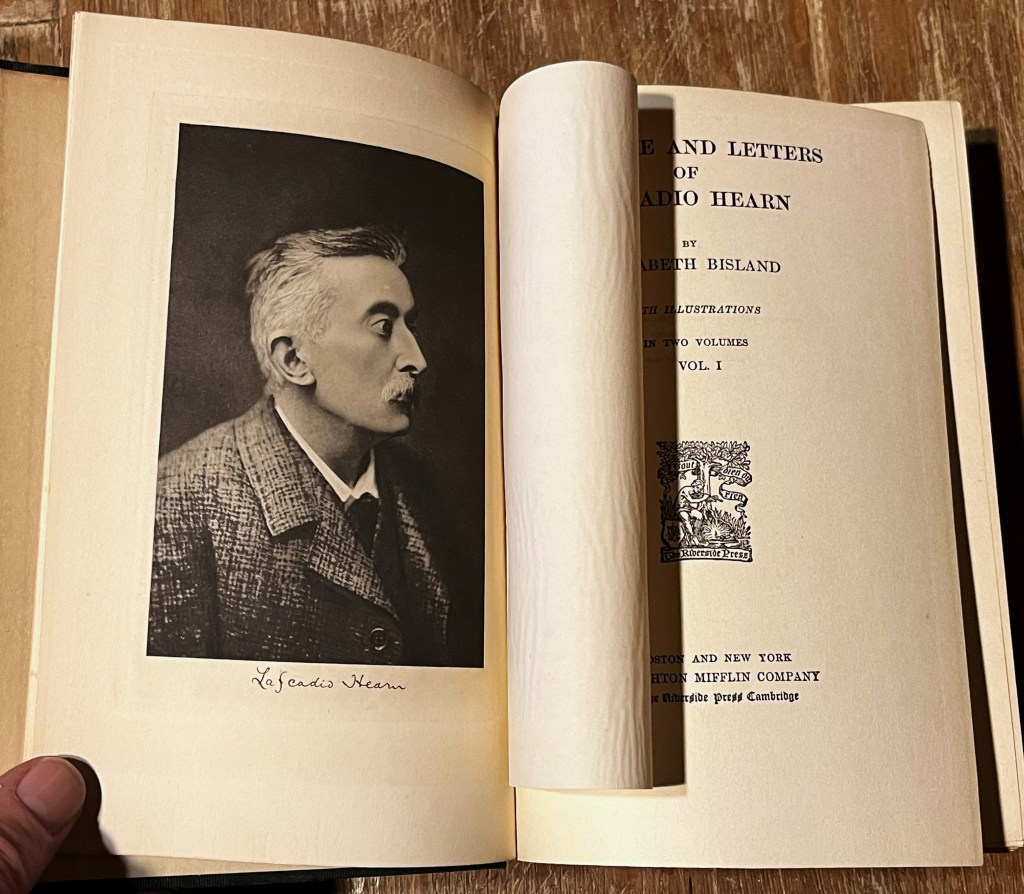
He Always Hid His Damaged Left Eye When Being Photographed
Lafcadio Hearn (1850-1904) was a true exotic. Born in Lefkada, Greece, he came to the United States and published several charming works of folklore, of which his Stray Leaves from Strange Literature (1884) was one title. And then he went to Japan, married a local woman, and published his best known works. These were collections of Japanese folktales in English. Masaki Kobayashi’s gorgeous color horror film anthology, Kwaidan (1964), was based on three of Hearn’s tales. Hearn changed his name to Koizumi Yakumo. Today he is revered by the Japanese for his works.
The following excerpt is from Stray Leaves from Strange Literature from the tale of “Yamaraja,” about a Brahmin who attempts to visit the Hindu god of the dead, who is called Yamaraja, to plead to bring his dead son back to life.It is this god who speaks:
“Verily thou hast not been fitted to seek the supreme wisdom, seeing that in the winter of thine age thou dost still mourn by reason of a delusion. For the stars die in their courses, the heavens wither as leaves, the worlds vanish as the smoke of incense. Lives are as flower-petals opening to fade; the works of man as verses written upon water. He who hath reached supreme wisdom mourneth existence only…. Yet, that thou mayst be enlightened, we will even advise thee. The kingdom of Yama thou mayst not visit, for no man may tread the way with mortal feet. But many hundred leagues toward the setting of the sun, there is a valley, with a city shining in the midst thereof. There no man dwells, but the gods only, when they incarnate themselves to live upon earth. And upon the eighth day of each month Yamaraja visits them, and thou mayst see him. Yet beware of failing a moment to practice the ceremonies, to recite the Mantras, lest a strange evil befall thee! …Depart now from us, that we may reenter into contemplation!”
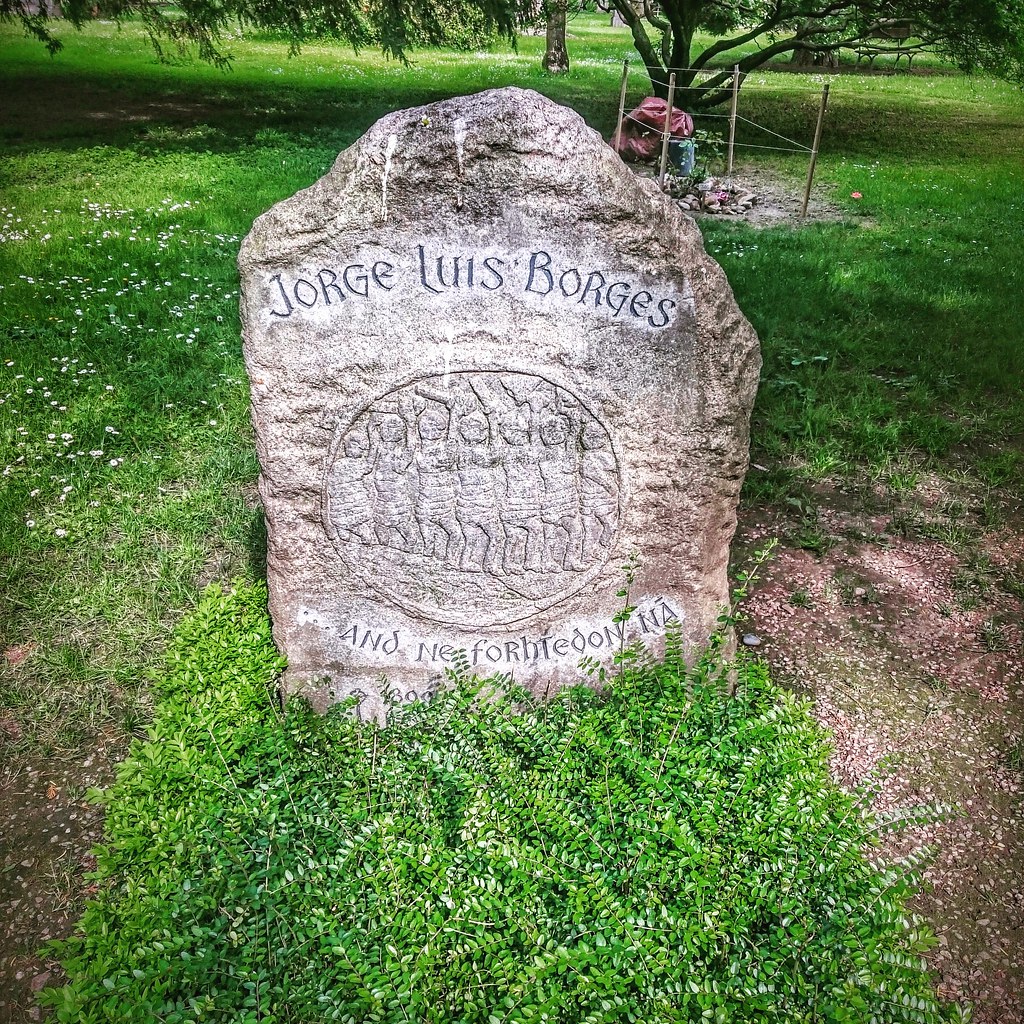
The Tomb of Jorge Luis Borges (1899-1986) in Geneva Switzerland
The title of this post is in Anglo-Saxon from the gravestone of Jorge Luis Borges. It comes from The Battle of Maldon. Translated, it means “Be not afraid.” Toward the end of his life, Borges learned Anglo-Saxon and even studied Old Norse, which is the language of Iceland.
Here is an early poem by Borges (from Fervor de Buenos Aires, 1923) on the subject of death. The translation is by W. S. Merwin.
Remorse for Any Death
Free of memory and hope,
unlimited, abstract, almost future,
the dead body is not somebody: It is death.
Like the God of the mystics,
whom they insist has no attributes,
the dead person is no one everywhere,
is nothing but the loss and absence of the world.
We rob it of everything,
we do not leave it one color, one syllable:
Here is the yard which its eyes no longer take up,
there is the sidewalk where it waylaid its hope.
It might even be thinking
what we are thinking.
We have divided among us, like thieves,
the treasure of nights and days.







 Tarnmoor
You must be logged in to post a comment.