
Smouldering in the Dunes

Zendaya as Chani in Dune 2

To begin with, I am a big fan of Frank Herbert’s novel Dune and the three feature films based on it: David Lynch’s Dune (1984) and Denis Villeneuve’s Dune: Part One (2021) and Dune: Part Two (2024).

Recently HBO has been screening Dune: Part Two almost daily, so I have seen the film a number of times. Although Timothée Chalamet is the acknowledged star of the film, I have been increasingly drawn to Zendaya’s portrayal of Chani Kynes, the Fremen Sayyadina and concubine of Paul Muad’Dib Atreides. In fact, I think the film revolves more around her reaction to Muad’Dib and his assumption of the role of Kwisatz Haderach than to Muad’Dib’s military exploits.

Chani clearly loves Paul, but she doesn’t buy into the myth that is being built up around him. And when Paul decides to take Princess Irulan, daughter of Emperor Shaddam IV, as his bride. She wanders off alone into the desert while her love moves on to an imperial role.

During all of Dune: Part Two, she is seen as smouldering with blazing eyes during all the stages of Paul’s transformations. Chalamet does a good job acting the role of Paul, but Zendaya is almost crazy good, like one of the great silent actresses with her full range of expressions.

This is in marked contrast to Sean Young’s portrayal of Chani in the 1984 Dune, which was one of the major weaknesses of the David Lynch version as released.
Return to Arrakis

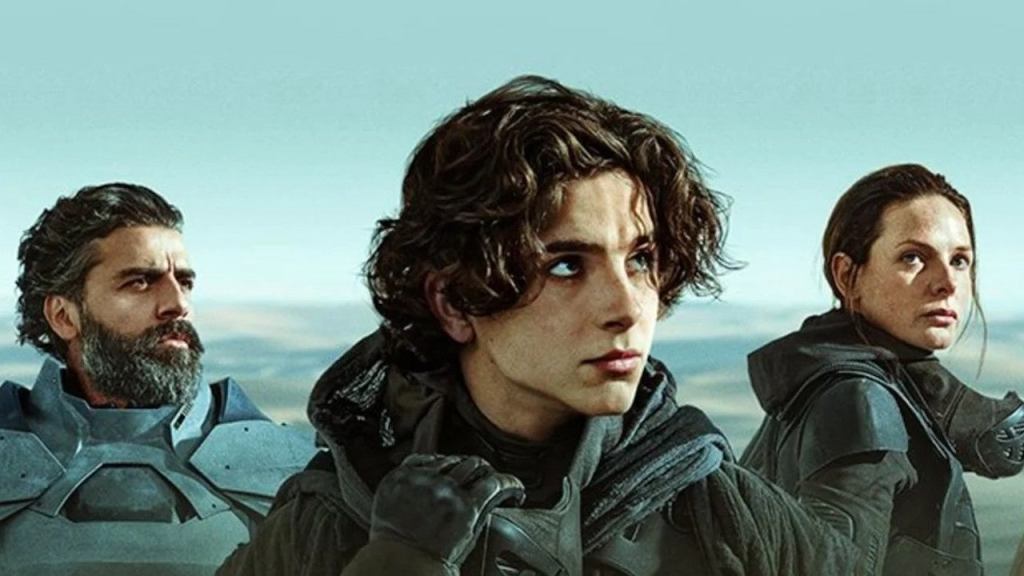
This afternoon, I went to the movies to see the new Dune: Part One directed by Denis Villeneuve. I went expecting not to like it, but ended up liking it a lot—but not quite so much as David Lynch’s magnificent 1984 Dune, as fragmentary as it was. What threw me off were all the stills of Timothée Chalamet as Paul Atreides. I kept saying to myself, “Why, he looks like a whiny little bitch!” In the actual film, he was quite good, at least as good if not better than the wooden Kyle MacLachlan in the David Lynch film.

Where the 1984 Dune came across as fragmentary, Villeneuve’s version plugged many of the gaps, such as the death of Duncan Idaho and the role played by Liet-Kynes, who seems to have changed both gender and race in the new film. (No matter, Sharon Duncan-Brewster was not only stunning: She could act!)

Frank Herbert’s original book is probably the closest the science fiction genre will ever come to a true epic. And as such, it is pretty much unfilmable. The new film does not tell the whole story: It stops just as Paul Atreides and Jessica are accepted by the Fremen, but does not show how Paul and the Fremen defeat the brutal Harkonnens and the whole empire. That was the weakest part of Lynch’s masterpiece, and I suspect that it would take a bit of doing to make it as interesting as Part One.

Whichever version you choose to see, I highly recommend you read the novel first. It is incredibly dense, but it manages to carry you along. To be confronted by the likes of the Bene Gesserit, the Spacing Guild, CHOAM, and Tleilaxu Face Dancers without having encountered them in the novel might be a bit much for most viewers. I’ve read the novel three times in the last half century, and I love it—despite its many flaws. As I said, it is probably the closest to an epic that you will ever see in the sci-fi genre.