A Different Order of Beauty

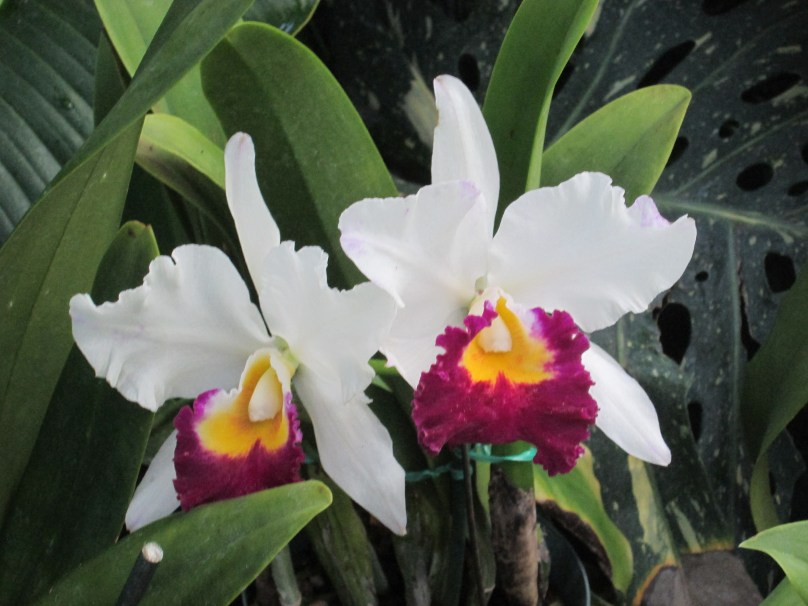
Orchids at Honolulu’s Foster Botanical Garden

At first, I saw nature from the point of view of a Midwesterner. Cleveland had some few beauty spots in its extensive park system, but they tended to be muted. And then there was the matter of Cleveland’s horrible weather.

Then, when I came out to Southern California, I saw that the desert had an entirely different beauty. I am still exploring it slowly. After all, the desert is not an inviting place during the summer months.

In our recent visits to Honolulu, Martine and I visited a couple of botanical gardens, most notably the Foster which abuts Chinatown on the north. We didn’t see any of the other islands, though I am sure there were eye-opening botanical gardens elsewhere, too.

I am eager to visit Alaska. There is yet another order of beauty: Majestic and huge, dwarfing the human scale.

In 1965, John Ford directed a film about Sean O’Casey entitled Young Cassidy. In one scene, William Butler Yeats offers the O’Casey character some advice which has kept rattling around inside my head:

You’re young Cassidy, and that makes your passion effortless and artless. Think towards the day when you are old and the passion is painful and remorseless. What you have now has given you pity. What you must one day find will give you compassion. Age, the winter days, make the chill of the frost as compelling as the heat of the sun. Lovers look towards the time of day when the sun goes down. But give a thought to the time, when as an old man, you’ll be surprised to see the sun come up. The warmth of your girl’s body inspires you now, Cassidy. There will be a time when you must be inspired by the Arctic waste. Prepare for that.

Yes, I can see myself being inspired by the Arctic waste, or the Mojave desert, or the tropical islands of the Pacific. It’s all part of really and truly being where you are, and allowing yourself to be acted upon by all the flavors and colors and tonalities of life.

The Alabama Hills

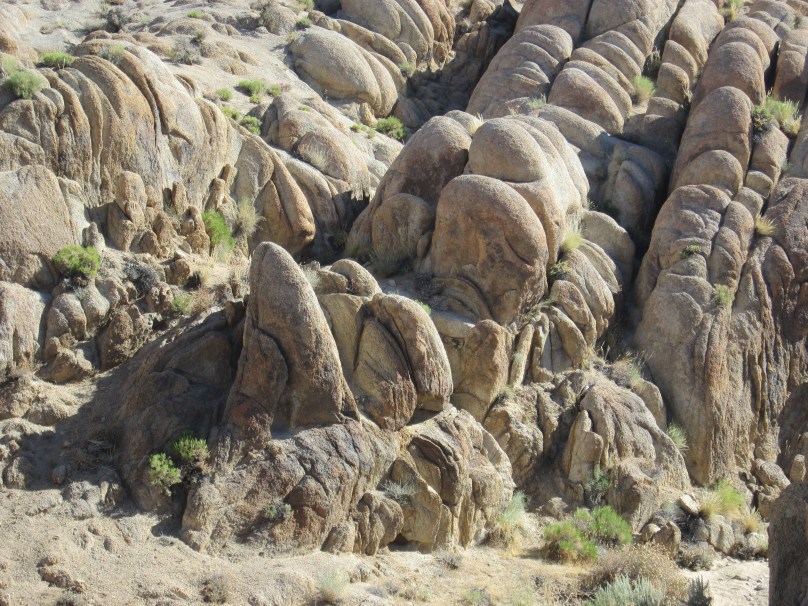
Hundreds of Hollywood Films Were Shot in the Alabama Hills

If you take California 14 from Los Angeles through the Antelope Valley to the end, you will find yourself on U.S. 395 near China Lake and Ridgecrest. In another hour or so, you will pass the turn-off for Death Valley in Olancha and soon afterwards the little town of Lone Pine.

Just west of Lone Pine, along the road that takes you to the Whitney Portal, are the Alabama Hills, which if you have seen as many films as I have, may be surprisingly familiar to you. That is because literally hundreds of scenes in Hollywood films were shot there, Here is a short list:

  • Gladiator (2000)
  • Django Unchained (2012)
  • Tremors (1990)
  • The Great Race (1965)
  • Bad Day at Black Rock (1955)
  • How the West Was Won (1962)
  • Gunga Din (1939)
  • Around the World in 80 Days (1956)
  • The Ox Bow Incident (1942)
  • High Sierra (1941)
  • Greed (1924)
  • Ride Lonesome (1959)
  • Three Godfathers (1948)
  • Samson and Delilah (1949)

If you should find yourself driving up that lonely Eastern Sierra highway, you might want to spend an hour or two taking the Alabama Hills loop road and seeing the sights. You can find out more if you should eat breakfast or lunch at the Alabama Hills Cafe in Lone Pine, probably the best eatery for a radius of a hundred miles.

Also highly recommended is the town’s Museum of Western Film History, which memorializes the Westerns shot in the Alabama Hills area.

The Desert Training Center

Display at the General Patton Memorial Museum

When Germany declared war on the United States right after Japan’s Peal Harbor attack, the U.S. Army set up a Desert Training Center in the Mohave Desert, centered on the Chiriaco Summit. Only the Army called it Camp Young and even built an airstrip so that top brass could fly in.

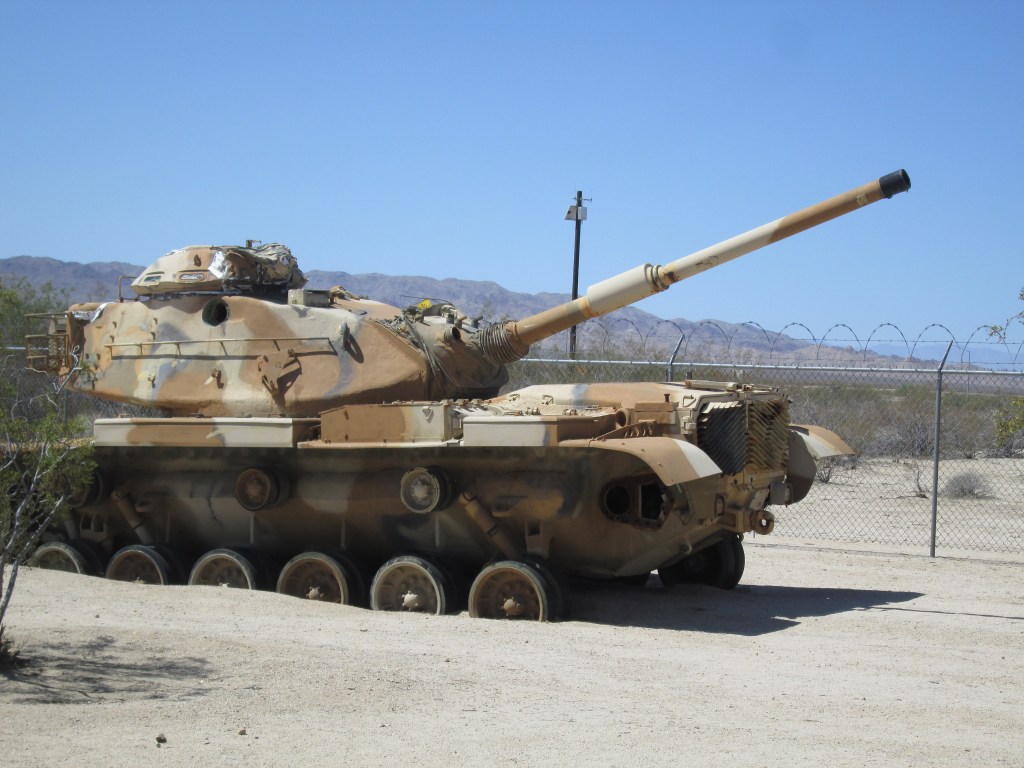
On the trip to Arizona, Martine and I spent a couple of hours at the Summit’s General Patton Memorial Museum seeing numerous exhibits on Patton’s life and the U.S.military in the Second World War, Korea, Viet Nam, and Iraq. It was nice and cool and there were a lot of things to see. We even braved the desert heat to view the tanks and other military vehicles parked outside.

Camouflaged Tank at the General Patton Memorial Museum

Martine liked the museum so much that she talked me into stopping there on the way back from Arizona. It was all right with me, because I know that my little girl is fond of military museums, having been a civilian Army employee for many years at Fort Monmouth in New Jersey, the Sacramento Army Depot, and the Twentynine Palms Marine Combat Center.

Plus we had the opportunity of eating a yummy lunch at the Chiriaco Summit Coffee Shop and a Foster’s Freeze chocolate cone at the convenience store.

Sometimes I wonder what will happen to all the military museums scattered across the country when all the veterans who fought in WW2 have passed on. These museums are most densely distributed in areas where Veterans have made their homes after they retired from the military. These museums are a useful reminder of one of the most traumatic episodes in our country’s history.

High Point

Interior of the Chiriaco Summit Coffee Shop

In the 100 or so desolate miles (161 km) between Indio, California and the Arizona State Line, there is really only one inviting place to stop and relax along the way. The highest point enroute is the Chiriaco Summit at an altitude of 1,706 feet (520 meters), some one-third of the way to the border.

There, one can find:

  • A gas station with multiple fuel pumps
  • An inviting coffee shop with good food
  • A Foster’s Freeze concession in the convenience store
  • The General Patton Memorial Museum, at the site of World War 2’s Camp Young of the Desert Training Center

A few years back, Huell Howser did a program in which he interviewed the descendants of the founding family of Chiriaco Summit. You can view it by clicking here.

Martine liked the General Patton Memorial Museum so much that we visited it twice, once on the way to Tucson and once on the return trip. I will be writing a separate post about the museum this weekend.

12 Desert Rats

Saguaro Cacti in the Arizona Desert

As I prepare for our road trip to Tucson this next week, I have been doing a lot of reading in preparation. It struck me that there are a lot of great books about or set in deserts. Here are an even dozen recommendations organized alphabetically by author:

  1. Abbey, Edward. Desert Solitaire: A Season in the Wilderness. A classic of the growing environmental movement and a threnody for the beauties that have been lost.
  2. Anonymous, Arabian Nights (or A Thousand and One Nights). Great stories about Sinbad, Ali Baba, and others.
  3. Austin, Mary. The Land of Little Rain. The author’s experiences in the Owens Valley along the Eastern Edge of the Sierra Nevada Mountains.
  4. Banham, Reyner. Scenes in America Deserta. Delightful essays about travels in the California deserts.
  5. Bissell, Tom. Chasing the Sea. A visit to one of the most desolate places on Earth, namely what used to be the Aral Sea in Uzbekistan.
  6. Bowden, Charles. Desierto. Essays about the desert of Southern Arizona and the State of Sonora in Mexico.
  7. Herbert, Frank. Dune. A great. sci-fi tale of a desert planet caught in the middle between warring factions in a corrupt empire.
  8. Lawrence, T. E. (“Lawrence of Arabia”). The Seven Pillars of Wisdom. A British officer convinces Arabs to revolt against their Ottoman oppressors in World War I.
  9. McCarthy, Cormac. Blood Meridian, or the Evening Redness in the West. Violence on the desert frontier among white settlers and Indians.
  10. Powell, John Wesley. The Exploration of the Colorado River and Its Canyons. The first American to navigate the length of the Colorado River.
  11. Theroux, Paul. On the Plain of Snakes. Unforgettable scenes along the border with Mexico, with chapters on the deserts of the State of Oaxaca.
  12. Thesiger, Wilfred. Arabian Sands. The author’s journeys throughout the Arabian peninsula.

As I write these, I become acutely aware that there are more titles I should include. Perhaps, as I read more, I will re-visit the subject later.

Death in an Oasis

The Canon PowerShot A1400

At high noon, as I was preparing to shoot more snapshots of the oasis at the Whitewater Preserve, I stubbed my toe on a rock and fell on my face. My skin bore a few scrapes, and it took my brother and a large bystander to stand me up on my feet; but the lens on my trusty A1400 rangefinder camera was shattered.

I was worried that I wouldn’t be able to retrieve the pictures I had shot that day, but fortunately I had nothing to worry about. Even with a broken lens, I was able to copy the pictures to my hard drive and edit them for possible use in this blog. The following two photos were from my old camera.

The Oasis at Whitewater Preserve

Since Martine and I are scheduled for a trip to Tucson, Arizona the week after next, I wanted to replace the camera quickly. Fortunately, a lightly used A1400 was on sale at Amazon Marketplace. I jumped on it and received it promptly. I would rather deal with old technology at this point than spend great gobs of cash for something that would take at least a month to research.

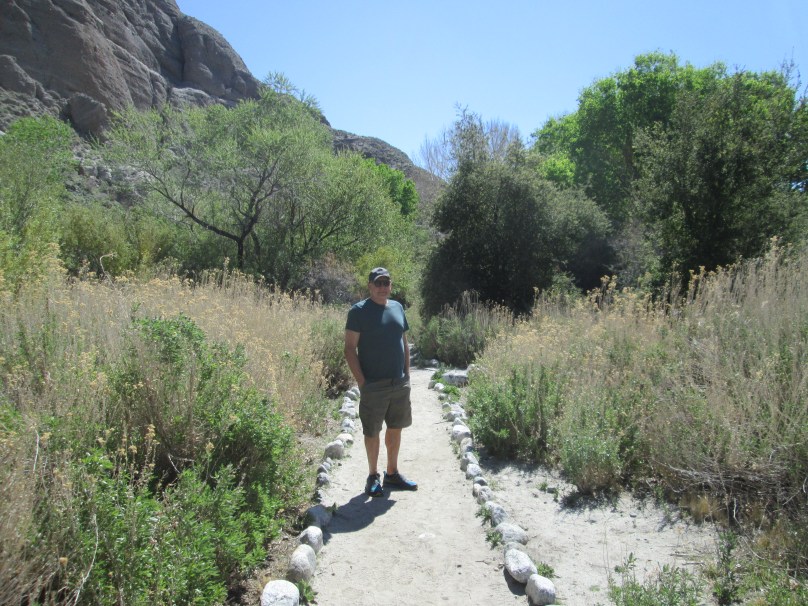
Me at Whitewater

This picture was shot by my brother using my camera. (You can see his water bottle on the fence to my right.)

Whitewater

The Whitewater River Near the Campground

On Sunday, my brother Dan suggested we visit the Whitewater Preserve. Now I was familiar with the desolate Whitewater exit off the I-10, all bleached rocky desert. But apparently, head uphill from the exit and one comes upon one of those little green paradises one often finds in desert canyons.

The altitude of the part of the Whitewater Preserve we visited was at 2,223 feet (678 meters). Whereas the floor of the desert was around 90° Fahrenheit (31° Celsius), the temperature at the visitor center was in the mid 70s (around 24° Celsius).

My brother took the above picture from his smartphone. The water is from the Whitewater River, which flows from Mount San Gorgonio and ends up, when not absorbed by the aquifer underlying the Coachella Valley, in the Salton Sea.

The Whitewater Preserve is part of the Sand-to-Snow National Monument, comprising parts of Southern San Bernardino County and Northern Riverside County.

Over the next few days, I will share with you some of the photographs I took there—the very last photographs from my trusty Canon PowerShot A1400 (R.I.P.).

Desert Dreams

Cacti at the Moorten Cactus Garden in Palm Springs

In the next few weeks, I will be making two road trips to the desert. First, this weekend I will spend a long weekend with my brother in Palm Desert. I don’t know how much I’ll be seeing inasmuch as we are in the middle of March Madness. No matter, because a few weeks later, Martine and I will be driving to Tucson, where we will definitely do some concentrated sightseeing.

I love the desert—but not in the summer! Several years ago, Martine and I flew to New Mexico and drove around in a rental car during the month of June. Every day, the temperature was in the three-digit range, often hitting 110° Fahrenheit (43° Celsius). There were times I was afraid to touch the handle of my rented Hyundai lest I leave behind the skin of my hand.

During the cooler months, however, especially when the wind isn’t blowing too strongly, the desert puts forth its most welcoming aspect. And April is one of the nicest times, as the floor of the desert is full of tiny wildflowers.

I don’t know what I’ll find in the Coachella Valley and Southern Arizona, but I have high hopes. And you can be sure that I’ll have some pictures to share with you.

Anza-Borrego

Me at the Vallecito Stage Depot in 2014

A large chunk of Eastern San Diego County is occupied by the Anza-Borrego Desert State Park, the largest in California’s state park system. I used to go hiking and tent camping there with my friends.

The Vallecito Stage Depot, which is located in the general park area, was an important stop on the first official transcontinental route, serving the San Diego-San Antonio (‘Jackass’) mail line (1857-1859), the Butterfield Overland Stage Line, and the southern emigrant caravans. This was at least a full decade before the first transcontinental railroad connected the Eastern U.S. with San Francisco.

Little known outside the State of California, Anza-Borrego Desert State Park is a scenic destination with the town of Borrego Springs in the middle and near the museums and restaurants of mile-high Julian, California. To the east is the Salton Sea and desolate Imperial County.

Kumeyaay Indian Morteros at Anza-Borrego

The original inhabitants of the area were the Kumeyaay Indians, who also called parts of northern Baja California home. One keeps running into evidences of their habitation of the area on the park’s many trails.

Influencers

Some people are influencers. They package themselves as a product and try to sell it via the Internet. As they grab your attention, they hope you will send some shekels their way as well as lots of “likes.”

I used to have a neighbor (the pretty woman in the above photo) who was an influencer in at least three areas:

  • “Female motorcycle rider, moto camping, outdoors, exploring, solo travel.”
  • Wellness and fitness
  • Marketing

She is no longer my neighbor because it turns out she was living on the edge. When you live on the edge, it is easy to fall into the abyss that runs close to the edge.

What happened? She was planning on moving to the East Coast. She put all her valuables onto an open-top trailer and set off with her mother. Somewhere in the Mojave Desert, she blew a tire. Eventually, a tow truck showed up and either changed or patched up the tire. No sooner was she on her way again than the car and trailer caught fire and burnt all her goods to the ground. Most particularly, she felt the loss of her beloved Suzuki DRZ motorcycle.

I sincerely hope she manages to pick up the pieces and get a new start wherever she is.

Although I have been a blogger for upwards of twenty years (on WordPress, the late Blog.Com, and the late Yahoo 360), I am resolutely a non-influencer. I write mainly to express myself and to help put in words what I am seeing and feeling. There is no way you can send me shekels, though I accept “likes.” In fact, I cannot even imagine the existence of a person who would hang on the edge of my every word.

Reader, beware: Wherever there is an edge, there is an abyss. Don’t fall into it.