Having It All

Daily writing prompt
What does “having it all” mean to you? Is it attainable?

I think that “Having It All” is a recipe for unhappiness. In most cases it can’t be done. And if it is done, it is not sustainable. In the words of the Dhammapada:

If you are filled with desire
Your sorrows swell
Like the grass after the rain.

But if you subdue desire
Your sorrows fall from you
Like drops of water from a lotus flower.

Fuge, late, tace

Big Sur Coastline, Central California

The last two days, I was revisiting one of my favorite authors, Honoré de Balzac. In his novel The Country Doctor (Le Médecin de Campagne), Doctor Benassis visits 5the Grande Chartreuse monastery in the French Alps and finds the following inscription left by one of the monks in an empty cell:

Fuge, late, tace

This is Latin for “Flee, hide, be silent.”

Which reminds me of Stephen Dedalus’s “Silence, exile, and cunning” from James Joyce’s Portrait of the Artist as a Young Man. It also makes me think of Russian poet Joseph Brodsky’s “If one’s fated to be born in Caesar’s empire, let him live aloof, provincial, by the seashore.”

I embrace this advice (except for the part about being silent, of which this post is a clear violation). At my advanced age, I have no hope of—or even desire for—success.

To quote the old antique dealer in Balzac’s The Fatal Skin (Le Peau de Chagrin):

Man depletes himself by two instinctive acts that dry up the sources of his existence. Two words express all the forms taken by these two causes of death: DESIRE and POWER. Between these two poles of human action, there is another principle seized upon by the wise, to which I owe my happiness and my longevity [the speaker is 102 years old]. Desire sets us afire and Power destroys us; but KNOWLEDGE leaves our fragile organism in a state of perpetual calm.

Alas, Balzac wasn’t able to follow his own advice. He burned through his life in 51 years, yearning for years to marry the Polish Countess Evelina Hanska. No sooner did he get his wish and return to Paris with his bride than he took sick and died.

Taking Stock

An All-But-Abandoned Park in Santa Monica

This was for me a day of taking stock and meditating. It all started with a fortune cookie I received at lunch from Siam Chan: “You can only live once, but if you do it right, once is enough.”

When I got home, I decided to take a walk to a little park at 26th Street and Broadway in Santa Monica. I grabbed my copy of Dhammapada: The Sayings of the Buddha and set out. It’s a nice little park which is all but abandoned on weekends. (On weekdays, the surrounding office buildings are crowded with folk.)

Arriving there, I grabbed a chair and started to read. As usual, Buddha hit the nail on the head:

And yet it is not good conduct
That helps you on the way,
Nor ritual, nor book learning,
Nor withdrawal into the self,
Nor deep meditation.
None of these confers mastery or joy.

O seeker!
Rely on nothing
Until you want nothing.

Again and again, it is he stifling of desire that is the key:

Death overtakes the man
Who gathers flowers
When with distracted mind and
     thirsty senses
He searches vainly for happiness
In the pleasures of the world.
Death fetches him away
As a flood carries off a sleeping village.


Desire’s Dog

There is something in the voice of American Indian writers that is worth listening to. I have just finished reading Louise Erdrich’s Tracks, and now I have come across this delightful poem by Joy Harjo, a Muscogee Creek who was poet-laureate of the United States:

Desire’s Dog

I was desire’s dog.
I ate when I was fed. I did what I was told.
I knew how to sit, stand and roll over on command.
When I was petted, I was made whole.
Even when I dreamed, I dreamed a chain around my neck.

Desire is a bone with traces of fat.
It’s the wag smell of a bitch in heat.
It’s that pinched hit at the end of a beat.
It’s a stick thrown into a rabbit chase.

I lay at the feet of desire for years.

Then I heard this song, calling me.
It was a woman in a red dress,
It was a man with a gun in his hand.
It was a table filled with fruit and flowers.
It was a fox of fire, a bird of stone.

Then, it was gone.

What was left disintegrated by rain and wind.

I had followed desire, to the end.

Is and Is Not

Scene from Sesshu Toyo’s Long Scroll

The following is from Sam Hammill’s translation of Lao Tzu’s Tao Te Ching written some 2,500 years ago:

Beauty and ugliness have one origin.
Name beauty, and ugliness is.
Recognizing virtue recognizes evil.

Is and is not produce one another.
The difficult is born in the easy,
long is defined by short, the high by the low.
Instrument and voice achieve one harmony.
Before and after have places.

That is why the sage can act without effort
and teach without words,
nurture things without possessing them,
and accomplish things without expecting merit:

only one who makes no attempt to possess it
cannot lose it.

A Lemming Named Desire

Frank “Lefty” Rosenthal and Wife Geri

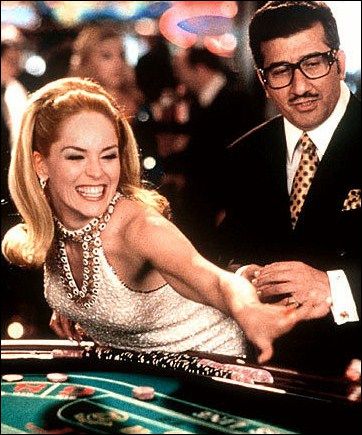
If you’ve seen Martin Scorsese’s film Casino about the mob days in Las Vegas, you’ve seen Sharon Stone in the role of Ginger McKenna as well as Robert DeNiro as Sam “Ace” Rothstein. Throughout the film, names were changed to protect both the innocent and the guilty. The actual characters were named Frank “Lefty” Rosenthal and Geri McGee Rosenthal.

Between 1976 and 1983, Rosenthal was in charge of four casinos that were secretly skimming profits to Chicago and other Midwestern mobsters. As a nationally known sports bettor, he had in 1969 married a Vegas showgirl named Geri McGee.

Vegas Showgirl Geri McGee

Geri was one of those tall, lovely showgirls for whom most men would sell their souls. Not that Lefty had not sold his soul early on, but hooking up with Geri turned out to be a nightmare. Although Lefty and Geri had two children together, Geri started taking drugs and having a not-well-hidden affair with mob enforcer Tony “The Ant” Spilotro (played by Joe Pesci in the film).

As her marriage began to implode, Geri had a very open break with her family and took thousands in cash and jewelry that Lefty had in a joint safe deposit box to prove his trust in Geri. She left for Los Angeles and was dead within months of a drug overdose. Lefty, meanwhile, was the victim of a car bomb, which, fortunately for him, he escaped without major injury. But shortly after that, he was finished in Vegas and moved on to Laguna Niguel, California, and then Boca Raton, Florida, where he died in 2008.

Sharon Stone in the Role of Geri

As men, most of us dream of falling for a long-stemmed beauty like Geri McGee, but it rarely ends well. There’s something about the whole mechanism of sexual desire which seems to militate against long-term happiness.

Thirty-Six Streams

The following selection on desire is taken from the sayings of Gautama Buddha known as The Dhammapada:

If you sleep
Desire grows in you
Like a vine in the forest.

Like a monkey in the forest
You jump from tree to tree,
Never finding the fruit—
From life to life,
Never finding peace.

If you are filled with desire
Your sorrows swell
Like the grass after the rain.

But if you subdue desire
Your sorrows fall from you
Like drops of water from a lotus flower.

This is good counsel
And it is for everyone:
As the grass is cleared for the fresh root,
Cut down desire
Lest death after death crush you
As a river crushes the helpless reeds.

For if the roots hold firm,
A felled tree grows up again.
If desires are not uprooted,
Sorrows grow again in you.

Thirty-six streams are rushing toward you!
Desire and pleasure and lust ...
Play in your imagination with them
And they will sweep you away.
Powerful streams!
They flow everywhere.