“No Surprise”

A short Emily Dickinson piece that shows that poetess from Amherst has, at times, ice in her veins and steel in her nerves.

Apparently with no surprise
To any happy flower,
The frost beheads it at its play
In accidental power.

The blond assassin passes on,
The sun proceeds unmoved
To measure off another day
For an approving God.

“It Is Bells Within”

Like me, Emily Dickinson loved reading. (Unlike me, she had the talent to show for it.) Today, I present one of her untitled poems on the joys of books.

Unto my books so good to turn
Far ends of tired days;
It half endears the abstinence,
And pain is missed in praise.

As flavors cheer retarded guests
With banquetings to be,
So spices stimulate the time
Till my small library.

It may be wilderness without,
Far feet of failing men,
But holiday excludes the night,
And it is bells within.

I thank these kinsmen of the shelf;
Their countenances bland
Enamour in prospective,
And satisfy, obtained.

“A Toad Can Die of Light”

I can never tire of Emily Dickinson’s poems. Short though they may be, they resonate far beyond their few lines. I love the last two lines about “the gnat’s supremacy.”

A toad can die of light!
Death is the common right
Of toads and men,--
Of earl and midge
The privilege.
Why swagger then?
The gnat's supremacy
Is large as thine.

“Fame Is a Fickle Food …”

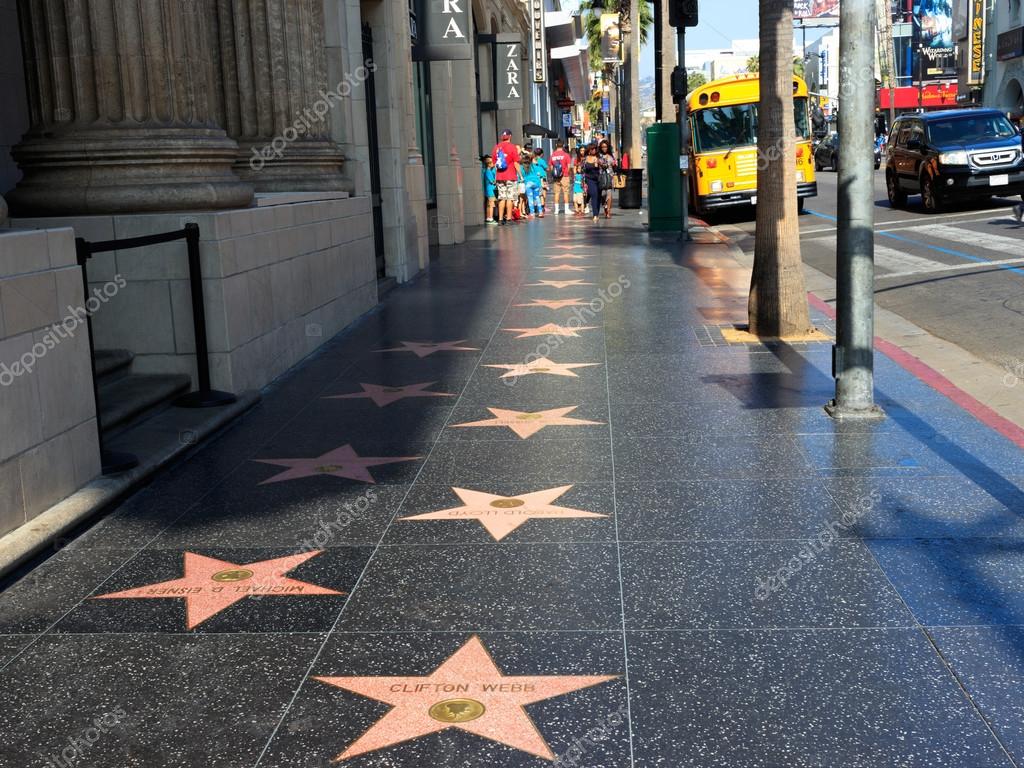
The Hollywood Walk of Fame

Here is a poem by Emily Dickinson on the subject of fame. It is short, but packs a punch.

Fame Is a Fickle Food

Fame is a fickle food
Upon a shifting plate
Whose table once a
Guest but not
The second time is set
Whose crumbs the crows inspect
And with ironic caw
Flap past it to the
Farmer’s corn
Men eat of it and die

A Bird Came Down the Walk

This is probably one of Emily Dickinson’s clearest poems, and one of her best.

A Bird, came down the walk

A Bird, came down the Walk - 
He did not know I saw -
He bit an Angle Worm in halves
And ate the fellow, raw, 
 
And then, he drank a Dew
From a convenient Grass -
And then hopped sidewise to the Wall
To let a Beetle pass -
 
He glanced with rapid eyes,
That hurried all abroad -
They looked like frightened Beads, I thought,
He stirred his Velvet Head. - 
 
Like one in danger, Cautious,
I offered him a Crumb,
And he unrolled his feathers, 
And rowed him softer Home -
 
Than Oars divide the Ocean,
Too silver for a seam,
Or Butterflies, off Banks of Noon,
Leap, plashless as they swim. 

“A Bird Came Down the Walk”

Bird With Captive Worm

Here is another delightful poem from Emily Dickinson (1830-1886), Queen of American Poets. It is called:

A Bird Came Down the Walk


A Bird, came down the Walk - 
He did not know I saw -
He bit an Angle Worm in halves
And ate the fellow, raw, 
 
And then, he drank a Dew
From a convenient Grass -
And then hopped sidewise to the Wall
To let a Beetle pass -
 
He glanced with rapid eyes,
That hurried all abroad -
They looked like frightened Beads, I thought,
He stirred his Velvet Head. - 
 
Like one in danger, Cautious,
I offered him a Crumb,
And he unrolled his feathers, 
And rowed him softer Home -
 
Than Oars divide the Ocean,
Too silver for a seam,
Or Butterflies, off Banks of Noon,
Leap, plashless as they swim. 

Wild Nights

Emily Dickinson (1830-1886)

There is probably no woman in the history of our country’s literature who is worthy to touch the hem of Emily Dickinson’s garb. In our obsession with the “Great American Novel,” we have quite forgotten that we have no other real claimants to the title of “Great American Poetess.” And by “Poetess,” I do not mean to belittle her excellence. She stands side by side with Walt Whitman, Robert Frost, Edgar Allan Poe, and Ezra Pound—and not so much as a half step behind any of them. She is, in sum, a national treasure.

Here is one of her short, savage poems which will leave you gasping:

Wild Nights—Wild Nights
Wild nights - Wild nights!
 Were I with thee
 Wild nights should be
 Our luxury!

 Futile - the winds -
 To a Heart in port -
 Done with the Compass -
 Done with the Chart!

 Rowing in Eden -
 Ah - the Sea!
 Might I but moor - tonight -
 In thee!

“Because I Could Not Stop for Death”

Emily Dickinson (1830-1886), One of America’s Greatest Poets

It has been a while since I’ve presented a poem by Emily Dickinson. Along with Robert Frost and Walt Whitman, she is one of the greatest poets our country has ever produced. This one is called “Because I Could Not Stop for Death.”

Because I could not stop for Death –
He kindly stopped for me –
The Carriage held but just Ourselves –
And Immortality.

We slowly drove – He knew no haste
And I had put away
My labor and my leisure too,
For His Civility –

We passed the School, where Children strove
At Recess – in the Ring –
We passed the Fields of Gazing Grain –
We passed the Setting Sun –

Or rather – He passed us –
The Dews drew quivering and chill –
For only Gossamer, my Gown –
My Tippet – only Tulle –

We paused before a House that seemed
A Swelling of the Ground –
The Roof was scarcely visible –
The Cornice – in the Ground –

Since then – ‘tis Centuries – and yet
Feels shorter than the Day
I first surmised the Horses’ Heads
Were toward Eternity –

A tippet is a narrow piece of cloth worn over the shoulders, and tulle is a kind of netting, which could be made from any of several fibers.

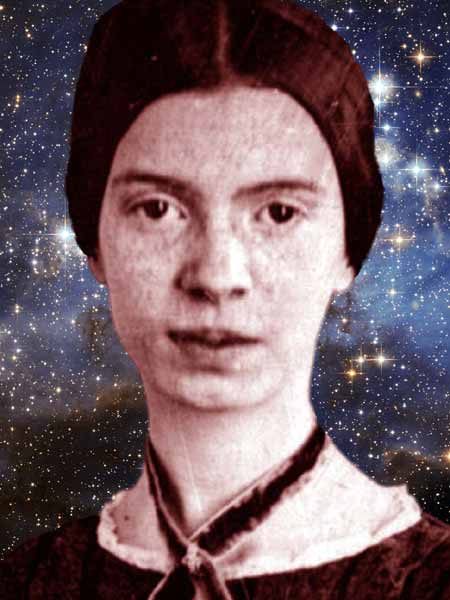
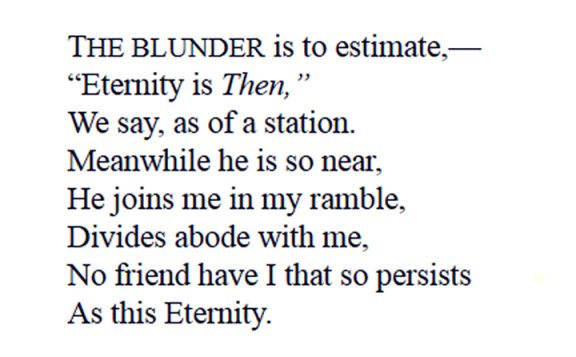
Emily and Eternity

Emily Dickinson

Emily Dickinson

Every so often, I feel like sharing an Emily Dickinson poem with you. Her stark simplicity opens blocked passages in my lungs and brains, allowing my breaths and thoughts to flow more freely.
POEMEmilyEternity

“I’ve Seen a Dying Eye”

Emily Dickinson

Emily Dickinson

The above illustration is from TeenReads.Com, which has an interesting take on the New England poetess. Whenever I have been away from her for a while, I love to read a few scattered poems by the poetess from Amherst, Massachusetts. Most recently, I have admired the following short poem:

I ’ve seen a dying eye
Run round and round a room
In search of something, as it seemed,
Then cloudier become;
And then, obscure with fog,
And then be soldered down,
Without disclosing what it be,
’T were blessed to have seen.

The images of the eye of the dying person running round and round, becoming obscured with fog, and finally being “soldered down” are a sobering, almost too intimate view of death. At the very end, Dickinson at last calls the dying person’s sight “blessed” without divulging the mystery of what was seen during those last few moments. A sense of mystery pervades the room, and our consciousness as readers.