
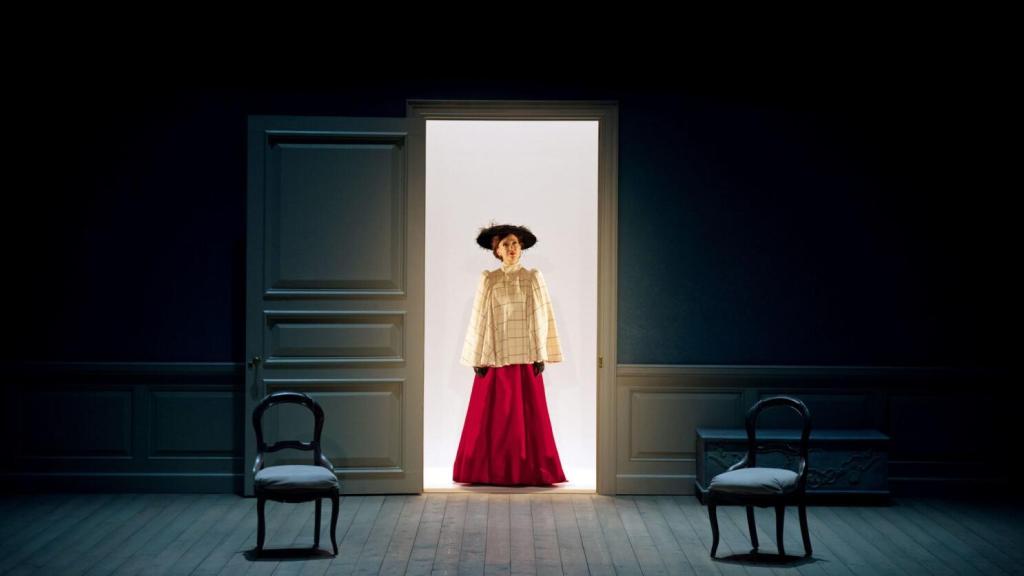
Nora Helmer Walking Out of Her Marriage
One of the characters in Kurt Vonnegut Jr’s Bluebeard has an interesting take on Henrik Ibsen’s play A Doll’s House, which ends shockingly (for its time) by the wife, Nora Helmer, walking out on her husband. Speaking is Marilee Kemp, with whom the artist Rabo Karabedian, is in love.
Her sense of her lace in the world back in 1933, with the Great Depression going on, revealed itself, I think, in a conversation we had about A Doll’s House, the play by Henrik Ibsen. A new reader’s edition of that play had just come out, with illustrations by Dan Gregory, so we both read it and then discussed it afterwards.
Gregory’s most compelling illustration showed the very end of the play, with the leading character, Nora, going out the front door of her comfortable house, leaving her middle-class husband and children and servants behind, declaring that she had to discover her own identity out in the real world before she could be a strong mother and wife.
. . .
That is how the play ends. Nora isn’t going to allow herself to be patronized for being as uninformed and helpless as a child anymore.
And Marilee said to me, “That’s where the play begins as far as I’m concerned. We never find out how she survived. What kind of job could a woman get back then? Nora didn’t have any skills or education. She didn’t even have money for food and a place to stay.”
. . .
That was precisely Marilee’s situation, too, of course. There was nothing waiting for her outside the door of Gregory’s very comfortable dwelling except hunger and humiliation, no matter how meanly he might treat her.
A few days later, she told me that she had solved the problem. “That ending is a fake!” she said, delighted with herself. “Ibsen just tacked it on so the audience could go home happy. He didn’t have the nerve to tell what really happened, what the whole rest of the play says has to happen.”
“What has to happen?” I said.
“She has to commit suicide,” said Marilee. “And I mean right away—in front of a streetcar or something before the curtain comes down. That’s the play. Nobody’s ever seen it, but that’s the play!”

 Tarnmoor
You must be logged in to post a comment.