
Don’t Toque to Me About Chefs!

Making a $45.00 Tower of Exotic Foodstuffs

The following is a repost from December 20, 2014.

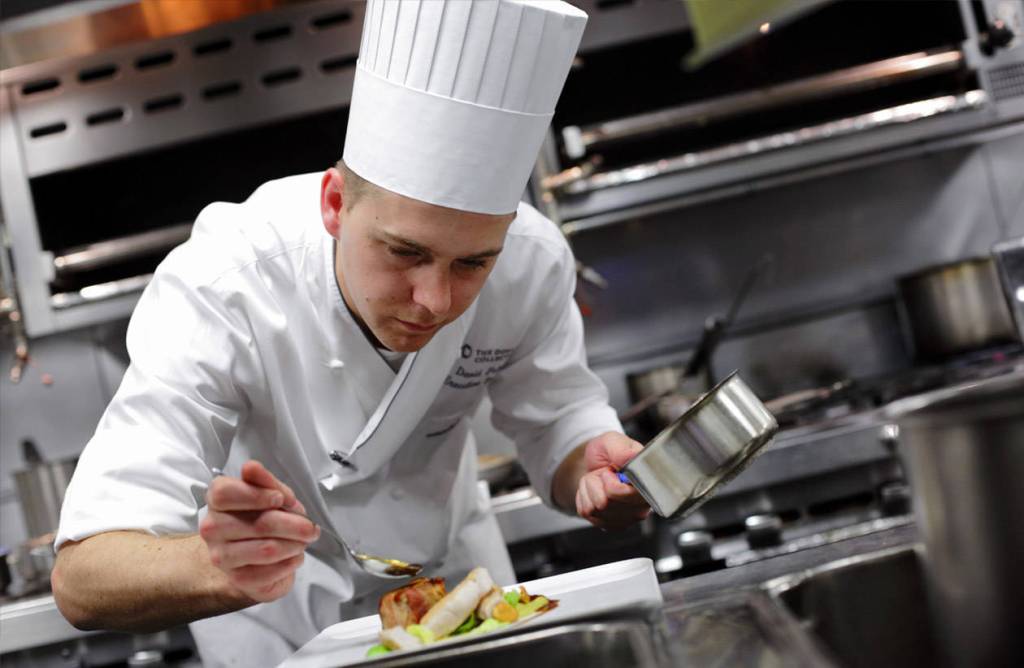
The problem with American restaurants is that there are too many chefs and not enough cooks. Ever since the Food Network went on the air, people started paying too much attention to people with large white toques who like to mess around with food, forming little towers of quinoa with raspberry sauce and maybe a small amount of meat or fish. The less the foods appear to go together, the more renown the chef is likely to earn for his or her daring.

It’s become an epidemic. The tutsi-fruitsie is king. The ice tea is contaminated with passion fruit or other petrochemical waste. Side dishes avoid the usual rice or potatoes and provide instead broccolini with mashed yeast and ground Murano glass and Galena lead pellets.

Whenever I see some Culinary Institute of America (CIA) chef wearing a towering white toque, I know I’m in for a pretentious soaking. On the other hand, when I see what Hungarians call a szakács or szakácsnő (cook, masculine or feminine gender respectively), I know I am likely to have an excellent meal. There must be no toque or other sartorial trimmings. I want a good, honest cook who knows how to prepare food. And no little towers!

As for the Food Network, I hope they switch over to running “Antiques Roadshow” or “Pawn Stars.” Or maybe they can talk about Kim Kardashian or some other celebrity twinkie. They certainly have not done anything to improve the quality of food in this country.

How Chefs Are Destroying American Cooking

Archvillain Guy Fieri and His Inedible Creations

My original title for this post was “How the Food Network Is Destroying American Cooking,” but I decided the problem is more general. It’s almost as if all the young chefs have been subsisting on Cheerios and S’mores until they suddenly got religion and started putting together things that never really belonged together. It’s like those stupid Iron Chef competitions in which cooks are challenged to make something intriguing from unlikely ingredients. For instance, some competing chefs may have to cook a dish using:

  • A men’s size 10 double wide leather shoe sole
  • Two cups of lard
  • A dash of Asafoetida
  • Several pounds of kale
  • A pint of Ben and Jerry’s Cherry Garcia ice cream

All the components of a dish must be built up in a tower of food, as in the photo below:

Small Tower of Miscellaneous Ingredients

I was raised on Hungarian food, but living in Los Angeles has given me an abiding interest in Asian food (principally Chinese, Indian, and Japanese) and Mexican food. Although Martine and I do visit restaurants (principally on weekends), most evenings we eat dishes which I have prepared. For instance, tonight I made a Middle Eastern vegan stew containing potatoes, chickpeas (garbanzo beans), tomatoes, onions, and cumin. I also liked to prepare a jambalaya (minus shrimp, which we don’t eat), keema, chili con carne, chicken chow mein, kasha varnishkas, and ratatouille vegetable stew. I never pile the main dish up into a tower of any sort, and I studiously avoid ingredients that conflict with one another.

When I read a restaurant review, I have to read between the lines to determine whether the food is good, or merely showy in some strange way.

There used to be a great Hungarian restaurant in the San Fernando Valley by Ventura and Vineland called the Hortobagy. When that restaurant closed down, the owner opened another place off Tujunga and Magnolia called Maximilian’s Austro-Hungarian Restaurant. It turns out that the owner, who fancied himself a chef, thought that the liberal use of raw onions was his trademark. The women chefs who worked at Hortobagy were the real artists; the owner, Laszlo, was anything but.