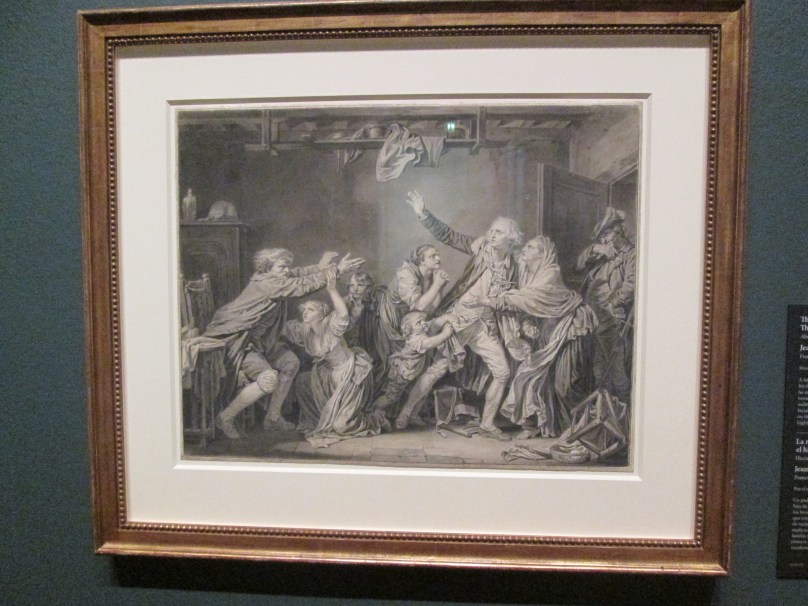
It was the Getty Center that turned me on to the art of Jean-Baptiste Greuze when they had an exhibit in 2002 on “French Drawings in the Age of Greuze.” He may be been something of a moralizer, but his drawings and his paintings are wonderfully dynamic. The above drawing is from a special exhibit at the Getty entitled “Virtue and Vice: Allegory in European Drawing.”
The vice in this case is a son (standing, right) announcing to his family that he has joined the army. He is embraced by his mother while his father (seated, left) curses him for his decision. The full name of the brush and gray wash over graphite drawing is: “The Father’s Curse: The Ungrateful Son.” The museum description of the drawing is as follows:
A father reacts furiously to his son’s decision to leave his family and join the army. With outstretched arms, he releases an angry curse that thrusts the young man toward the door, where a recruiting officer watches with indifference. The family’s pleading gestures and dramatic facial expressions communicate their anguish. Based on the popular painting the artist exhibited in 1777, this highly finished sheet served as the model for a print.
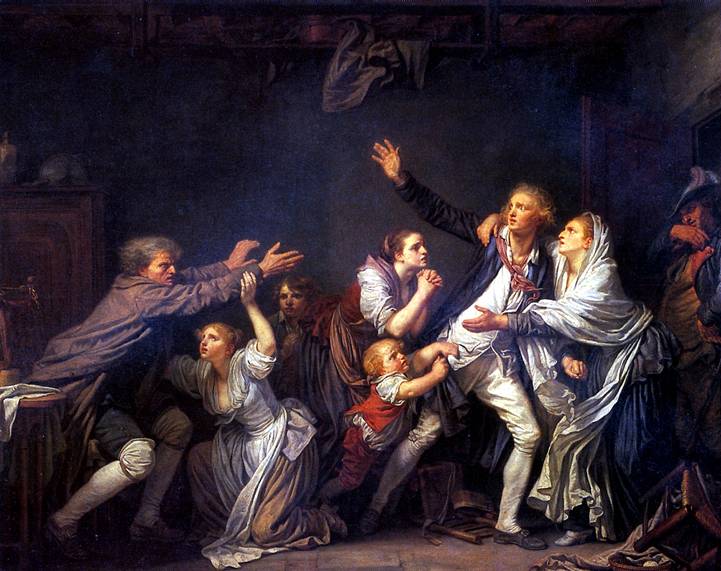
Here is the painting by Greuze that preceded the drawing:
This painting was praised by no less a critic than Denis Diderot, the famous French Encyclopedist. I actually like the drawing that ensued more than the painting because it looks more like a domestic scene rather than a stage proscenium.
I wonder why Greuze found it necessary to do a drawing afterhe did an oil painting. If, as the Getty description noted, the drawing was turned into a print, I would be very interested in seeing the print or engraving based on it.
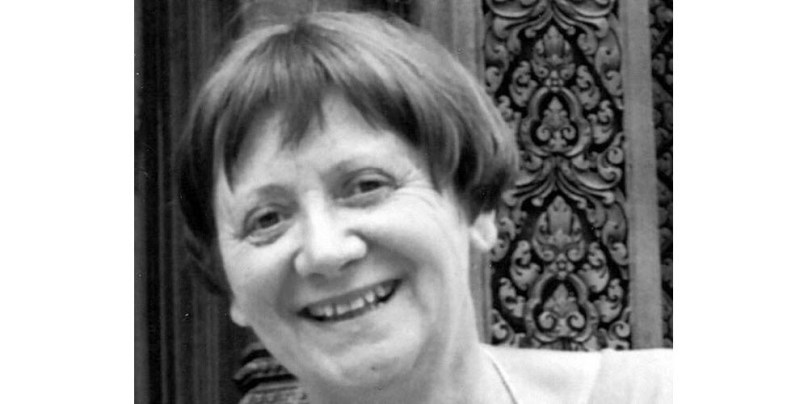
Humanitarians tend to come off as pretty insufferable people. British author John le Carré (a.k.a. David Cornwell) tells of one who had a sense of humor. The story is told in le Carré’s The Pigeon Tunnel, an autobiographical work that traces the real-life antecedents of the characters in his books. This one tells of Yvette Pierpaoli’s efforts to save Cambodian children during the Khmer Rouge atrocities.
I made a couple more journeys to Phnom Penh before the city finally fell. By the time I left for the last time, the Indian shopkeepers and the girls in their rickshaws were shaping to be the last to get out: the traders because the greater the shortages, the higher the prices; the girls because in their innocence they believed their services would be in demand whoever won. In the event, they were recruited to the Khmer Rouge, or died of deprivation in the killing fields. From Saigon, as it still was, I had written to Graham Greene to tell him that I had reread The Quiet American, and that it stood up wonderfully. Improbably the letter reached him, and he wrote back urging me to visit the museum in Phnom Penh and admire the bowler hat with ostrich feathers with which Khmer kings had been crowned. I had to tell him that not only was there no bowler hat; there was no museum any more.
Yvette has become the subject of many wild tales, some apocryphal but many, despite their improbability, true. My favourite, which I heard from her own mouth—not always a guarantee of veracity—tells how in Phnom Penh’s final days she marched a troop of orphaned Khmer children into the French Consulate and demanded passports, one for each child.
“But whose children are they?” the besieged consular official protested.
“They are mine. I am their mother.”
“But they’re all the same age!”
“And I had many quadruplets, you idiot!”
Defeated, perhaps complicit, the Consul demanded to know their names. Yvette reeled them off: “Lundi, Mardi, Mercredi, Jeudi, Vendredi …” [The names of the days of the week in French]
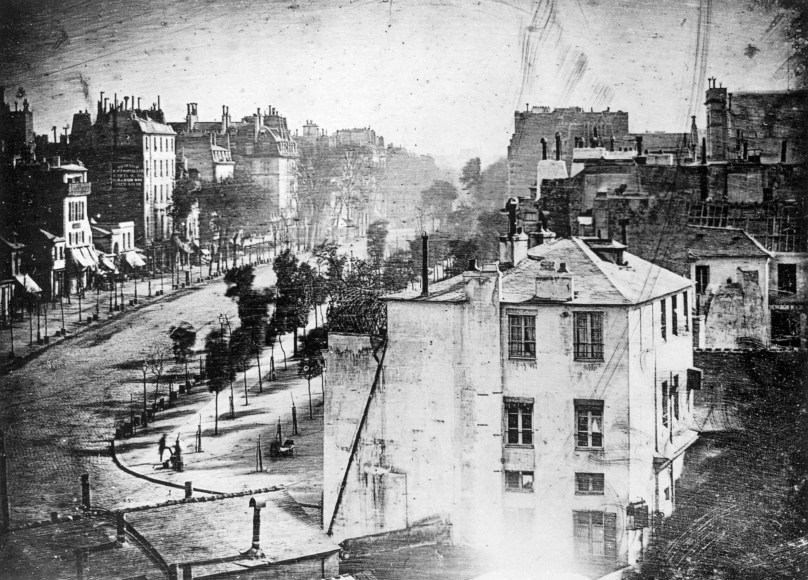
The above photograph is the first one to show a human being. There he is, in the lower left, having his shoes shined. All the pedestrians and carts and carriages have disappeared because this was an eight-hour exposure, ensuring only that static subjects could be recorded. Below is a description of Paris by Honoré de Balzac at the beginning of The Girl with the Golden Eyes (1835) that is anything but static:
One of those sights in which most horror is to be encountered is, surely, the general aspect of the Parisian populace—a people fearful to behold, gaunt, yellow, tawny. Is not Paris a vast field in perpetual turmoil from a storm of interests beneath which are whirled along a crop of human beings, who are, more often than not, reaped by death, only to be born again as pinched as ever, men whose twisted and contorted faces give out at every pore the instinct, the desire, the poisons with which their brains are pregnant; not faces so much as masks; masks of weakness, masks of strength, masks of misery, masks of joy, masks of hypocrisy; all alike worn and stamped with the indelible signs of a panting cupidity? What is it they want? Gold or pleasure? A few observations upon the soul of Paris may explain the causes of its cadaverous physiognomy, which has but two ages—youth and decay: youth, wan and colorless; decay, painted to seem young. In looking at this excavated people, foreigners, who are not prone to reflection, experience at first a movement of disgust towards the capital, that vast workshop of delights, from which, in a short time, they cannot even extricate themselves, and where they stay willingly to be corrupted. A few words will suffice to justify physiologically the almost infernal hue of Parisian faces, for it is not in mere sport that Paris has been called a hell. Take the phrase for truth. There all is smoke and fire, everything gleams, crackles, flames, evaporates, dies out, then lights up again, with shooting sparks, and is consumed. In no other country has life ever been more ardent or acute. The social nature, even in fusion, seems to say after each completed work: “Pass on to another!” just as Nature says herself. Like Nature herself, this social nature is busied with insects and flowers of a day—ephemeral trifles; and so, too, it throws up fire and flame from its eternal crater. Perhaps, before analyzing the causes which lend a special physiognomy to each tribe of this intelligent and mobile nation, the general cause should be pointed out which bleaches and discolors, tints with blue or brown individuals in more or less degree.
By dint of taking interest in everything, the Parisian ends by being interested in nothing. No emotion dominating his face, which friction has rubbed away, it turns gray like the faces of those houses upon which all kinds of dust and smoke have blown. In effect, the Parisian, with his indifference on the day for what the morrow will bring forth, lives like a child, whatever may be his age. He grumbles at everything, consoles himself for everything, jests at everything, forgets, desires, and tastes everything, seizes all with passion, quits all with indifference—his kings, his conquests, his glory, his idols of bronze or glass—as he throws away his stockings, his hats, and his fortune. In Paris no sentiment can withstand the drift of things, and their current compels a struggle in which the passions are relaxed: there love is a desire, and hatred a whim; there’s no true kinsman but the thousand-franc note, no better friend than the pawnbroker. This universal toleration bears its fruits, and in the salon, as in the street, there is no one de trop, there is no one absolutely useful, or absolutely harmful—knaves or fools, men of wit or integrity. There everything is tolerated: the government and the guillotine, religion and the cholera. You are always acceptable to this world, you will never be missed by it. What, then, is the dominating impulse in this country without morals, without faith, without any sentiment, wherein, however, every sentiment, belief, and moral has its origin and end? It is gold and pleasure. Take those two words for a lantern, and explore that great stucco cage, that hive with its black gutters, and follow the windings of that thought which agitates, sustains, and occupies it! Consider! And, in the first place, examine the world which possesses nothing.
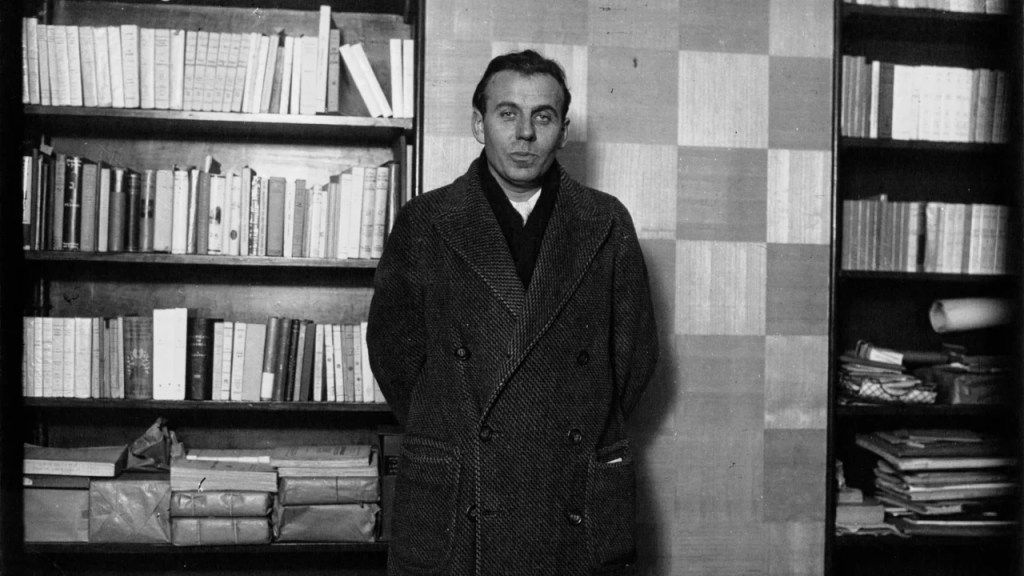
He will never win any humanitarian awards, or, for that matter, any awards, but Louis-Ferdinand Céline is one of the greatest writers of the twentieth century, an anti-Semite, a Nazi sympathizer, and probably a very decent human being otherwise. Born Louis Ferdinand Auguste Destouches in Courbevoix, France in 1894, Céline became a wounded war hero at Ypres in 1914
After the war, he became a physician and toured Africa and the Americas working for the League of Nations. In 1932, he published his greatest and most approachable novel, Journey to the End of the Night (Voyage au bout de la nuit). Unfortunately, in the early 1940s, he published several anti-Semitic books urging closer ties to Hitler’s Germany.
After the Allied invasion of France, Céline fled to Germany after having been identified by the Resistance and the British as a collaborationist. It was the beginning of a long and confused period escaping Allied bombing attacks and the Russian Army that was brilliantly described in his trilogy about being a guest of the Nazis as they were being pounded to pieces:
Castle to Castle (D’un château l’autre) 1957
North (Nord) 1960
Rigadoon (Rigadon) 1961
Years after reading the first two volumes, I have just finished reading Rigadoon and loving it. Céline and his wife are constantly being shuttled on trains from one bombed-out city to another. At one point, he escorts a group of eighteen severely retarded children from Hannover to Hamburg and manages to transfer them to a special Swedish Red Cross train taking them to safety. Unfortunately, the same train took Céline to Copenhagen, where he served a year in prison for his collaboration with the Nazis.
He died in 1961. Although his novels were a powerful influence on other novelists, Céline was never treated with the honor that his literary and medical work deserved. He spent his last years being a doctor treating poor patients in the slums of Paris.
So fair and foul a career I have not seen. I love Céline’s novels even as I detest his racial and political views. Life can be strange.
Watteau de Lille (Louis-Joseph Watteau, dit). “Assemblée dans un parc”. Huile sur toile, vers 1785. Paris, musée Cognacq-Jay.
I have always loved the paintings of Jean-Antoine Watteau (aka Watteau de Lille and Louis-Joseph Watteau). There is a kind of sad elegance in them, frequently in a beautiful natural setting. I saw the above painting at a small art museum in Paris that is little visited. The Musée Cognacq-Jay is dedicated to the art of the 18th Century and features, besides Watteau, such painters as Boucher, Fragonard, Greuze, Chardin, Tiepolo, and Robert.
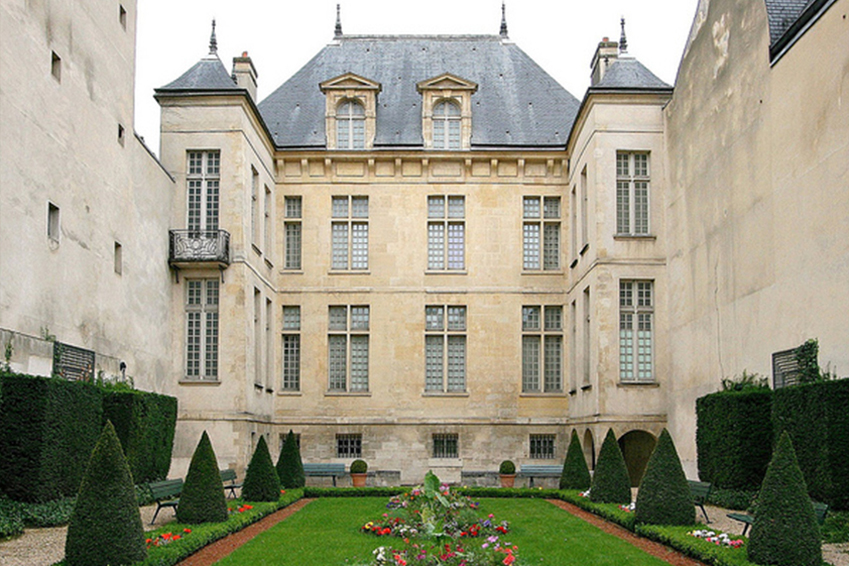
Most of the works therein were acquired between 1900 and 1927 by Ernest Cognacq, founder of the Samaritaine department store, and his wife Marie-Louise Jay. The building the collection sits in is an elegant structure redolent of the 18th century. Situated at 8 rue Elzévir, it is close to the Marais District of Paris.
Musée Cognacq-Jay
If you love art, I have no doubt you would find the Cognacq-Jay more interesting than the nearby Picasso Museum or the Pompidou Center. Unless, of course, you are a big fan of modern art, which I am not.
My last name is Paris, although I have not a drop of French blood in my veins. In Hungarian, my last name is Páris, pronounced PAH-reesh. On my father’s Czechoslovakian passport when he emigrated to the United States in 1929 (bad timing), his last name was shown as Parisej. When I asked him about this, he said the dominant Czechs always messed with Slovak last names.
There was a time when I was anti-French. This reached its height in 1976, when my Laker Airlines flight to London first stopped at Paris’s Orly Airport. We were all deplaned and made to go through security by the French police. When one of the officers wanted me to open up the back up my Olympus OM-1 camera and expose the film that was loaded, I refused and remarked rather snootily, “Je ne suis pas Carlos le terroriste!” Somehow, the officer smirked and let me continue without sending me to the guillotine.
Since then, I began to admire France more and more. My girlfriend, Martine, was born in Paris. My favorite novelists (Honoré de Balzac and Marcel Proust) are French. Subsequently, I visited Paris twice with Martine, staying first near Place de Clichy and then on the Left Bank near the Eiffel Tower.
I fell in love with Arthur Rimbaud, Blaise Pascal, Paul Eluard, François Villon, Emile Zola, Albert Camus, Patrick Modiano, Jean-Pierre Manchette, Nicolas Poussin, Antoine Watteau, Claude Lorrain, Auguste Renoir and his cinéaste son Jean, Jean-Luc Godard … Oh, hell, the list goes on damn near forever! In the end, I did a 180.
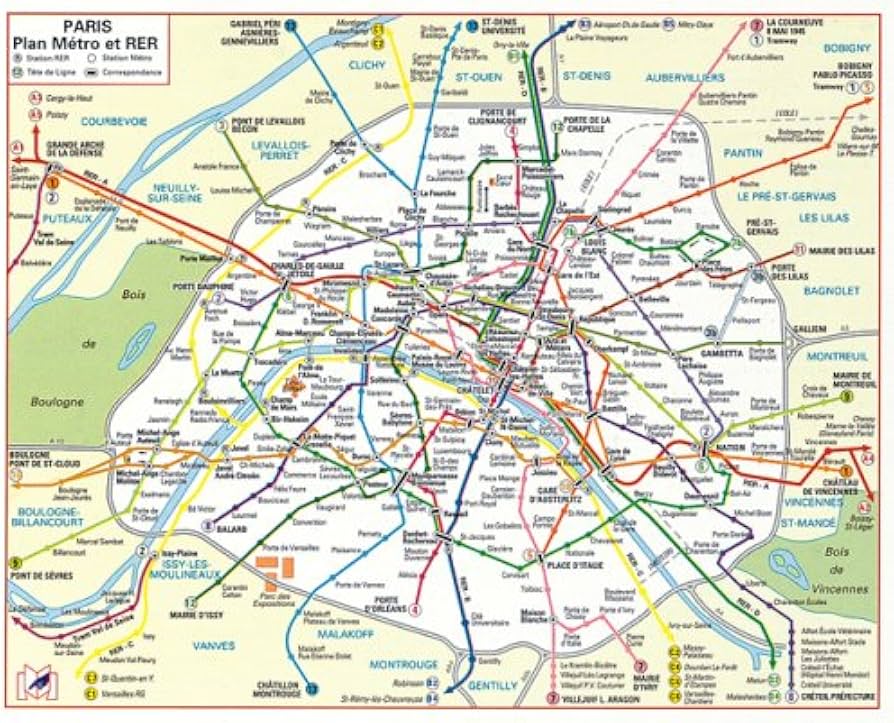
Public Transit Map of Paris
Now with the opening ceremony of the 2024 Paris Olympics, I am more impressed than ever with the French. In a handful of brilliant images, France reminded us who and what they were, and what they meant to the world.
Whenever I read a French novel, I am never without a copy of Paris Pratique Par Arrondissement in my lap, so I can follow the action street by street, neighborhood by neighborhood. It’s almost as if I considered Paris as more than just another city: It is a city I revere, a world city.
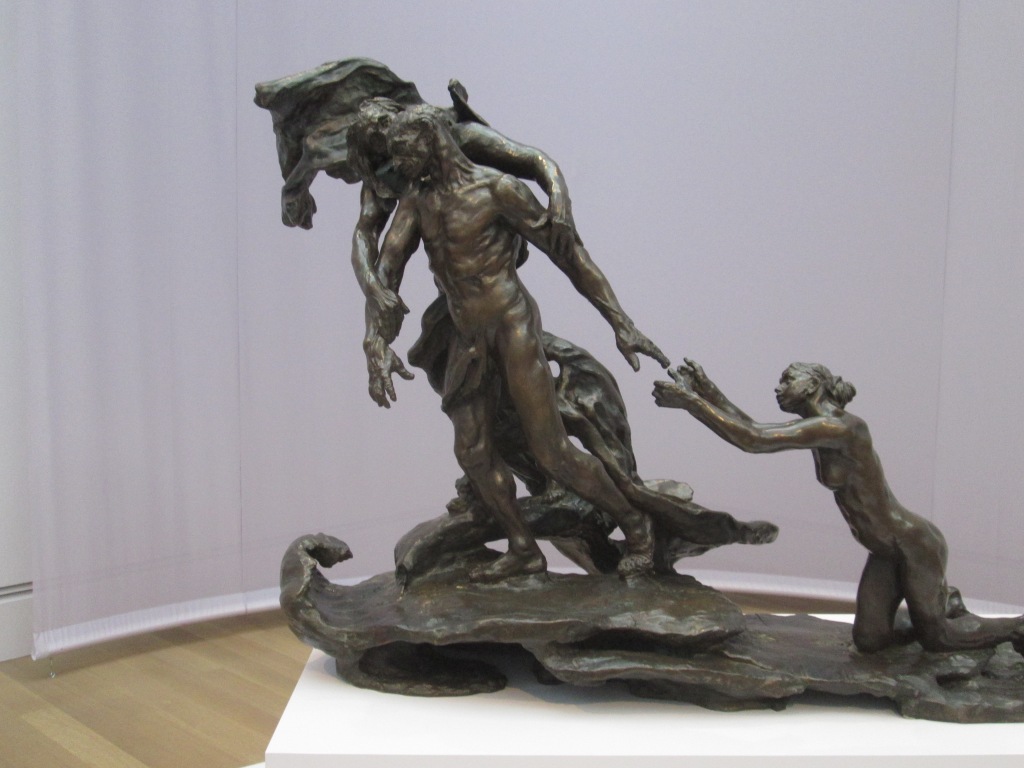
The 19th century was not a good time for a female artist of genius to enter the orbit of an older male genius. Can one ever escape that orbit? The above photo was taken of Camille Claudel at the age of nineteen, when she started working in Auguste Rodin’s sculpture studio.
Now there is no doubt that Rodin was one of the greatest sculptors who ever lived. I visited his museum on the Left Bank of the Seine in Paris over twenty years ago. In fact, there was a whole room dedicated to the work of his young protegée.
But she deserved more. Today, I visited the Getty Center, where there was a traveling exhibit of Camille Claudel’s sculpture. Seen by itself, it was nothing short of amazing.
“The Age of Maturity” (1902)
There is something particularly poignant about Claudel’s female nudes. I was particularly struck by the pleading figures such as the nude in “The Age of Maturity” (above). Another impressive nude appears below:
“Wounded Niobid” (1907)
There was also something wounded about poor Camille. Around the time of the above sculpture, she appeared to be suffering from mental illness. In fact, in 1913, her younger brother, the famous French author Paul Claudel, had her committed to an insane asylum, where she lived out the last thirty years of her life. Was she in fact mentally ill? Some say yes and some say no. In any case, it is a tragedy considering what a great artist she was.
In 1988, a film of her life called Camille Claudel was made in France by Bruno Nuytten, starring the lovely Isabelle Adjani as Camille. When I first saw it years ago, that was the first time I had heard of her. Now, with this exhibit at the Getty Center, I think she is one of the all time greatest sculptors whose work I have ever seen.
Sam Riley and Garrett Hedlund in Walter Salles’ Movie On the Road
This month I read two classical “road novels.” The first was Jean Giono’s The Open Road (Grands Chemins) about two down-at-heel pals walking through the countryside of Southern France around 1950 looking to pick up cash from work or gambling. Conceived of around the same time was Jack Kerouac’s On the Road about two down-at-heel pals crossing the continent at high speed looking to pick up enough cash for gas to get to their destination. Curiously, neither writer was aware of the other, even though Kerouac came from a French-Canadian family.
Both books are well worth reading, especially as I feel that Kerouac and Giono would have admired each other’s work.
Jean Giono (1895-1970)
I had read the Kerouac decades earlier, but upon finishing Giono’s book, I thought I wanted to get on the road again, so I re-read On the Road. They were two very different authors. Giono was in love with the land of his birth as was Kerouac. Unfortunately, Kerouac’s love was so heavily suffused with alcohol that he only lasted to the age of 47. His later books, such as Big Sur, showed him to be headed down the road to liver failure.
Still, I love reading Kerouac’s books. He had such a vital enthusiasm for his friends and for mid-century America that, even in his experiments in bop prosody, something splendid shines through. Perhaps it was a never ending sense of youthfulness. Giono’s France is centuries old, but Kerouac’s America was bottled in bond in the years right after the Second World War.
Of recent French authors, the one I am most addicted to is Patrick Modiano, winner of the 2014 Nobel Prize for Literature. Since I first read his Out of the Dark (1998) for an Internet French Literature group ten years ago, I have read most of his work and am still hungry for more, though there are only a few titles left to go. And, no doubt, I will probably start re-reading them.
Scene of the Crime (2021) is one of his most recent novels, which I just finished today. Jean Boesman experienced some fascinating but very dicey people back in the 1960s and is haunted by the memory. He has been sought after by several of them for knowing where some swag from past smuggling has been hidden, but he successfully avoids them. Nonetheless, he still endlessly goes over his relationship with the young women in the group. As he says at one point, “We are from our childhood as we are from a country.”
That country was the Paris of the 1960s and 1970s. I cannot read Modiano without a map book of Paris on my lap, following his characters wanderings and evasions through the most walkable city on Earth.
In Scene of the Crime, I tracked Boesman through Boulogne-Billancourt (where Modiano was born), Auteuil, Pigalle/Place Blanche, the Quays along the Seine, and Saint Lazare.
None of Modiano’s books are particularly long: Most can be completed in one or two sittings. I usually take a little longer, because I am following the action on a map of Paris.
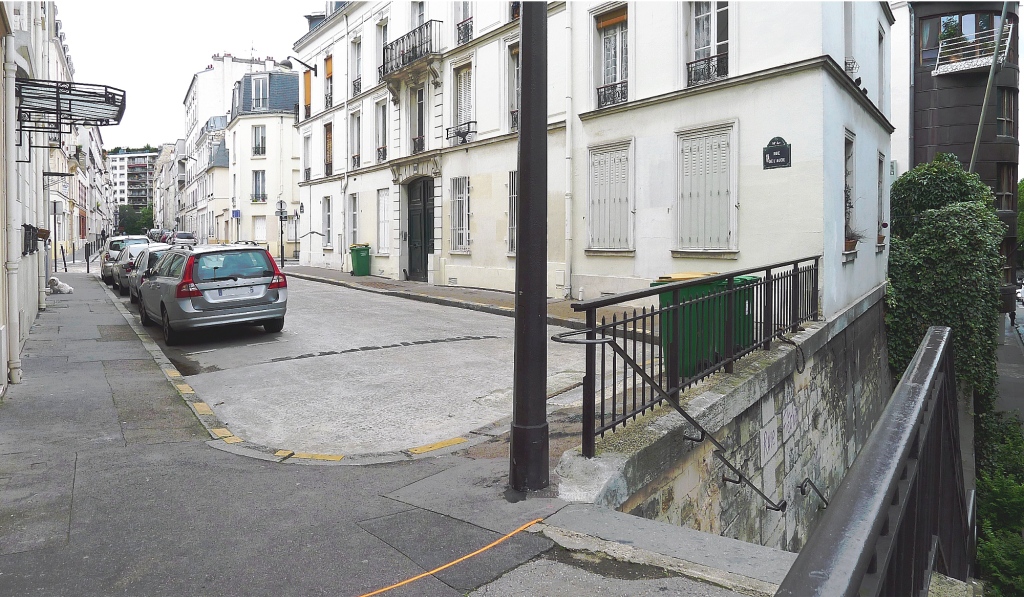
The Rue de l’Aude in the XV Arrondissement of Paris
I am fatally in love with the novels of Patrick Modiano. This evening, I re-read his The Black Notebook, published in France in 2012 as L’Herbe des nuits. His fatally lost characters end up wandering the streets of Paris, trying to recover lost memories. Meanwhile, I try following their path using an old copy of Paris Pratique par Arrondissement.
The following is from page 75 of my Houghton-Mifflin edition:
And I was afraid I would be waiting for her in vain that night. Then again, I often waited without knowing if she’d show. Or else she would come by when I wasn’t expecting her, at around four in the morning. I would have fallen into a light sleep, and the sound of the key turning in the lock would startle me awake. Evenings were long when I stayed in my neighborhood to wait for her, but it seemed only natural. I felt sorry for people who had to record appointments in their diary, sometimes months in advance. Everything was prearranged for them, and they would never wait for anyone. They would never know how time throbs, dilates, then falls slack again; how it gradually gives you that feeling of vacation and infinity that others seek in drugs, but that I found just in waiting. Deep down, I felt sure you would come sooner or later.





 Tarnmoor
You must be logged in to post a comment.