

Jean-Luc Godard (1930-2022) with Wife Anna Karina
Beginning in the 1960s and extending through the early 1970s, I thought that the most exciting filmmaker in the world was Jean-Luc Godard. While I was a film student at UCLA, it seemed that two or three new titles came out every year. All of them enthralled me.
Then, something happened. When La Chinoise came out, I was sorely disappointed. Always sympathetic to revolutionaries, Godard seemed to have turned Maoist. His stars—Jean-Pierre Léaud and Anna Wiazemski—endlessly quoted from Chairman Mao’s little red book. Godard had gone doctrinaire on me. Even though I myself had flirted with the Progressive Labor Party in 1967, as a Hungarian-American I had uneasy feelings about dogmatic Communism.
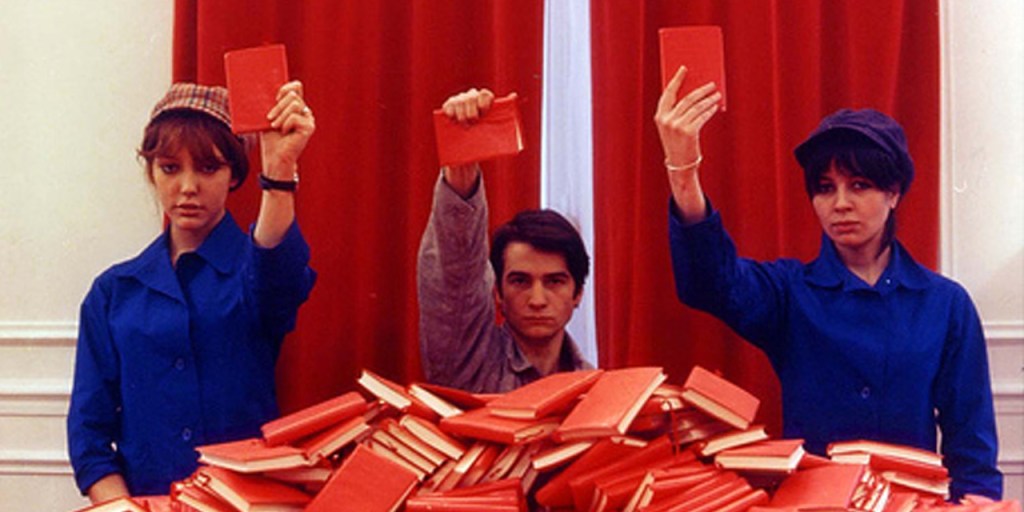
La Chinoise: Way Too Dogmatic
Still, I thought that most of Godard’s films of the 1960s were exciting. At the time, all my favorite American directors were either dead or dying, and here was a young French director still in his thirties who could be relied upon to produce more masterpieces in the years to come. Alas! It was not to be. I have seen a few of his later productions, which I found not quite up to the standard Godard had set earlier in his career.
Among my favorites of his were:
- À bout de souffle or Breathless (1960), one of the iconic films of the French New Wave
- Vivre sa vie or My Life to Live (1962)
- Le mépris or Contempt (1963), starring Brigitte Bardot
- Alphaville (1965), a great combo of noir and science fiction
- Pierrot le fou (1965)
- Masculin féminin (1966), starring French pop star Chantal Goya
- Made in USA (1966)
- Weekend (1967), an apocalyptic satire of the French bourgeoisie
Many of the above films starred Godard’s wife, the lovely Anna Karina, which for me served as an added inducement to see the films.
Godard continued to make films. Between 1968 and 1972, he made political films with the Dziga Vertov Group, none of which I have seen. As late as 2022, he kept releasing films. The exhilaration of the earlier works, however, was gone. I have yet to see more than a handful of them, but I would like to at some point. Many of them are pretty obscure and hard to find.
Last year, at the age of 91, Godard found himself suffering from a series of incapacitating illnesses, such that he committed assisted suicide on September 13, which is allowed by Swiss law. It is an unfortunate end for a great artist whose work influenced my life in so many ways at a time when I was young and alienated. But then, such is life.

 Tarnmoor
You must be logged in to post a comment.