
My Years with Gabo

The Mayan Ruins at Chichén Itzá

The Mayan Ruins at Chichén Itzá

It was November 1975. For the first time in my life, I was outside the United States on my own. I always thought it was somehow significant that my first bid for freedom from those endless bad weather trips back and forth to Cleveland to see my parents was a two week vacation in Yucatán. When visiting the ruins at Chichén Itzá, I stayed at the old Hacienda Chichén, which contained the cottages used by earlier archaeologists. I was within walking distance of the ruins.

Back then, a road cut through the ruins. On one side was the Castillo and the structures best known to visitors; on the other, there was Old Chichén. By the side of the road, there was an open-air souvenir stand with thatched roof that sold the usual tourist junk. On the side, there was a book rack that happened to have a Penguin paperback edition of Gabriel García Márquez’s One Hundred Years of Solitude (1967). I had heard of the author before and was just beginning to wake up to that breakout generation of Latin American writers that included Borges, Cortázar, Vargas Llosa, and García Márquez. Here in front of me was a grey-covered Penguin (“This edition not for sale in the United States”) that looked like an interesting read.

How could I not read a book that opened this way:

Many years later, as he faced the firing squad, Colonel Aureliano Buendía was to remember that distant afternoon when his father took him to discover ice. At that time Macondo was a village of twenty adobe houses, built on the bank of a river of clear water that ran along a bed of polished stones, which were white and enormous, like prehistoric eggs. The world was so recent that many things lacked names, and in order to indicate them it was necessary to point.

That was my first acquaintance with the Colombian writer whose work was to become a lifelong pursuit with me. Ever since, I have rationed the books I read by him so that I didn’t run out too soon. Yesterday, I re-read Chronicle of a Death Foretold, which I last read thirty years ago in a magazine that had an illustration by Fernando Botero. (I forget which magazine it was.)

Since my first acquaintance with Colonel Buendía in 1975, I have gone on to read:

  • Leaf Storm (1955)
  • No One Writes to the Colonel (1961)
  • In Evil Hour (1962)
  • The Story of a Shipwrecked Sailor (1970)
  • The Incredible and Sad Tale of Innocent Erendira and Her Heartless Grandmother (1978)
  • Chronicle of a Death Foretold (1981)
  • Love in the Time of Cholera (1985)
  • The General in His Labyrinth (1989)

Then, too, there were numerous short stories, which I will re-read in as many years as are left to me. Although we lost García Márquez in April of this year, his work will live forever.
 

Ice

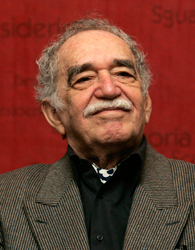
Gabriel Garcia Marquez

Gabriel Garcia Marquez

Many years later, as he faced the firing squad, Colonel Aureliano Buendía was to remember that distant afternoon when his father took him to discover ice. At that time, Macondo was a village of twenty adobe houses, built on the bank of a river of clear water that ran along a bed of polished stones, which were white and enormous, like prehistoric eggs. The world was so recent that many things lacked names, and in order to indicate them it was necessary to point. Every year during the month of march, a family of ragged gypsies would set up their tents near the village, and with a great uproar of pipes and kettledrums they would display new inventions. First they brought the magnet. A heavy gypsy with an untamed beard and sparrow hands, who introduced himself as Melquíades, put on a bold public demonstration of what he himself called the eighth wonder of the learned alchemists of Macedonia. He went from house to house dragging two metal ingots and everybody was amazed to see pots, pans, tongs, and braziers tumble down from their places and beams creak from the desperation of nails and screws trying to emerge, and even objects that had been lost for a long time appeared from where they had been searched for most and went dragging along in turbulent confusion behind Melquíades’ magic irons. “Things have a life of their own,” the gypsy proclaimed with a harsh accent. “It’s simply a matter of waking up their souls.”—Gabriel García Marquez, the opening lines of One Hundred Years of Solitude

Gabo

Gabriel Garcia Marquez with Shiner

Gabriel García Márquez with Shiner

Here’s a question for you: Which two winners of the Nobel Prize for Literature had a fist fight with each other? The above picture is a clue to the identity of one of them: The other is Mario Vargas Llosa of Peru, who felt that “Gabo” had been paying undue attentions to his wife. You can find all the gory details at this New York Times website from 2007.

I first discovered García Márquez’s One Hundred Years of Solitude in November 1975 while I was in Yucatán. There I was at the ruins of Chichén Itzá at an open air souvenir stand with a thatched roof looking for a book to read. On the rack was a UK Penguin paperback edition of the book not for sale in the United States. I picked it up, started reading it, and found myself entranced. First at Chichén, then at the majestic old Gran Hotel in Mérida, and then at Uxmal, I pored through the pages and fell in love with Macondo (the fictionalized birthplace of the author in Aracataca, Colombia) and its weird history.

Ironically, it was in Mexico City that García Márquez died today of infection and dehydration. I will miss him the way I miss Jorge Luis Borges of Argentina and a handful of other greats who died in my time, such as John Ford, Orson Welles, and Howard Hawks.

Since that 1975 trip that changed my life in so many ways, I have read more than a dozen of Gabo’s books and expect to finish the rest within the next year or so.

If you’d like to read a Paris Review interview with the author, click here.

Gabriel Garcia Marquez Says Farewell

Gabriel Garcia Marquez

Gabriel Garcia Marquez

If for a moment God were to forget that I am a rag doll and granted me a piece of life, I probably wouldn’t say everything that I think; rather, I would think about everything that I say.

I would value things, not for their worth but for what they mean. I would sleep less, dream more, understanding that for each minute we close our eyes, we lose sixty seconds of light.

I would walk when others hold back, I would wake when others sleep, I would listen when others talk.

And how I would enjoy a good chocolate ice cream!

If God were to give me a piece of life, I would dress simply, throw myself face first into the sun, baring not only my body but also my soul.

My God, if I had a heart, I would write my hate on ice, and wait for the sun to show. Over the stars I would paint with a Van Gogh dream a Benedetti poem, and a Serrat song would be the serenade I’d offer to the moon.

I would water roses with my tears, to feel the pain of their thorns and the red kiss of their petals… My God, if I had a piece of life… I wouldn’t let a single day pass without telling the people I love that I love them.

I would convince each woman and each man that they are my favorites, and I would live in love with love.

I would show men how very wrong they are to think that they cease to be in love when they grow old, not knowing that they grow old when they cease to be in love!

To a child I shall give wings, but I shall let him learn to fly on his own. I would teach the old that death does not come with old age, but with forgetting.

So much have I learned from you, oh men … I have learned that everyone wants to live at the top of the mountain, without knowing that real happiness is in how it is scaled.

I have learned that when a newborn child first squeezes his father’s finger in his tiny fist, he has him trapped forever.

I have learned that a man has the right to look down on another only when he has to help the other get to his feet.

From you I have learned so many things, but in truth they won’t be of much use, for when I keep them within this suitcase, unhappily shall I be dying.—Gabriel Garcia Márquez, Farewell Letter After Learning of His Lymphatic Cancer