
What Does “Heritage” Mean?
It’s words like “liberty” and “patriotism” that get my hackles up because they mean little but try to enforce agreement with some person or organization’s political stance. “Heritage” is one of them. Originally,it meant birthright, or something inherited such as values. It is used particularly by conservatives who want to convince people that the old values are best and worth preserving. You will find it most heavily used in the South, particularly in connection with the antebellum South in the good old days of slavery. That Confederate battle flag that was recently brought down in South Carolina stands for a whole congeries of values that many people outside the South would find repellent, such as nigras staying in their “rightful place” and local governments taking precedence over the Federal Government.
Today, you will find Southern apologists saying that the Civil War was fought over “States’ Rights,” not over slavery. All that “States’ Rights” really means is that those powers not specifically reserved by the Federal Government in the U.S. Constitution may be exercised by the individual states. The wording from the 10th Amendment of the Bill of Rights reads as follows: “The powers not delegated to the United States by the Constitution, nor prohibited by it to the States, are reserved to the States respectively, or to the people.” In actual practice, the term has been used as a code word advocating racial segregation.
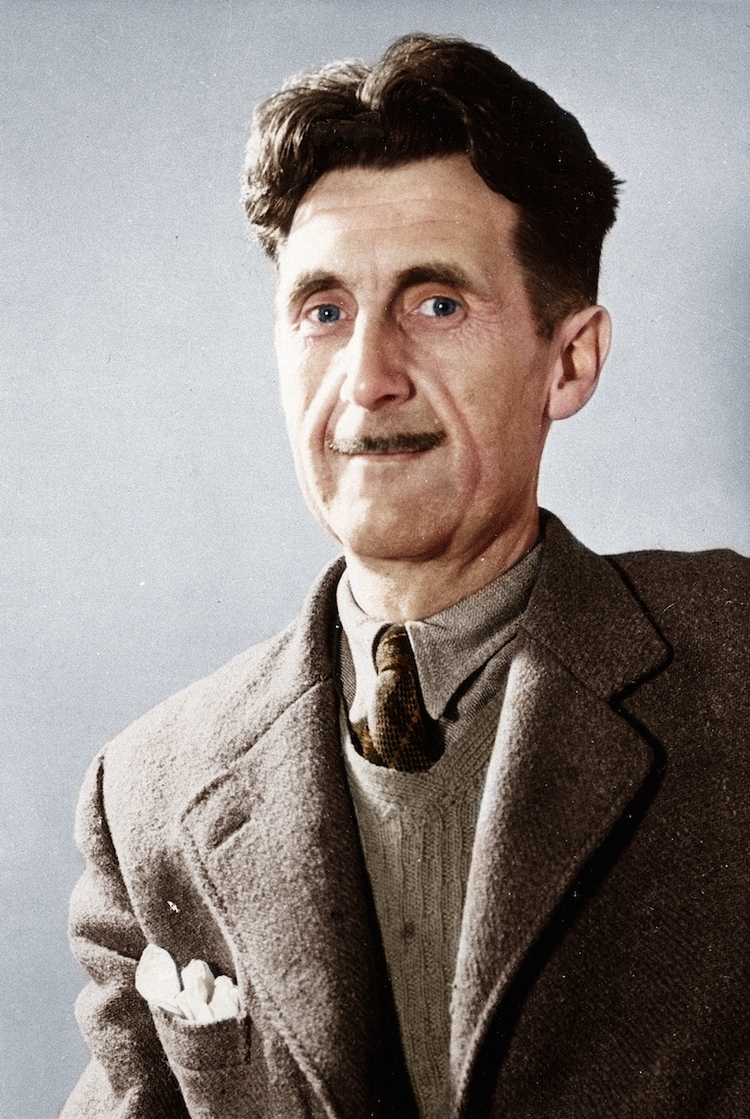
George Orwell
Perhaps the best statement of how language is used to confuse political issues is a 1946 essay by George Orwell entitled “Politics and the English Language.” It is so applicable even today that I urge you to take a few minutes to read it on this website. Under the heading of Meaningless Words, Orwell wrote:
In certain kinds of writing, particularly in art criticism and literary criticism, it is normal to come across long passages which are almost completely lacking in meaning. Words like romantic, plastic, values, human, dead, sentimental, natural, vitality, as used in art criticism, are strictly meaningless, in the sense that they not only do not point to any discoverable object, but are hardly ever expected to do so by the reader. When one critic writes, ‘The outstanding feature of Mr. X’s work is its living quality’, while another writes, ‘The immediately striking thing about Mr. X’s work is its peculiar deadness’, the reader accepts this as a simple difference opinion. If words like black and white were involved, instead of the jargon words dead and living, he would see at once that language was being used in an improper way. Many political words are similarly abused. The word Fascism has now no meaning except in so far as it signifies ‘something not desirable’. The words democracy, socialism, freedom, patriotic, realistic, justice have each of them several different meanings which cannot be reconciled with one another. In the case of a word like democracy, not only is there no agreed definition, but the attempt to make one is resisted from all sides. It is almost universally felt that when we call a country democratic we are praising it: consequently the defenders of every kind of regime claim that it is a democracy, and fear that they might have to stop using that word if it were tied down to any one meaning. Words of this kind are often used in a consciously dishonest way. That is, the person who uses them has his own private definition, but allows his hearer to think he means something quite different. Statements like Marshal Petain was a true patriot, The Soviet press is the freest in the world, The Catholic Church is opposed to persecution, are almost always made with intent to deceive. Other words used in variable meanings, in most cases more or less dishonestly, are: class, totalitarian, science, progressive, reactionary, bourgeois, equality.
Particularly in the political sphere, one must be vigilant about the definitions of words, especially when they border on the meaningless. So celebrate your “heritage” if you must—whatever it is—but don’t try to bludgeon us over the head with it.

 Tarnmoor
You must be logged in to post a comment.