
The Story of Joseph

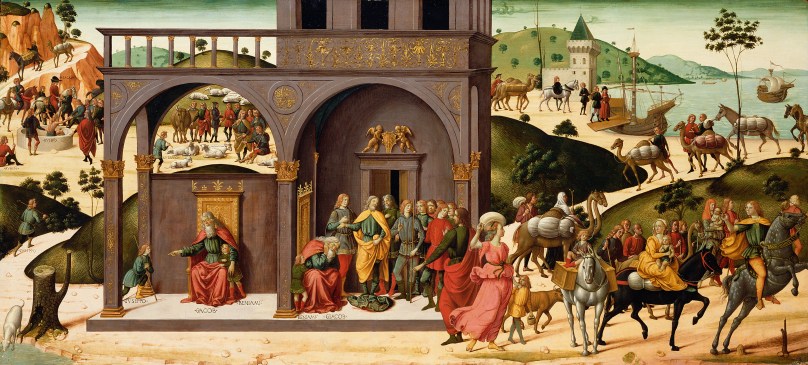
Biagio d’Antonio’s “The Story of Joseph” (ca 1485)

I loved this early Renaissance painting which shows, in the same frame, several incidents in the life of Joseph from the Book of Genesis. What caught my eye was the crowded landscape filled with Old Testament figures. According to the Getty Center website:

In the left-hand loggia, Jacob, seated on a throne, sends Joseph to his half-brothers tending sheep in the field. In the far left corner, the brothers, jealous of their father’s love for Joseph, strip him of his jacket and throw him into a pit. Passing merchants purchase the young boy from his brothers for twenty pieces of silver. In the background to the right, the merchants board the ship that will take them and their cargo to Egypt. In the right-hand loggia, the brothers show a blood-smeared coat to their father as evidence that Joseph is dead. With his head in his hand, Jacob mourns his son, whom he believes to be dead.

A companion panel in the Metropolitan Museum of Art depicts the next sequence of events in Joseph’s life. Originally framed next to one another, these two panels would have been inserted into the paneling of a room in a Tuscan family’s home.

There is always something picturesque and fanciful about the outdoor backgrounds in many Renaissance paintings, most particularly those by Giovanni Bellini (1430-1516). I particularly remember liking one of his paintings I saw in the Frick Collection in New York many years ago. It was called, I believe, “St. Francis in the Desert.”
Beyond the Master Forger’s Ability

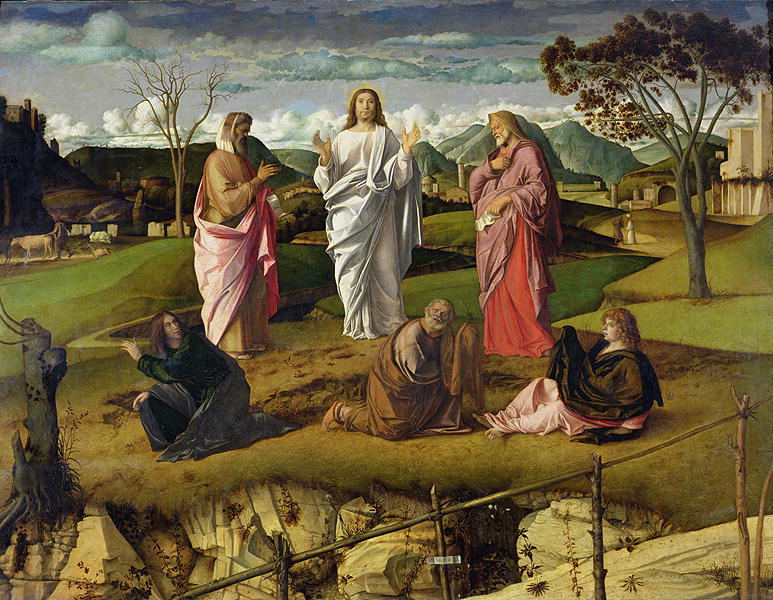
Giovanni Bellini’s “The Transfiguration” (1480)

This is a repost from ten years ago today: August 4, 2014.

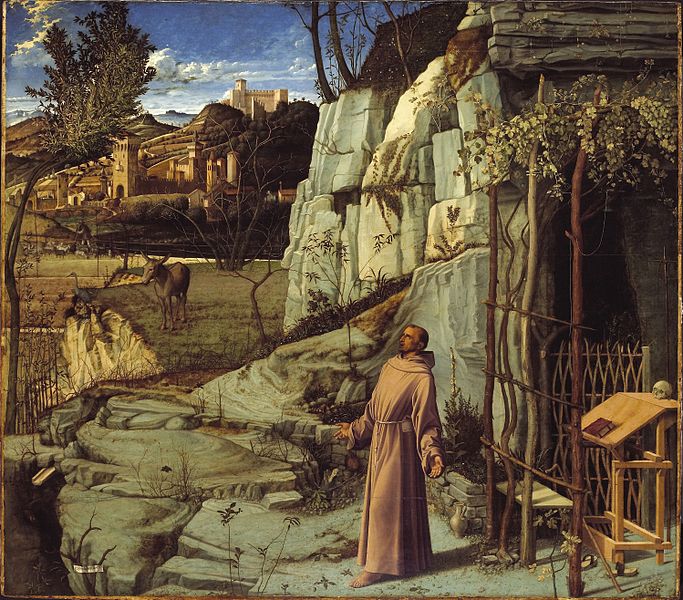
Yesterday, I was drawn to the television by a segment on “Sixty Minutes” about the noted German art forger, Wolfgang Beltracchi. When Bob Simon of CBS asked him what painters he couldn’t forge, Beltracchi, without hesitation, answered Bellini. I took him to mean Giovanni Bellini (1430-1516) and not his brother Gentile (they were both brothers-in-law of the great Andrea Mantegna). The only time I remember ever seeing or original Giovanni Bellini was at the Frick Collection in New York City, which has a superb “St. Francis in Ecstasy” also painted in 1480. I have included an image below.

There is such an incredible sense of detail in a Bellini oil that I feel as if I could pick a background segment (say 1/64th of the total) and enlarge it to full size without losing anything. And the detail would be almost as fascinating as the foreground. Look at that fence following the upward path in “The Transfiguration” (above), and note the minor variations from post to post. Look at that dead tree at the lower left, or that couple meeting in the upper right near the tree.

I can almost imagine Bellini in an ecstasy such as St. Francis in the painting below.

St. Francis in Ecstasy (1480) at the Frick Collection

Beyond the Master Forger’s Ability

Giovanni Bellini’s “The Transfiguration” (1480)

Giovanni Bellini’s “The Transfiguration” (1480)

Yesterday, I was drawn to the television by a segment on “Sixty Minutes” about the noted German art forger, Wolfgang Beltracchi. When Bob Simon of CBS asked him what painters he couldn’t forge, Beltracchi, without hesitation, answered Bellini. I took him to mean Giovanni Bellini (1430-1516) and not his brother Gentile (they were both brothers-in-law of the great Andrea Mantegna). The only time I remember ever seeing or original Giovanni Bellini was at the Frick Collection in New York City, which has a superb “St. Francis in Ecstasy” also painted in 1480. I have included an image below.

There is such an incredible sense of detail in a Bellini oil that I feel as if I could pick a background segment (say 1/64th of the total) and enlarge it to full size without losing anything. And the detail would be almost as fascinating as the foreground. Look at that fence following the upward path in “The Transfiguration” (above), and note the minor variations from post to post.Look at that dead tree at the lower left, or that couple meeting in the upper right near the tree.

I can almost imagine Bellini in an ecstasy such as St. Francis in the painting below.


St. Francis in Ecstasy (1480) at the Frick Collection

St. Francis in Ecstasy (1480) at the Frick Collection

Some people I know are put off by the Christian religious themes of Renaissance painting. The great ones would be great even if they were depicting a shoelace or a dirty dish. It’s almost as if the subject were irrelevant.