The Little Ice Age in Holland

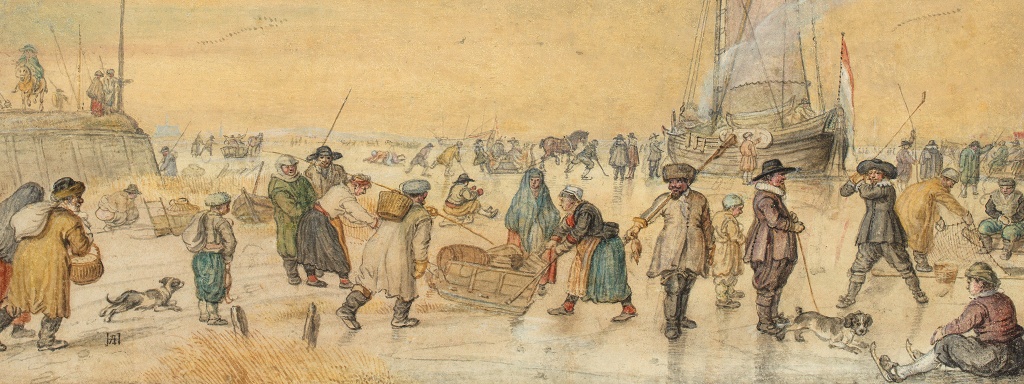
Skating on the Ice in Holland

One of the exhibits I saw at the Getty Center last week was a collection of drawings depicting cold weather in Holland during the 17th century. According to the Getty website:

In the 17th century, frigid winters and unusually cool summers blanketed northern Europe in what became known as the Little Ice Age. Dutch artists depicted this persistent global cooling in scenes of daily activities like ice skating and fishing. Highlighting human vulnerability and resilience in the face of a changing climate, these works offer opportunities to reflect on our current environmental crises. This exhibition features works by Hendrick Avercamp and other Dutch artists of the 1600s.

It was during this Little Ice Age that the Greenland colony of Scandinavian and Icelandic colonists was abandoned at some point between 1350 and 1400.

Dutchmen Playing Ice Hockey

I have always been fond of Dutch art, and that was only reinforced when Martine and I visited Amsterdam more than twenty years ago. Uniquely, it seems, Dutch painting elevated the humdrum to the level of high art in the works of Vermeer, Rembrandt, Hals, Bosch, and Bruegel.

As I looked at all the drawings of the Dutch enjoying themselves in what looked like wickedly cold weather, I wondered if the global warming that the news media talks about is a permanent feature, or just another of earth’s mysterious centuries-long cycles that we don’t understand. Not that we shouldn’t do everything in our power from making it worse than it is, but it does make one think.
Heat » Evaporation » Clouds » Rain » Flooding

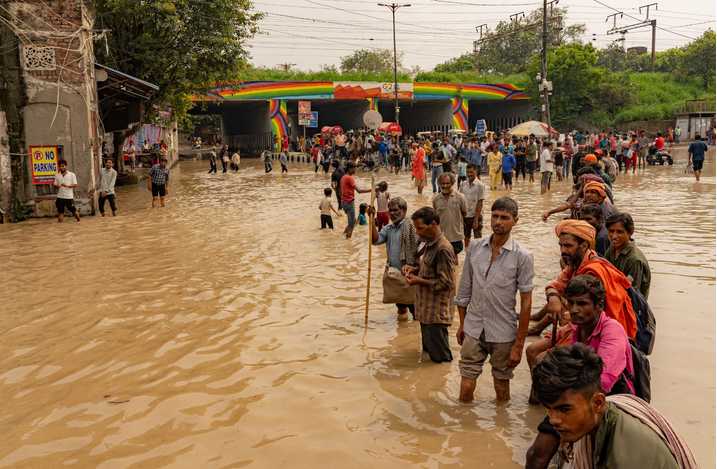
Scene of Flooding in Delhi, India

This isn’t altogether scientific, but I think I might possibly see how global warming translates into disastrous weather such as tornadoes, hurricanes, typhoons, and other types of storms associated with heavy rains and flooding.

It all begins with hot weather. According to National Geographic Magazine, the hotter it gets, the more evaporation takes place;

The National Weather Service in the United States measures the rate of evaporation at different locations every year. Scientists there found that the rate of evaporation can be below 76 centimeters (30 inches) per year at the low end, to 305 centimeters (120 inches) per year on the high end.

The variability is based on temperature. The evaporated vapors form clouds until the air in a place just can’t take any more. The article continues:

Once water evaporates, it also helps form clouds. The clouds then release the moisture as rain or snow. The liquid water falls to Earth, waiting to be evaporated. The cycle starts all over again.

Many factors affect how evaporation happens. If the air is already clogged, or saturated, with other substances, there wont be enough room in the air for liquid to evaporate quickly. When the humidity is 100 percent, the air is saturated with water. No more water can evaporate.

Then—you guessed it!—it comes down as rain. Sometimes, lots of rain. Such as Los Angeles received when a hurricane hit Southern California a couple weeks ago with record rainfall. Those record rainfalls have been happening all over the globe: Burning Man at Black Rock City in Nevada; Derma in Libya, at the edge of the Sahara Desert; and Delhi, India.

So I think that the whole cycle of drought and flood will become ever more extreme, sometimes in the most unlikely places.

Earth’s Answer

Hurricane Seen from Above

If global warming was some sort of challenge to us, then I would say we lost. There are still multitudes that will think nothing of denying it until their own asses catch fire. Re-reading J. R. R. Tolkien’s The Lord of the Rings, I am conscious of a kind of Celtic sadness as the Barbarians stagger up to the gates and unthinkingly push back against anything that will help our world as we knew it survive into the future.

There are just too many Barbarians, and they delight in making grimaces at us Libtards. We are to be pwned at all events. It as as Sly says in Shakespeare’s The Taming of the Shrew: “Therefore, paucas pallabris, let the world slide. Sessa!”

Well we some some indications of what the world’s “slide” will entail. There are hurricanes, tornadoes, overheated oceans that cook the fish, floods, droughts, record heat. And that°s just the start.

Face it, we humans are toxic to the earth. So we can expect that the earth will just up the ante and make it impossible for us to live as we have done into the future. I can think of no better symbol for our future than the floods at Burning Man near Nevada’s Black Rock City:

Perhaps to come are cacti growing in the Amazon Basin, Hurricanes in Southern California (hey, we had one last week!), trees growing the northern Alaskan bush, accelerated extinction of plant and animal species, ever fiercer and more widespread wild fires, food shortages, water shortages, the disappearance of green lawns—and that’s just the beginning.

So continue to say there is no such thing as global warming, and get ready to run for your life.

A Beneficiary of Global Warming

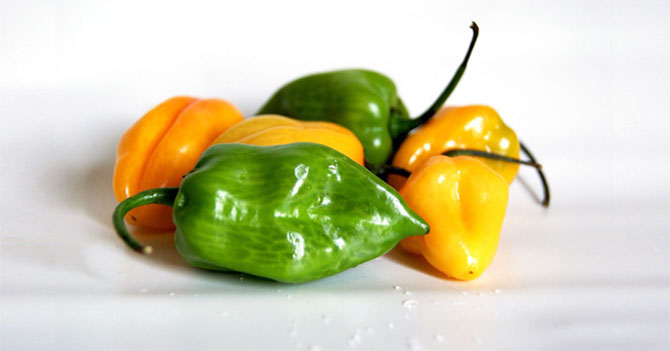
Habanero Chile Peppers

If you are looking for a hot time tonight, you could do worse than biting into a habanero chile, also known as a Scotch Bonnet or a Jamaican Chile. Although you can theoretically get hotter chiles from specialty food retailers and farm scattered farms, the hottest chiles I can normally find in Southern California are the habaneros. (For more information of the Scoville Heat Unit rating of the hotness of various chiles, click here.)

As I plan for my Yucatán/Belize vacation, I have taken to reading the website of The Yucatán Times. One interesting story I found related to a university study of which crops would benefit most from global warming and increased carbon dioxide in the atmosphere. You’ll never guess which crop would benefit the most. Of course, it’s the habanero chile, which is so fierce that I would not use more than one-half of a small pepper to heat over a gallon and a half of soup.

Following is an excerpt from the article:

However, people who work with habanero pepper expect higher production, due to the conditions that will prevail in the State, as was observed with the study that was carried out by specialists of Technological Agricultural Institute (ITA) and the Scientific Research Center of Yucatán (CICY).

“The Capsicum chinense harvest will improve as the conditions of temperature and concentrations of carbon dioxide (CO2) increase,” Garruña Hernández said.

He explained that the favorable result was obtained in different theoretical models of climate change simulated under controlled conditions in growth chambers located inside the CICY greenhouse.

That is to say, “in the laboratory it was possible to regulate both the temperature and the concentration of CO2 in the air, and the results with this emblematic product of the Yucatan Peninsula were remarkable,” he said.

Garruña Hernández indicated that habanero crops were grown in different environments, with temperatures of 30, 35 and 40 degrees [Celsius], similar to those registered as a result of climate change. At the same time, different concentrations of CO2 were maintained, CO2 levels are increasing, also as a result of climate modifications.

Are you thinking of biting into a habanero chile any time soon? See this video for the grisly result.

https://youtu.be/L8ip5oGlMfU

Note that the Mayan name of the chile means “the crying tongue.” Unless you are a real chilehead, be warned.