Samhainophilia

The Winner: Most Popular and Guilt-Free Holiday

There is a such a word as samhainophobia, which means hatred of Halloween. By applying the principal of parallelism, there must be such a word as samhainophilia, meaning love of Halloween. According to Wikipedia:

Samhain is a Gaelic festival on 1 November marking the end of the harvest season and beginning of winter or the “darker half” of the year. It is also the Irish and Scottish Gaelic name for November. Celebrations begin on the evening of 31 October, since the Celtic day began and ended at sunset. This is about halfway between the autumnal equinox and winter solstice. It is one of the four Gaelic seasonal festivals along with Imbolc, Bealtaine, and Lughnasa.

We don’t celebrate Imbolc, Bealtaine, or Lughnasa very much any more; but Samhain, or Halloween, is continue to grow more and more popular. Think about it: There isn’t any guilt associated with buying a few bucks worth of candy and giving it to kids. On the other hand, you have to cook up a huge complicated feast for Thanksgiving and pretend to be nice to all your most objectionable relatives.

And don’t even get me started about Christrmas! You have to kill a tree, decorate it with expensive ornaments, buy expensive gifts for everybody, and do all the same stuff required for Thanksgiving, except maybe you don’t have to serve turkey at your holiday feast.

Then there are all those other holidays: You have to set off an explosive on Independence Day, blowing off a finger or limb. You have to get drunk and endanger your marriage at a New Years office party. And so on and so on.

Heck, I’ll take the candy any day.

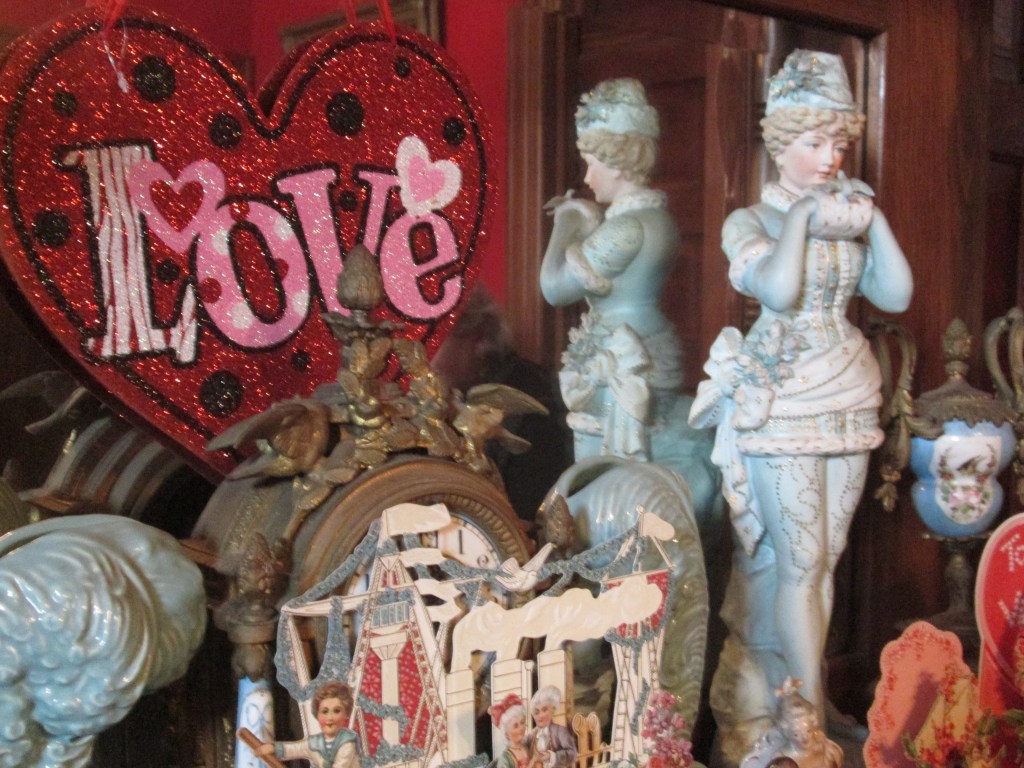
The above photo was taken at Los Angeles’s Grier Musser Museum of Victoriana. Martine and I spent a pleasant afternoon visiting the museum owners, Susan and Rey Tejada, who live on the premises. They have an impressive collection of holiday-related books, animated displays, and figurines. I spent over an hour looking at 3-D First World War images on a stereopticon. They also have a great collection of pop-up books of every description.
Christmas Cheer

Christmas Display at the Grier Musser Museum

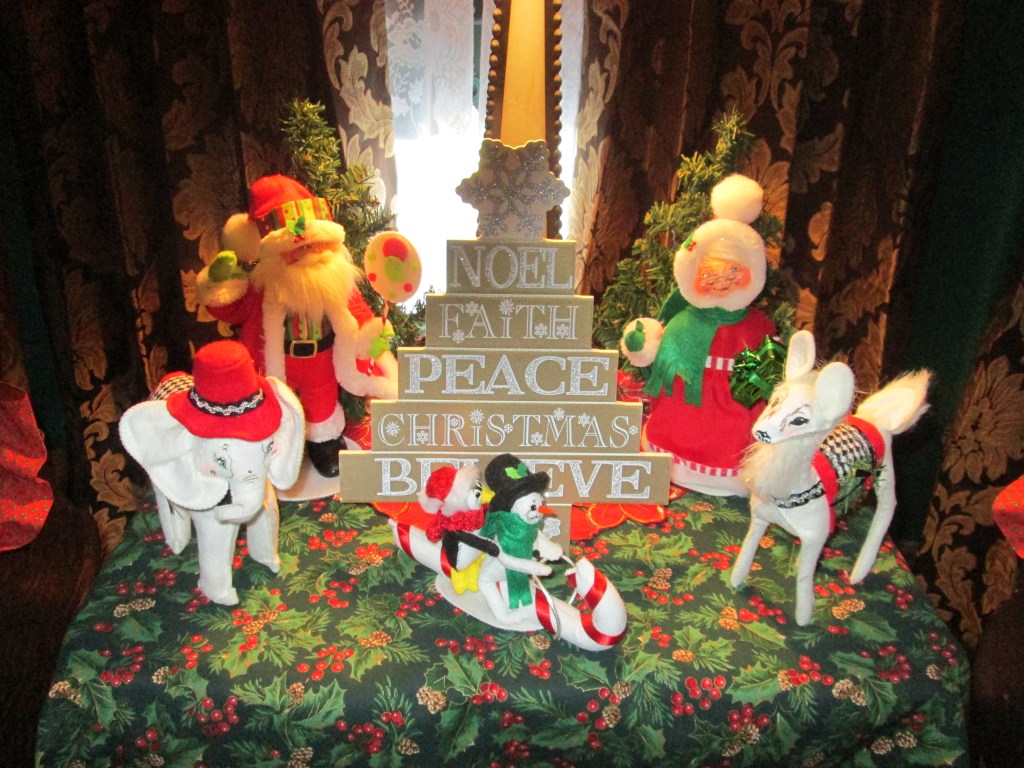
This afternoon, Martine and I visited our friends Rey and Susan Tejada at the Grier Musser Museum near downtown L.A. The Victorian house is being dwarfed by a four-story apartment building under construction just north of them, but the Spirit of Christmas is very much evident in the holiday-related antiques on display.

I forgot to bring my camera along, so the picture above is from our 2019 visit at Christmas time.

As Christmas Day gets closer, I have pretty much surrendered to the good feelings that supposedly prevail at this time. Martine is listening to the Classic Christmas Music channel on Music Choice, and I no longer grit my teeth—unless they decide to play “The Little Drummer Boy,” in which case I feel it incumbent on me to leave the room. Pah-RUP-pup-PUM.

I just want to make Martine happy this time of year. On Monday, I will cook up one of her favorite dishes, a beef stew from a recipe in the New York Times. And we already have a couple of bottles of her favorite wine, Egri Bikavér (Bull’s Blood of Eger) from Hungary.

If Martine is happy, I will be happy.

Halloween vs Christmas

Display at the Grier Musser Museum

At first, Martine and I liked visiting the Grier Musser Museum because of the of the interesting holiday related displays. We still like the displays, but in the meantime, we have become friends with the owners, Rey and Susan Tejada. Re-visiting the museum and chatting with the Tejadas has become part of the fun surrounding holidays.

Speaking of holidays, it is becoming ever clearer to me that celebrating Halloween is becoming more of a thing, and that celebrating Christmas is becoming less of a thing. Perhaps because it is so associated with guilt trips: so many things that have to be done, some many unrealized goals that remain unrealized, so much expenditure of cash and effort.

Halloween, on the other hand, is cheaper and more fun. And it is not tinged with guilt. It involves pretending that you’re a ghastly monster (no difficulty for most people), attending fun events, and eating a ton of candy.

So even if we don’t get any trick-or-treaters this year (they don’t like climbing stairs), Martine and I feel good about Halloween. Martine got her annual pumpkin pie from Marie Callender’s, we stockpiled candy in case some trick-or-treaters do ascend the stairs, and I’ve read some good scary books this month.

Of course, coming up is my least favorite holiday. I really dislike Thanksgiving. And I’m not overly fond of the traditional food items associated with it.

Valentine’s Day in the Rear View Mirror

Valentine Exhibits at the Grier-Musser Museum

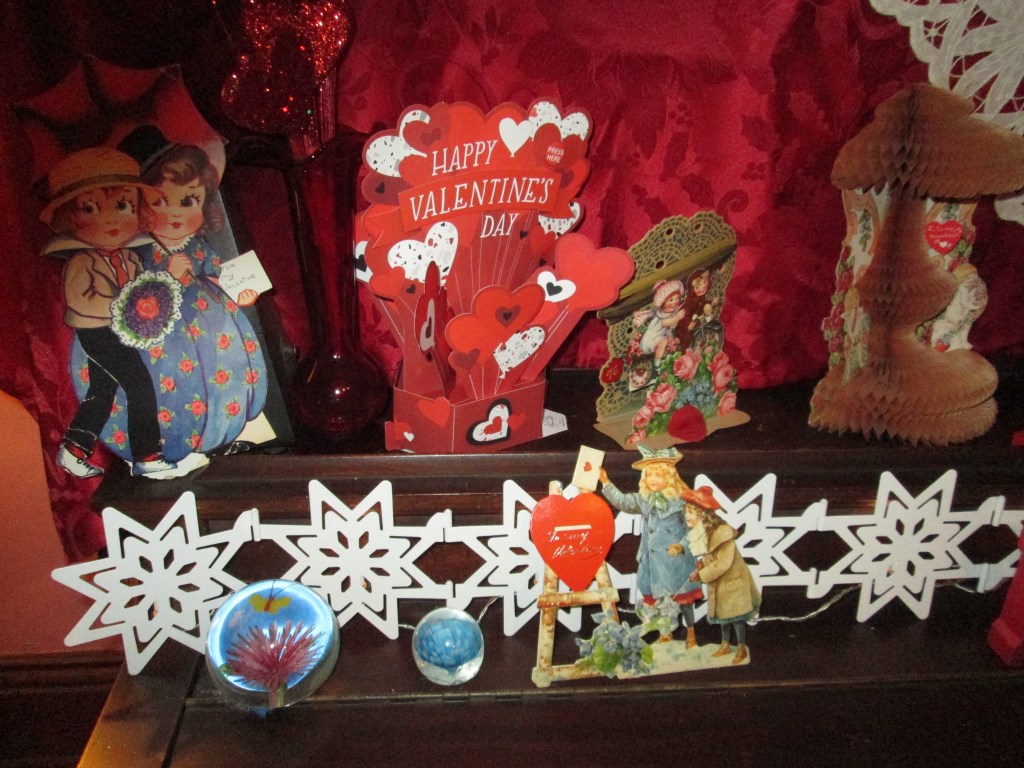
I know that Valentine’s Day was three days ago, but Martine and I decided to commemorate it anew with a visit to Susan and Rey Tejada’s Grier-Musser Museum. There we saw the elegant collection of figurines, greeting cards, and other antiques honoring the holiday.

There is an elegance, even a sense of formality, to the way our forefathers saw the rites of love-making in the 19th cntury. One could see a change in the way the subject was treated after the First World War. The flappers of the 1920s appeared to be more in charge, an impression that was underlined by the newfound power of Hollywood.

The Grier-Musser Museum brings us almost up to the present day. Sue and Rey are big-time movie junkies and spend a lot of time with their fingers on the pulse of popular culture. Their holiday exhibits, particularly around Halloween and Christmas, are a great way to see how the culture has changed and continues changing.

A Grier-Musser Valentine

Valentine’s Day Memorabilia at the Grier-Musser Museum

On Sunday, Martine and I stopped in at the Grier-Musser Museum in the shadow of Downtown L.A. to see their Valentine’s Day memorabilia. Of late, Susan and Rey Tejada have been concentrating on paper in the form of old-fashioned images on postcards, greeting cards, and books—especially with pop-up illustrations.

There’s something about seeing this type of material in the Victorian mansion on Bonnie Brae Street that sends you back in time. Afterwards, we sat down with Rey and Susan over cookies and punch and talked for a couple of hours.

Although I got Martine a card for Valentine’s Day, we both decided to go out for lunch on the day after, when we were less likely to run into crowds. So tomorrow we will have a nice English lunch at Ye Olde King’s Head in Santa Monica. It is a great place to have fish and chips or bangers and mash or Cornish pasties. Fortunately, one is not likely to encounter such downmarket English cuisine items as spaghetti sandwiches or baked beans on toast.

Martine and I hope you enjoyed this little gem of a holiday. Why do I call it that? I would rather honor the love I feel than some bogus political or historical event, such as Columbus “discovering” America. After all, wasn’t he met at the beach by the local residents?

The Better Angels of My Nature

Christmas Angels at the Grier-Musser Museum

Although I am of two minds about the Christmas holidays, the better angels of my nature have urged me to wish for all of you a time of caring and warmth. Even if you don’t have a tree decorated with ornaments and tinsel, even if you don’t send out a hundred Christmas cards, even if you don’t spend hundreds of dollars on carefully wrapped presents—may the real meaning of the holiday catch up with you and leave you with a good feeling all throughout this year and the year to come.

Merry Christmas!

Pumpkins and Skeletons

This last Saturday, Martine and I visited the Grier Musser Museum, which had just re-opened to the public after the Covid-19 lockdown. I have always particularly loved their Halloween antiques, art, and other displays, such as the above throw pillow. Martine wore her witch costume (see yesterday’s post: Decidedly a Good Witch). We both resolved to re-visit them just before Christmas, when their displays will be less horrific.

Tonight, I watched four horror films in a row, three of which were the original Universal Frankenstein releases:

  • Frankenstein (1931)
  • Bride of Frankenstein (1935)
  • The Son of Frankenstein (1939)
  • The Plague of Zombies (1966)—a Hammer horror film

I waited by the door just in case some trick-or-treaters would come. As usual none came. I don’t think any have climbed the stairs for upwards of thirty years. I thought this year would be different because my downstairs neighbors are Ukrainian refugees with two young daughters.

Now that Halloween is almost past, I realize we are in the HallowThanksMas Continuum, where three Holidays seem to come one after the other like falling dominoes.

This October, I read four horror-related books in celebration of Halloween:

  • Tales of Terror from Blackwood’s Magazine (1817-1834)
  • Ann Radcliffe’s The Romance of the Forest (1791), the first half of which is set in a spooky abandoned monastery
  • Edith Wharton’s Ghosts (1937), selected by the author
  • Peter Ackroyd’s The Casebook of Victor Frankenstein (2008), a re-telling of the original Mary Shelley story

Of Two Minds About Christmas

Christmas Display at L.A.’s Grier-Musser Museum

It is very easy to regard Christmas as both a time of happiness and a major pain in the ass—all at one and the same time. Below are some excerpts from the letters of Victorian novelist Wilkie Collins (1824-1889):

  • “This awful Christmas time! I am using up my cheque-book – and am in daily expectation of fresh demands on it.” to Charles Ward, December 1860-62 (I 286).
  • “at this festive season when the Plague of Plum pudding extends its ravages from end to end of the land, and lays the national digestion prostrate at the feet of Christmas…I had planned to give up eating and drinking until the return of Spring …”  to Miss Frith, 27 December 1870 (II 226).
  • “…are the filthy ‘Christmas festivities’ still an insurmountable obstacle to any proceeding that is not directly connected with the filling of fat bellies, and the exchange of vapid good wishes?” to William Tindell, 29 December 1874 (III 60; B&C II 387).
  • “…there are all sorts of impediments – literary and personal – which keep me in England at the most hateful of all English seasons (to me), the season of Cant and Christmas…But for Christmas-time, I should have read it long ago. I have returned to heaps of unanswered letters, bills, payments to pensioners, stupid and hideous Christmas cards, visits to pay – and every other social nuisance that gets in the way of a rational enjoyment of life…There is no news. Everybody is eating and drinking and exchanging conventional compliments of the season. You are well out of it” to Nina Lehmann, 28 December 1877 (III 180; B&C II 409-410).
  • “I suppose the dreadful Christmas literature is absorbing Mr Kelly’s printers.” to A P Watt 5 November 1883 (III 434).
  • “There is every temptation to die. We have not seen the sun for three weeks, in London – the plague of Christmas Cards is on the increase…Oh, what a miserable world to live in!” to Sebastian Schlesinger, 29 December 1883 (III 452; B&C II 463-465).
  • “Your kind and liberal letter reaches me , at the season devoted to prodigious eating and drinking, universal congratulating and holiday-making, and voluminous appearance of tradesmen’s Christmas bills. ‘Business’ is at a standstill, this year, until Monday next” to Perry Mason & Co, 26 December 1884 (IV 74). 
  • “But there is surely a chance of a change for the better, after the horrors of Christmas are over” To Emily Wynne, 19th December 1885 (IV 139).
  • “The horrid Christmas Day is over -. Let me forget it – and heartily wish you a happy New Year.” to A P Watt, 28 December 1885 (IV 140).
  • “It is a relief to hear that you have got over Christmas Day, and that you have energy enough to confront (I don’t say to eat) that dreadful composition called plum pudding.” to Emily Wynne, 28 December 1885 (IV 141).
  • “I have just discovered a letter of mine dated the 1st of this month – and thanking you for your kind new year’s gifts – huddled away, God knows how, among a mass of Christmas and New years’ cards in my ‘Answered Letters’ basket.” to A P Watt, 5 January 1887 (IV 222).

Despite these feelings Wilkie did keep Christmas. On 18 December 1854 he invited his friend Edward Pigott to his home in Hanover Terrace.

“Don’t talk about having no home to go to – you know you are at home here. Come and eat your Christmas dinner with us – you will find your knife, fork, plate and chair all ready for you. Time six o’clock…Mind you come on Christmas Day.” (I 110; B&C I 129).

I owe the above selections to the Wilkie at Christmas website, which also contains much useful information about this author, whose work I like more the more I read him.

Looking Back at Christmas

The Grier Musser Museum in Los Angeles

The Pico-Union District of Los Angeles is a tough neighborhood with heavy concentrations of Central American immigrants. Yet there on Bonnie Brae Street lies the Grier Musser Museum with its huge collection of antiques and seasonally related memorabilia. During the key holidays of Halloween and Christmas, there are fascinating exhibits of decorations, music boxes, pop-up books, greeting cards, postcards, and other popular culture highlighting the present and past.

Although Martine and I have visited only during those periods, there are also special exhibits for Valentines Day, Chinese New Years, and Independence Day.

Susan Tejada with Christmas Elf

On Saturday, we spent several hours viewing the Christmas exhibits and chatting with Susan and Rey Tejada, the owners (and inhabitants) of the museum. Christmas is now safely in the past, but it was nice to see the constantly growing exhibits that Susan has collected. They represent what we all want the holidays to be like, far from the mayhem in the parking lots and department stores in mega-malls which it has become. Visiting the Grier Musser Museum gives you a picture of what we all want Christmas to be like. It’s actually a nice feeling.