
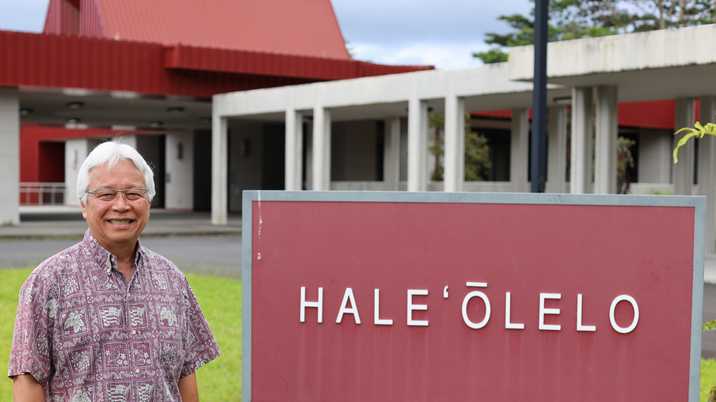
Not Quite a Dead Language

Wherever You Go in Hawaii, You Are Reminded of the Native Language

The State of Hawaii has two official languages: English and Hawaiian (ʻŌlelo Hawaiʻi). There is also a third unofficial language, namely Pidgin English, but that is a subject for another day.

Although the ratio of purebred Hawaiians to persons of White or Asian ancestry has been in decline ever since the 19th century, the language has been adopted by many residents of the islands, irrespective of their ancestry, as a means of differentiating them from the invading mainlanders.

In our hotel room was a large sign that read E komo mai. Fortunately, it means “Welcome,” and not “Yankee Go Home!” It is astonishing how many place names are in Hawaiian, wholly or in part. (“Hawaii Kai ” includes the first syllable of the last name of mogul Henry J. Kaiser.) It can be confusing, since so many of them begin with the latter K, such as Kalihi, Kalmuki, Kaka’ako, and Kahala.

There are a number of words from the Hawaiian language that are now part of everyday English:

  • Aloha: Means Hello (and Good-Bye)
  • Haole: Foreigner or outsider
  • Hula
  • Kahuna: priest, wizard, or sachem—found in many beach movies of the 1960s
  • Lanai: A veranda or patio
  • Ukulele
  • Taboo, comes from the Hawaiian kapu. Hawaiian does not have the letters t or b
  • Wahine: girl

Two words visitors will frequently encounter, particularly on menus and signs, are keiki (children) and kama’aina (persons born or raised in Hawaii, sometimes expanded to persons residing in Hawaii).

It takes a while to get used to, but but I regard it as part of the adventure of visiting such a culturally diverse state as Hawaii.
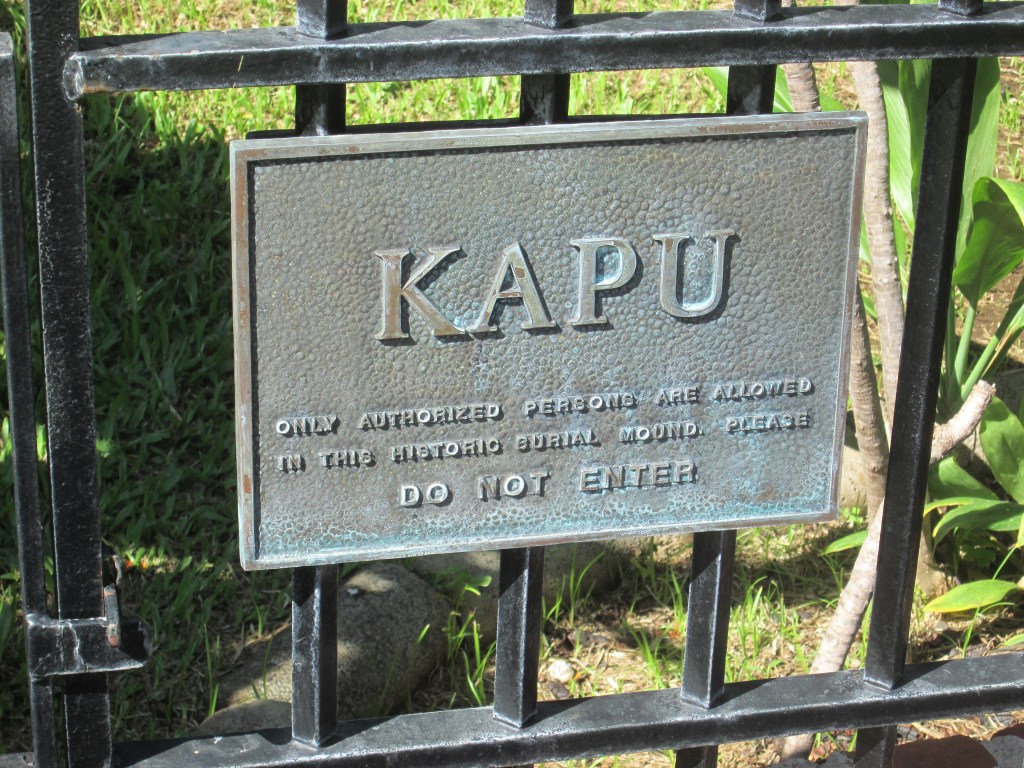
Forbidden

Sign on the Grounds of Iolani Palace

In the southeast corner of the grounds at Iolani Palace is a low mound that bears the Hawaiian language warning “Kapu.” Because the Hawaiian language doesn’t have the sounds of the consonants “t” and “b,” it would not make any sense if the sign red “Tabu.” Yet that is what it means.

Similarly, foods made from the pounded taro root are everywhere. Yet in Hawaiian, the word is written “kalo.” (There is no “r” in the language.)

The forbidden mound contains the remains of many old Hawaiian chieftains, or ali’i. Before the Iolani Palace was built in the late 19th century, there was an earlier, less European-looking palace that housed the great of O’ahu and the outlying islands. The earlier kings of the Kamehameha dynasty were buried there before a mausoleum was built to house their remains a mile or so to the west.

After the bones of the kings were removed, the Hawaiians had trouble identifying the other remains; so they fenced in the mound and made access to it Tabu.

A Tricky Language

Children learning their native language in Hawaii don’t study their ABCs. For one thing, there is no “B” or “C” in the Hawaiian alphabet. In fact, their are only twelve letters in all—the same five vowels we have and seven consonants. Then, too, there is the okina, or glottal stop, which looks like a single apostrophe. You can see it in the above illustration next to the Hawaiian flag.

The sparseness of the alphabet could be the reason there are so many long words in the language. For instance, my favorite Hawaiian singer, the late Israel Kamakawiwo’ole has a name that is virtually unpronounceable to us haoles (i.e., mainlanders). When Bruddah Iz, as he was called, died in 1997 at the age of 38, he was well over 700 pounds. The flag of Hawaii flew at half mast—the only non-governmental-official to be so honored. He had the voice of an angel. I own several of his albums on CD and regard them among my most treasured possessions.

As a rare treat, here is Iz singing “Somewhere over the Rainbow”:

The video also shows his funeral, when his ashes were scattered in the Pacific.

Here are just a few Hawaiian street and neighborhood names in Honolulu. Imagine trying to pronounce them aloud to a native after you’ve had a few drinks::

  • Kaka’ako
  • Kekeaulike
  • Kalakaua
  • Kawaiaha’o
  • Nu’uanu
  • ’Aihualama
  • Pu’uohi’a
  • Likelike
  • Kapahulu
  • Kapi’olani

Sadly, the Hawaiian language is endangered, with most natives reverting to Pidgin, which I discussed in an earlier post.